
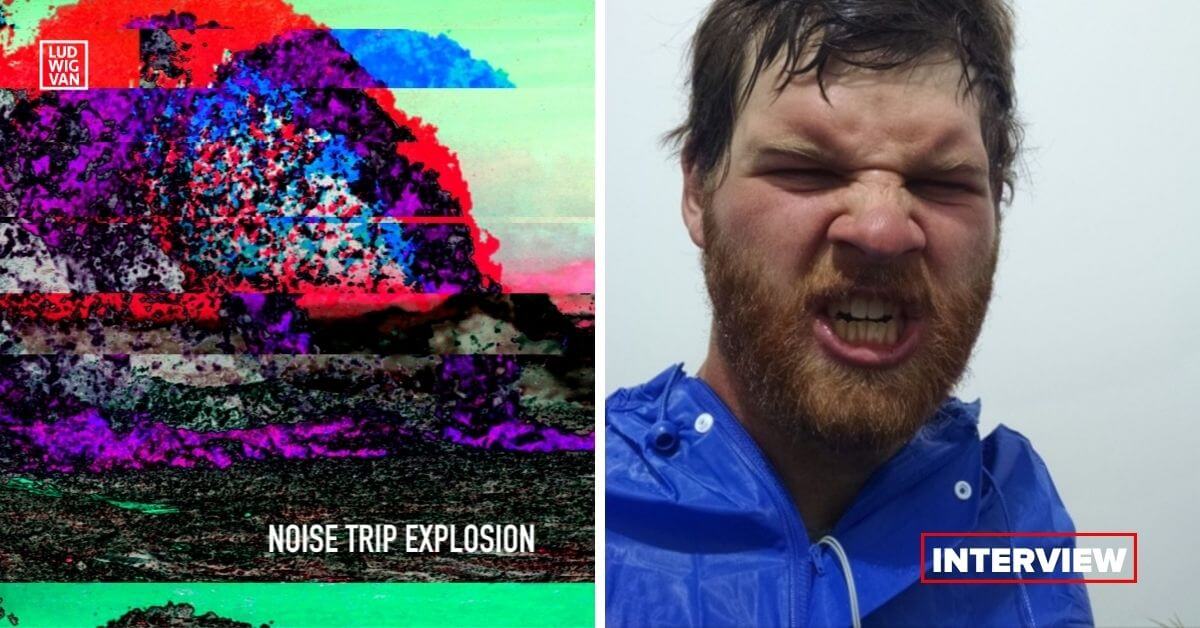
Noise, modern composition, electroacoustic, chamber music… you could check off all of the above when it comes to Noise Trip Explosion, the upcoming album by Toronto composer Nolan Hildebrand. In his work, he pushes the limits of sound and the norms of chamber music to create original sound worlds.
For the new album, he’s collaborated with a number of artists, including Roan Ma (violin), Veronica Zupanic (violin), Patrick O’Reilly (electric guitar), Hirad Moradi (piano), and Colin Fisher (saxophone).
Noise Trip Explosion drops on June 5, 2026 on the Redshift Music label.
LV spoke to Hildebrand about the release.
Digital Concrete Euphoria by Nolan Hildebrand, commissioned and performed by Slow Rise Music:
Nolan Hildebrand
Nolan Hildebrand is a composer, researcher, improviser, and noise artist. He earned a BMus in composition at the University of Manitoba, and an MMus in composition at the University of Toronto. He is currently pursuing a DMA in Music Composition at the University of Toronto, while also serving as a composer in residence at the UofT’s TaPIR Lab (Technology and Performance Integration Research Lab).
He uses noise to explore both physical and conceptual extremities in music, and as a solo performer is known as BLACK GALAXIE.
Earlier this year, he undertook a Research Residency at the Centre for Research in New Music and the University of Huddersfield in the UK, and published a paper titled Phenomenological Open Graphic Notation with Chaotic Systems in Interactive Electroacoustic Music in Organised Sound. 2025 saw the premiere of his work The Complete History of the Piano, for piano and electronics, a piece he wrote and was first performed by Wesley Shen. Digital Concrete Euphoria, for saxophone, drum kit, electronic guitar, electronic bass, soprano, and keyboard with electronics, and three other works also premiered last year, along with the US premieres of two additional works.
Hildebrand has performed at a number of festivals, including the Cluster Musici Festival and Winnipeg New Music Festival, among others, and worked with ensembles and artists such as the Winnipeg Symphony Orchestra, ECM+ Ensemble, XelmYa Ensemble, Jonny Axelsson, and Nick Photinos. His music has been performed across North America, and in Germany, the United Kingdom, and Switzerland.
Nolan Hildebrand’s DADA BENDER:
The Album
His pieces use innovative scoring techniques, and he looks to create a spontaneous and untamed kind of sound. The first track, generative open graphic score #1, uses a Rorschach-like graphical score to guide the soloist (saxophonist Colin Fisher). Fisher’s playing is routed into a mixer that is manipulated by Hildebrand. It creates a combination of the instrument and an unpredictable feedback, the sounds fused together.
knurl cracked green, which was performed at the 2023 Bang on a Can summer festival, features Veronica Zupanic (violin), Patrick O’Reilly (electric guitar), and Hirad Moradi (piano), whose performance is also manipulated electronically, live, by Hildebrand. The piece references iconic Canadian noise artist Alan Bloor, and in a physical sense, the ridged pattern on a metal surface that’s used to help gripping. The work is percussive, and unfolds in sections — with melodic snippets, and other parts that wouldn’t be amiss in an industrial music track.
Raw Data Speed Demons features a violin soloist Roan Ma. Ma’s playing is surrounded by an electronic part that uses raw data from hundreds of file to generate audio. The results are energetic and unpredictable, with the violin layered over a buzzing white noise. For the track, Hildebrand uses his phenomenological open graphic score, accompanied by text. Ma performed according to her interpretation of an abstract image as a whole, rather than in a linear manner. The violin triggers random changes in the electronics live.
portals II (everywhere and everything right now) uses principles of quantum physics to lay out what Nolan calls multiple sound universes. Fisher (saxophones), O’Reilly (electric guitar), Pino (drum kit and tam-tam) perform with Hildebrand on a no-input mixer. Each of the three instrumentalists can choose their own sound universe, and play separately or cross into each other’s sound universe via portals that are indicated by coloured shapes. It’s a longish piece at more than 16 minutes, and incorporates everything and the kitchen sink in terms of sounds, including vocal-like noises, percussive riffs, and electronic hum.
DADA BENDER uses a percussion sextet, (Andrew Bell, Nikki Huang, Hoi Tong Keung, Thomas Li, Bevis Ng, Jasmine Tsui), incorporating instrumental writing and fixed media electronics. Hildebrand supplies mixer feedback and data bending; the latter converts raw data from a range of files into audio. It’s a playful piece, almost cartoony in its mode, with drums, xylophone, and various metallic sounds alongside electronic noises.
Nolan Hildebrand: The Interview
Despite the fact that it’s been around for several decades, noise music is not well understood.
“I guess the genre proper developed in the late 80s and early 90s,” Hildebrand explains. “It was performed primarily on electronic instruments.” He describes it as characterized by it loud dynamics and intensity.
“It’s so intense and loud that it calls into question what music can really be.” As such, it’s an inherently radical practice in the world of composition.
“My solo practice would be characterized similarly,” he says. He maps out that ethos onto his more conventional compositional practice on the album.
Each track on the album takes a different approach, and he collaborates with a range of performers. “It depends on the type of piece. Usually, the electronics dictate the kind of performer I’m looking for.” Aside from other considerations, facility with improvisation is essential for many of his pieces.
“I’m thinking of the performers as I’m building the electronic system,” he explains. “Other times, they’re playing along with a fixed track with a click track — a more traditional practice,” he continues. “I don’t necessarily call for improvisation in those contexts.”
Evolution of Style
Nolan’s music has evolved over time.
“I think it’s developed quite a bit. I started composing a little bit later in life.” He says he was around 23 when the composing bug caught him about a decade ago.
“The first pieces I was writing, it was really just me getting a handle on how to do it.” He credits his undergrad professor, Canadian composer, improviser and sound artist Gordon Fitzell with introducing him to a wide range of music he’d never heard before. “Once I got into my Master’s degree which was in 2020, it really solidified,” he says.
“It was the intensity and viscerality that really excited me,” he adds. “Over the last two or three it has really crystallized.”
He counts avant-garde composers such as Giannis Klearchou Xenakis and Karl Stockhausen among his influences, along with more modern artists such as Jason Thorpe Buchanan, Igor C Silva, Alexander Schubert, and legendary Japanese noise artist Merzbow.
“I’ve been into a lot of what is called cut up,” he says. It involves hard panning (a mixing technique that sends 100% of the audio to a far end of the stereo field), and a lot of motion (pitch changes).
Noise Listeners
“I think with integrated noise music and these kinds of radical concepts, I’m sure there will be a lot of people who don’t like it,” he says. Hildebrand points out that much of early noise music was considered unlistenable. That was essentially the point.
“What I’d like people to get out of it is the visceral intensity of sound,” he says. It grabs your attention. “It’s more of a sensory perception thing rather than reflecting or interpreting in the moment. “
Collaborators
Despite the nature of the music, finding collaborators wasn’t difficult.
“A lot of the people who I chose are familiar with improvised music, noise music, they were all down and fine with it.”
Some performers had less experience with the genre. “For them it was a different experience, and they seemed to respond positively.”
In the end, all the musicians picked up on wha the was trying to get across.
“I never had anyone who didn’t want to play it,” he says. “We both benefitted a lot from it.”
Noise Trip Explosion
- Noise Trip Explosion will be available on June 5, and can be pre-ordered before that date, at Redshift Records [HERE].
Are you looking to promote an event? Have a news tip? Need to know the best events happening this weekend? Send us a note.
#LUDWIGVAN
Get the daily arts news straight to your inbox.
Sign up for the Ludwig Van Toronto e-Blast! — local classical music and opera news straight to your inbox HERE.

- THE SCOOP | TO Live Announces The Recipients Of Its 2026 explorations artistic research program - July 21, 2026
- SCRUTINY | Guild Festival Theatre: Brontë: The World Without Offers A Portrait Of The Lives, Trials & Triumphs Of The Brontë Sisters - July 20, 2026
- INTERVIEW | Violinist Mark Fewer Talks About His Upcoming Release Of Bach Solo Sonatas & Partitas, Canadian Luthiers, And More - July 17, 2026