
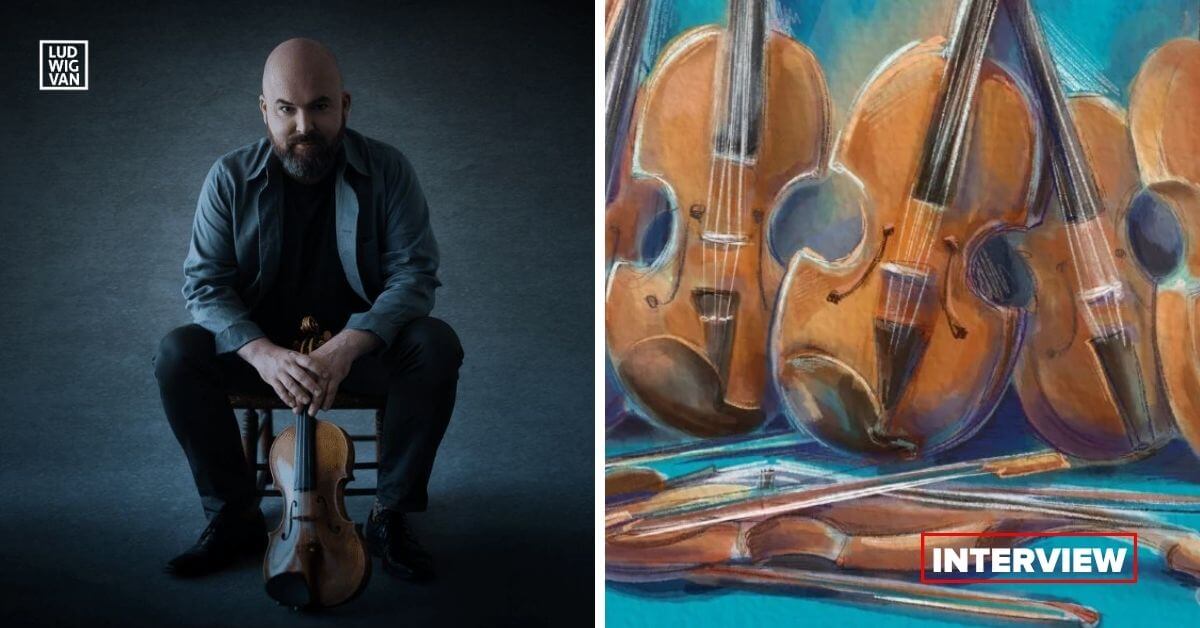
Celebrated Canadian violinist Mark Fewer will be releasing a new album of solo Bach works, J.S. Bach: Violin Sonatas & Partitas, BWV 1001-1006 on the Leaf Music label. The full album release date is August 14, 2026.
What makes it unique is that Fewer performs each work on a different instrument, made by Canadian luthiers David Prentice, John Newton, Mark Schnurr, Itzel Avila, Isabelle Wilbaux, and Sibylle Ruppert. The six makers include three women and three men, some born in Canada and others who have made it their home.
A single track from the upcoming album just dropped today — Bach’s Violin Partita No. 3 in E Major, BWV 1006: I. Preludio.
LV caught up with the busy violinist to talk about the album, Canadian luthiers, and more.
Mark Fewer
Over a three decades plus career, Mark Fewer has performed in prominent concert halls across the world, including Carnegie, Wigmore, and Salle Pleyel, as well as smaller venues like Bartók House (Budapest), the Forum (Taipei), and Le Poisson Rouge (NYC). He has appeared as a featured guest soloist with diverse ensembles and artists, including the Zapp Quartet of Amsterdam and the Fodens-Richardson Brass Band (UK), the Chieftains, and Stevie Wonder and his band, along with symphony orchestras from Toronto to Melbourne, Australia, and back.
His repertoire includes everything from the Baroque to new works. Mark has premiered more than 200 works, including over 50 that were composed specifically for him. He plays jazz as well as Western classical music, and has performed with luminaries in that field such as Dave Young, Brad Turner, Jodi Proznick, Jim Doxas, Jan Jarczyk, Pekka Kuusisto, Suba Sankaran, and Aaron Davis, among others.
He is a prolific recording artist, and his contributions have appeared on albums that have won multiple JUNO Awards, one GRAMMY, a Prix Opus, and an ECMA for Best Instrumental Recording of the Year for his own 2024 album Alikeness.
As a performer, Mark has served as concertmaster of the Vancouver Symphony, Artist-in-Residence at Stanford University, William Dawson Scholar at McGill University, and Artist-in-Residence at the Glamorgan Festival in Wales.
Fewer is also a dedicated chamber musician. He was a founding member of the Duke Piano Trio, a violinist with the SuperNova and St. Lawrence String Quartets, and an original member of the ARC Ensemble. He is currently first violinist of the Axelrod String Quartet at the Smithsonian Institution in Washington, DC. The Axelrod String Quartet performs and records exclusively on Stradivari and Amati instruments from the museum’s collection.
Mark was the founding Artistic Director of the SweetWater Music Festival, and is now in his eighth season in the same role at Stratford Summer Music. He is an Associate Professor of Violin at the Faculty of Music, University of Toronto.
Mark Fewer, Aiyun Huang and the Newfoundland Symphony Orchestra Sinfonia perform from his 2024 album Alikeness:
Mark Fewer: The Interview
The PR material for the upcoming album indicates that this project was several years in the making.
“In fact, you could make the argument that it was almost 20 [years],” Mark says. The idea originated back when he co-founded the SweetWater Music Festival. “I started that festival with the intention of bringing string players up to Owen Sound to meet luthiers.”
As it turns out, the region was a hub for many luthiers at the time. “At a certain point they were kind of jokingly referring to it as ‘Cremona North’,” he says. “It was high time that we [as artists] support the industry, as they have been supporting us.”
While he performs on historic instruments with The Axelrod String Quartet, he is deeply appreciative of the work of modern violin makers, particularly in Canada.
“I think somehow in the last 20 to 30 years there have been a number of revolutionary ideas on how to make string instruments,” he says.
He points out that many breakthroughs have occurred in terms of understanding the frequencies inherent to different types of wood, as well as sharing ideas and information across the industry.
That’s not to say he’s throwing away the old. “There is no denying that you cannot get rid of the history. The modern violins will never have the mystery.” One of the instruments he plays with Axelrod, part of the Smithsonian collection, is the “Ole Bull” Stradivarius, created in 1687 by Antonio Stradivari. “It’s quite possible that this instrument was used in the premiere of a Haydn symphony or a Beethoven string quartet,” he says.
“I love that about it, and you’ll never get that with a new instrument,” he continues, “but what you can get is the sound.” Modern violinists can choose from a full range of instruments. “I think it’s a great time to be a string player.”
Canadian Violins
Fewer relates that, at the Stratford Summer Music premiere, one of the fiddle players performed on an instrument crafted by Mark Schnurr. “She couldn’t be more excited by the violin.”
When it comes to modern instruments, he firmly believes that Canadian violins can be counted among the world’s best.
“You put them up against the other instruments that are being made in the world, they’re [the same quality],” he says. “It’s the new golden age.”
The specific makers he chose for the album come from the connections he made in Owen Sound. “They’re all tied to that festival,” he explains. Each of luthiers appeared at the SweetWater Festival, and worked with the guest artists he brought in. “Very keenly, I wanted to feature the makers who were associated with this festival.”
Instruments & Music
He chose the instruments for the new album with care. “A couple of them are my own violins.”
Fewer matched each instrument with the specific pieces he recorded. Some of those decisions, he relates, came very easily, while others took longer to pinpoint.
“I think the matching between the instruments and the works on this recording is something I’m very happy with,” he says.
When it came to choosing the repertoire to showcase the violins, the decision was much easier. Bach’s violin sonatas and partitas form one of the cornerstones of classical violin repertoire.
“I’ve wanted to record [these works] for my whole life,” he says. “The need for me to do this with these instruments was really a labour of love.”
He considered various elements of each work when making the decisions of how to match instrument and piece. “Depending on ones’ approach to the sonatas and the partitas as a cycle,” he says, “the first four are written in minor keys.”
Mark points out, however, that in the European Baroque era, minor keys weren’t associated with sadness and a melancholic tone, as they largely are now.
“The G minor is a case in point.” The work, as he points out, is about birth and growth, a celebration of the winter solstice. “It’s a thankful and a praiseful sonata,” he says. “When I tell that to students, they’re surprised,” he adds.
“I wanted to have a chance to use a violin by David Prentice.” The instrument is modelled after the late Jeanne Lamon’s instrument, the famous 1759 Jeanne Lamon Santo Serafin violin (nowadays part of the Canada Council Instrument Bank). “I wanted to have something full and generous in sound,” he explains.
“The Newton, I used for the B minor,” he says. “The B minor is the most religious of all six works.” Fewer says the Newton violin has a specific focus. “It’s almost like you’re in a state of prayer,” he adds.
“The Mark Schnurr, I use for the A minor. That’s the violin I play the most. I really wanted that specifically for the andante movement,” Mark says.
“The D minor was with the Itzel Avila.” Fewer explains that one of his students had bought the instrument, and he borrowed it for the recording.
“The C major, Isabelle Wilbaux from Montréal.” He says chose it because he’d heard it many times in performance over the years. It was the open quality of the sound that drew him in. “For me, it’s the biggest, most joyous work [of the six],” Fewer explains. “It’s completely open and sky blue.”
The Sibylle Ruppert violin was chosen for the E major. “The E major, for me, is a party. For all the thematics of birth, concentration, prayer, death, joy, euphoria — you get to the E major, and it’s all about fun. I wanted something that will reflect that. I think if you look at Sibylle’s fiddle […] you can hear the absolute joy coming out of that violin.”
Final Thoughts
Naturally, with so much focus on the quality of sound, recording was a painstaking process. “It took a long time to put together,” Mark says.
He credits the careful work of Pouya Hamidi as recording engineer. “It probably took a year between all those instruments,” he says.
“Now that it’s done, I’m very happy that it’s going out into the world.”
He’s hoping listeners will focus on both the music and the instruments, giving due credit to Canadian luthiers.
“They are among the world’s best.”
Listen to the Music
- You can find the single track from the album, Bach’s Violin Partita No. 3 in E Major, BWV 1006: I. Preludio, available today (July 17) to stream or download it from Leaf Music [HERE].
- Keep an eye on out for an additional advance single, Partita No. 1: IV. Double, on July 31, and the full album on August 14, 2026, available on Leaf Music [HERE].
Are you looking to promote an event? Have a news tip? Need to know the best events happening this weekend? Send us a note.
#LUDWIGVAN
Get the daily arts news straight to your inbox.
Sign up for the Ludwig Van Toronto e-Blast! — local classical music and opera news straight to your inbox HERE.

- INTERVIEW | Violinist Mark Fewer Talks About His Upcoming Release Of Bach Solo Sonatas & Partitas, Canadian Luthiers, And More - July 17, 2026
- PREVIEW | The Mandle Philharmonic Offers Mahler’s Resurrection Under The Stars - July 17, 2026
- INTERVIEW | Artistic Director Sharon Lee & Co-Artistic Director Marcus Scholtes Talk About Toronto Concert Orchestra’s Symphony In The City - July 16, 2026