
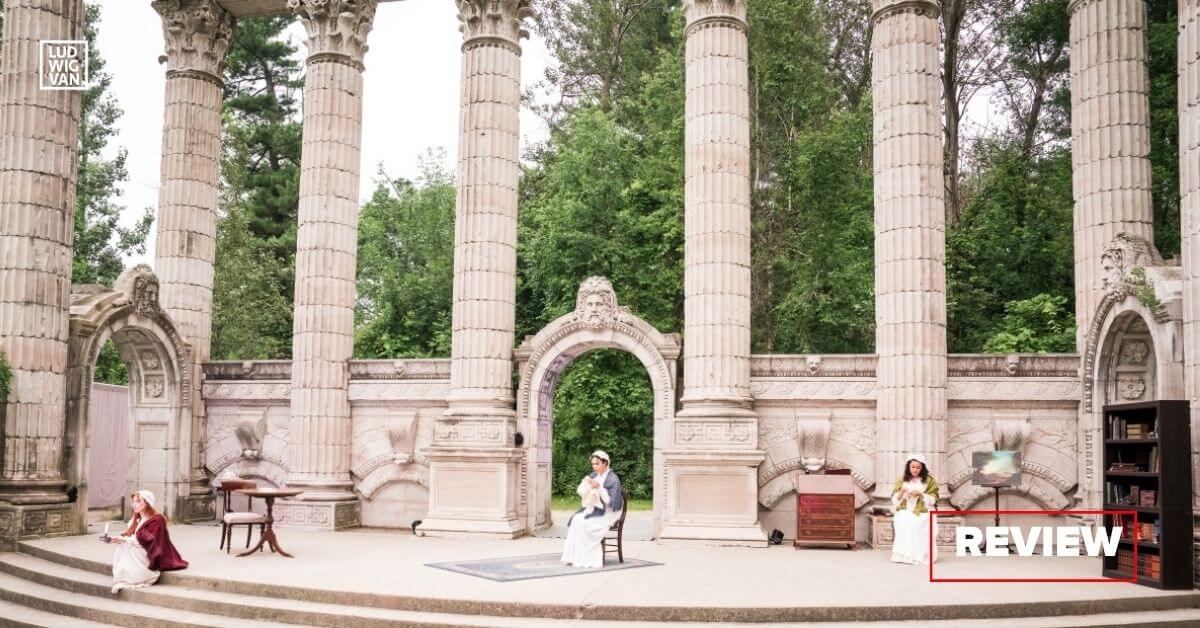
Guild Festival Theatre: Brontë: The World Without by Jordi Mand, Directed by Helen Juvonen; costume design by Alex Amini; sound design by Maddie Bautista; choreography by Leah Wilton. With: Laura Del Papa as Charlotte Brontë; Hilary Scott as Emily Brontë; Lara Lucia as Anne Brontë. July 17, 2026, Guild Park & Gardens. Continues until August 2, 2026; tickets here.
How do you create a play about writing, and writers? It’s a dilemma that has challenged playwrights across time. The act of writing, after all, is stationary, and most often, solitary.
It doesn’t, in other words, typically make for interesting stage time.
Toronto playwright’s Jordi Mand’s Brontë: The World Without uses a thoughtful structure, music, and effective choreography to create an interesting portrait of the lives and tragedies behind some of the most beloved books of English literature.
It didn’t hurt, of course, that the play unfolds in the classically designed open air amphitheatre of Guild Park & Gardens in Scarborough. With its imposing columns and masonry, it was easy to believe that the action was set in another place and time.
The Story & Historical Context
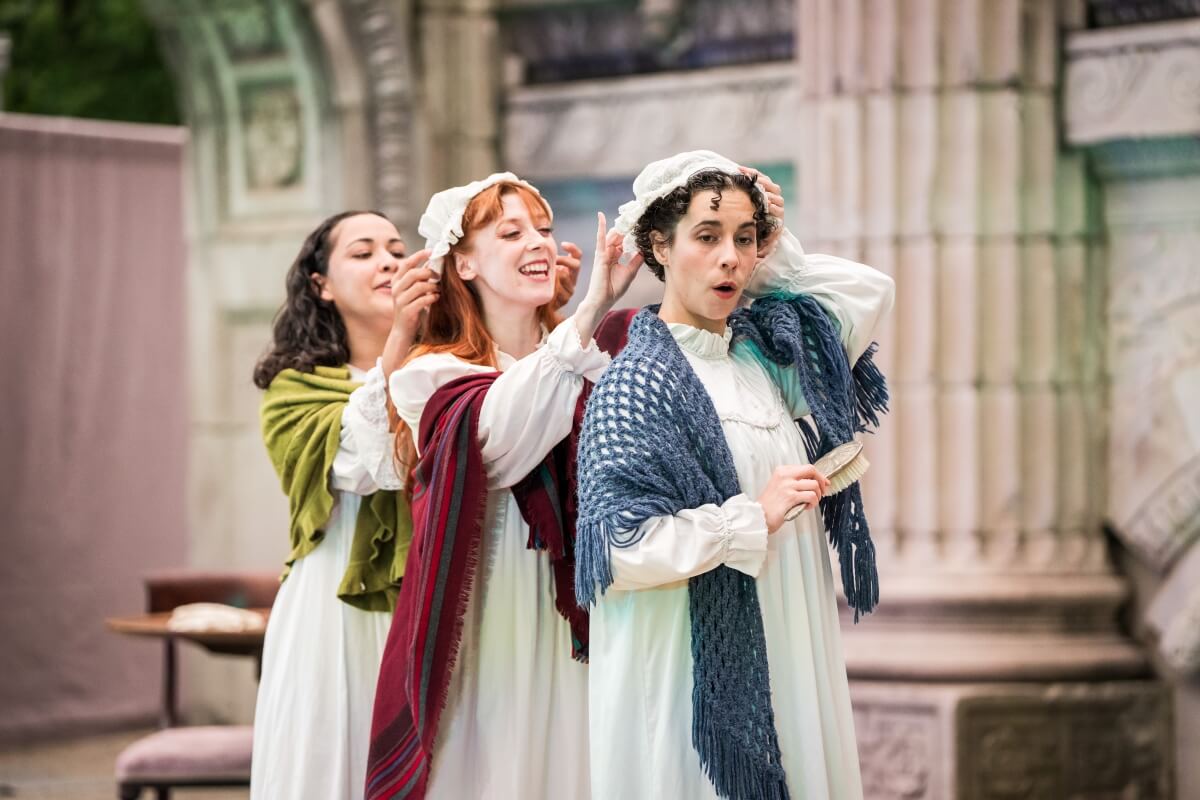
The three Brontë sisters — Emily, Charlotte, and Anne — live with their father and brother Branwell in genteel poverty in the Haworth Parsonage on the windblown Haworth Moor. Within the first few minutes of the play, which begins 1844, their situation is sketched out deftly in dialogue and interactions.
Their father — Poppa — needs eye surgery, or he may lose his position, which will essentially put the family out in the street. Brother Branwell, who is a poet and writer, is drowning himself in alcoholism after a disastrous affair with a married woman. Both men are seemingly oblivious to their precarious circumstances, leaving the three sisters to manage the household.
They come up with various money making schemes, including occasional governess positions. Charlotte, in fact, has just returned from Brussels, where she studied French and taught English, and fell in love with her teacher Constantin Héger.
It turns out that all three have been writing poems, and Charlotte and Anne eventually persuade the fiercely private Emily to publish a joint collection of poems under the title Poems by Currer, Ellis and Acton Bell, using men’s names. After several rejections, it was published in 1846.
That success leads them to continue writing, and the three eventually publish novels, still under the fictitious men’s names. But, eventually, rumours begin to circulate about the books, including the notion that Action and Currer were the same person, leading Anne and Charlotte to confess their deception — but only to their publishers. Emily remains doggedly determined to keep her identity a secret.
Then, tragedy intervenes.
The play makes the precarious nature of life itself in the late 19th century abundantly clear. Two older Brontë sisters, in fact, Marie and Elizabeth, had died in childhood.
Emily died in 1848 at age 30, and Anne at 29 the following year in 1849. Branwell had already passed away at 31, all three of them from tuberculosis — known as consumption at the time — and its complications.
Only Charlotte lived a little longer, dying at age 38 in 1855 of pregnancy complications. It occurs after the end of the play’s story, although her eventual marriage is hinted at.
In 1847, Emily would see Wuthering Heights published, her only novel, along with Anne’s Agnes Grey. Anne would later publish The Tenant of Wildfell Hall in 1848. Charlotte’s first foray into novel writing was rejected, but she followed up with Jane Eyre in 1847, and later published two more novels during her lifetime. The first novel, The Professor, which had been rejected while her sisters saw their initial success, was published in 1857, after her death.
The play keeps its focus on their lives, and their relationships as sisters. The men in their lives, Poppa and Branwell, appear in the story as footsteps, doors opening and closing, or the thump of a fall, from upstairs.
Their lives are intimately intertwined with their work, and any Brontë fan will instantly recognize the details. Anne’s Agnes Grey was based on her years spent as a governess, and Charlotte’s Villette (1853), was set in a French speaking boarding school.
The Structure
Playwright Jordi Mand employs an ingenious and thoughtful structure to keep the action moving, and portray the sisters’ lives and writing progress largely via dialogue. Each scene depicts a telling moment in their evolution, from the opening set up, when they decide to pursue publishing, the moments they receive their first acceptances, and so on.
In between, Mand has created song interludes. The sisters sing songs of the era, including Long, Long Ago, which opens the play. The songs serve to focus on the emotional context of what takes place, and the warm relationship between the sisters — despite their moments of bickering and jealousy.
Choreography by Leah Wilton is naturalistic and unforced, and makes good use of the amphitheatre stage.
Both poetic and effective, the song interludes nicely break up the more straightforward dialogue rich scenes.
The Performances
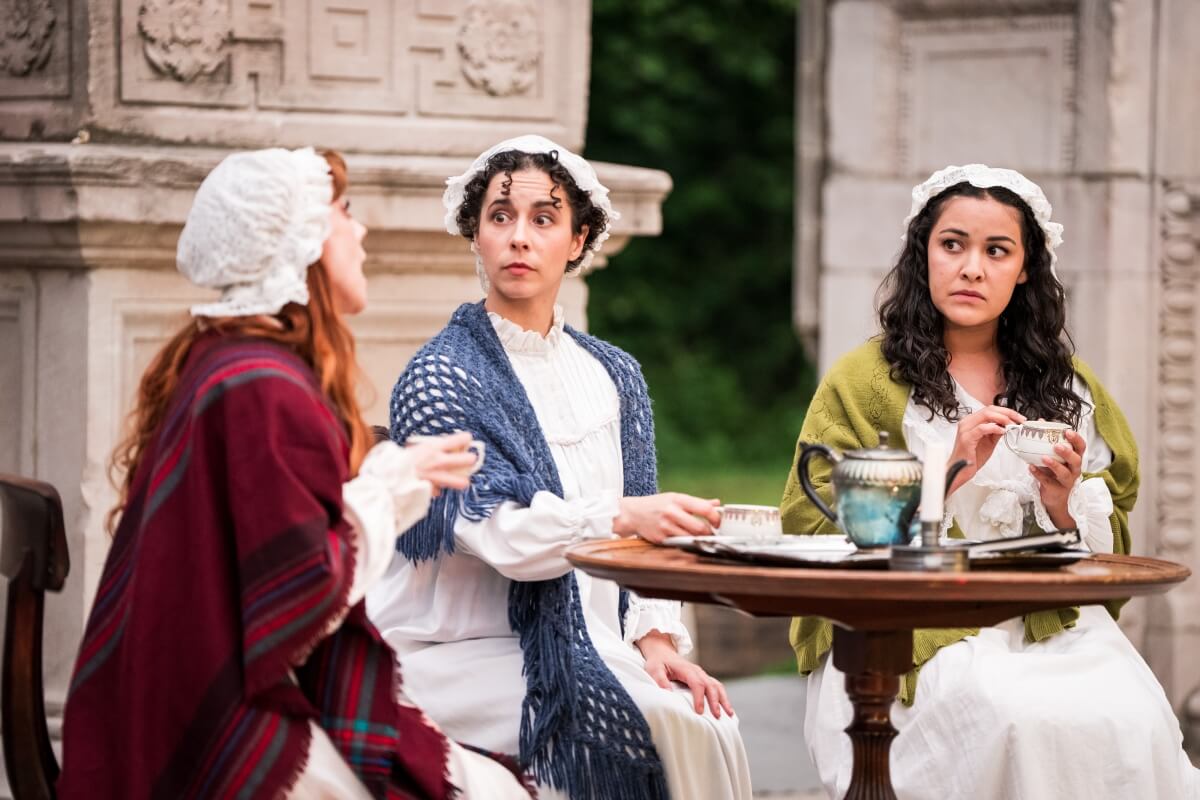
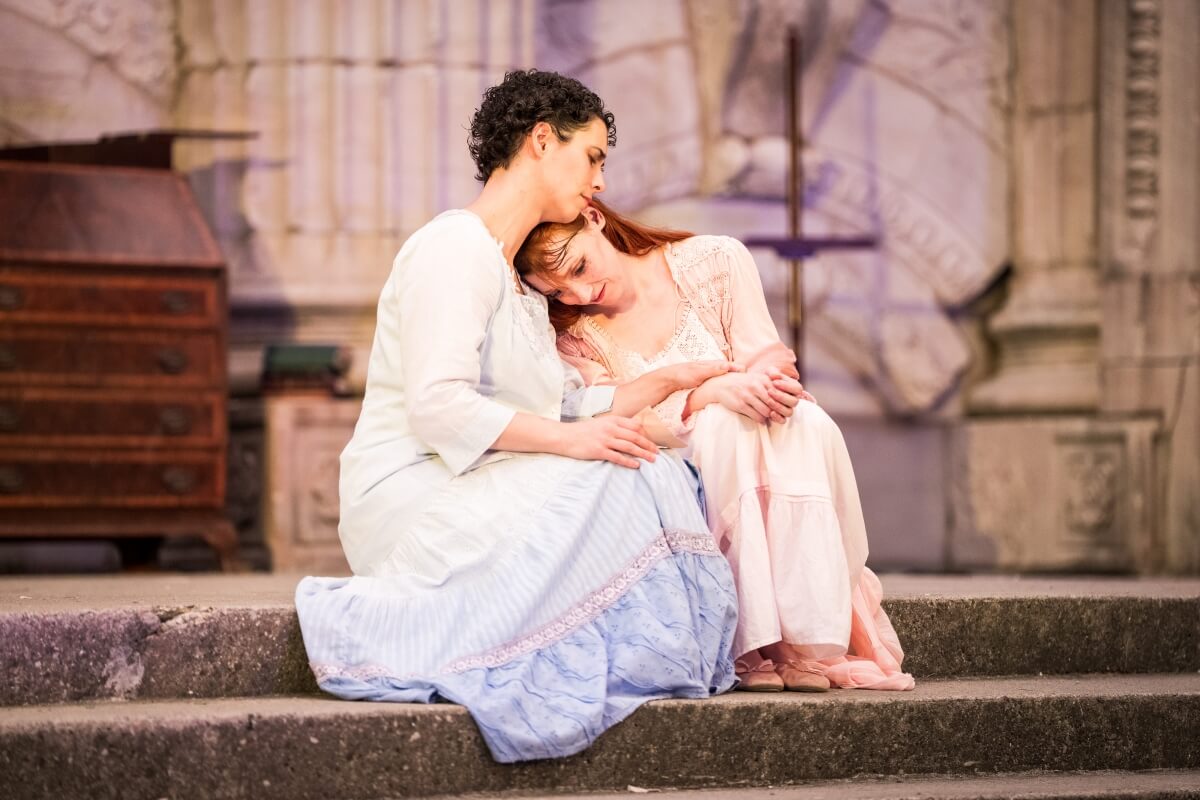
Laura Del Papa, Hilary Scott, and Lara Lucia create three distinct characters in Charlotte, Emily, and Anne respectively.
The sister’s writing begins with childhood games, then as a way of expressing themselves, and also to pass time (embroidering and sewing are their other occupations), but the actor’s portrayals reveal their deeper motivations. Charlotte is the more ambitious of the three, at the same time practical, level headed, but also delusional regarding her Belgian teacher. She wants to make her mark.
Emily is strong willed, the one who tells the truth unvarnished, but she can’t bear to leave home for any length of time, and balks at revealing her author identity. Anne feels like the lesser of the three, motivated by those insecurities into continuing her writing.
The three actors have developed a natural flow that nicely portrays the gamut of sisterly relationships, from easy camaraderie to flashes of jealousy and even bitterness. They portray the ups and downs, lighter and darker moments, with conviction.
There are flashes of humour as well as pathos in the script, and it comes out via character as much as via the words — such as the line about making money as a writer that drew an appreciative laugh from the audience. It’s delivered with a delicious naïveté.
Direction & Design
The set consists of a few pieces of period furniture at either end of the stage, with a simple chair in the middle. It’s an economical design by Elisia Evans that effectively creates a sense of their living space downstairs in the parsonage.
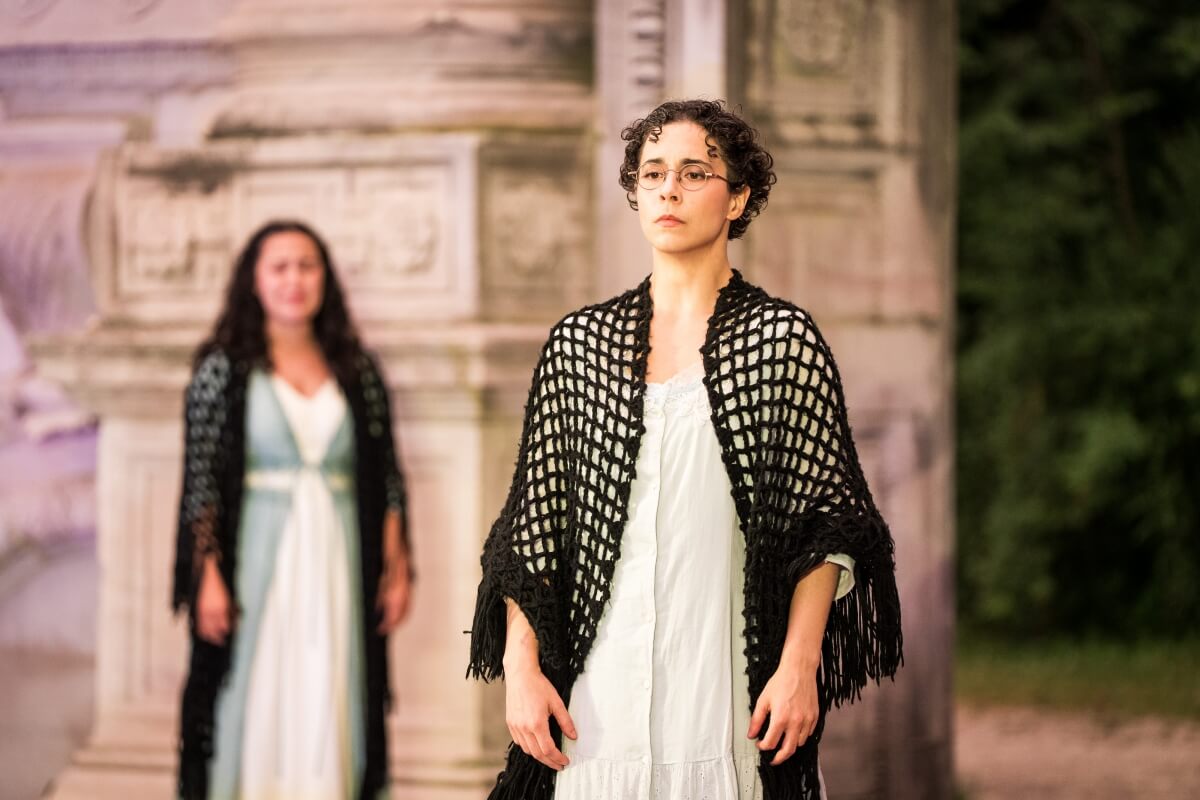
Director Helen Juvonen adds action to the talk-heavy scenes, moving the three characters around the space in a way that seems effortless. The three sisters pace, embrace each other, fight, and portray their determination with a nicely realized physicality.
Sound designer Maddie Bautista deserves special mention. Through speakers set on either side of the audience and stage, the father’s and brothers footsteps echo through an unseen upstairs space, and ghost voices add depth to a segment where the three sisters are writing.
Final Thoughts
It seems incredible to modern sensibilities that the imaginative books that are still so beloved today were written by three sisters who barely left their family home in a sparsely populated area.
Brontë: The World Without offers a thoughtful story about the agonies of the writer’s life through an affecting portrait of sisterhood and resilience.
Are you looking to promote an event? Have a news tip? Need to know the best events happening this weekend? Send us a note.
#LUDWIGVAN
Get the daily arts news straight to your inbox.
Sign up for the Ludwig Van Toronto e-Blast! — local classical music and opera news straight to your inbox HERE.


- SCRUTINY | Guild Festival Theatre: Brontë: The World Without Offers A Portrait Of The Lives, Trials & Triumphs Of The Brontë Sisters - July 20, 2026
- INTERVIEW | Violinist Mark Fewer Talks About His Upcoming Release Of Bach Solo Sonatas & Partitas, Canadian Luthiers, And More - July 17, 2026
- PREVIEW | The Mandle Philharmonic Offers Mahler’s Resurrection Under The Stars - July 17, 2026