
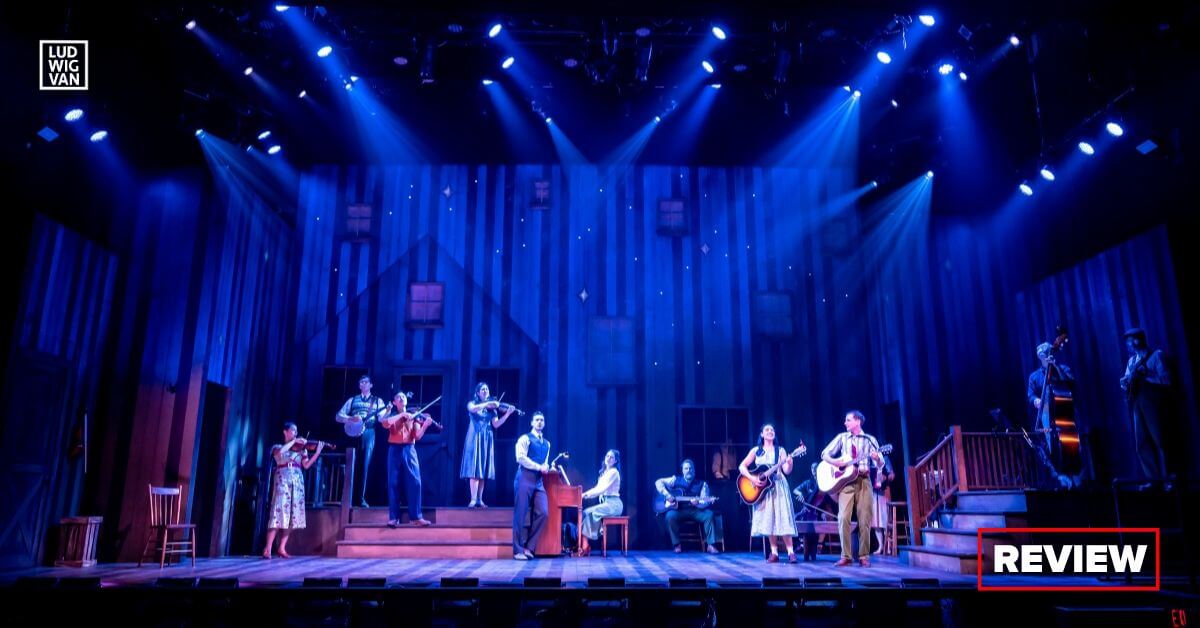
David Mirvish & Hannah Mirvish and Garner Theatre Productions/ Bright Star, music, book and story by Steve Martin, music, lyrics and story by Edie Brickell, music direction by Donna Garner, choreographed by Lisa Goebel, directed by Jacob Wolstencroft, CAA Theatre, until Nov. 2. Tickets here.
Bright star is not a musical filled with Broadway glitz and glamour. It’s a gentle show with a tender heart, performed by an extremely talented Canadian cast, and featuring a fabulous bluegrass/Appalachian/folk inspired score that’s absolutely seductive.
Being Your Own Band
Some musicals just need actors who can sing like the shows of Stephen Sondheim or Lord Lloyd-Webber. Others need actors who can sing and dance like Anything Goes, Chicago or A Chorus Line.
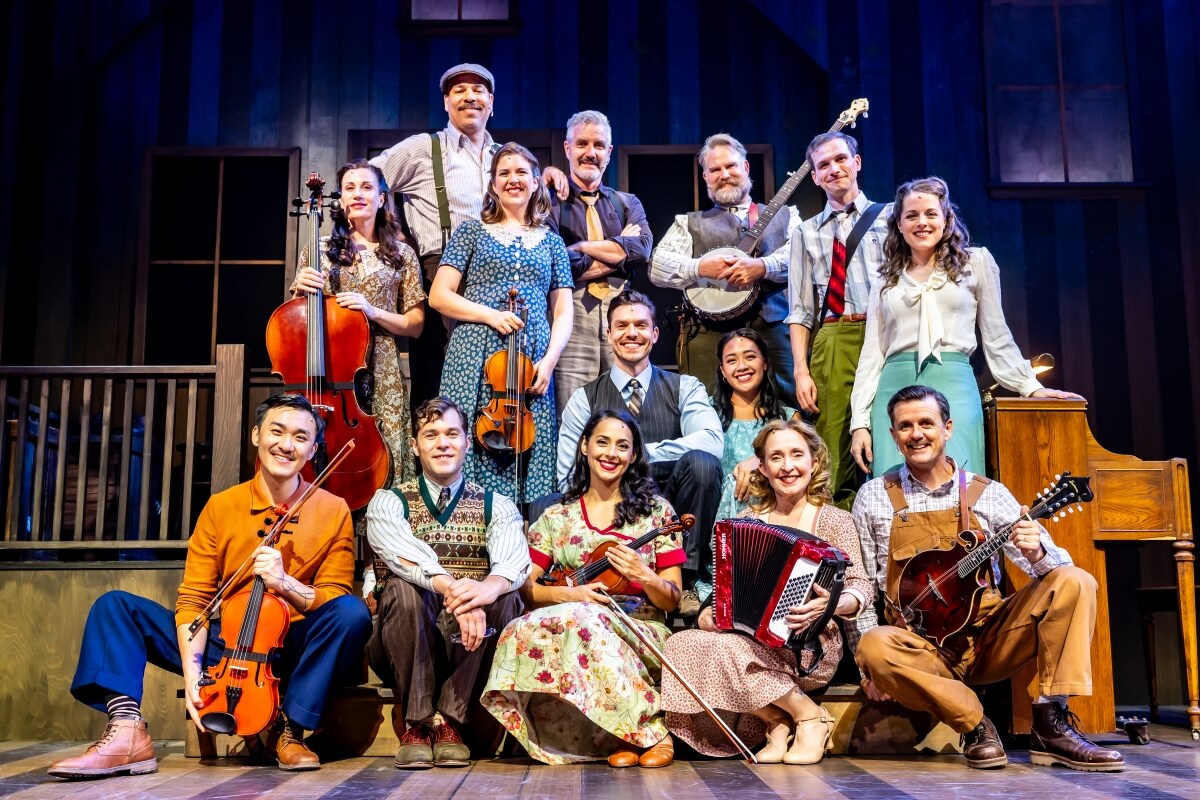
And then there are those musicals were the actors have to sing, sometimes dance, but always have to play musical instruments. In these cases, the actor-musicians, as they’re called, also form the band or the orchestra for the show.
Such is the case of Bright Star.
Collectively the cast plays piano, percussion, guitar, mandolin, banjo, bass, drums, fiddle, viola, cello, accordion, bugle, and harmonica, in other words, an authentic bluegrass sound with the rhythm driven by plucked strings and percussion.
Let’s have a look at an individual in the cast like well-known musical man about town Beau Dixon who appears as Daddy Cane/Dr. Norquist. In the show he plays banjo, bass, guitar, piano, drums and percussion. So not only do the program credits list the characters that the actors play, it also lists their instruments.
A Little Bit of History
Actor-musician theatre is not a new idea. In fact, the very first time that happened was a musical called Pump Boys and Dinettes in 1982.
Occasionally shows that had separate orchestras when they first appeared on Broadway were revived as actor-musician theatre such as Sweeney Todd in 2005 and Company in 2006.
When Bright Star debuted on Broadway in 2016 it had a 10-member separate bluegrass band. The 17-member cast were singing actors.
The 14-member Toronto Bright Star cast are actor-musicians. They are replacing a combined Broadway cast of 27 people.
Why Bring Your Own Band
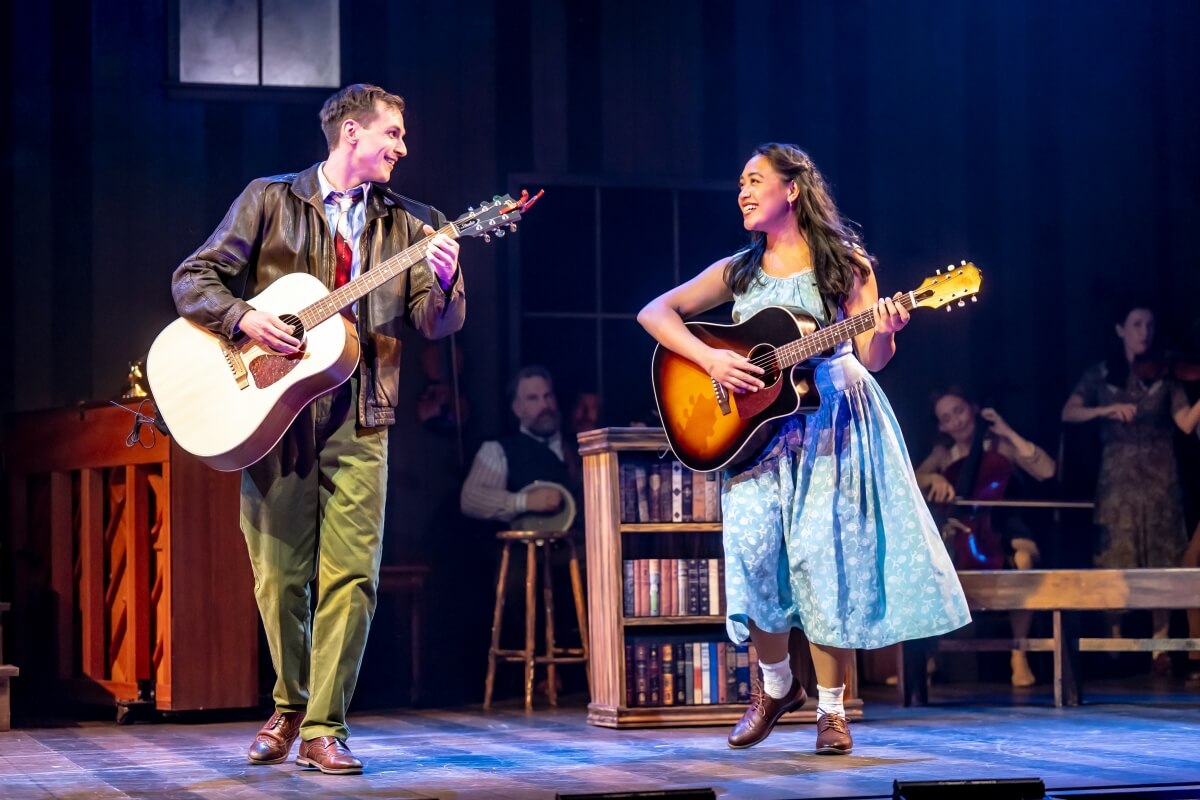
In her program notes, Donna Garner, Bright Star’s musical director and the artistic director of Garner Theatre Productions, co-producer of the show with Mirvish, states that the immersion of script and song within one musical body makes actor-musician theatre an experience like no other.
In fact, her GTP company is devoted to the cause of promoting actor-musician theatre. Garner also appears in Bright Star as Mama Murphy/Government Clerk. She plays piano, accordion, cello, viola, fiddle, and the bugle.
Any research that I’ve done into the subject seems to support Garner — that an actor-musician show is a more immersive and intimate experience for both the cast and the audience.
Now I know at this point the reader is saying, for heaven sakes are you ever going to tell us what the show is about, what the production is like, but the reason I am stressing the actor-musician component is because that is the most consequential take away from Bright Star.
The cast and their instruments form the single greatest impression — its crowning glory — witnessing Bright Star’s narrative told through physical music. I just can’t stress this enough. It is a profoundly emotional experience.
Let me give just one example.
At one climactic point in the story unimaginable disaster strikes Alice Murphy (Kaylee Harwood). In fact, disaster is too light a word for what happens to her. Even devastation is too light a word.
Five women holding violins and violas stand in a line at the front of the stage and in unison play the most excruciating, jarring chord of music. Then they pause in agonizing silence. Then they repeat that heart-wrenching, tormented sound again.
Three times they play it.
Now you tell me, would there be any possible way for a conventional musical to convey the private tormented hell of Alice Murphy with the same visceral assault as artist-musician theatre?
The Wellspring for Bright Star
There are actually two points of departure for the show.
One is the fascination that bluegrass musician Steve Martin had with the true story of the Iron Mountain Baby, but if I tell you the story of the Iron Mountain Baby, it would be the worst kind of spoiler so that ends that.
The other is the 2013 Grammy winning Roots album Love Has Come For You, a collaboration between banjo player Martin and vocals/lyricist Edie Brickell.
When they decided to weave the story of the Iron Mountain Baby into a musical, they realized that many of the album’s songs could be the DNA of the score for Bright Star.
The Story
The narrative takes place on two timelines.
In the 1940s, wannabe writer Billy Cane (Nick Dolan) comes home from the war to the small town of Hayes Creek, North Carolina, determined to pursue his craft by getting published in the prestigious Southern Literary Journal based in Asheville.
This puts him head-to-head against the journal’s hard-nosed editor, the aforementioned Alice Murphy.
The second timeline goes back 20 years to the small town of Zebulon, North Carolina, to find out what made Alice so bitter and cynical, and of course it was a torturous love affair with Jimmy Ray Dobbs (George Krissa).
The two stories are Billy’s relationship with Alice in the 1940s, and Alice’s relationship with George in the 1920s, both told through songs of sweetness and sadness overlying a vibrant bluegrass underscore, mixed with delicious bits of humour.
The Other Characters
The people around Billy are his father (Dixon) and Margo (Yunike Soedarmasto) the girl who loves him.
Alice has her father (Scott Carmichael) and mother (Garner). Her assistant editors at the journal are the bitchy Darryl Ames (Jonathan Gysbers) and the vampish Lucy (Marie Mahabal Hauer).
Jimmy Ray must put up with his domineering father Mayor Josiah Dobbs (Brendan Wall) and the Mayor’s Yes-Man Stanford (Andrew Legg).
Margo’s friends are Florence (Rita Dottor) and Edna (Leah Grandmont) while nerdy comic relief Max (Randy Lei Chang) has a crush on Margo.
The Acting
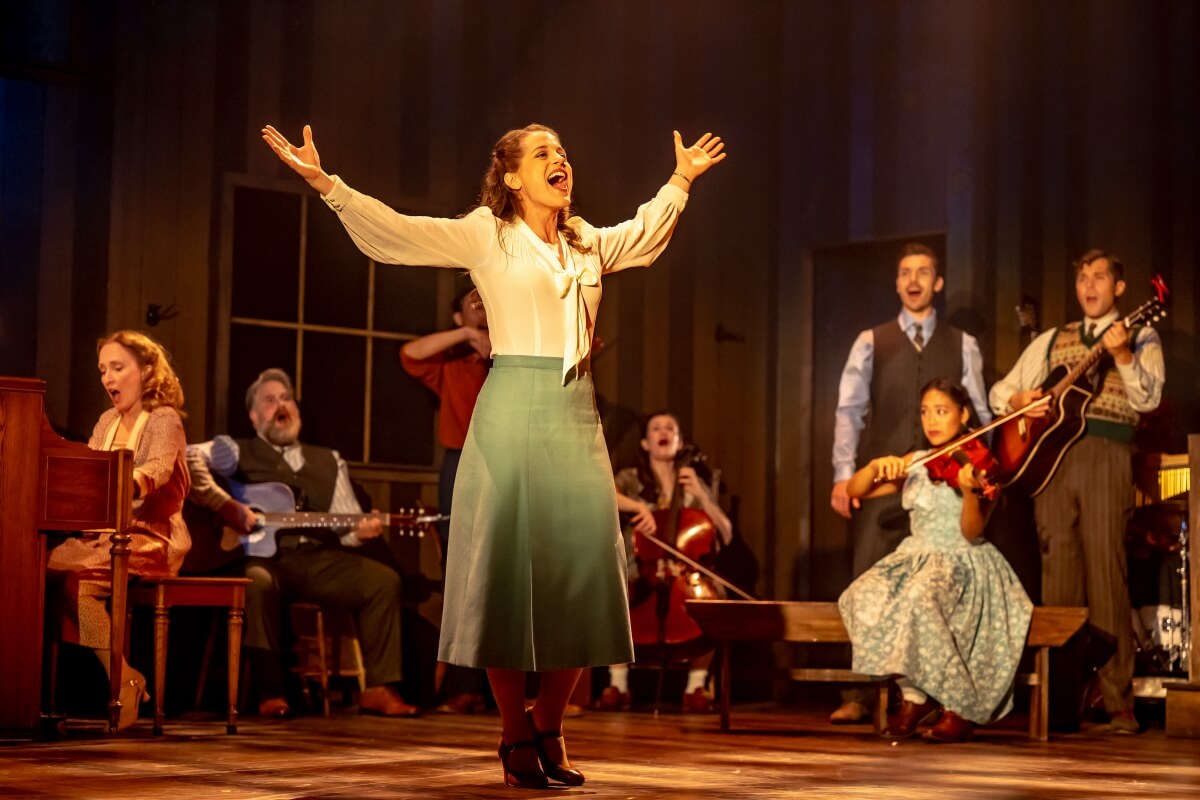
Harwood as Murphy gives a truly magnificent performance, both as the young, barefoot, winsome country girl, and the sophisticated, cynical editor with the withering put downs.
If there is a sexier man in musical theatre than George Krissa, I can’t imagine, because his Jimmy Ray sure is a come on. On the other hand, and all kidding aside, Krissa shows heart and compassion and depth behind his good looks, resulting in a moving performance where it counts.
Dolan and Soedarmasto make a sweet soubrette couple, while Gysbers and Hauer practically steal the show because they have the best one-liners and salty humour always wins the day.
Dixon is lovable, Wall detestable, Legg infuriating, Carmichael pathetic, and Garner pitiful — as all their characters should be.
The Production
Actor-musician theatre demands an open set because almost everyone is on stage most of the time. When they are not accompanying singers, they are playing cinematic background music which in this show is particularly effective.
Set designer Brandon Kleiman has covered the stage in frame to give the effect of a wooden house in Appalachian country.
There’s a staircase off centre to evoke a porch, with another staircase off to the side which seemed to be a good place to park the double bass. The effect of this set is to create a wide-open space to roll in set pieces as needed, for example a bar or an editorial desk.
Director Wolstencroft is extremely efficient at moving people around. This is a highly choreograph show because basically 14 people are in play all the time.
In particular, I like the director’s grouping of people to create very evocative stage pictures by placement of sound — for example, the strings can be bleak while the banjos and the mandolin are much more raucous. The instruments became a palette that he used to colour the stage.
The Beginning Not The End
I called Bright Star a gentle show with a tender heart because that was how the stories of Alice and Billy were reaching me.
But at the same time, I questioned why was this musical having such a deep impact on me when the story is so simple and there is nothing really surprising about the characters or the narrative.
But then the realization became obvious.
Accompaniment had become embodiment. Music had become emotion centred inside the drama.
The actors were not only playing their instruments; my emotional psyche was being played like an instrument. I was being played like an instrument.
Are you looking to promote an event? Have a news tip? Need to know the best events happening this weekend? Send us a note.
#LUDWIGVAN
Get the daily arts news straight to your inbox.
Sign up for the Ludwig Van Toronto e-Blast! — local classical music and opera news straight to your inbox HERE.


- SCRUTINY | The Foster Festival’s Production Of The Long Weekend Delivers The Laughs - July 15, 2026
- SCRUTINY | Mirvish’s Water For Elephants Is A Marvel Of Creative Staging, Design & Direction - July 14, 2026
- SCRUTINY | 4th Line Theatre’s Remount Of Leanna Brodie’s Schoolhouse Blossoms On The Outdoor Stage - July 10, 2026