
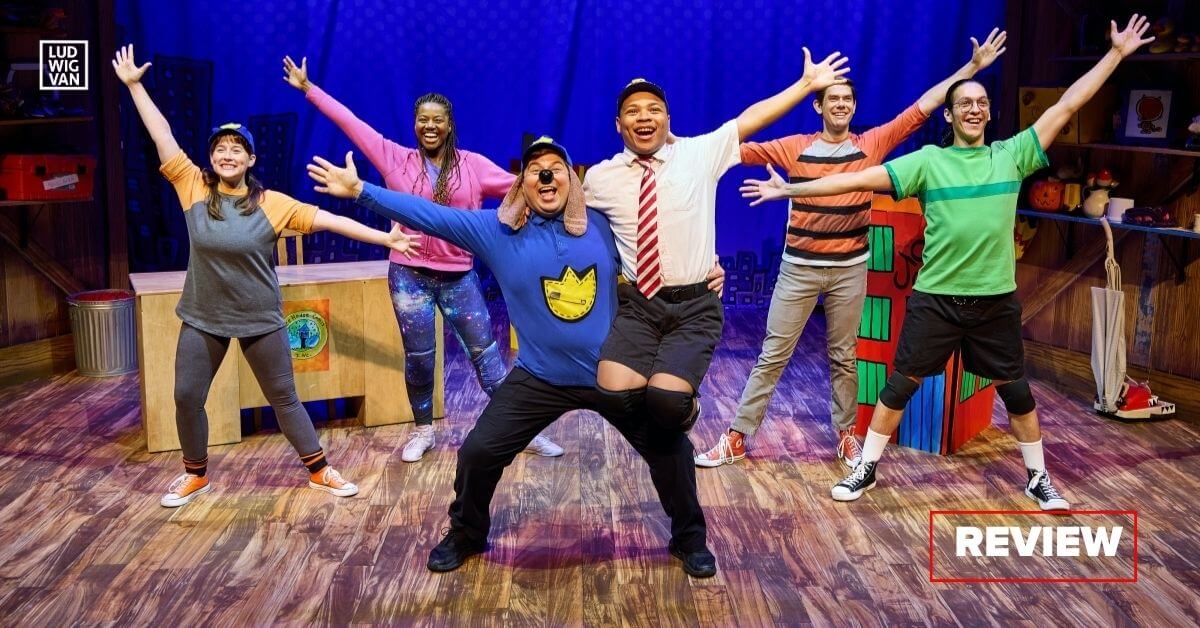
TW Theatricals/Dog Man: The Musical, book and lyrics by Kevin Del Aguila, music by Brad Alexander, adapted from the Dog Man series of books by Dav Pilkey, directed and choreographed by Jen Wineman, CAA Theatre, closes Jun. 14. Tickets here.
Dog Man: The Musical is a dog of a show.
Mercifully, the saving grace is that the children seem to like it.
Problems
Ordinarily, the pleasure of a family musical lies in its ability to work on two levels — to engage young audiences while giving adults something to hold onto. A show like Shrek: The Musical manages that balance with ease. One can recommend it to parents with confidence: you will enjoy the experience as much as your children.
Alas, that is not the case here.
Adults, be warned: Dog Man: The Musical is a chore to sit through. If one were to sum it up in a single phrase, it would be this: loud, noisy, and messy. The score is undistinguished, the storytelling resolutely silly, and the relentless assault of sound and activity quickly becomes wearing rather than engaging.
In short, what might pass as anarchic fun for its target audience registers, for adult viewers, as exhausting.
The Creator
When one looks at the background of Dav Pilkey, the creator of the wildly popular Dog Man universe, a great deal begins to make sense.
As a child, Pilkey struggled with ADHD and dyslexia, was frequently sent out of class, and began drawing comics as a coping mechanism. The framing device of the musical — with George and Harold creating their own comicbook world — is essentially autobiographical.
Pilkey’s writing style is deliberately goofy and anarchic, steeped in bad puns, toilet humour, and comicbook chaos. But beneath that surface lies something more generous — an emphasis on kindness, empathy, and forgiveness.
His books are designed for reluctant readers, using simple language, strong visuals, and rapid pacing to make reading feel like play. It is no wonder children respond to them so enthusiastically.
The musical, with book and lyrics by Kevin Del Aguila and music by Brad Alexander, is a faithful adaptation of that sensibility. Perhaps too faithful. What is, perhaps, charming and inventive on the page translates, onstage, into something loud, punishing, and dramatically thin.
The Plot
The premise is this.
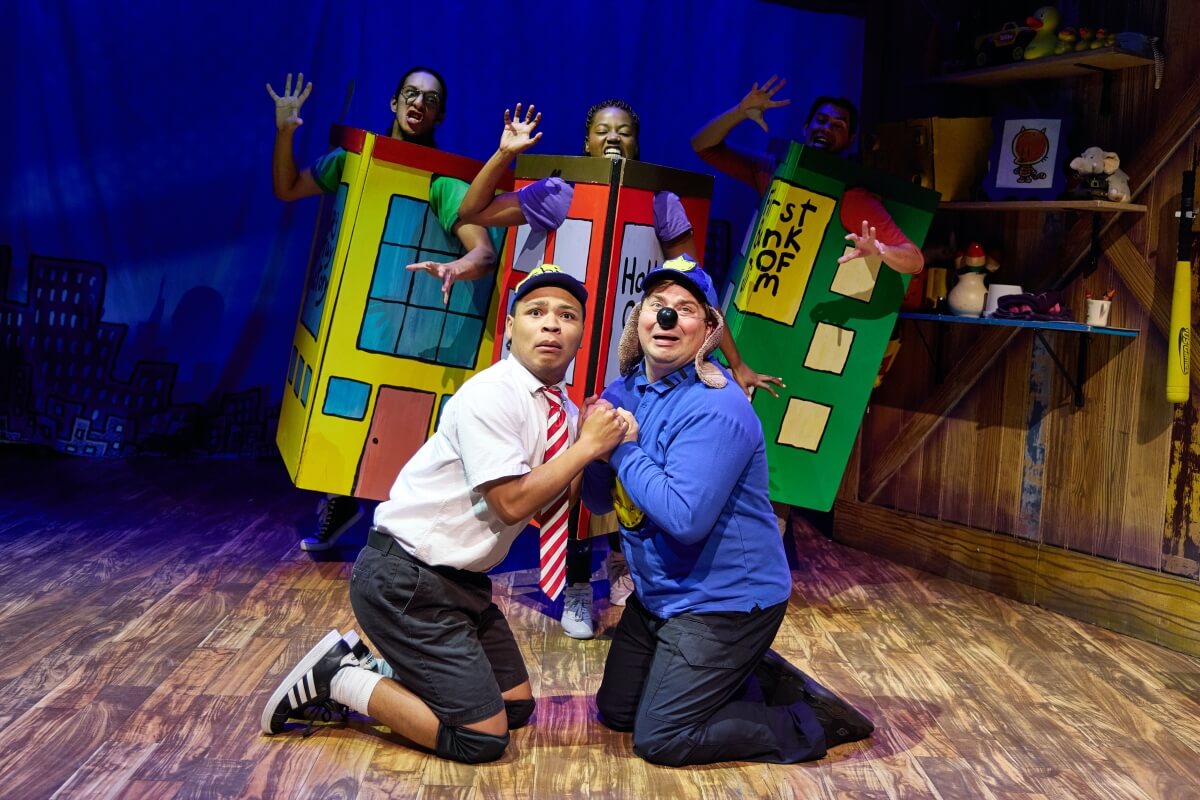
Harold (Mundo Ballejos) and George (Troi Lennoxx Gaines) have been thrown out of the school musical for creating a disturbance — hardly an encouraging start, since bad behaviour is immediately rewarded. Deciding that if one can make a musical about an orphan — a clear nod to Annie — then why not make a musical based on a comic strip of their own.
Their story centres on a police officer and his dog who are blown up in an explosion. In a grotesquely absurd twist, the dog’s head is grafted onto the policeman’s body, creating Dog Man. The character cannot speak, but the performer (Nick Manna) makes an energetic effort to communicate through barks, physicality, and canine mannerisms.
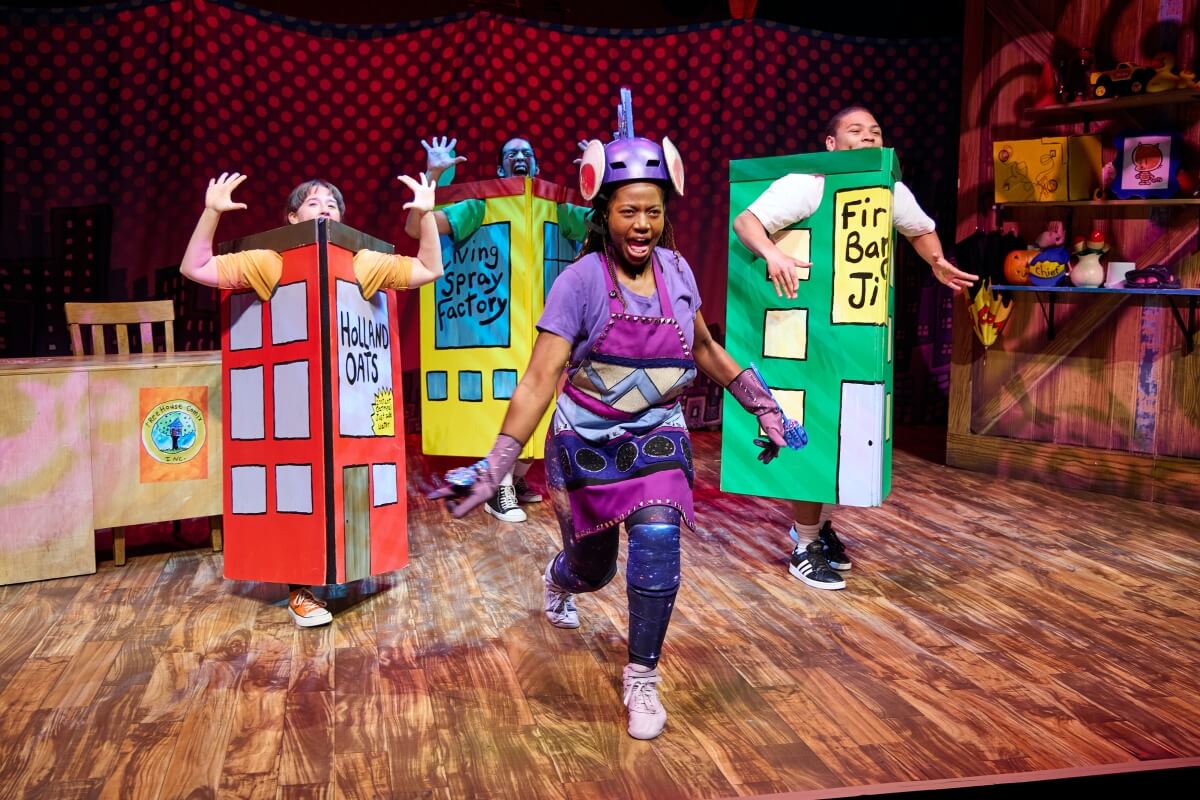
Every hero needs a villain, and here it is Petey the Cat (Anthony Rodriguez whose singing diction is appalling), who attempts to clone himself. The result is not the adult double he expects, but Li’l Petey (Sadie Jayne Kennedy) — a child version whom he treats with casual cruelty. Inevitably, the young Petey gravitates toward Dog Man, introducing what is clearly intended to be the show’s emotional thread: the uneasy dynamic between neglectful “parent” and innocent child.
The introduction of Flippy the fish (Glory Yepassis-Zembrou) — a telekinetic supervillain — only adds another layer of incoherent invention without contributing meaningfully to the story, further muddying an already overstuffed narrative.
The second act just dissolves into chaos, compounded by a company of actors who play their parts at level 10 out of 10.
The Production
As for the production values, there is, on paper, a full creative team of designers — scenic, (Timothy R. Mackabee), costume (Heidi Leigh Hanson), lighting (David Lander) and sound (Emma Wilk), a music director, (Miriam Daly) a director/choreographer (Jen Wineman), yet little of that work registers in a meaningful way.
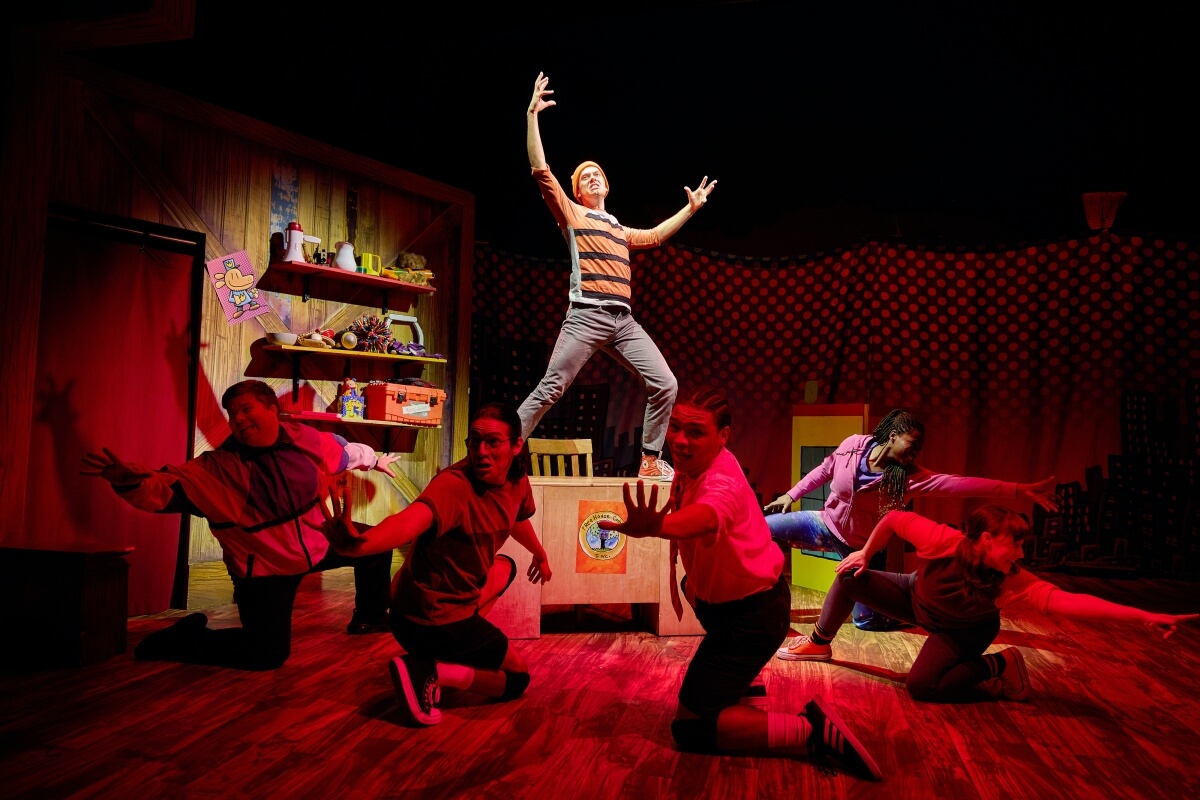
The set aims for a deliberately cartoonish aesthetic — flat surfaces, rough-hewn elements, a kind of deliberately lo-fi design — but without the wit or inventiveness needed to make such an approach land. Cartoon simplicity can be clever; here it feels merely underdeveloped.
The same applies to the staging and choreography. There is movement, certainly, and plenty of activity, but little sense of shape, progression, or purpose. The musical numbers blur together, and the score itself is largely undistinguished, failing to provide the kind of melodic or rhythmic interest that might anchor the evening.
In short, despite the presence of an experienced creative team, the production offers surprisingly little in the way of theatrical craft to support the material.
The Purpose of the Show
This is, after all, a purpose-built touring family show, designed to travel across North America — and no doubt to do excellent business along the way, not least at the concession stand, where the merchandise is clearly part of the appeal. One suspects it will continue to tour for years.
For this reviewer, one viewing is more than enough, but the children in the audience were clearly delighted, and in the end that is what matters.
The Dog Man books, which have been going strong since 2016, remain enormously popular, and this stage adaptation is tapping directly into that enthusiasm.
Who am I to argue with that?
Are you looking to promote an event? Have a news tip? Need to know the best events happening this weekend? Send us a note.
#LUDWIGVAN
Get the daily arts news straight to your inbox.
Sign up for the Ludwig Van Toronto e-Blast! — local classical music and opera news straight to your inbox HERE.


- SCRUTINY | Mirvish’s Paranormal Activity On Stage Is Full Of Thrills And Chills - June 18, 2026
- SCRUTINY | The National Ballet Of Canada’s Brilliant, Visionary MADDADDAM Revival - June 15, 2026
- SCRUTINY | The National Ballet Of Canada: Kismet, Jera Wolfe’s Triumph & Helen Pickett’s Emma Bovary - June 1, 2026