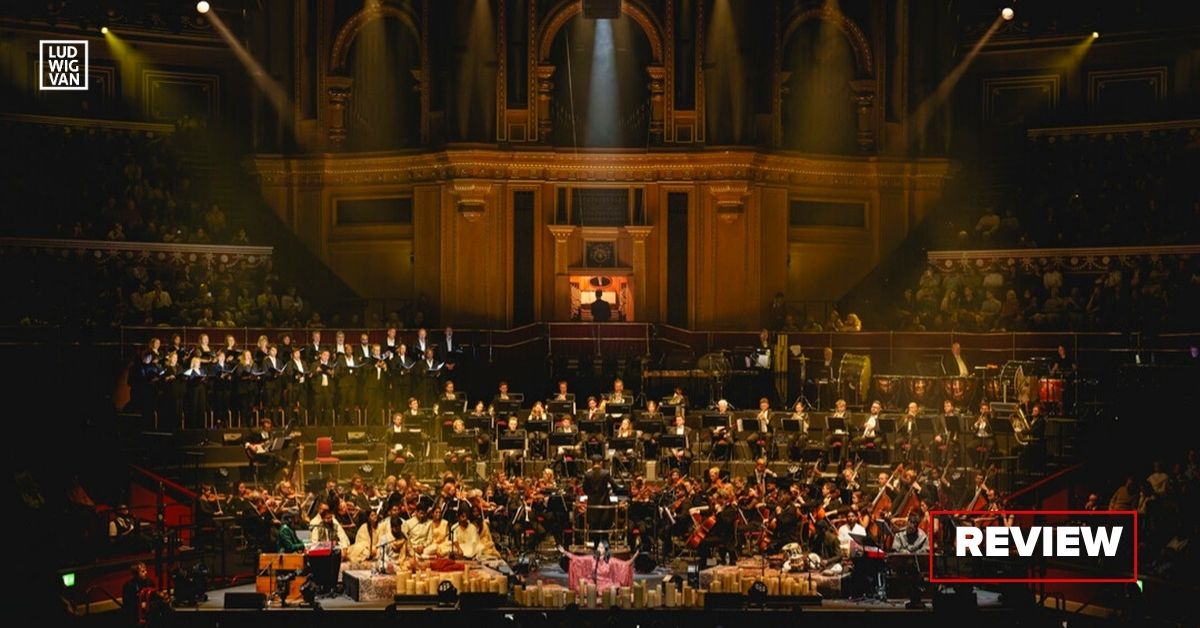
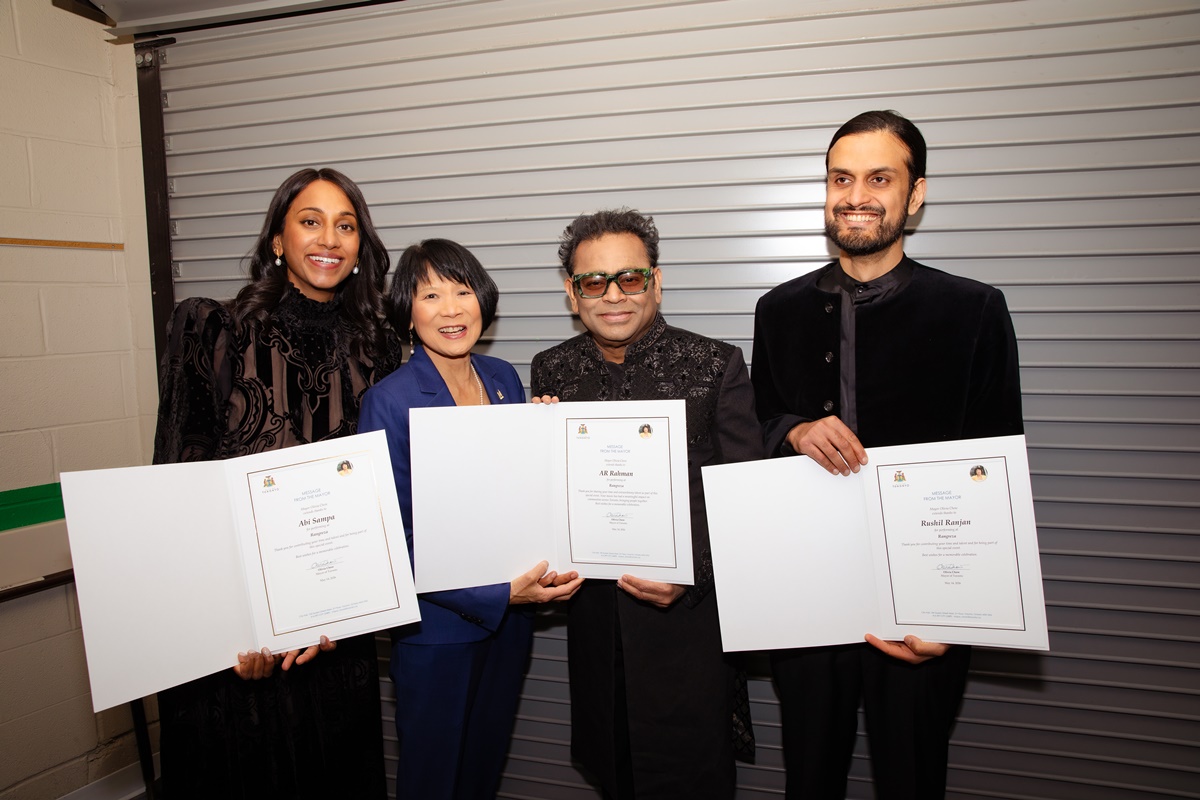
TO Live: AR Rahman & Rushil Ranjan: Rangreza रंगरेज़ा ft. Abi Sampa Live in Concert, Meridian Hall, May 14 and 15, 2026.
There are concerts, and then there are concerts.
The weekend appearance of AR Rahman at Meridian Hall was unlike anything I have ever experienced before.
Who Is AR Rahman?
Go to any digital music platform, type in his name, and watch page after page of film scores appear. He is probably the most prolific composer of Indian cinematic music — Bollywood music, to use the western shorthand — on the planet.
Yet, what is astonishing is that the scores do not sound alike. One moves from lush romanticism to pounding dance rhythms, from devotional music to symphonic sweep, from electronics to folk and rap to soaring vocal writing.
That incredible range explains why diaspora audiences packed Meridian Hall for two performances. It was simply because AR Rahman was in town.
Rahman first came to widespread Western attention when he won two Academy Awards in 2009 for the film Slumdog Millionaire — Best Original Score and Best Original Song for “Jai Ho,” shared with lyricist Gulzar. Those Oscars introduced Western audiences to a composer already legendary across the Indian film world.
A Concert Extravaganza
What made the Meridian Hall appearances so remarkable is that Rahman rarely tours, and this was no ordinary concert. It was an extravaganza, spectacle, an overwhelming multimedia event.
A 60-piece orchestra filled the stage, backed by a 16-member choir, while Toronto-based Indian musicians occupied raised platforms on either side, along with special guest tabla player/percussionist Janan Sathiendran from Britain.
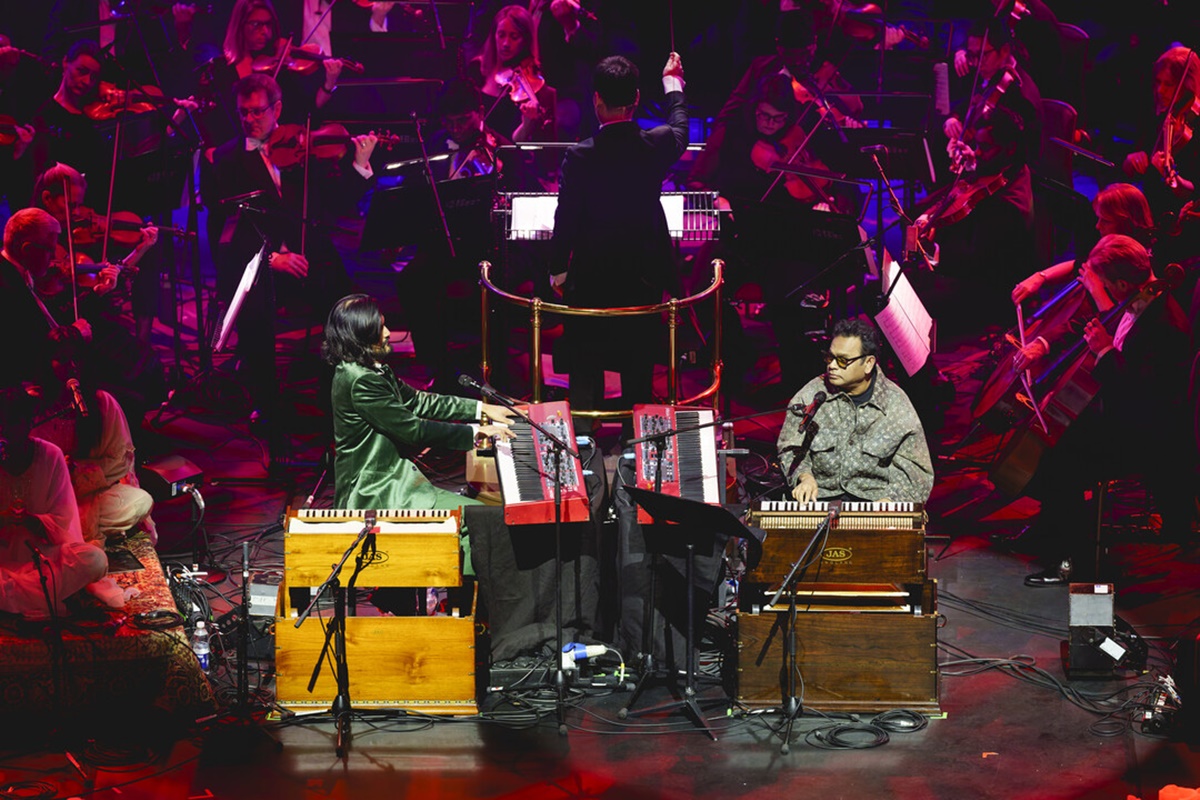
Rahman himself, playing a harmonium, was centre stage facing the evening’s other major creative force, composer-arranger Rushil Ranjan on piano.
The vocal forces included lead singers Abi Sampa from Britain and Sarthak Kalyani from India, and four supporting vocalists from Toronto. Later, we even had dancer Aakash Odedra from Britain
The scale of the undertaking was simply epic.
The Music
People would hear one or two notes and immediately erupt into cheers and applause because they instantly recognized what was coming next.
Yet, these were not three-minute pop songs in the Western commercial sense. Many unfolded as vast musical structures, sometimes stretching toward 20 minutes, combining symphonic writing, choral forces, devotional intensity, cinematic sweep, and Indian classical traditions into a single musical architecture.
What made the evening so astonishing was the sheer fusion of East and West — ancient Indian musical forms interwoven with Western orchestral writing, film music merged with classical traditions, everything building into waves of sound that simply swept the audience along with it.
Then there were the layers. First came the solo singers, then duets, then larger vocal ensembles, all constantly interweaving with backup vocalists and the massed choir behind them. Hand-clapping rhythms surged through the hall. Indian classical instruments — bamboo flutes, percussion, gongs, and drums — conversed with the full Western orchestra.
The result was an immense tapestry of sound, extraordinarily rich in orchestration and yet astonishingly transparent. Somehow, within this gigantic musical apparatus, individual strands still emerged clearly. One could hear the solo line, the choral response, the rhythmic undercurrent, the orchestral colouring, the Indian instrumental textures, all at once.
That was the monumental achievement of the evening: music of enormous complexity that nevertheless remained sweeping, majestic, and emotionally immediate.
The Logistics
Conductor Melvin Tay reportedly had only from Monday to Thursday to weld all these forces into a single cohesive musical entity before the performances. That the result sounded as unified, polished, and emotionally overwhelming as it did is really a testament to the extraordinary professionalism of everyone involved.
The chorus was Toronto’s own That Choir, which under the direction of Craig Pike is rapidly becoming one of the city’s most distinctive vocal ensembles.
Pike, amusingly enough, is also the founder of the wildly popular Toronto chain Craig’s Cookies, but onstage there was nothing gimmicky about the choir’s contribution. Their sound had tremendous weight and richness, capable of moving from devotional resonance to explosive rhythmic energy in an instant.
Perhaps even more astonishing was the orchestra itself. As I discovered afterward when I cornered one of the bass players on the street, this was not a standing orchestra at all but a collection of roughly 60 Toronto session musicians assembled specifically for the concerts. You never would have guessed it.
Who Is Melvin Tay?
The man responsible for welding these disparate musicians into what sounded like a long-established ensemble was conductor Melvin Tay, born in Singapore and now based in Birmingham, England.
Tay specializes in exactly these kinds of cross-cultural projects that require Eastern and Western musical traditions to function as a unified whole, and what he achieved here was extraordinary.
He not only held together the massive orchestral and choral forces, but also integrated the Indian instrumentalists, solo singers, percussionists, and amplified elements into a single coherent musical organism. The precision and sweep of the result were remarkable.

Who Is Rushil Ranjan?
Now we come to the evening’s other major creative force, Rushil Ranjan, the British-born composer, orchestrator, and producer whose work formed the backbone of the entire enterprise.
Although born in England, Ranjan draws deeply upon the musical and devotional traditions of India, reshaping them into vast contemporary concert experiences that have made him and his artistic partner, singer Abi Sampa, major cultural figures in Britain.
Sampa, amusingly enough, is also a practicing dentist in real life, but onstage she has become one of the leading voices of this new orchestral South Asian crossover movement. Together, Ranjan and Sampa pioneered the Orchestral Qawwali Project, which has sold out major venues including London’s Royal Albert Hall.
Qawwali
Qawwali, the ecstatic devotional music tradition associated with Sufism and northern India and Pakistan, is usually performed by singers, harmonium, percussion, and hand-clapping. What Ranjan has done is transform that intensely spiritual form into a gigantic symphonic and choral experience without stripping away its devotional core.
The emotional fervour remains intact, but it now unfolds through sweeping orchestral textures, massive choral forces, cinematic climaxes, and highly sophisticated orchestration.
The result has attracted enormous and passionate audiences across Britain and increasingly Europe as well. Rahman, who has long encouraged younger composers and collaborative experimentation, has clearly embraced Ranjan as part of that artistic continuum.
What made the Toronto concerts particularly fascinating was that the evening became a true fusion of the two composers’ musical worlds.
We heard music Rahman originally composed for film, alongside music Ranjan created for the Orchestral Qawwali Project, for dance, and for other concert works. Yet, much of the evening passed through Ranjan’s orchestrational imagination, meaning that what emerged was not merely a film-music concert but something closer to a gigantic symphonic event.
The Dancer
Then there was the dancer Aakash Odedra, another major figure from Britain’s South Asian performance world and an artist closely associated with choreographer Akram Khan.
Odedra, best known for his solo work, originally trained in the classical Indian form of Kathak before moving into contemporary Western dance, eventually developing a style that fuses both traditions into something highly personal and intensely lyrical.
His appearance on the program came almost as a surprise amid the massive orchestral and choral spectacle surrounding him, yet it became one of the evening’s most haunting moments.
Ranjan has composed music for Odedra before, and here the dancer performed a mesmerizing piece based on the image of a blinded nightingale forced into smaller and smaller cages so that it will sing more beautifully, the piece unfolded as a kind of tragic meditation on beauty, suffering, and transcendence.
Odedra’s dancing was exquisite. Much of it revolved around endless turning, spiraling again and again into tightening circles, suggesting both captivity and spiritual ecstasy at once.
The fusion of Kathak spins with contemporary movement language created something hypnotic and emotionally devastating, while the orchestral score swelled around him with enormous richness.
That there was even a major dance component within this already gigantic concert experience speaks to the extraordinary ambition of the entire undertaking. Odedra later returned as part of the evening’s overwhelming grand finale when all the musical and visual forces came together.
Rangreza
The culmination of the evening was Rangreza, the newly created work jointly composed by AR Rahman and Rushil Ranjan.
The title roughly translates as “colourist” or “one who brings colours together,” but within the Sufi tradition the meaning goes much deeper, evoking the divine as the ultimate artist who colours the universe with blessing, beauty, and spiritual illumination. In many ways, that idea perfectly embodied the entire evening itself — artistry, devotion, cultural fusion, and transcendence all flowing together within a single work.
Rangreza was a true international collaboration, jointly commissioned by Royal Albert Hall, TO Live, the Royal Philharmonic Orchestra, the City of Birmingham Symphony Orchestra, and the Melbourne Symphony Orchestra. It took five major organizations spanning three continents to bring the piece into being, which gives some sense of its scale and ambition.
And scale was exactly what the audience experienced in the final performance. Sung by Abi Sampa and involving all the assembled musical forces, Rangreza unfolded in immense surging waves of sound.
Chorales rose and receded. Soloists emerged and dissolved back into the larger ensemble. Orchestral climaxes swelled beneath Indian percussion and devotional vocal lines. The music seemed to move in great tides, enfolding the audience in layer upon layer of sound and colour.
More than merely heard, the piece was experienced physically and emotionally as an embrace of music.
At the world premiere in London on April 24, 2026:
The Visuals
The visual component was equally astonishing.
Lighting design by Britain’s Liam Drewery was among the richest and most sophisticated I have ever encountered in a concert setting, transforming Meridian Hall into an immersive environment of colour, atmosphere, and constantly shifting emotional landscapes.
Spotlights, cross beams, colour plays, aerial lighting — the visual element actually became a major player in the event, almost as important as the music.
Finale
Through all of this overwhelming spectacle, there was still the simple fact that AR Rahman himself was there.
A musical hero of mine was suddenly no longer a name on recordings or film credits, but a living presence onstage, singing, playing the harmonium, shaping the music in real time before us.
Beside him sat Ranjan at the piano, while Rahman’s longtime manager, Kevin Doucette, himself an accomplished concert pianist, also appeared as a soloist during the evening.
Yet for all the scale and grandeur of the event, what remains with me most is that direct human presence.
After years of listening to Rahman’s music through recordings and films, I was finally hearing him live, surrounded by this dazzling fusion of orchestral power, devotional fervour, cinematic imagination, and spiritual intensity.
It was not simply a concert. It was an experience unlike any other.
Are you looking to promote an event? Have a news tip? Need to know the best events happening this weekend? Send us a note.
#LUDWIGVAN
Get the daily arts news straight to your inbox.
Sign up for the Ludwig Van Toronto e-Blast! — local classical music and opera news straight to your inbox HERE.