
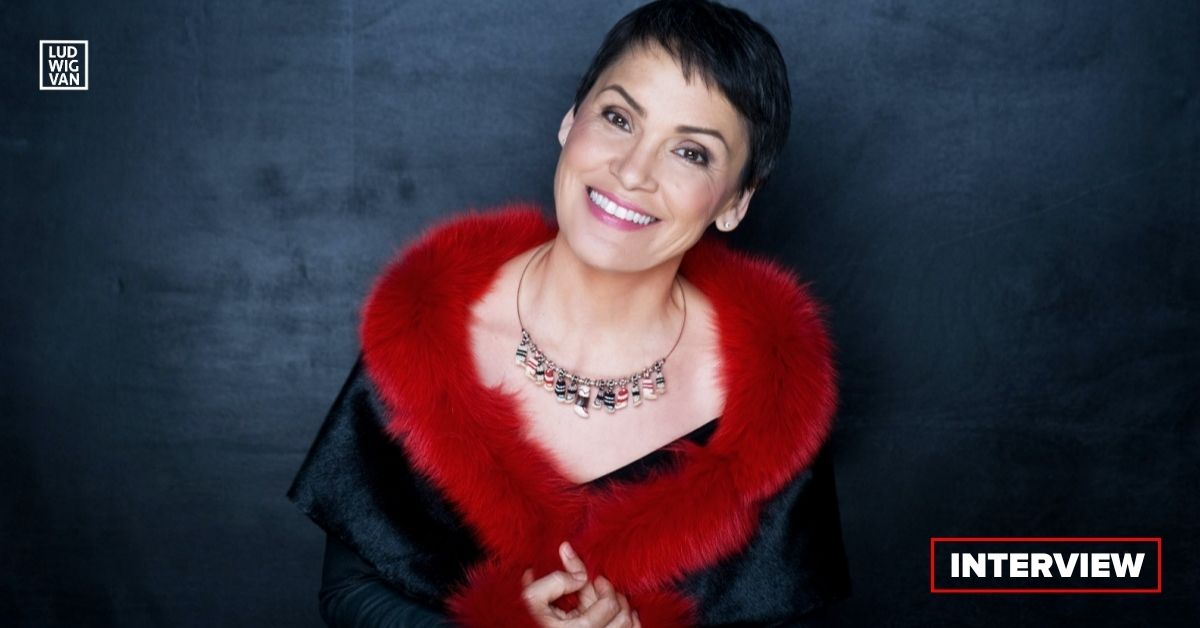
Singer-songwriter Susan Aglukark will be performing at the upcoming Indigenous Arts Festival. The Festival takes place June 20 at Biidaasige Park.
The veteran Inuk artist will be closing the event, a free and family-friendly day-long celebration of Indigenous cultures. More than 30 years after her breakout album This Child, she’s still making music and advocating for Inuit communities in the North.
LV spoke to Susan Aglukark about her career, working as an Inuk artist, reconciliation and more.
Susan Aglukark
Uuliniq Susan Aglukark, (ᓲᓴᓐ ᐊᒡᓘᒃᑲᖅ suusan agluukkaq) OC, was born in Churchill, Manitoba, and raised in Arviat, Northwest Territories, a region that is now part of Nunavut.
Susan worked for the Department of Indian & Northern Affairs in Ottawa, later returning to NWT to work with the Inuit Tapirisat of Canada. She began to sing in Inuit communities, and released an independent album of her own music in 1992 titled Arctic Rose, which won the Best Music of Aboriginal Canada Recording award at the JUNO Awards of 1995. Her musical style blends country and pop with her Inuit roots, and she sings in both English and Inuktitut.
This Child, released in 1995, sold more than 300,000 copies in Canada, and the lead single O Siem became the first top ten hit by an Inuk performer. She has since released seven studio albums of original music.
Susan was the first Inuk artist to win four JUNO Awards. Aglukark was made an Officer of the Order of Canada, and received a Governor General’s Performing Arts Award for Lifetime Artistic Achievement in 2016, and the Allan Waters Humanitarian Award at the 2022 Juno Awards.
In addition to her music career, Aglukark has worked with several non-profit groups advocating for Inuit and other Indigenous youth as a spokesperson, including writing workshops. She has advocated and worked for food insecurity in the North, among other issues. She has also written two children’s books.
Susan Aglukark: The Interview
Is music a career or a calling?
“A bit of both,” says Aglukark. “As a career, it was series of opportunities that came along shortly after moving to Ottawa in the fall of 1990. And, it started with a project that was part of my day job. I worked for Indian Affairs at the time.”
As she relates, she was part of a video project that was dedicated to telling the stories of Inuit children like her who’d had to leave home to get an education. “Those of us who still had to leave home and live in residence to get their grade 12 diploma,” she explains. “This was short video project that became a music video.”
The video went viral before viral was a thing, and went into heavy rotation on Much Music. She was gaining recognition even before she knew anything about the music industry.
“It was the beginning of discovering that was a possibility,” she says.
Next came a call from CBC Radio North. “They asked for more music,” she says. It started the ball rolling. “Just a series of happenstances. We ended up with a CBC project with a producer.”
That’s what resulted in Arctic Rose. The album’s success garnered even more notice from the industry, including major labels.
“I signed a record deal with EMI,” she says.
Aglukark co-wrote the song This Child with Canadian producer Chad Irschick, and sales in the hundreds of thousands convinced her that a career in the music industry was a possibility.
Was it more than just a music career for her?
“Yes and no. I think we straddle this position. What does success look like? We wear many hats as an Indigenous artist,” she says. “As artists, and if we’re successful artists, we’re also voices and advocates for critical issues.”
Those issues, she notes, haven’t changed much over the years. “They were critical 35 years ago when I launched Arctic Rose. They’re basic human rights issues,” she adds. Such as, housing, clean water, food security, the mental health crisis. “So of course we have to be advocates.”
It puts an extra weight on the position of being an artist. “It’s hard to pursue success for the sake of success. We have to find a balance. And learn — social media has changed how we advocate. How we speak up,” she points out. “The message is out there more instantly,” she adds.
“I think we’re always going to straddle that, because the issues haven’t really changed.”
Music and creation in general can also be a path to renewal. “To choose to also utilize this platform as a tool to stay on a healing journey, and if we’re very successful on healing journeys, and I’ve been fortunate in that I am successful, to continue that healing,” Aglukark says.
“Part of that healing is connecting with joy. I’m loving what I’m discovering, and part of that is navigating our trauma, our collective trauma as Indigenous people. We have to sit with that. We have to find a balance and sit with that,” she adds.
“That’s been my discovery and my joy.”
The act of expression by itself can bring healing.
“By it’s very nature, it becomes that. I think that’s part of our inner deep conflict as Indigenous people, is back to that whole conversation around success. What does success look like for you? Do you pursue success as a celebrity? Or for healing?”
As she points out, it can be both.
“It’s going to come to that. Your art is going to bring you to that,” she says.
Career Evolution
Over time, her notion of what a career in music can be has changed.
“It has evolved,” says Aglukark. “The beginning was definitely that — I would say the first five or six years, was this holy crap. Is this really happening? I didn’t see this coming.”
As with so many Indigenous artists, there was a period of own awakening to her own heritage.
“There was so much we were disconnected from.” Inuit children went through their own iteration of residential schools. By the 1950s, run by the federal government, many of them operated on a model that consisted of day schools, and student hostels, where students lived. Children were relocated, often far away from their families. To attend secondary school, students had to move out of the region entirely.
“We were disconnected from our cultures. We were also institutionalized,” she says. The experience left its mark. “In the early years of my career, I felt like I constantly had to ask [permission],” Aglukark says. “The first years, it feels amazing — I’m an artist. But, the feeling like someone could take it away at any moment [stuck].”
After the first flush of success came a period of questioning. “The time between This Child and Unsung Heroes, the follow up album, [I asked myself] the question, do you want to do this, and what are the next steps — because there was a lot of learning to do,” she says.
“I had to learn basic English.” As she explains, it wasn’t from scratch, “but there was a lot of catching up to do.” She also had to learn about the music industry and how it operates.
“I had to sink my fingers into, how to write for the sake of music, and not for the radio. I had to navigate that.”
In the end, she knew she wanted to continue as a musician. “I think I want to do that, but I have a lot of learning to do.”
Taking the institutionalization out of her thinking was one of the issues she had to tackle. “That’s when I knew, I am an artist.” She could focus on her music. “To be a better writer, be a better singer,” she says.
“That’s what the journey has been since then. Since the early 2000s.”
Reconciliation From An Artist’s Perspective
Has the environment changed at all for Indigenous people over the years? Is reconciliation just a word that’s thrown around, one with no true meaning? As someone who’s been in the business for decades, Susan is uniquely positioned to offer a relevant opinion.
“Watching how much has changed in the industry in terms of making access to it safer, and what I mean by that is, there was a time when there were very few of us at this level, and there was always that pressure from the industry to be an ‘Indigenous artist’, and look Indigenous,” she says. “Versus I am just a person, who happens to be an Inuk person, who wants to be a good singer and songwriter,” she adds.
Working under industry pressure to serve up some notion of what an Indigenous artist is supposed to be and look like can be stifling. “I kind like just being here, and taking up space,” she explains.
“Am I being disingenuous to say, I’m just an artist who happens to be Inuk?’
She’s used that kind of pressure and conflict to inform her songwriting. Through time, and artists like her who’ve been in the industry since the 1990s, attitudes gradually change. “It allows the next generation — and there’s so many of us — to take up that space.”
Nowadays, there’s a conversation about Indigenous traditional vs. contemporary cultures. “And that’s exciting. Our world changed,” she says.
“My parents came from the land. We have to be true to how much changes, and how fast it changes. I think that access to that platform, and that safe access, has been firmly established,” Susan continues.
“One of the great privileges I have had as an Indigenous artist, is to become part of that reconciliation process.”
Music and other arts are ways of healing as well as expression. “Healing has to be a critical part of that reconciliation process.”
She emphasizes that the process is ongoing. “And we’re not there,” Aglukark says.
Final Thoughts
She’s grateful that she’s been able to make her mark in the music industry.
“I get to do this everyday,” Susan says.
The pressure, though, can be debilitating.
“It burned me out. I was so burned out about 15 years ago. Even today, when I go into a singer songwriting environment, I have high anxiety,” she explains.
“The space we navigate as Indigenous artists, we’re all healing, and to sit and take up the space as artists, and be part of the reconciliation process,” she continues. “I want to be an artist, and I love being an artist. But, it’s also triggering me.” In part, that conflict is what fuels her art.
“That’s what we’re dealing with as Indigenous artists today.”
Despite the fact that reconciliation is a process that’s only just begun to bear fruit, she’s optimistic as long as it continues.
“As long as the dialogue continues, as long as we don’t go back to being stagnant,” Aglukark says, “even if we go sideways for a generation — as long as there’s some movement, it will progress.”
The Indigenous Arts Festival
The Indigenous Arts Festival takes place Saturday, June 20 at Biidaasige Park in Toronto’s Port Lands district. The park entrance is on the south side of Commissioners Street on the island of Ookwemin Minising. Find out out to get there here.
It’s a free, community-focused and family-friendly event, and offers traditional and contemporary music, dance, artisan and culinary experiences with workshops and activities, art and food markets, and live musical performances.
The concert takes place from 5 to 9 p.m., and features Mississauga Credit First Nation Youth, Manitou Mkwa Singers, Lacey Hill, Derek Miller and Susan Aglukark.
- Find out more [HERE].
Are you looking to promote an event? Have a news tip? Need to know the best events happening this weekend? Send us a note.
#LUDWIGVAN
Get the daily arts news straight to your inbox.
Sign up for the Ludwig Van Toronto e-Blast! — local classical music and opera news straight to your inbox HERE.

- INTERVIEW | Susan Aglukark Talks About Career, Music, And Working As An Inuit Artist - June 15, 2026
- PREVIEW | Cirque du Soleil’s LUZIA Returns To Toronto Summer 2026 - June 12, 2026
- INTERVIEW | Andrew Sterman Talks About The Philip Glass Ensemble, Performing In Toronto As Part Of Luminato Festival - June 12, 2026