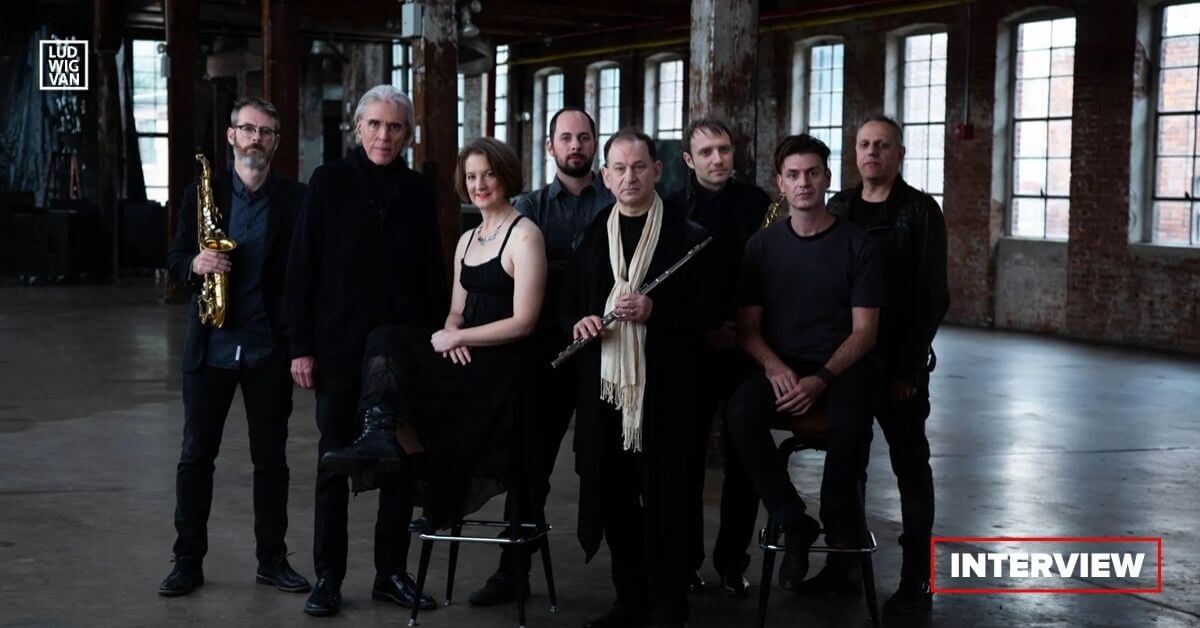
On June 20, 2026, the Philip Glass Ensemble will be performing as part of the Luminato Festival. The one-night only performance takes place at Koerner Hall.
At the Toronto concert, they’ll be focusing on The Early Works, a program of Philip Glass’ acclaimed music from the period 1974 to 1984, including Glassworks, Dance 1 (Einstein on the Beach), Grid (Koyaanisqatsi), and Funeral (Akhnaten). The music was written for PGE, and is still performed exclusively by them.
Philip Glass and the Philip Glass Ensemble
”The Philip Glass Ensemble represents the most authentic performance practice of my music in our time. I am looking forward to championing them as they carry it forward and bring its unique repertoire to new generations.” — Philip Glass
Philip Glass was born in Baltimore, and is a graduate of the University of Chicago and the Juilliard School. He subsequently studied in Paris with Nadia Boulanger for two years. During that time, he transcribed Ravi Shankar’s music from Indian to Western notation.
He founded the Philip Glass Ensembles in 1968, and his career was in full bloom by the mid 1970s. He composed the music for Einstein on the Beach, written with Bob Wilson, in 1976, and the work is celebrating its 50th anniversary this year. The piece is regarded as a milestone in 20th century theatre, disrupting conventional notions of plot, staging, and what a musical score could be, and the Luminato performance is part of a worldwide celebration of the music.
Glass has written music for opera, dance, theatre, chamber ensemble, orchestra, and films, and his work has garnered Academy Award nominations, along with a Golden Globe for The Truman Show score. In 2012, he received the Praemium Imperiale, the U.S. National Medal of the Arts from President Barack Obama followed in 2016, and the 41st Kennedy Center Honors in 2018.
The Philip Glass Ensemble, or PGE, is made up of musicians handpicked by the groundbreaking composer.
LV spoke to saxophonist/flutist/clarinetist, author, composer, and educator Andrew Sterman — General Manager and Performing Member — about PGE, the music, and the concert.
Andrew Sterman: The Interview
Andrew Sterman has been a member of the Philip Glass Ensemble since 1992. He has toured and recorded with the Ensemble extensively alongside a busy performing career in NYC, including appearances with Frank Sinatra, Sarah Vaughan, Tony Bennett, Dizzy Gillespie, Freddie Hubbard, Rashied Ali, Fred Hersch, Bruce Springsteen, Kelly Clarkson, Leonard Cohen, the New York and Los Angeles Philharmonics, Bang on a Can, and other ensembles. His work can be heard on about 100 feature film scores, and many Broadway shows.
“I wasn’t there at the beginning of the Ensemble, but I’ve been with Philip for a long time, some 35 years,” Sterman says. “Philip started an ensemble of his own to hear his music at all. It was such radical music, and it required a new way of thinking,” he explains.
“He needed a dedicated group of musicians who were willing to go on that journey.”
Glass’ music required techniques and approaches that traditional orchestral training did not prepare for. “Some of it’s more like painting than music,” Andrew adds.
Along with his focus on contemporary minimalism, Glass explored intermusical forms, influenced in part by his early association with Ravi Shankar.
“The way I think of it to myself, playing Philips’s music myself and in close association for so many decades — new times required new art. And new art requires a new way of performance.”
PGE is made up of individuals who have learned to think together. “We have a shortcut way of thinking,” he says. “We have a lightning fast response to each other.”
That includes both newer and veteran members of PGE. “There have been some brilliant new members over the last ten years,” Sterman adds. Developing that group process doesn’t come right away. “It does take a couple of years,” he notes. “It takes a couple of years easily, if not longer, because there’s a performance practice that’s unique to Philip Glass Ensemble.”
Over time, the music world has learned about and accepted Glass and his music. “Nowadays a lot of people are performing his music all over the place,” Andrew says. “It wasn’t like that [in the early days].”
Creative Freedom
PGE, however, still approaches it in a unique way. “The music is written in a short hand for the PGE.” That’s another aspect the ensemble has to pass along to new members. “When you do that, there’s a lot of agreement that comes into it. What does this mean, as the composer writes it?”
That shorthand incorporates a lot of artistic freedom. “Most composers like to be very much in control,” he explains. “Philip, he does know deeply what he wants, but once he hands the score to us, he wants us to take and run. He wants to be surprised by this. He’s looking for a true collaboration of the musicians of the PGE. It’s very collaborative,” Sterman adds.
“With rare exceptions, we don’t take notes. He’s more inviting than any other composer that I’ve worked with,” Andrew says. “He wants to be surprised by what you do.”
That’s not to say he’s looking for first impressions. The composer is looking for a developed and thoughtful response to his music. Sterman recalls performing a piece where Glass had written a featured solo for him.
“I thought I nailed it, I thought I had it,” he says. “His response was, okay, good, well let’s see where you take it. I thought, wait a minute, I just took it!” he laughs.
PGE has performed that piece many times since then. “And I was surprised by how much music was in it,” Sterman says. “I’d watch him turn in his chair and wonder, okay, what are you going to do with it?”
It’s a dream situation for a musician.
“For a composer, you’re in collaboration with a great composer, and it’s ideal. And every night, it’s shared with an audience.”
Old vs. New
New music is essential to respond to new realities. Music has to live in its own time and place. It doesn’t mean throwing Beethoven and Bach away. It’s simply acknowledging that reality has changed.
“As much as we love it, it’s not our art,” he says. “We need fresh, moving art in order to know ourselves and what we are. Philip himself loves all kinds of music. He writes in a very strong signature style.”
Meeting Glass, at first, Andrew had assumed he’d be immersed in contemporary music and nothing else. “But in his car, he’s listening to South Indian music, or pop music, and music of the 40s and 50s,” Sterman relates. “He knows and respects these people. He’s interested in people doing what they do — not his way, or the way of the past,” he adds.
“The ideas in the way of serious music culture is not to negate anything, but it adds the necessary new layer that we need in our times.”
What is beautiful in 18th century music can’t simply be replicated over and over. Modern music can still be beautiful, but in a different way.
“When we come to Toronto on June 20, we will be playing some beautiful music,” he says.
That includes the composer’s Glassworks, a six-movement piece that was recorded in 1982. “We’ll be playing the entire record live,” he says.
“The movement Facades is absolutely gorgeous. It’s beautiful music by anyone’s standards.
It’s very melodic. It’s touching and experientially beautiful.”
Responding to the modern world poses its own set of hurdles. “Modern music has had certain challenges. How to be beautiful?” he asks.
“The music can be so thoughtful and head oriented,” he points out, “the number of decisions are so intricate and so complex that the music has slowed down. We don’t have a lot of fast music.”
The label of minimalism can itself be a distraction. Sterman says the members of PGE often joke about it. “How can this be called minimalism when we just played 2 1/2 billion notes?”
It’s now how Glass himself characterizes his work. “We don’t like the label. He got rid of it after a few years.” He notes, however, that the label has stuck when it comes to media and even academic writing about his music.
“It’s beautiful music, but is totally effective in a new way. A lot of the complexity of harmony in high classical music had to do with form,” Sterman points out. “We’ve gone to a distant place from the tonal centre of the piece. Philip […] has organized the piece in a totally different way,” he adds.
“Philip developed a new kind of architecture.” It often begins with a very simple motif. “And, before you know it, and you don’t even know how it happens, it develops in a powerful locomotive of sound. How did it get there? He is an absolute master of formal development,” Sterman says.
“Every night that I play with the Ensemble, it’s a lesson in form. I’m still wide eyed and wide eared about it,” he adds. “It works with a different language. Within that language he’s capable of saying everything human that he wishes to say.”
The Concert
“The Glassworks is the first half,” he says of the concert. “It’s one of Philip’s early records.” It’s still one of his most popular. “It’s a beautiful record,” he continues.
“And then we’ll have an intermission,” Andrew says. Next will be excerpts from Koyaanisqatsi, a 1982 non-narrative documentary film Glass wrote the score for.
“And then we’ll play the first dance, Dance 1 from Einstein on the Beach.” Glass has had a significant presence at Luminato over the years, Sterman points out. In addition to the world premiere of Glass’ Book of Longing at the inaugural Luminato Festival in 2007, his Einstein on the Beach was remounted at the Festival in 2012.
“That was an important appearance in Toronto,” he notes. “We’ll finish the concert with a selection from Akhenaten. That opera opens with his funeral, and it’s a magnificent sequence,” he adds.
“And, if all goes well, we might have an encore.”
It’s a kind of greatest early hits approach. “The classic masterpieces. These are huge masterworks. The concert all told with be 1:45, something like that.” Glass himself doesn’t come on tour with PGE anymore. “He’s 89 1/2,” Sterman points out.
It’s a concert for both Glass aficionados, newcomers, and the simply curious.
“Everyone’s welcome. The best way to find out is to come out to our concerts live. It sounds very good on recording, but it’s nothing like hearing it live,” he adds.
For the curious, open mindedness is all you need. “It has a different aesthetic.” Glass’ music doesn’t have the linear narrative that you’d expect from traditional classical music. “This music is just there. It’s philosophically there. This music requires us to listen to it in a different way,” he says.
“Give yourself up and drop your defences,” he advises.
If you listen with open ears, he promises an intimate experience. “I feel like the audience joins us on stage,” he says. “We drop our front — we don’t have a front. This happens in live performance. Instead of, where is the forest? — we are the forest,” Andrew adds.
“Something very special happens. There is definitely something magic in the concert hall with this music,” he says.
“And it’s why I’ve stayed doing it for so very long. It’s still absolutely compelling.”
The Concert
The Philip Glass Ensemble performs on June 20, 2026 as part of the Luminato Festival. The concert takes place at Koerner Hall.
- Find tickets and other show details [HERE].
Are you looking to promote an event? Have a news tip? Need to know the best events happening this weekend? Send us a note.
#LUDWIGVAN
Get the daily arts news straight to your inbox.
Sign up for the Ludwig Van Toronto e-Blast! — local classical music and opera news straight to your inbox HERE.