

World on Fire Theatre Collective: World On Fire written and directed by George F. Walker
with Alex Clay (Dr. Emilio), Elizabeth Friesen (Jules), David Huband (David), Marline Yan (Annie), Anne van Leeuwen (Casey), and Chris Peterson (Marius), with set design by Madeleine Rosenberg, Daniel Rosenberg, Nicholas Friesen. May 28, 2026, The Assembly Theatre. Continues until June 7, 2026; tickets here.
“All my life, people have been trying to forget about me.”
Strong characters light up iconic Canadian playwright George F. Walker’s latest work, titled World On Fire. The title is also the name of the new theatre collective that’s been formed to showcase Walker’s work.
The story revolves around Jules (Elizabeth Friesen), a harried social worker at the end of her rope, and a collection of her clients, including Annie (Marline Yan), the kid who’s been on the streets since she was 13, Casey (Anne van Leeuwen), a jittery, troubled homeless woman who yells at people about social justice at the entrance of a shopping mall, David (David Huband), the suicidal adult child of Holocaust survivors, and Marius (Chris Peterson), who’s afraid of everything.
The fate and the backstory of the group of society’s cast offs is fleshed out over the course of the play, at least in part, leaving to the inevitable conclusion: there are no easy solutions — and perhaps no solutions at all — to any of it.
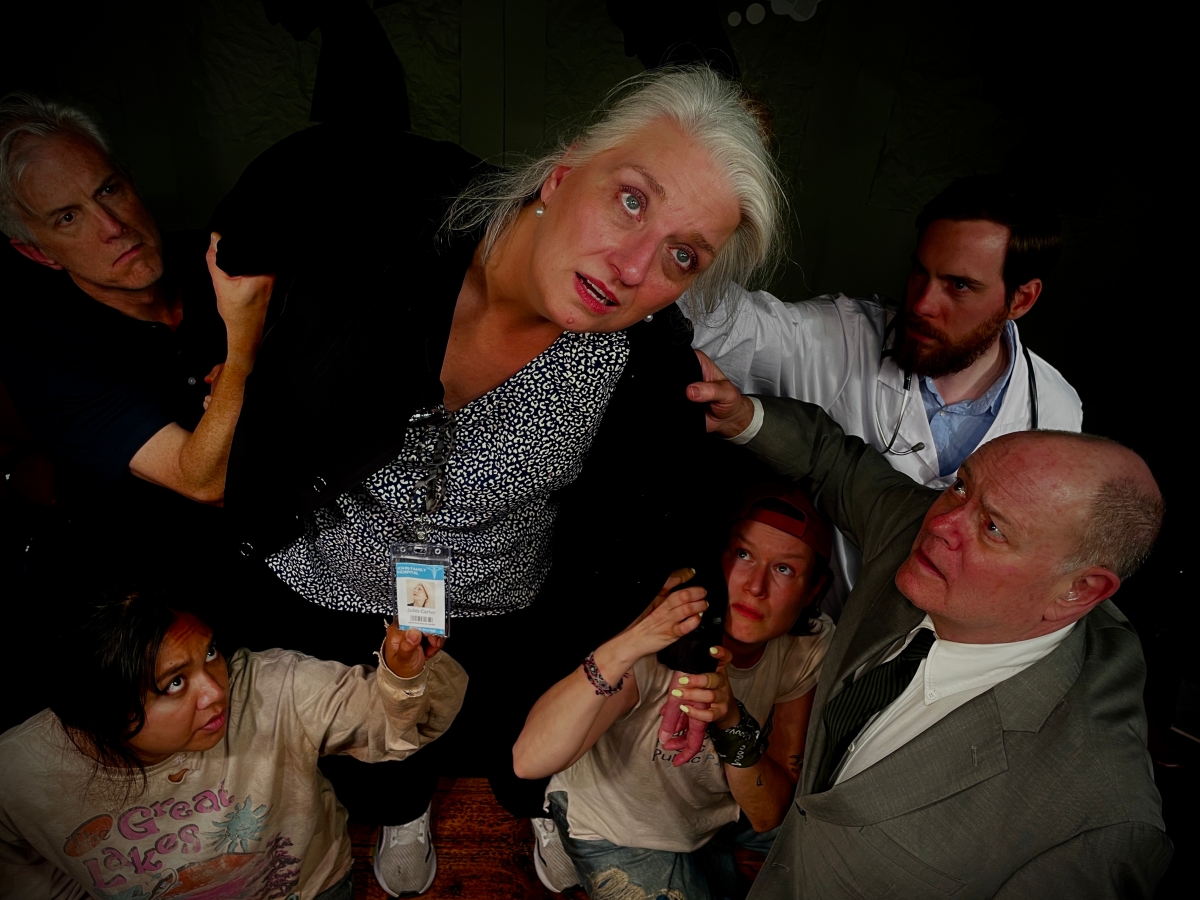
Strength In Characters
Strong characters, and characterizations, carry the message of the play. Casey is by turns belligerent, delusional, and tearfully repentant as she reluctantly interacts with Jules and the three other clients. Her story, what is revealed, is horrific — homelessness, a miscarriage, and more. Some details, including the original reason she ended up on the street, are left uncertain, leaving the audience to fill in the blanks.
Casey began as a married mother. Then, the marriage fell apart, leaving her to juggle multiple jobs, and leaving her vulnerable to homelessness. Her children are taken away, and she simply breaks under the strain.
Anne van Leeuwen plays her as jittery, seldom still, with a facade of smiles that can instantly veer to overwrought emotion. She’s the one that Jules feels especially close to, and the story of her childhood trauma makes her brittle vulnerability understandable. She’s fixed on social justice as a kind of framework for the life she’s been left with.
Marius is the more inscrutable of the four. He’s got the resources to live a better life, but his pervasive fears leave him crippled and stymied at every turn. It’s easy to understand Jules’ flashes of impatience with him and her other clients. Why can’t he simply see the world for what it is?
All three actors play the emotions of their client/characters raw and unfiltered, entirely convincing in their portrayal of people on the edge who can’t find their way back.
Elizabeth Friesen’s Jules is a multidimensional character, driven by a basic impulse to do good, and help, but also human enough to be impatient, question the purpose of their talks, and, in the end, to become exhausted by the experience. It’s a performance delivered with subtlety and nuance that convey the burned out human underneath the professional facade.
Exceptions
David Huband’s David, as the character is written, is somewhat less convincing. The survivors of the Nazi death camps and their children carry a burden of trauma that can manifest in many different ways, but as it happens, suicide is not often one of them, according to research that’s been done. It’s an extreme reaction, and the character of David does not carry the weight with that kind of intensity.
He’s more of a cranky, irritable old man, given to joking about his situation. He reacts with the same kind of irritation when he meets Annie, for example. While Jules’ other clients wear their emotions vividly on their sleeves, David doesn’t demonstrate that same kind of visceral feeling. It’s not to say that different people might display their emotions in a different manner; David’s anguish doesn’t come across as part of the present moment of the story.
There’s also a detail about the timing of events that seems incongruent. Jules mentions David inheriting family property from his parents as if it had occurred recently, however, even if his parents were children during WWII, the pivotal event in his past that is mentioned throughout the story must necessarily have taken place decades ago.
Alex Clay’s Dr. Emilio is something of an antagonist in the story, and while some of his actions and observations — such as questioning whether Jules’ role is really to speak for her clients — have a ring of truth, at other moments he’s almost a farcical character.
There is humour sprinkled throughout the play; where it works best is more when it reveals truth with a skewed lens, as opposed to one-liners.
Play Structure
In many instances, Jules and Annie speak directly to the audience. It works in the case of Jules, where the audience serves as a sort of sympathetic ear she can bounce her thoughts against.
It’s less successful in the case of Annie, who stops to berate the audience at a couple of points in the play. The audience here serves as a stand in for the public in general, who are, after years of living with troubled homeless people on their streets in real time, already numb to the effect. In Annie’s eyes, it may well be a case of individual responsibility, but the reality is that the roots of it are institutional and societal, an aspect that’s not touched upon in the play at all.
Set and Design
The set design by Madeleine Rosenberg, Daniel Rosenberg, and Nicholas Friesen is both simple and effective. Two chairs and two benches serve as both hospital meeting rooms and Jules’ office. Graphic designs on the back wall depict a both the stresses and uncertainties of the characters.
Snippets of old school alt rock blast during scene transitions to help set the mood.
Final Thoughts
It’s another strength of Walker’s script that most of the characters are portrayed as multifaceted and complex. Their situation might evoke empathy, but their behaviour often isn’t so easy to sympathize with. Jules’ clients bicker between themselves, and it reveals the truth — being a victim doesn’t necessarily make a person more sympathetic to other victims.
“I became a social worker specializing in people who don’t want any help.”
What do you do with people who keep making bad choices? Who won’t acknowledge what is clearly the reality of their situation? Or who’ve suffered a psychotic break?
The story underscores the reality of Jules’ job — simply caring clearly isn’t enough. It’s an intractable problem in a society that keeps leaving larger and larger swaths behind.
Despite its less successful moments, World On Fire’s script and strong acting deliver the message clearly.
Are you looking to promote an event? Have a news tip? Need to know the best events happening this weekend? Send us a note.
#LUDWIGVAN
Get the daily arts news straight to your inbox.
Sign up for the Ludwig Van Toronto e-Blast! — local classical music and opera news straight to your inbox HERE.