
Pleiades Theatre will present the world premiere of Syrian-Canadian playwright Aksam Alyousef’s Karma at Theatre Passe Muraille. The play takes the stage from May 1 to 17, directed by Ash Knight.
The story revolves around themes of family, the trauma left by a civil war, and forgiveness. How are we shaped by the circumstances of our lives?
It’s set in 2012, and follows Adeeb, a young man who was born in Canada, but believes he lived a previous life in Syria. His mother, Karma, is Syrian. She’s troubled by what she sees as mental health problems, and pressures him into denial.
But, as an adult, Adeeb persists in his belief, and he travels to Syria in a move that forces both his mother and he to confront both the past and present.
“There is a quiet possibility that life is not a single flame but a returning light,” says playwright Aksam Alyousef in a statement. “That we might inherit the burdens we helped create. That every judgment plants a future in which we stand on the other side of our own certainty. If this is so, then cruelty is only a debt deferred. Compassion becomes the only form of freedom.
“To see this play receive its world premiere with Pleiades is deeply meaningful to me. Their commitment to bold, thoughtful storytelling creates the right space for these questions to live on stage, not as abstract ideas, but as human encounters shared with an audience in real time.”
Director Ash Knight adds, “This is the second collaboration between Aksam and Pleiades, the first where we have been fully involved in the development of the work. Aksam brings years of experience as a theatre practitioner around the world, and with his talents now in Canada, we are stronger for it. With Karma, Aksam brings to life a complex story, with poetic language. The piece is a challenge for artists and audiences alike, one that will leave everyone who experiences it moved and aware. The play explores themes of forgiveness and trauma, and Aksam does this without ever preaching or handing us the answers. He asks the questions, and hopefully, we find the answers together.”
LV caught up with composer and sound designer Gurpreet Chana to talk about his work on this complex story that takes place in multiple locations and times.
KLoX performs Falling Live at Koerner Hall postlude concert:
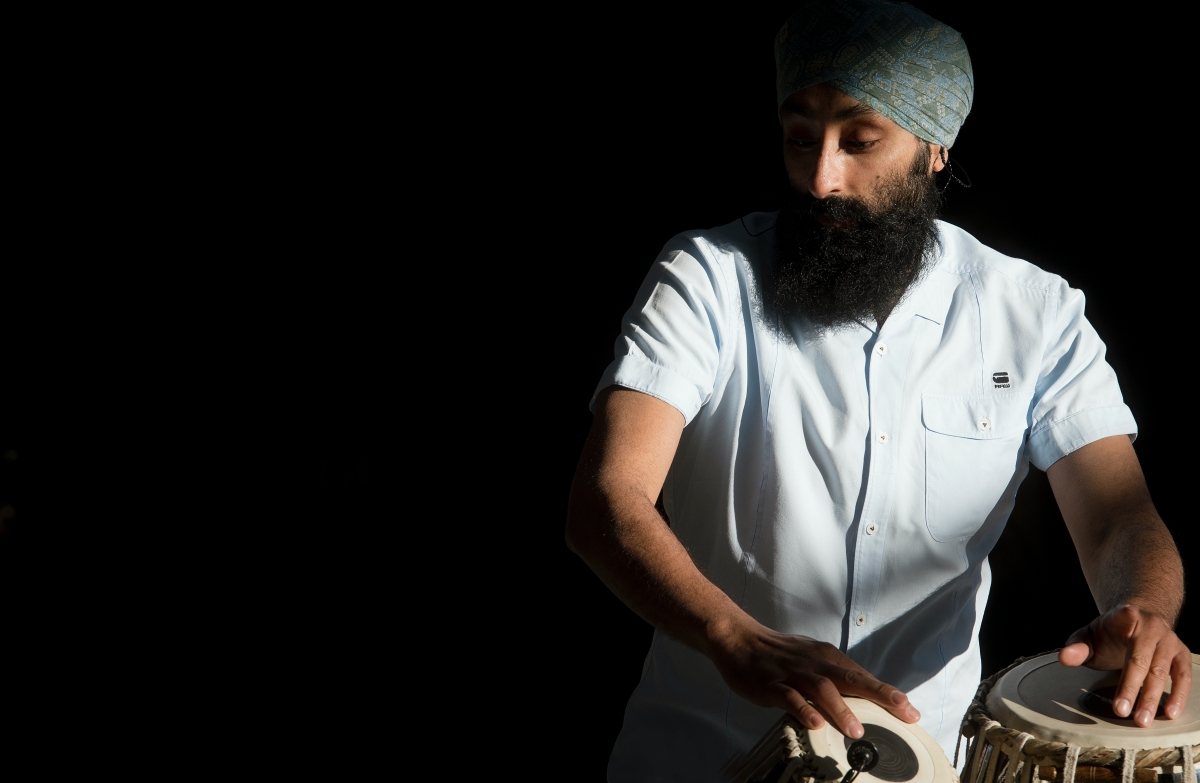
Gurpreet Chana
Hamilton-based musician, technician, composer and performer Gurpreet Chana’s music blends centuries old traditions with modern technology. He adds the mesmerizing rhythm of the tabla to the music of many cultures and genres.
Gurpreet began his study of the tabla since the age of three, and trained in the Punjab Gharana. He uses the venerable instrument to connect with the many musical styles he’s surrounded by in contemporary Canada.
It’s led to many musical collaborations across the globe, including studio sessions with artists like Nelly Furtado, Tanya Tagaq, Niyaz, Bombay Dub Orchestra, Jorane, Kiran Ahluwalia, DJ Starting from Scratch, and legendary UK DJ/producer Bally Sagoo.
Gurpreet has created a digital fusion technique called tablixing, which integrates the tabla to custom software. He expands on the concept in kLoX, a creative partnership with classical violinist Robert Mason. The duo explores the relationship between classical instruments and digital composition, resulting in music that is infused with a variety of sources, including tech house, drum ‘n’ bass and dubstep. He’s developed his method into TABLIX, an integration of tabla and digital technology.
Chana is also one of the leading proponents of the Hang, a Swiss instrument that is both percussive and melodic.
Bach Prelude performed by Gurpreet Chana and Aaron Larget-Caplan at the Banff Centre:
Gurpreet Chana: The Interview
The play, as Chana explains it, is a story about intergenerational trauma — but also interdimensional trauma. Different lives are lived in different dimensions.
“There are quite a few layers for it,” he says. “One of the actors is going between different lives.”
The sound design provides a kind of sonic backdrop to the action on stage.
“The main […] sense of the story takes place in Syria, a large part of it,” He works with the creative team, considering various elements of the production to come up with ideas. “Once the picture got a bit clearer, working with the other design partners, and the director.”
He considered styles of music from the region, with attention to the details specific to Syrian music.
“Whether it’s for the whirling dervishes, or the Sufi practice, there’s a lot of nuance as to how it’s practised in Syria as opposed to how it’s practised in Turkey, for example,” he explains. “What are some of the specificities that can place us into Syrian music in particular?”
He’s working with various other artists in developing the soundscape. “I’ve also been lucky to be working with the Canadian Arabic Orchestra.” The involves conversations with the music director along with a few of the orchestra’s musicians.
“It was interesting to get an idea what’s similar, what’s different,” he says.
It’s about using sound to create a sense of place. “How do we give a sense of place and location?”
The details include using the musical scales as well as instruments of the times and places depicted in the play. That includes Syria during the civil war as well as an interdimensional space. “Then, I’m taking a few liberties. […] I’m still keeping the music informed in Arabic culture, but making it more contemporary, or doing fusion things,” he explains.
He thinks of it as separate worlds, but which also exist within the of the play as a whole. “That’s been a way to organize it in my head.”
In addition to location and space, there are other elements in the play to take into account. “In this play, there is some multimedia stuff going on,” he says. That includes projections and lighting effects that go along with the music. “We’re still figuring out how all of that comes together, being in rehearsals right now.”
Direction Notes And Details
Most of his notes, naturally, come from the director.
“He doesn’t like to pre-deliver the emotion of the music. The goal is not to pre-tell the story musically too much. So, as much as we want to give it away, we don’t want to give it away too much,” he explains.
It won’t be like your average horror movie, in other words, where the music will announce what’s about to happen. “We want to support and tell the story, but don’t give it away,” he says.
It’s an interesting challenge.
“Very much so. It’s so subjective. It’s an interesting challenge — I don’t want to say it helps to keep it minimal; I think that’s more of a design choice.”
Knowing how director Ash Knight works helps. “This is the second time that I’m working with the director,” he says. “It’s filtering some of the decisions I’m making.”
His first step is to delve into research.
“I come from an Indian classical music background,” he notes, “which is different than Arabic music.” He points out there are some similarities. Some of the Arabic scales have Western equivalents, for example, but others are more similar to Indian music. “That’s been really helpful to the composing side of things.”
Along with the Canadian Arabic Orchestra, he’s been working with other Arabic artists, and licensing some music, including tracks from a Lebanese oud player now based in Montréal. “When I heard it, it kind of hit me — this would be perfect for the dream world.”
Chana is also using common Syrian folk instruments such as the ney, a reed flute. “Any instruments that I’m choosing when it comes to traditional instruments, we’re making sure they’re having a connection to Syria,” he says.
“I’m being a bit strategic in how I’m approaching the design.”
Performances
Karma takes the stage from May 1 to 17, 2026 at Theatre Passe Muraille.
Content note: Mature language & content. Age recommendation: 14+. Tickets start at $15, with a tiered pay-what-you-can structure.
Karma is directed by Ash Knight, starring Basel Daoud, Andrew Iles, Zaynna Khalife, Tony Nash, and Christina Tannous.
Karma will feature scenic and projection design by Lucas Arab, costume design by Arianna Lilith Moodie, sound design by Gurpreet Chana, stage management by Jennifer Stobart, and production management by Carlos Varala, with costume volunteer Jasmine Bough.
- Find show details and tickets [HERE].
Are you looking to promote an event? Have a news tip? Need to know the best events happening this weekend? Send us a note.
#LUDWIGVAN
Get the daily arts news straight to your inbox.
Sign up for the Ludwig Van Toronto e-Blast! — local classical music and opera news straight to your inbox HERE.