
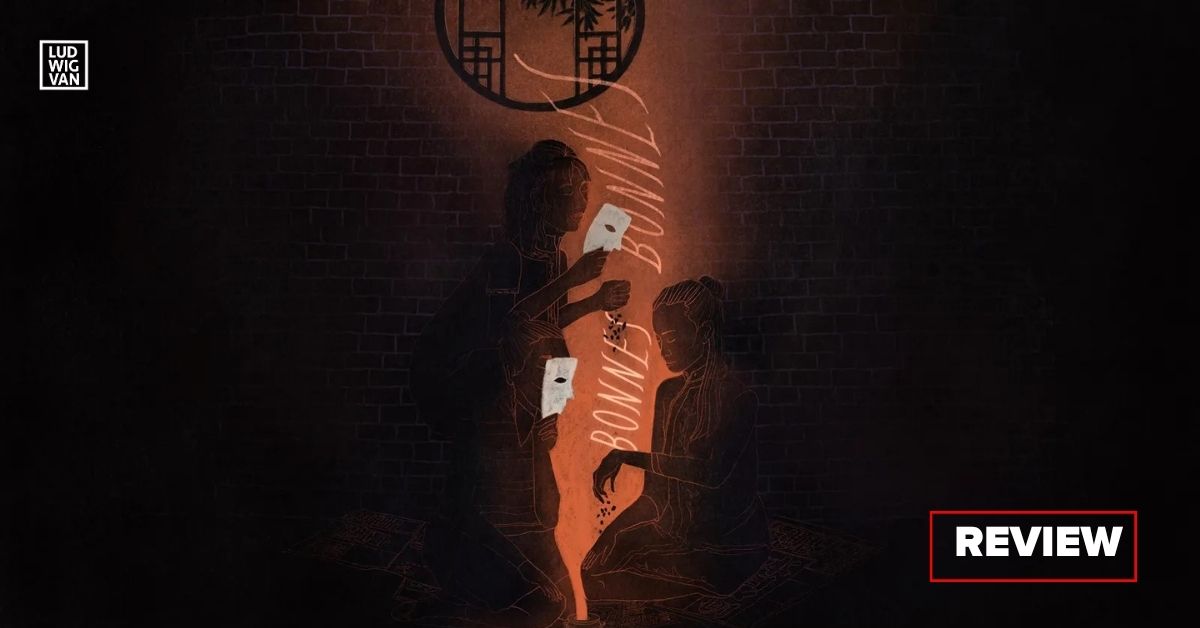
Nervous Hunter production presented by Factory Theatre and Théâtre français de Toronto: Bonnes Bonnes. Written by Tamara Nguyen and Sophie Gee, directed by Sophie Gee, Director, with Sophie Gee, Performer (Sophie); Meilie Ng, Performer (Meilie), Video Performer (Claire); Wai Yin Kwok, Performer (Wai Yin); Charo Foo Tai Wei, Video Performer (Solange); Holly Gauthier-Frankel, Voice performer (News Reporter, English). April 17, 2026 Studio Theatre at Factory Theatre, continues April 22 to 26 in French; tickets here.
The risk of creating under the influence of a genius is being subsumed by it.
For the most part, Nervous Hunter Production’s Bonnes Bonnes, written by Tamara Nguyen and Sophie Gee and presented by Factory Theatre and Théâtre français de Toronto, avoids this trap.
The Play & Production
As soon as you enter the Studio Theatre, your nose is greeted by the scent of incense.
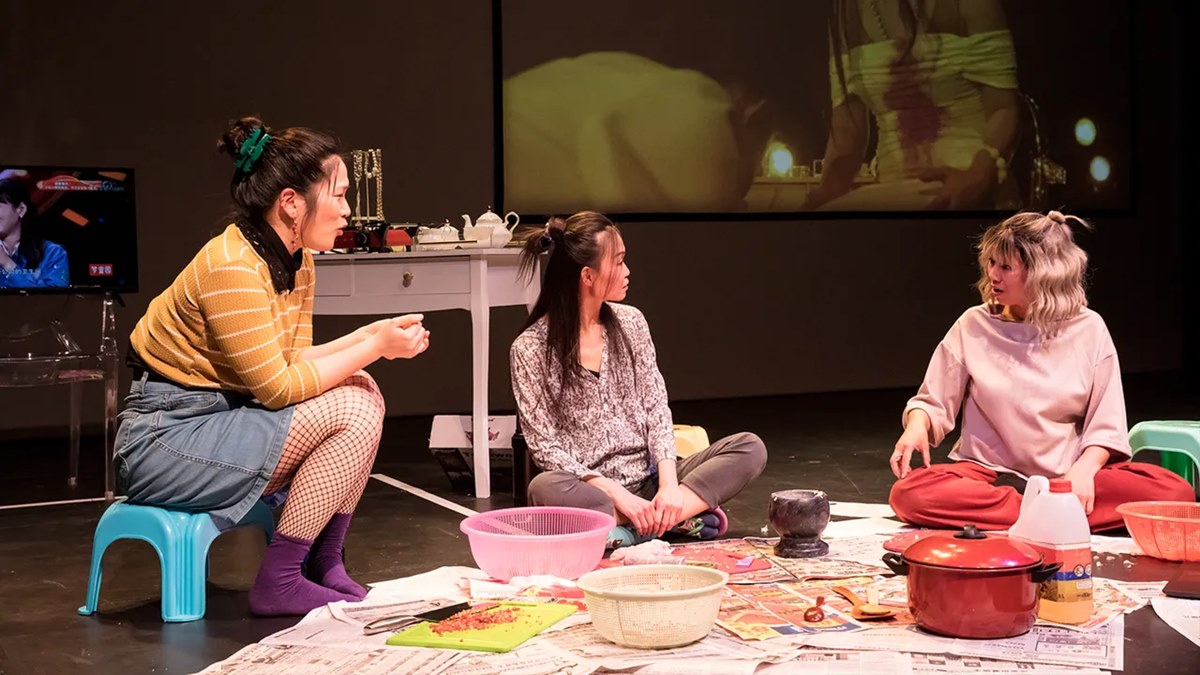
On stage a TV streams CCTV — China’s national television broadcaster — and music from a variety of East Asian languages and popular genres fills the space. The only senses the creators seem to have omitted are touch and taste, but they evoke the ambiance of an East Asian living space, where a porcelain teapot isn’t out of place (set and prop design by Maryanna Chan).
Bonnes Bonnes begins with three East Asian women coming together to cook chili oil. There’s Wai Yin (Wai Yin Kwok), a Hong Kongese worker who arrived in Canada later in life, and Meilie Ng (Meilie Ng), a modern, second-generation woman who is not fluent in Mandarin.
The most interesting figure is the host: Sophie (co-writer and director Sophie Gee), who is eager to practice this tradition and to share her adaptation of Jean Genet’s The Maids with them.
Having formed an assembly line — Meilie on the chillis, Wai Yin the garlic, and Sophie the shallots — they watch the film on a laptop screen, the image of which is projected for the audience on a screen behind them. Rather than chronologically, the play thrusts us into Genet’s world in media res, where Claire (also played by Ng) — masquerading as Madame — and Solange (Charo Foo Tai Wei) are caught in the shape-shifting dynamic of their power plays.
At one point, multiple layers of spectatorship emerged: the TV broadcast, the projected film and the audience watching the women watching themselves. This doubling extends to depictions of labour, in the kitchen and the theatre, which is further amplified by synchronized interpretative dance sequences that depict the monotonous life of factory workers.
When Solange says “I love you,” a pause — the first of many — provides an opportunity for the women to discuss and interpret the scene from their distinct perspectives. Meilie has never “felt Asian enough”, Wai Yin recalls the pervasiveness of aspiring to white ways of being, and Sophie insists her engagement with Genet is more appropriative than one of kowtowing reverence.
Theatre and Race
These scenes of annotation — touching on smelly food, Crazy Rich Asians and growing up with affluent white peers — feel dated upon arrival. I wondered if they might give way to sharper reversals, as in Genet’s play; for the most part, it does not. Where the bulk of the subversion should take hold, these conversations follow along well-trodden paths, where the most vicious insult that can be hurled at one another is: “You’re practically white.”
Bonnes Bonnes recalls a persistent issue in theatre’s engagement with race — a tendency to find comfort in binary thinking. Even in works by East Asian creators that gesture towards nuance, the antipode is always white. And while no single play can encompass every experience — no race is monolithic, the immediate rebuttal to this critique goes — settling on this framework narrows the scope of its inquiries. If racialized creators seek nuance, they must acknowledge racial relations extend beyond this black box of a world.
Progress might only be when whiteness is not a work’s primary referent.
That the play, originally written in French and produced by Théâtre français de Toronto, was created in Montreal makes sense: its diluted dialogues would appeal to a white audience who may be unaccustomed to Asian culture and customs — or Michelle Yeoh’s brilliance — but is well-versed and attracted by its proximity to Genet.
In a talk back after the show, Gee explained one of their intentions with the chili oil was to fill in these “white spaces” with Asian scents, to create something the audience couldn’t consume, a choice which I respect and felt was earned.
Final Thoughts
Formally and sensorially, Bonnes Bonnes is formidable, as when the screen playing the film gets larger and larger through Amelia Scott’s projection design, lighting designer Nine Desbaillet’s drowning the room in bright red, and sound designer Christine ML Lee’s converging to create a resounding atmosphere.
As Solange and Claire trash the Madame’s home, yearning for a world where China takes over the world — where the Yuan, WeChat and Mandarin reign supreme — the energy in the room shifted, the play having tapped into The Maids’ furtive psychic poison.
Towards the end of the play, in a monologue where Sophie confronts how her self-perception has been warped by the white world, we finally witness the anticipated subversion, where the radical, insurrectionary impulse of Genet and bleed, blend and blur into theirs, the way that the fragrance, flavour and colour of chilis becomes part of the oil to create an entirely altered substance.
Presented for its first time in English, followed by a French-language run with subtitles a week later, Bonnes Bonnes — unassumingly assured, positively wicked — ends with a desire to recognize oneself when one looks in the mirror.
An impossible task, but not difficult to serve.
By Nirris Nagendrarajah for Ludwig-Van.
Are you looking to promote an event? Have a news tip? Need to know the best events happening this weekend? Send us a note.
#LUDWIGVAN
Get the daily arts news straight to your inbox.
Sign up for the Ludwig Van Toronto e-Blast! — local classical music and opera news straight to your inbox HERE.


- CLASSICAL CHARTZ | The Top Ten Classical Music Albums For The Week Of June 8 To 14 2026 - June 9, 2026
- SCRUTINY | Toronto Opera Festival: Opera 5 Offers An Entrancing Double Bill Of Tears And Laughter - June 8, 2026
- CLASSICAL CHARTZ | The Top Ten Classical Music Albums For The Week Of June 1 To 7 2026 - June 2, 2026