
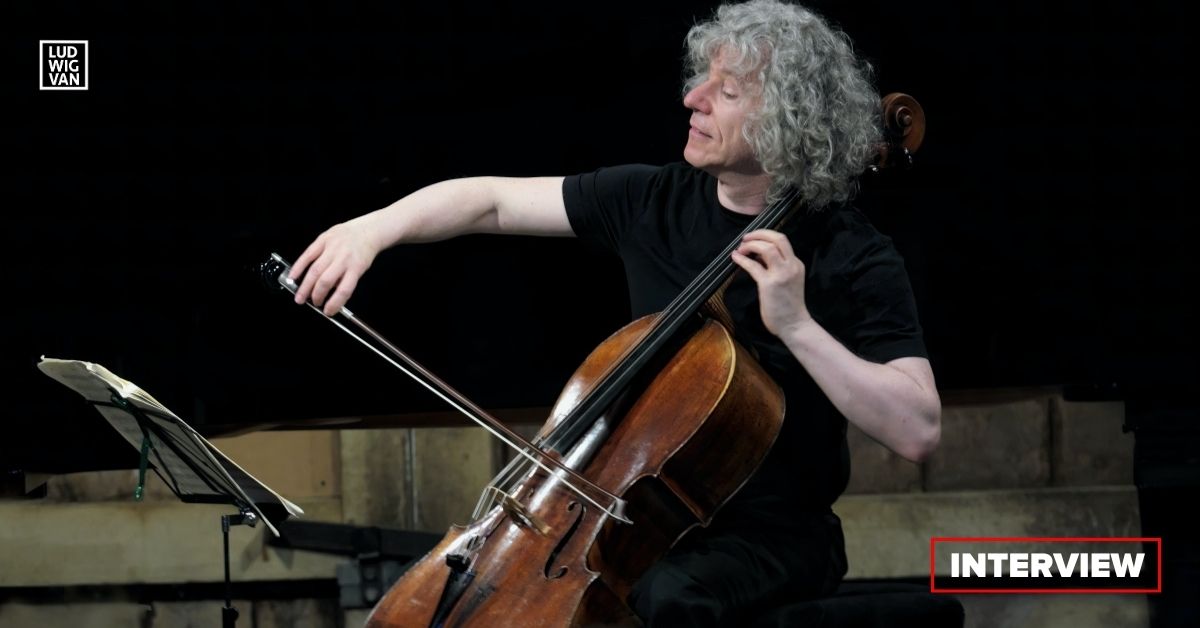
“What’s so exceptional about the cello?,” asks Steven Isserlis in a mockingly stern voice.
Ludwig Van is speaking to him in London via Zoom a week before his duo concert with pianist Connie Shih for Music Toronto at the Jane Mallet Theatre in Toronto.
“It’s such a human voice, but with a far bigger range than any human voice. It really feels like part of me. It’s the way you hold it. It’s so much more natural than a violin. It just becomes part of your body.”
Steven Isserlis
The passionate British cellist, whose charismatic demeanour is set off by a famous mane of curly hair, now quite grey, is an articulate speaker, writer, educator and broadcaster.
Isserlis’s recorded discography is vast and award-winning. He won the Gramophone Instrumental Album of the Year prize for his JS Bach suites and garnered Grammy nominations for his Haydn concertos and Martinů cello sonatas with Olli Mustonen.
Isserlis is justly acclaimed for such chamber pieces as the Mendelssohn Piano Trios with Joshua Bell and Jeremy Denk and the complete Beethoven works for cello and piano as well as—on a larger scale–the Brahms double concerto with Joshua Bell and the Academy of St Martin in the Fields.
Nor is Isserlis’s work confined to old masters. He’s justifiably acclaimed for commissioning and offering world premieres for such pieces as Sir John Tavener’s The Protecting Veil, Thomas Adès’s Lieux retrouvés and four works for solo cello by György Kurtág.
The cellist has been a featured performer at the Berlin Philharmonic, Vienna Philharmonic, London Philharmonic, Cleveland Orchestra, New York Philharmonic, and Chicago Symphony, to name just a few. A recipient of the CBE in England, Isserlis has been recognized internationally by such commendations as the Piatigorsky Prize (USA) and the Glashütte Original Music Festival Award (Germany).
The Concert
Isserlis is offering a varied program with Shih for Music Toronto on Thursday evening. It consists of: Beethoven’s 12 variations on a theme from The Magic Flute, op 66; Schumann’s 3 Fantasiestucke, op 73; Kabalevsky’s Cello Sonata in B Flat Major, Op. 71; Kapralova’s Ritournelle and Beethoven’s Sonata for cello and piano in A Major, Op. 69, No. 3.
Ludwig Van asked Isserlis first about the two unique offerings for the evening, the works by Dimitri Kabalevksy and Vítězslava Kaprálová.
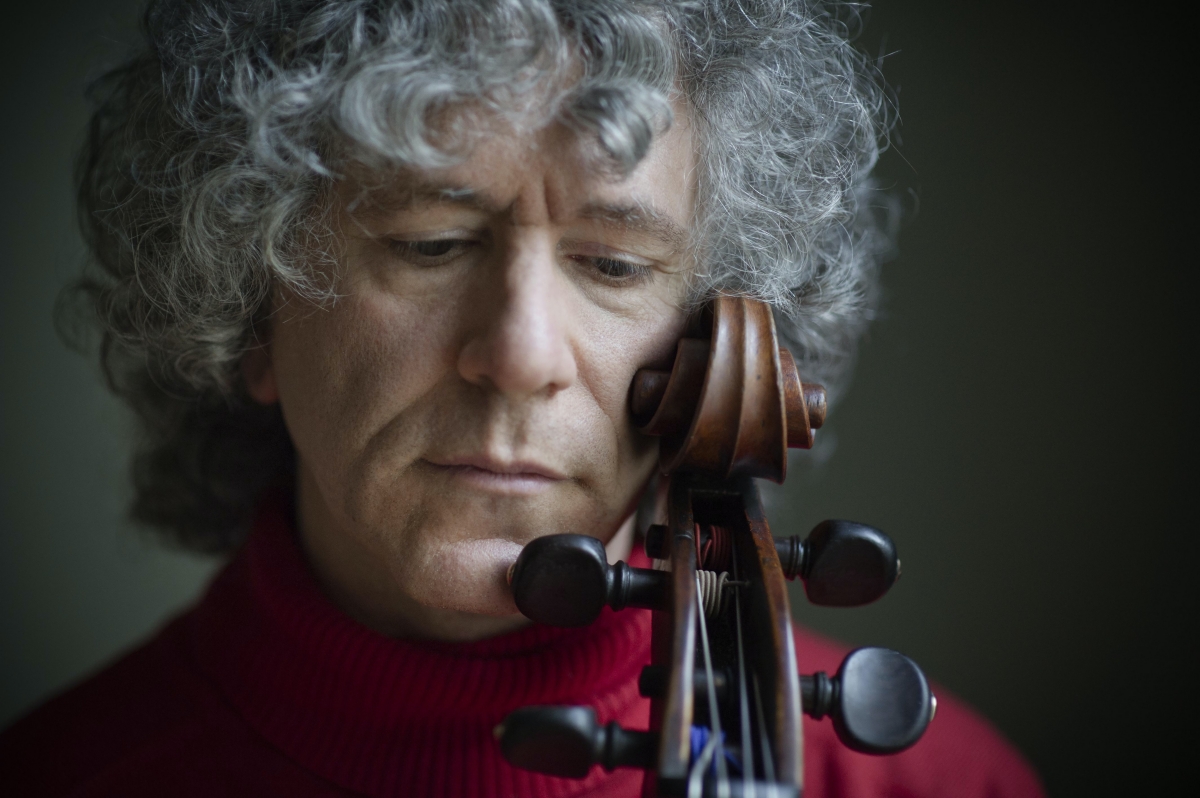
Steven Isserlis: The Interview
He’s quite enthusiastic about helping in the rediscovery of Kabalevksky’s work, which has been abandoned since the end of the Soviet Union.
“His first cello sonata is just a fantastic piece as you will hear. It’s stunning. I gather that young performers are starting to play it. It’s very funereal — quite gloomy in a way — but it’s also incredibly beautiful. I find it thrilling to play and, I hope, for others to listen to. It’s really unique.”
Kabalevsky was the head of the Union of Soviet Composers during the Stalin era, and his reputation has been besmirched by descendants of those who suffered during the Communist regime. Isserlis is an admirer of his talent despite the politics of that era.
“Some Russians won’t play Kabalevsky because he behaved badly under the Soviet regime, but few composers behaved well,” he says. “Prokofiev wasn’t great either and people still play his music. I also play Kabalevsky’s second cello concerto which is similarly exciting. Kabalevsky was a complex man — and really, his music is stunning.”
Isserlis is pleased to bring forward the work of Kaprálová, a Czech woman of great promise who died in 1940.
“Kaprálová’s story is bizarre and tragic. She died young, possibly of typhoid fever. She had moved to France to be near Bohuslav Martinů, who was her teacher, and a community of Czech artists. She had just married the month before. Martinu and his wife were at the ceremony. This is her last work. You can hear the influence of Martinů, but it’s got its own character. It’s quite simple in a way — very rhythmic with a sort of bell-like character followed by a charming slower, gentler theme. I think it’s a very lovely piece. Knowing the story makes it special.”
Beethoven & Schumann
Isserlis is forthright about the rest of the Toronto program, which consists of two of his favourite composers, Beethoven and Schumann.
“There’s nothing greater for the cello and piano than Beethoven. They’re just incredible — all five sonatas, all three sets of variations. They gave me as much pleasure to play as anything I ever perform. I just adore them. I love the variations with which we start the program; it’s meant to put the audience in a good mood. They’re just so charming and witty. The A major is probably the best with which to finish a program because it’s so full of sunlight and radiance and joy. It is the perfect duo sonata — all the material is perfect for both instruments. As for the Schumann, I never need any encouragement to play him. I’ve been semi-obsessed with him since I was 12 years old.”
Ludwig Van asked Isserlis if any other composers make him respond as personally as Schumann.
His reply is swift, “Gabriel Fauré. I feel that he has been a godfather in my life.
“I adore Brahms but he’s less confessional than Schumann. With Brahms, it’s mostly in his very early and very late works that he invites you into his life in the same way Schumann does. It is Schumann’s particular genius that he can treat each member of the audience as if he’s confiding in you personally. It’s not that I feel he’s a greater composer than Brahms, but I just feel closer to him.
“I don’t know what it is about Fauré. He’s just been with me my whole life. My son is named after him.”
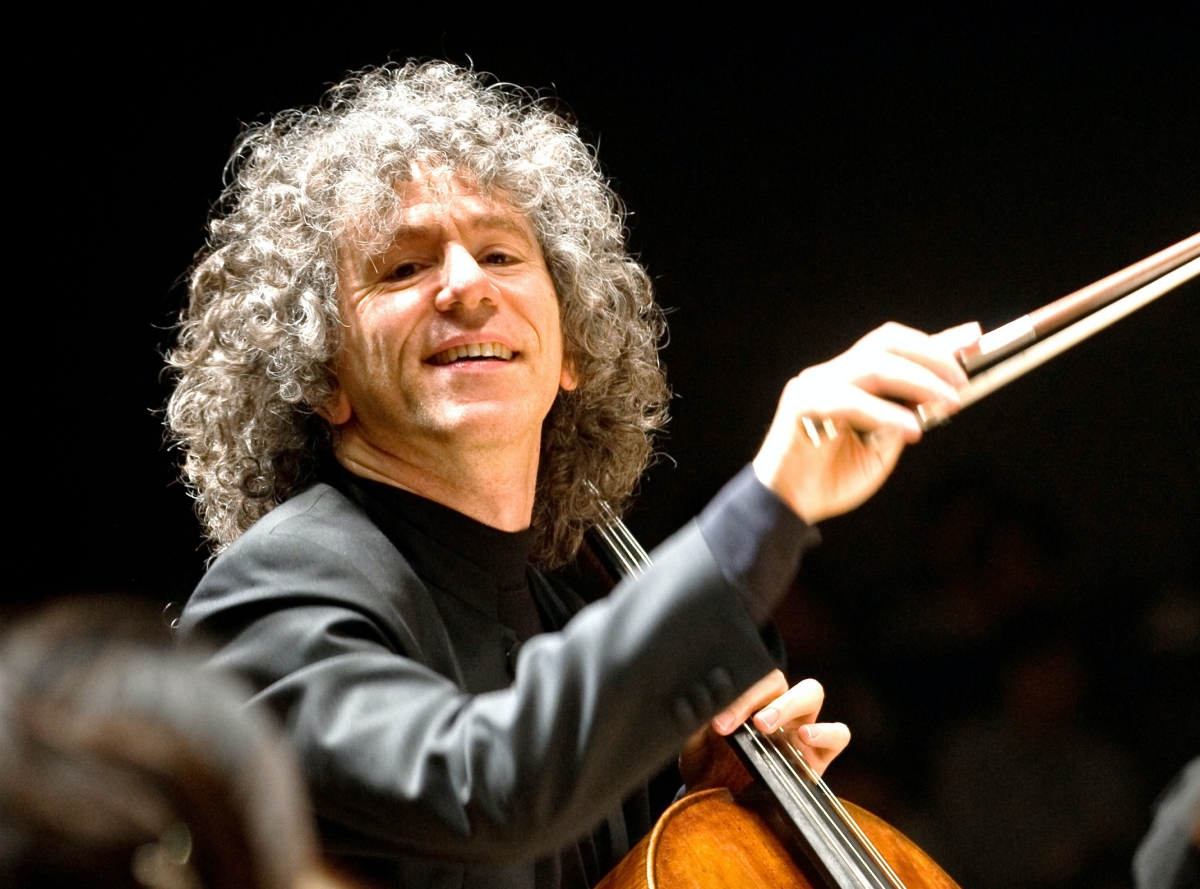
Books & Cellos
Isserlis’s son inspired him to become a book writer.
“When my son was about six or seven, I wanted to find a book about the composers for him because he was getting interested in music. And I just couldn’t find the one I wanted for him. They were either too dry or too full of fantasy and not factually accurate. So, I decided why don’t I try writing one? I’ve written four books, two for children, one for young musicians with my co-author Robert Schumann [updated and revised by Isserlis] and one for adults about the Bach suites.”
The books are titled: Why Beethoven Threw the Stew; Why Handel Waggled His Wig; Robert Schumann’s Advice to Young Musicians Revised by Steven Isserlis; and The Bach Cello Suites — A Companion.
Steven Isserlis’s favourite cello, the 1726 ‘Marquis de Corberon’ Stradivarius has been the subject of media attention recently. He has it on near-permanent loan from the Royal Academy of Music and treats it with love and deference. Like any object of affection, Isserlis is happy to talk about it.
“It can play everything. But I wouldn’t play anything that’s too percussive on it, because it doesn’t like being hit. It’s a Marquis — an aristocrat.”
In general, he uses gut strings on the Strad. “I find gut strings much more human and simpler. There are shades of meaning in them. I’m sticking to my gut strings for which Schumann wrote his music, for which Beethoven wrote his music, for which Fauré wrote his music, etc., etc. The colours in them are just, to me, incomparably more subtle.”
Isserlis still has a Guadagnini and a Montagnana, but his first love is the Strad with gut strings.
His words are definitive, “I will use steel for repertoire that’s really better for steel, which is Shostakovich and many late 20th century composers. I say, if you really want decibels, go to a pop concert.”
Steven Isserlis’s concert with Connie Shih won’t be a pop concert. Expect chamber music at its finest.
Concert Details
Music Toronto presents Steven Isserlis (cello) & Connie Shih (piano). Program: Beethoven’s 12 variations on a theme from The Magic Flute, op 66; Schumann’s 3 Fantasiestucke, op 73; Kabalevsky’s Cello Sonata in B Flat Major, Op. 71; Kapralova’s Ritournelle and Beethoven’s Sonata for cello and piano in A Major, Op. 69, No. 3.
Special COSE pre-concert w/ Eric Guo at 6:30 p.m.
The concert takes place April 23, 2026 at The Jane Mallet Theatre, St. Lawrence Centre for the Arts.
- Find other details and tickets [HERE].
By Marc Glassman for Ludwig Van.
Are you looking to promote an event? Have a news tip? Need to know the best events happening this weekend? Send us a note.
#LUDWIGVAN
Get the daily arts news straight to your inbox.
Sign up for the Ludwig Van Toronto e-Blast! — local classical music and opera news straight to your inbox HERE.

- INTERVIEW | Poiesis Quartet, BISQC (Banff International String Quartet Competition) Winners’s On Their Premiere Concert in Toronto - July 20, 2026
- SCRUTINY | Jennifer Rider-Shaw’s Sensational Performance Makes Stratford’s Guys and Dolls A Must-See - July 13, 2026
- SCRUTINY | Stratford Festival’s Waiting For Godot Plays It Safe - July 13, 2026