
At medical school, doctors learn the skills they need to keep people healthy and treat illness. But, as science increasingly confirms, there’s more to it than the nuts and bolts, so to speak.
Interpersonal skills — soft skills, as they’re often called — also play a crucial role in what doctors do, and how effective they are at it.
When it comes to teaching those skills, more and more, medical organizations are turning to the arts. The Shaw Theatre Festival and the Royal College of Physicians and Surgeons have teamed up to offer doctors a program of learning called the Theatre of Medicine.
The program was launched as a pilot in 2024, and has been developed into a three-day Theatre of Medicine workshop. While there are many program across the country that combine theatre and medical skills in various ways, it is unique in Canada in being certified for Continuing Professional Development credits through the University of Toronto’s Temerty School of Medicine and the Royal College of Physicians and Surgeons.
LV caught up with program creator Alexis Milligan, who is both an M.IDST (Master’s in Interdisciplinary Studies), and actor, and the Shaw Festival’s movement director.
Alexis Milligan: The Interview
Milligan spent years creating the curriculum for the program.
“It was actually closer to about 15 [years],” she explains. Using theatre to train physicians was the research topic for her Master’s thesis. “This has been an ongoing curiosity of mine as an artist,” Milligan adds.
Over the years, she’s been called in multiple times to consult with various groups and organizations about the ways that theatre can enhance medical skills. One of those organizations was the Dalhousie School of Nursing.
“I actually started the ideas for this while I was working there.” It resulted in a class she conducted with nursing students.
From the outset, she could see the value of arts training for medical professionals.
“I was struck by how difficult it was,” she recalls. A beginning exercise for theatre students and actors in general is to simply see each other across the room in a group setting. The beginning acting exercise involves establishing a connection with someone else without using words.
With a room full of doctors, it initially results in awkwardness. The challenges became clear.
Dr. Glen Bandiera is an emergency physician at St. Michael’s Hospital in Toronto, and serves as co-ordinator of the Theatre of Medicine program with the Royal College of Physicians and Surgeons. Dr. Bandiera was introduced to Milligan when he served on the Shaw board of directors. Their connection was the beginning of the program as it exists today.
As Milligan points out, there is a lot of research that backs up the value of using theatre and other arts in physician training.
“It’s important to emphasize, in a program like this, artists in medicine is not a new concept,” she says. “
There’s been quite a few of us who have been screaming into the wind for a long time.”
With Bandiera’s connection, they could add the step of official accreditation as a continuing professional development program. It’s a significant step, as she explains, which allows doctors to claim participation in the program towards their annual requirements for professional development. It’s part of a new way of looking at training in the medical field pushed by government bodies.
“There’s been huge shift in some of the governance and policy development in health care,” Alexis says. It includes a framework of language used by the Royal College. “Some of the identifiers were communicator and leader.” As she details, the framework consists of seven points. “We realized our program actually aligns with quite a few of them.”
The Ontario government created a series of quality improvement guidelines and initiatives, many of them based on those concepts of “soft skills”.
“We’re really aligning with a lot of emergent ideas,” Milligan says. “We happened to have this program which really focuses on those skills to support those new frameworks and guidelines.”
As she points out, it’s part of an increasingly global conversation about health maintenance and disease treatment that takes the whole person into account. Social prescribing, where doctors prescribe visits to museums or artistic performances, are on the rise internationally as the medical field recognizes the real value of arts participation to patients as well.
“Doctors are prescribing arts and culture events for their health and well being. The science backs it up,” she says. “We were able to leverage that a little bit more.”
The Program
“We’re unique in our accreditation,” Milligan says. “But that being said, there are lots of programs across the country. The challenge with a lot of those is that they tend to be grant dependant.”
As she notes, relying on funding from grants means such programs have a limited time span and scope, and allow for few follow up opportunities. In contrast, the accredited program is now in its third year, and able to build on the experience gained.
“We’re now in our third year, and we’re making improvements based on our feedback from our participants over those three years.”
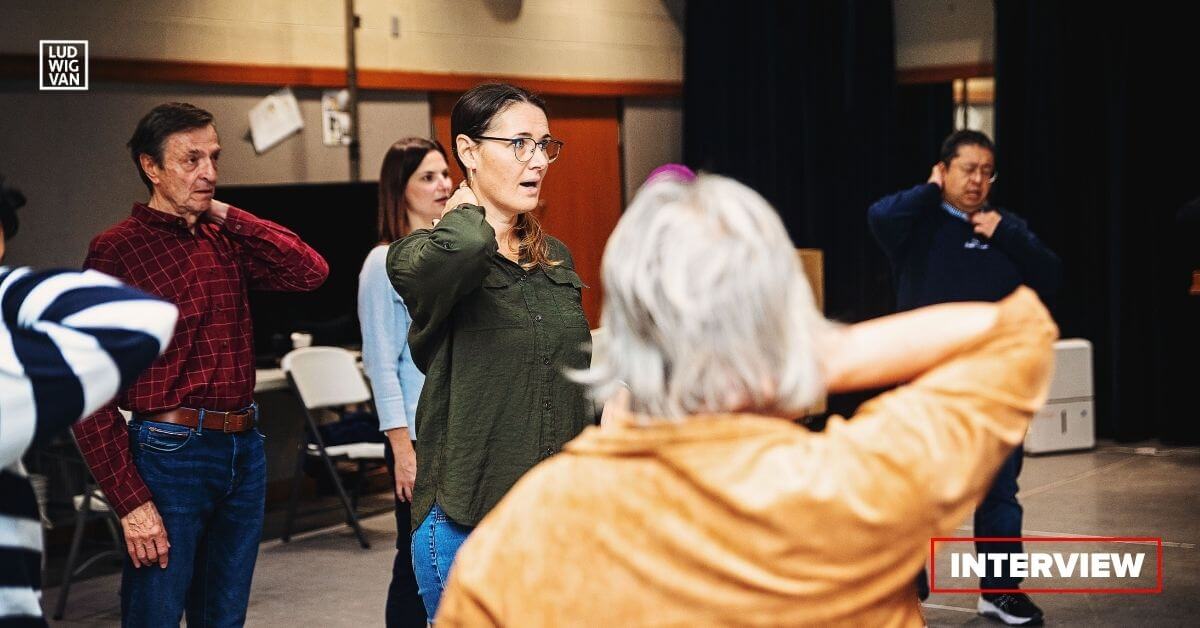
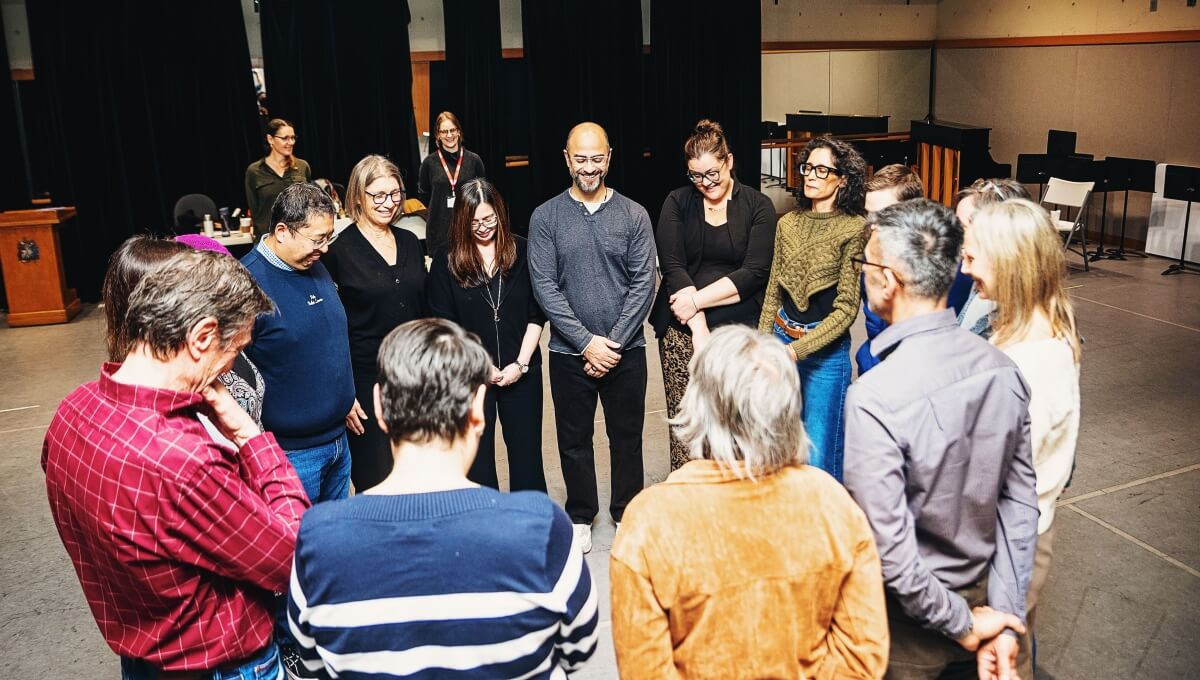
The doctor participants go through a series of common acting exercises and games.
“We would do things on just your body standing in space. What’s it like to look across the circle and make a connection with someone?” It sounds deceptively easily. “It gets very vulnerable. There’s a lot that’s already at stake.”
Putting the experience under a microscope reveals a lot. “It’s very telling. There’s a lot that we can learn from something simple like that.”
Active listening is another common theatre game that is used in the workshops. Making it fun as well as educational is the goal.
“We want to have that sense of play,” Alexis says. “We’ll play a listening game, which is again very basic in the theatre world. If you put that under a microscope, when we play this game, it never works the first time. It’s a disaster,” she laughs.
Before beginning the game, she asks the group of participants if they consider themselves to already be “active” listeners. Routinely, everyone in the group will say yes.
“It might not actually be what you think it is,” she warns. As she points out, doctors do receive training in concepts like body language and communication, but it’s most often delivered in a Power Point presentation and a theoretical environment. “Are you ever given a chance to try them?”
True active listening requires carefully studying the speaker to reach a deeper understanding and interpretation of their message, and to respond thoughtfully and without making judgments. All the senses are used, and non-verbal cues are taken into account. It’s an exercise that develops a sense of trust between the speaker and listener, along with empathy, and improved relationships.
It’s much more, in other words, than simply hearing the words and immediately responding.
Improvisation is another acting skill that proves useful to medical professionals, who, in real world conditions, are required to think up responses on the spot. It’s also important to be able to meaningfully respond to something that has been repeated over and over again. If a doctor, at the end of a long week, has heard the same complaints over and over, are they still able to adequately respond? Does the last patient of the week get the same kind of attention as the first?
Those are the kinds of real world situations where acting skills can help.
“Are they able to walk in without a sense that, you are my ninth patient today, and I still have four more after you?” she asks. “It’s important for the physician to be able to have that check in — is their voice tired? What do they need in those moments?”
Doctors, as she notes, often have to diagnose and propose solutions and next steps within minutes of meeting a patient. “You don’t get a lot of time,” she says, “but you can still maximize the effect that you have within that limited amount of time.”
Acting exercises and skills help train doctors in how to look after themselves too, which in turn results in better patient care.
“Warming up, cooling down — how do you refresh? How do you keep your curiosity and alertness up
? There are many factors that put a physician in a place of being impatient and perhaps not as attentive as they should be.”
Feedback
Over its three years, the program has used participant feedback to develop the curriculum.
“Oh, they just want more,” she says. “We’ve had to add more workshops.”
The first program saw participants attending three theatre productions over the course of the workshop in addition to their daily exercises. Feedback acknowledged the value of seeing the plays, but asked for more skills training.
“We’re going to focus more on one production,” she says. The participants will offer their observations, and then there are more opportunities for their own reflections and discussions.
Fine tuning the details is important. “We find that it leads to a stronger commitment to action,” Milligan says. The participants go back to their practices with a new set of tools, and/or reinforce existing skills.
It’s based on an understanding and empathy with both sides. Medical professionals deal with people in distress, and communication can be difficult.
“We’re meeting them in a really distressed place in our lives,” she points out. Patients can experience heightened emotions and physical distress. From the doctor’s perspective, just asking the right questions and getting basic information can become a challenge.
“There is this real sense of doctors knowing what they need to provide, but feeling really limited in that.”
Offering doctors an opportunity to help their patients feel seen and heard offers real results. “The science shows that improvement in quality of care has a direct link to improvement in patient outcomes,” Milligan says. She notes that some studies suggest a profound effect on elements like perception of pain and even survival rates.
“What we have […] are definitive numbers. We’re actually looking at tracking these numbers.”
She notes that one body of research indicates that a simple phone call from a nurse practitioner to even later stage cancer patients has shown improvements in patient outcomes.
“When someone looks after us, we feel better,” she says. “There are a lot of doctors out there who believe and work like this.” The program helps to improve the systems for them.
“I think our program helps to support those ideas. That already is a huge leap for a lot of people.”
Milligan points out that theatre and other arts professionals already know a great deal about learning through interactivity, and have long understood its profoundly beneficial effects.
And, theatre isn’t the only art form that can offer those benefits.
“There’s so many opportunities in the music world.” Milligan also teaches at the Verbier Festival in Switzerland. “We’re doing a series on social prescribing,” she says. She also notes that the Orchestre symphonique de Montréal (OSM) has partnered with Médecins francophones du Canada for “La musique sur ordonnance” or Music on Prescription, which offers free performance tickets on a doctor’s prescription.
“A lot of healthcare is actually coming through the arts,” she says. “Now, can we bring this into skills development and training. I think there’s tremendous opportunity for more programs to come into being,” she adds.
“How do you bring these non-technical skills into a very technical enviroment?” she poses. “Those skills go beyond language, and they go beyond culture.”
The next Theatre of Medicine Congress takes place September 25 – 27, 2026 at the Shaw Artists’ Village Hall.
- Interested physicians can find more information [HERE].
Are you looking to promote an event? Have a news tip? Need to know the best events happening this weekend? Send us a note.
#LUDWIGVAN
Get the daily arts news straight to your inbox.
Sign up for the Ludwig Van Toronto e-Blast! — local classical music and opera news straight to your inbox HERE.

- SCRUTINY | The National Youth Orchestra Of Canada Kicks Off Canadiana Tour In Toronto With Dazzling Performance - July 21, 2026
- THE SCOOP | TO Live Announces The Recipients Of Its 2026 explorations artistic research program - July 21, 2026
- SCRUTINY | Guild Festival Theatre: Brontë: The World Without Offers A Portrait Of The Lives, Trials & Triumphs Of The Brontë Sisters - July 20, 2026