
COSA —the Centre Of Singing Arts — is an organization that wears many hats, including education and training, advocacy and more. One of those hats is serving as a performing arts organization, and as such COSA presents many events showcasing opera and opera singers.
One of those events is Arias After Work. The performance series, which has been running since 2024, features trained vocalists whose career paths have taken then out of the operatic field.
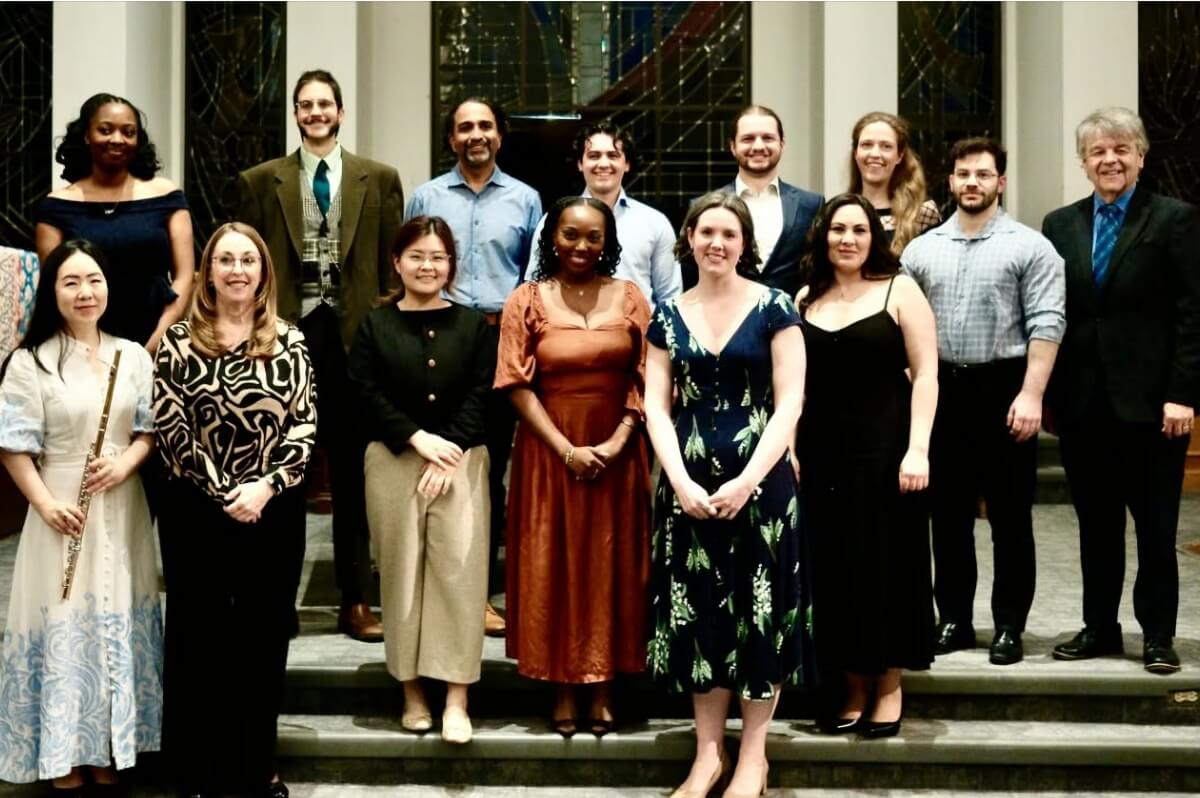
The next Arias After Work, Vol. 6, for example, features a speech pathologist, lawyer, coffee barista, engineer, dentist, event planner, paramedic, psychotherapist, hospital clerk, and a real-estate agent.
It takes place on June 13.
LV spoke to Dr. Darryl Edwards (Professor, University of Toronto Faculty of Music and Co-Head of Voice Studies: Graduate Admissions & Recruitment), along with Dr. Balaji Swaminath, Dentist, and originator of the idea, and Claire de Sévigné, international soprano and voice teacher about the project. Balaji and Curtis Zhang, COSA’s Executive Director, are also two of the founding performers in the series.
Arias After Work: The Interview
One of COSA’s main goals is to bring opera to a broader audience.
“Our original name was the Centre for Opera Studies and Appreciation,” notes Edwards. “Centre of Singing Arts just casually connects to people the way we need to do today.”
Unlike most traditional opera organizations, COSA’s goal is to move beyond the traditional concert format, and try to reach people who don’t necessarily respond to that environment. “It’s trying to redefine the same thing and capture the same audience, as they all huddle together on this shrinking iceberg of opera as it is/was,” Edwards explains. “This brings access. We’ve changed our tagline to a great time for everyone, every time. That’s for people who want access to singing that is rigorously achieved.”
The singers, in other words, are trained at an advanced level. “It’s more than community, it’s for really engaged people.”
Edwards has known Dr. Balaji Swaminath since he was a teenager. “He’s a very successful dental professional now,” Darryl adds. A dental professional and entrepreneur who just happens to also be a trained vocalist. “He said, I want to sing out there, in a really good way, a classical way. Because it takes a lot, and I want a place to do it,” Edwards adds.
“That’s how this came into being.”
Curtis Zhang, who works as a marketing specialist, coined the name Arias After Work.
“We started about this time about two years ago,” Edwards recalls. The series was immediately popular, and has grown in the ensuing years. “We have so many singers we cannot contain ourselves.”
Along with a roster of vocalists, Arias After Work usually includes a featured performer. Previous events have showcased a mariachi ensemble, a Sri Lankan dance and music group, and a Korean flutist.
“This time we’re going to have a Bengali traditional singer who’s playing with her daughter,” Edwards notes.
“Darryl was my teacher at the University of Toronto years ago, and honestly has become a mentor of mine over the years,” says Claire de Sévigné. These days, her practice involves both performance and teaching.
“Many of my students who come to me now are all highly trained,” she continues. “It’s easy to find a teacher now, but what’s not easy to find is a platform, a venue to share [their work],” Claire adds.
“Really, singing needs to be heard. You get better as a musician when you are performing,” de Sévigné says. Claire looked to create a space where her students could share their singing at an advanced level. It gives them tangible goals for a real performance. “It inspired them; it inspired me,” she adds.
“I said, I have all these incredibly talented singers, and we need this place to perform.”
Talent and training are challenging enough to acquire. Not everyone, however, is headed for, or wants to, pursue a professional career as a singer, which offers a whole new set of obstacles and challenges. Others sing professionally for a time, but life and circumstances take them eventually in a different direction.
“I’ve been really fortunate in that I’ve been able to pursue a career as a singer,” de Sévigné says. She understands that career paths can diverge. But, one essential truth remains. “Once a performer, always a performer.”
“Some of the people who are engaging with Arias After Work have had careers as professional performers,” Darryl adds. Today, they may be corporate event planners, or arts administrators. “They have got Master’s degrees in performing, and sang with one of Canada’s young artist programs.”
As he explains, Arias After Work is open to vocalists who work in other genres. “It’s not just for the super trained, it’s for the classically trained who sing in other styles. It’s not a closed loop, it’s an open loop.”
The Passion Of Performance
The unique event has proven to be a hit. Edwards notes that, at the first event, he asked Balaji and his wife to set up a reception for after the performances. “People practically ignored the reception, they were too busy talking about their excitement of having been able to perform. They’re on fire with excitement.”
The audience feels that passion too. Edwards reports that an audience member at a previous event told him, “I didn’t know what this was about, but it’s a feeling.”
“That’s how we’re growing,” Darryl adds. “It’s that intangible great feeling you get when you bring people together.”
Balaji Swaminath’s story is emblematic. He credits Edwards as the driving force behind Arias After Work.
“I met Darryl when I was grade nine,” Swaminath says, “which seems like an eternity ago — but also not.
The Darryl you see today is the same Mr. Edwards or Darryl that was presented to me in grade nine. He was a real force, he still is.”
Edwards was a high school music teacher at the time. “During the 80s and 90s, it was kind of a special time for music in high schools,” Balaji recalls. There were five music teachers at his London, ON high school.
“Growing up, I was exposed to a lot of different kinds of music,” he continues. “I played cello from grade six to grade 13. Meeting Darryl, I learned a lot about classical music, and really learned a lot about that. I became a dentist, and that took a lot of time away from my music, but that was always at the back of my mind,” Swaminath adds.
“This concert series that Darryl started for me, was a bit of sanctuary for me.” Balaji says that while he’d sung in choirs and other groups, he hadn’t sung solo publicly in some time before the first iteration of Arias After Work in 2024. “Having an environment where I can perform freely has been really profound for me. Having this opportunity with Arias After Work has really given me a focus and determination to keep going and improving as well.”
It’s also allowed Balaji to use his instrumental skills. “What I’ve brought to it as well, in addition to doing an opera piece or an aria, I also play guitar well enough to accompany myself as I’m singing,” he says. “That’s the really special thing about it, is that there are lot of people like me who do a lot of other things.”
Sharing the music is paramount, and the format breaks down barriers.
“It’s taken the stuffiness away from classical music,” Swaminath says. That includes more casual venues, and an audience that includes music lovers who range well beyond the usual classical music crowd. “It’s just all about the music.”
Certainly, there are many music schools and teachers in the city, fostering an even larger number of highly trained students. “There’s a lot of exceptional talent in Toronto,” Balaji notes. “[Darryl]’s spoiled for choice now for the sixth series, because there’s a lot of people who want to participate,” he points out.
“I’m really happy to be part of what’s going on here,” he adds. “It’s got a lot of potential.”
Final Thoughts
“It’s the phenomenon,” Edwards says, “the audience experience — that will draw people.
” It’s the kind of experience that leaves all the participants, including performers and audience, feeling upbeat. “That’s a phenomenon I want people to share in.”
“I’m the first and one of a growing number of teachers who are bringing in students,” de Sévigné says. “It becomes a circle of encouragement. It’s a really great open circle.”
“So many of us are on the outside looking in,” Darryl adds. “We’re all ripe for creating bigger communities.”
Arias After Work, Vol. 6
The sixth iteration of Arias After Work; a concert of opera classics sung by brilliant singers (who happen to work in other industries!) takes place June 13, 2026 at College Street United Church.
- Find tickets and show details [HERE].
Are you looking to promote an event? Have a news tip? Need to know the best events happening this weekend? Send us a note.
#LUDWIGVAN
Get the daily arts news straight to your inbox.
Sign up for the Ludwig Van Toronto e-Blast! — local classical music and opera news straight to your inbox HERE.