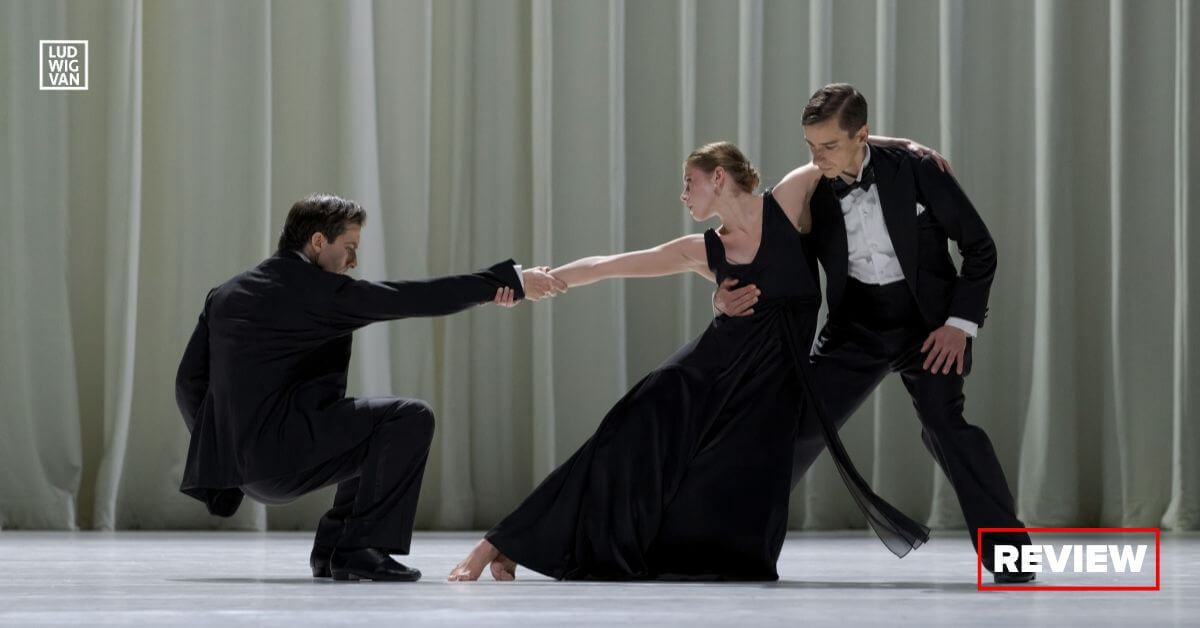
The National Ballet of Canada/Procession, choreographed by Bobbi Jene Smith and Or Schraiber, Four Seasons Centre, closes Nov. 8; tickets here.
The world premiere ballet Procession by Bobbi Jene Smith and Or Schraiber for the National Ballet of Canada is a masterpiece.
I define ‘masterpiece this way: when every element within the work aligns to the point of perfection.
Procession — The Meaning of the Title
For New York-based Smith and Schraiber, Procession is the journey we take through life — the rituals that bind us together, the mourning and the celebrations. But, it is also the other ways we gather through folk dance, song, and ceremony.
It is about the power of the ensemble.
Within the piece there are solos, duets, and a trio, but they are not singles out individually as they would be in other ballet programs. Instead, the cast is listed alphabetically — a judicious mix of principal dancers down to corps members — because Procession celebrates the community.
The work presents the public face rather than the private one. Even the intimate moments occur within the larger frame of the collective. The work belongs to the group, not to the individual.
The strength of Procession lies in its unity — the body politic of dance.
Design and Music
No one is credited as set designer, so the visual world of Procession appears to be the work of Smith and Schraiber.
The stage is swathed exteriorly in a black curtain, with a grey curtain backdrop, and at times a black front curtain drops — a simple but theatrical layering that creates its own sense of ritual space.
The music draws largely from the Baroque period — Purcell, Vivaldi and du Bailly— which is significant. Baroque music carries an inbuilt stately formality, and that quality permeates the entire ethos of Procession.
As custom, conductor David Briskin and the National Ballet Orchestra convey the appropriate gravitas within the music.
Costume designer Dana Osborne extends this formality visually.
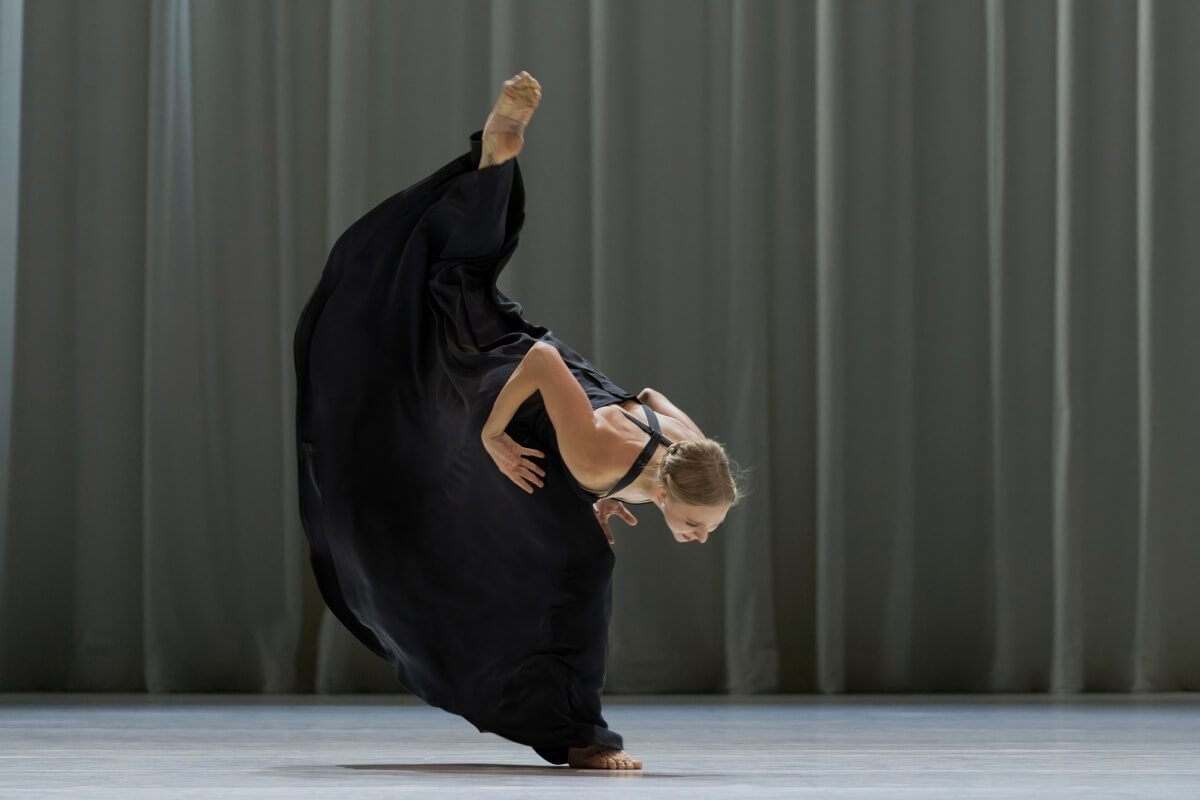
The men begin in morning dress, wearing tailcoats, while the women appear in variations of black ball gowns — sleeveless, and dignified. For the more rigorous dance scenes, the men exchange their tailcoats for tuxedo jackets, but the look remains refined, although admittedly, in the wilder sections of the second act, the jackets come off entirely.
Bonnie Beecher’s lighting design has darken the stage somewhat as if to obscure individuality of faces.
The formal edge of these designs adds a dignified grace to every passage of movement. No matter how vigorous the choreography becomes, it never loses that sense of decorum.
In Procession, Smith and Schraiber give life dignity.
Structure — Act 1
The structure of Procession unfolds as a series of dances, each distinct in texture and tone.
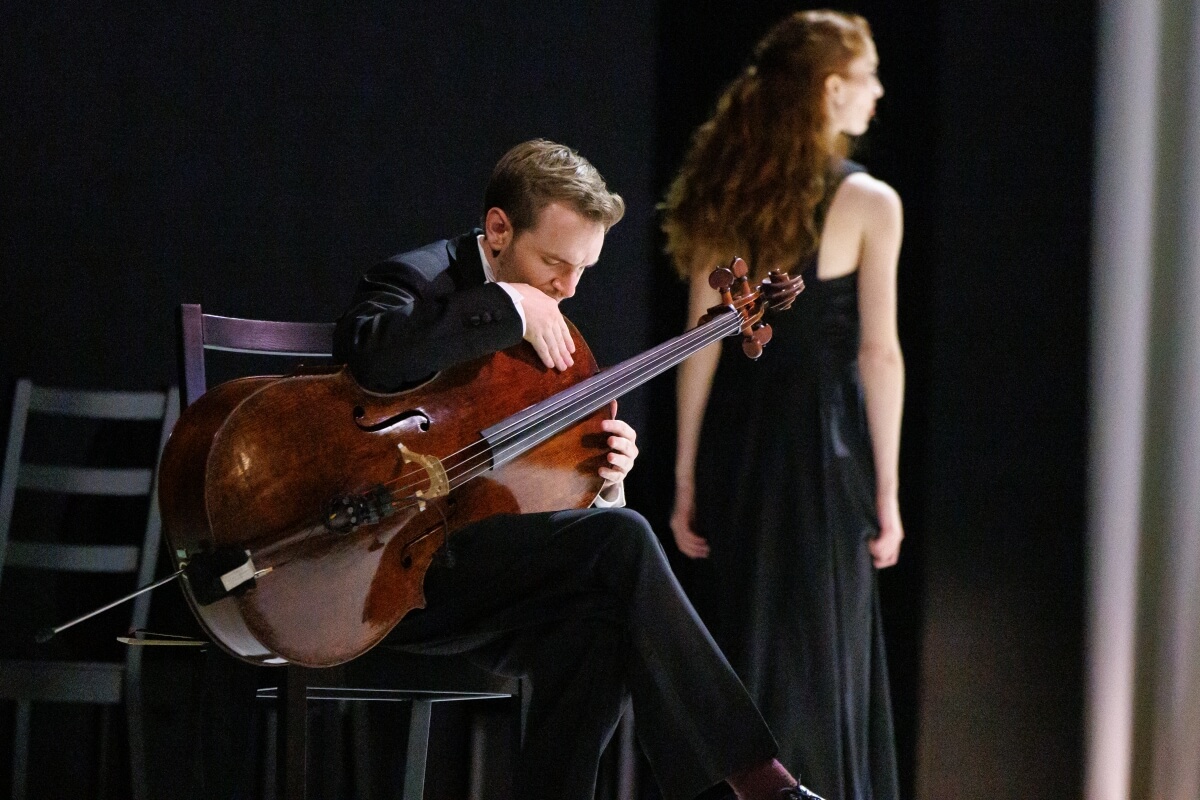
The music has been cleverly coordinated and arranged by American cellist Coleman Itzkoff, joined by American mezzo-soprano Rachael Wilson. Their placement onstage is as integral to the choreography as that of the dancers.
Music is after all the food of love, and Procession treats sound and movement as one organism.
Principal dancer Ben Rudisin functions throughout as a master of ceremonies, for example, escorting the cellist and the singer into position.
The ballet opens on an empty stage except for Rudisin.
He opens an invisible door, and the dancers file in one by one, each entering with an individual bearing before taking a place on stage to Purcell’s funeral Music for Queen Mary, where the human voice imitates sobs.
The men then withdraw, leaving the women to dance to Purcell’s What Power Art Thou?, their gestures heavy and solemn, but fierce and angry at the same time. What a wonderful ode to feminism!
A very important trio follows, performed by guest artist Alexander Bozinoff, Isabella Kinch and Spencer Hack to music by Vivaldi. (Bozinoff is a Canadian-born principal dancer with Royal Danish Ballet.)
I say important because even though much of the trio is aspects of push and pull between the dancers, the movement also attempts to merge the three bodies into one, which to me is the choreographers announcing the importance of community over the individual.
Subsequent scenes include a raw and gritty chair dance for men to Rameau, a luminous chain dance for couples to Ravel, and a Baroque-style formal couples’ ensemble again to Purcell.
The symbolism of each section is rich in meaning, read into them what you will.
The restraint imposed on the men confined to chairs, forcing them to cry out in anguish, the gentle finding of partners in the graceful act of wooing, and finally, the formal act of coupling.
The act ends with three male outliers, Rudisin, Chase O’Connell and Oliver Yonick attempting to break the calm of the couples’ dance with angry, gestural commentary, moving only their hands and face.
A black curtain drops behind them, with the cellist and the singer as bemused observers, isolating them all, until a single figure remains (Rudisin) — a lone voice in the wilderness, pleading to be seen.
It is a troubling image. We have just been concentrating on community, yet here is the reminder of the individual. Is it not ironic that the stately master of ceremonies is the one to lose control?
Structure — The Second Act
The second act of Procession is both more exhilarating and more angst-driven.
It opens with an actual hearse pushed slowly onto the stage, accompanied by a solemn parade of men and a group of apparent pallbearers who reveal they carry nothing — a phalanx of men whose movement grows increasingly spirited.
What follows is a wild reverie of male dancing to Mahler — groups of three, four, or six in exuberant invention including a Greek folk-style Zorba dance.
Two men repair the hearse with tool kits while another leans casually on its hood, turning mourning into irreverence.
Women enter in a stately folk dance, one following the other threading their way through the men, the last — Hannah Galway — in a black slip.
She performs a haunting duet with Christopher Gerty to De Falla, reminding us of private moments, and the choreography is quite torturous and challenging, even ending up with her standing on his chest. What relationship are we witnessing here?
Music by Du Bailly and Vivaldi begin what can only be categorized as the wild child section, accompanied by Itzkoff and Wilson.
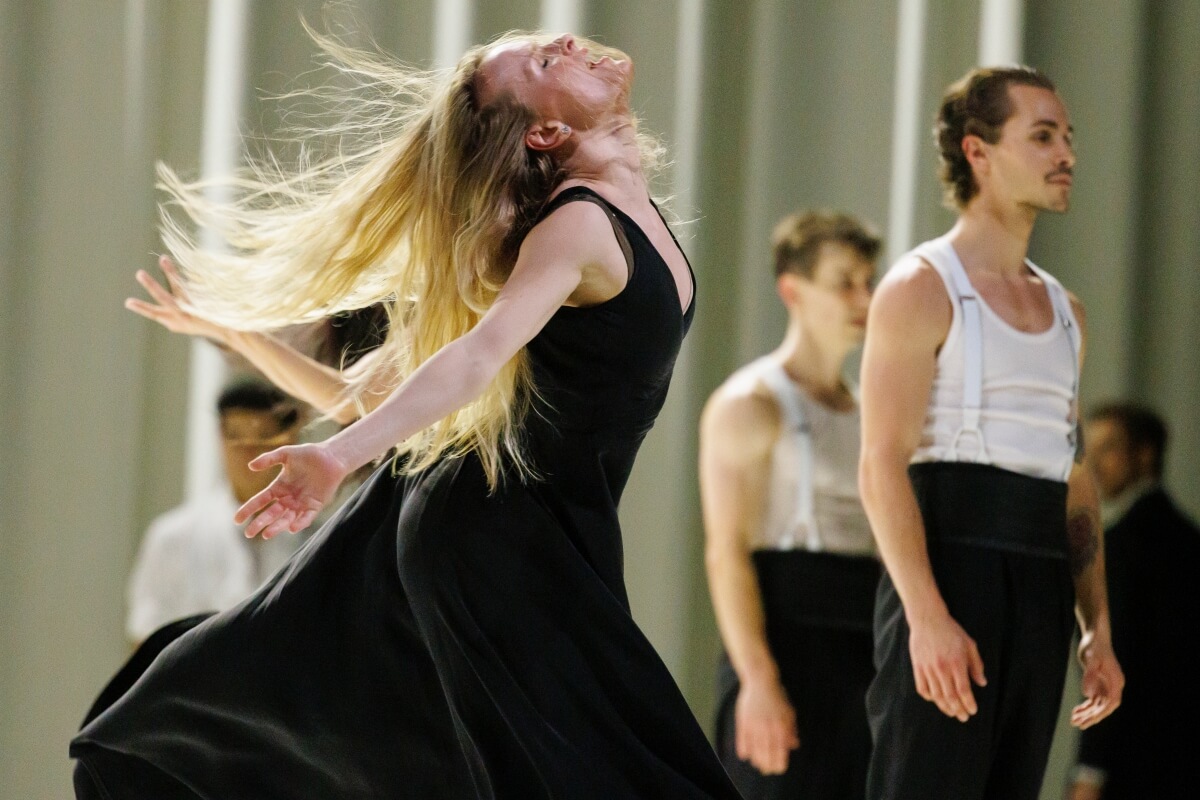
Solos of reckless abandon pour out from Connor Hamilton and Genevieve Penn Nabity, hair flying, with an equally raw and unrestrained duet from Hamilton and Kinch.
The frenzy peaks with Siphesihle November and Bozinoff leading the men in a dizzying display of Russian imperial style tricks before subsiding into a formal couples’ dance to Purcell’s Musick for a While.
These dances of untamed passion, are they hints at the dangers of losing control, or the ugly side of mob mentality?
One by one, the dancers exit through the grey back curtain with the musicians last, as the black curtain falls.
After chaos, Procession ends as it must: with the dignity of form and the continuity of life.
Why So Much Detail on Structure?
Because the devil is in the details and the utter beauty of Procession is in the magnificent journey of its construction.
The Movement of Procession
If you had parachuted me in from Mars, I would know instantly that Smith and Schraiber are children of Gaga.
Gaga is a teaching practice created by Ohad Naharin, long time former artistic director of Tel Aviv-based Batsheva Dance Company, of which Smith and Schrieber are former members.
Naharin teaches dancers to move by listening to their bodies instead of copying shapes — to replace steps with sensation, imagery, and impulse. Movement begins deep in the spine and pelvis, earthy, elastic, and centred low, yet buoyant and free.
Smith, and Schraiber bring their own spontaneity and wit to this language — more emotional, more muscular, yet with a grace and unexpectedness that make it theirs. The result is choreography that feels both disciplined and alive.
And through Procession runs the power of the ensemble — individuals merging into one living body, a community breathing as one.
Final Thoughts
When choreographers create a world premiere, the commissioning company usually holds the rights for a few years before the work can be set elsewhere.
The Royal Danish Ballet contributed significantly to Procession, so the ballet is also in their repertoire and will likely tour Europe.
Let’s hope the National Ballet of Canada can hold onto Procession long enough to establish the work as a signature piece. The company performs it magnificently; they’ve taken to the Gaga vocabulary as though born to it.
With performances scheduled for Ottawa next April, one hopes others will follow across Canada — and even to Sadler’s Wells in England — so audiences will have the chance to see Procession.
Smith and Schraiber have created a true masterpiece — a ballet for the ages that speaks about humanity and the life we lead together.
When the dance ended, I wanted only to see it again — and again — and again.
Are you looking to promote an event? Have a news tip? Need to know the best events happening this weekend? Send us a note.
#LUDWIGVAN
Get the daily arts news straight to your inbox.
Sign up for the Ludwig Van Toronto e-Blast! — local classical music and opera news straight to your inbox HERE.