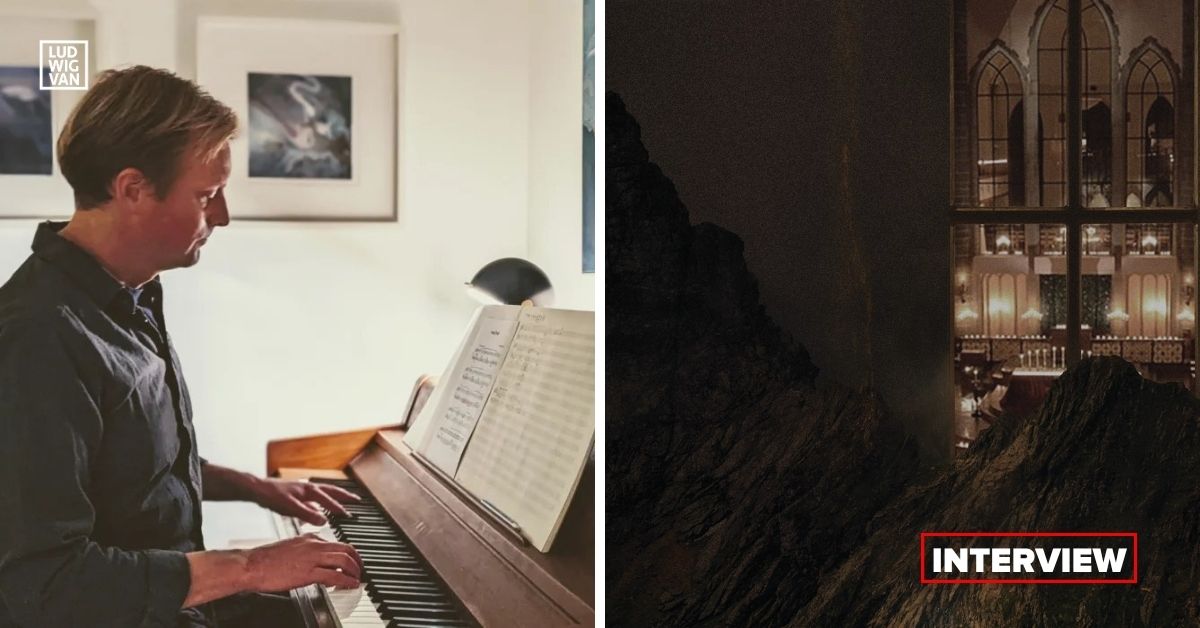
Canadian composer Toby Johnston-Stewart recently released an album of new music titled Cathedral After Dark on the Leaf Music label. The title is descriptive in a literal sense; the album was recorded live during a late night performance that took place inside Christ Church Cathedral in Victoria, BC. on September 12, 2025.
The program was presented as a single and continuous musical journey, rather than a series of pieces, and features pianist Jillian Forster Fair, the Emily Carr String Quartet, and double bassist Bruce Meikle.
The natural acoustics of the cathedral became an integral part of the character of the recording, resulting in an immersive sound.
LV caught up with Toby Johnston-Stewart to talk about the music.
Contemplation by Toby Johnston-Stewart, performed live at the Christ Church Cathedral in Victoria, BC:
Toby Johnston-Stewart
Toby Johnston-Stewart was born in Switzerland, and moved to Canada in 1989 with his family at the age of 12. Through high school, he lived with his family in Kelowna, and then went to Calgary to study music, before settling in Victoria.
His passion for music developed early, influenced by the ways that sound can shape space and mood.
As a composer, Toby has studied and been mentored by Tim Janz at the Mount Royal University Conservatory of Music. His atmospheric music sets aside traditional structures in favour of continuous narrative, shifting through moods from delicate to stirring, each section flowing seamlessly into the next.
Over the last few years, Toby has released a string of EPs, and a full length album, In Between Time (2024).
Performers
Pianist Jillian Forster Fair is a busy collaborative pianist, educator, and recording artist. She is known for her special affinity for neoclassical, atmospheric performance. Fair earned a Bachelor of Music in Piano Performance from the University of Victoria, and an Associate diploma in Music from the Western Board of Music. She also studied at the University of Alberta.
The Emily Carr String Quartet — Müge Büyükçelen (violin I), Cory Balzer (violin II), Mieka Michaux (viola), and Alasdair Money (cello) — was formed in 2006 by members of the Victoria Symphony and the Aventa Ensemble. The ensemble has gone on to perform across Canada, as well as in Europe and the US. They’ve been featured on CBC Radio, and have taken the stage at events that include the Victoria Summer Music Festival, ISCM World Music Days, and Music on Main, among others. Their recording catalogue includes Hidden Treasure, which was nominated for Classical Recording of the Year at the Western Canadian Music Awards.
Bassist Bruce Meikle studied privately with Kenneth Friedman in Vancouver, and later at the University of Ottawa. He spent three summers performing with the National Youth Orchestra of Canada. Bruce later returned to the West Coast and became a frequent freelancer with the Vancouver Symphony before joining the Victoria Symphony. Along with his career in orchestral music, Meikle is an avid chamber musician and jazz performer.
Our Broken Shores by Toby Johnston-Stewart, performed live at the Christ Church Cathedral in Victoria, BC:
Toby Johnston-Stewart: The Interview
Johnston-Stewart was already familiar with the cathedral and its acoustics before coming upon the idea of recording there.
“It’s gorgeous,” he says. “It’s a very special place. I’ve seen a number of concerts there.” As he points out, it’s one of the largest cathedrals in Canada, built in the neo-gothic style. “It’s got great history. It’s got a great presence.”
The initial spark of the idea for the album came via pianist Jillian Forster Fair, a frequent collaborator. The cathedral runs a robust musical program, and she suggested a performance there. Toby contacted the cathedral.
“They were interested in a late night concert,” he says.
From there, the idea grew. “Just from that it became something bigger.”
Jillian was also the link to the other musicians on the album. “Jillian is my first contact. She’s a wonderful pianist. She introduced me to Alasdair when we were thinking of doing my first concert in 2024.” Cellist Alasdair Money linked them to the Emily Carr String Quartet. “As the idea grew with Cathedral After Dark, my goal is always to expand the sonic landscape, so we had the entire Emily Carr String quartet, and we had Bruce come in on the string bass.”
Toby was also considering the audience experience. The cathedral was darkened, the audience area lit only by candles. People could recline while listening.
“I was very keen when I realized that I had that time to myself,” he says. “I really wanted to have an uninterrupted hour of having the pieces flow into each other.”
It allowed him to create a program that took the audience on a journey. “You can really sink in.”
Continuum by Toby Johnston-Stewart, performed live at the Christ Church Cathedral in Victoria, BC:
The concert was captured on video. The result was so successful, he’s thinking about how to recreate the format elsewhere.
“It’s a really great template,” he calls the experience. “I was just thrilled with how the recording turned out.”
He loves the Victoria church, but also considering where he can present his ideas next. Johnston-Stewart says he’s been in touch with Christ Church in Vancouver, and the Vancouver-based Black Dog String Quartet. “We’re trying to figure out the logistics,” Toby says. “I’m hoping something might come from that.”
He’s also thinking about festivals like the Brott Music Festival as another way of performing the music.
Feedback
The audience enjoyed the concept as much as the musicians, and Toby himself.
“I had great feedback,” he says. The audience was multi-generational, and included many people who were well versed in classical music. “They do a lot of classics at the cathedral,” Johnston-Stewart adds.
More than just the music, many people were moved by the emotional journey his music took them on.
“Someone came up to me and mentioned that it brought her back to her full journey against cancer,” he says. “She was reliving it, and finding her way through.”
It’s especially gratifying as a composer to hear that your music has allowed people to let down their guard and simply take it in. “When you’re taken away, you don’t know what’s happening or where you are,” he says. Toby credits the space for creating that experience as well. “I think the space was wonderful for that. It’s one of those grand spaces that you let the acoustics roll around.”
The church also offered positive feedback via Director of Music Donald Hunt. “I heard from Donald after that,” he says. About 150 people attended. “He mentioned there was some new faces,” he adds.
“He received a lot of positive feedback as well.”
Style
Johnston-Stewart’s sound is probably best described as neoclassical and minimalist, creating atmospheric soundscapes. But, like most composers, specific style is something he rarely thinks about.
“[I approach] each work differently,” he says. “It’s the hardest thing to pinpoint is style. I’m definitely not trying to be all things in the classical music world.”
Toby mentions influences and favourites like Polish composer Henryk Górecki, and Estonian Arvo Pärt. Like them, he works with creating atmospheres rather than specifically structured works.
“These shifting atmospheres. Still tonal. At the same time, I like the journey behind it,” he explains.
“I think it’s a mixture of neoclassical and minimalism, but trying not to be too tied down,” he says of his style. “I certainly know it when I find it.”
He enjoys creating both smaller and larger works. “I started with smaller pieces,” he says.
He mentions his Bitter Search I-IV, performed here live by Jillian Forter Fair at the University of Victoria’s Phillip T. Young Recital Hall:
“I like the emotional ups and downs of things, and that’s what I’m always after.”
Putting pieces together for the Cathedral After Dark program allowed him to create that kind of emotional ebb and flow.
“Cathedral After Dark was a mixture of older works [maybe from] two or three years, and a few were [very recent]. I hadn’t heard them [live] yet. They worked really well.”
Along with the soundscape, Toby considers the emotional basis of each work. “Definitely themes of time, and the difficulties of being human, and the ups and downs that come with it. Struggles,” he says.
Those themes appealed to his sensibility. “I’m always drawn to the darker pieces in classical. That has always grabbed me,” he explains.
“Within that space, it’s just expanding on the sonic landscape. Hopefully my next piece, which I’ve almost finished, is for string orchestra, voice, a choir.” Naturally, logistics and practical matters have to be taken into account along the way.
“That’s where my guide is going. It’s expanding the works and making them larger.”
It doesn’t mean, though, that he’s always looking to write for larger ensembles. “I just finished a piano project,” he says. Johnston-Stewart describes it as quiet, dark and moody. The next project will be larger in sound, about 25 to 40 minutes long, and very different in tone.
“But I think they’re following the same threads — death, and life.”
Listen To The Music
- You’ll find Cathedral After Dark at Leaf Music, available to stream or download, [HERE].
Are you looking to promote an event? Have a news tip? Need to know the best events happening this weekend? Send us a note.
#LUDWIGVAN
Get the daily arts news straight to your inbox.
Sign up for the Ludwig Van Toronto e-Blast! — local classical music and opera news straight to your inbox HERE.