
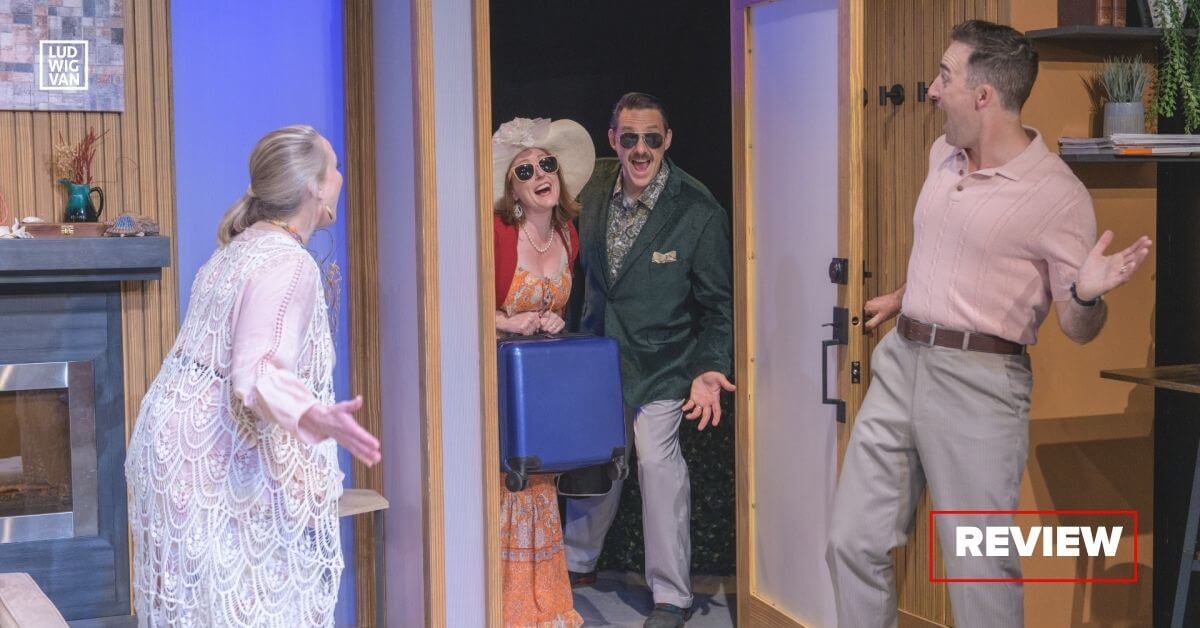
The Foster Festival/The Long Weekend, written by Norm Foster, directed by Liz Gilroy, Mandeville Theatre, Ridley College, closes Jul. 26. Tickets here.
The one thing you hope for when you see a Norm Foster play is laughter. Happily, The Long Weekend delivers.
Background
Of the three plays The Foster Festival is presenting this season, two are world premieres. The July offering, however, is a revival, The Long Weekend, which Foster wrote in 1993.
The play has an interesting history.
While living in Fredericton, New Brunswick, Foster and a few friends decided to start a theatre company.
The Long Weekend was the play he wrote for the occasion, and he even starred as Max when it was presented in a hotel.
From those modest beginnings, The Long Weekend went on to be produced around the world and continues to enjoy regular revivals.
As Foster notes in the program, the play’s enduring success gives him much satisfaction.
The Plot
The story is pure Foster.
Two couples have been friends for years, although the friendship exists largely because of the women. The men, in fact, cannot stand each other, yet they continue to socialize and even take an annual vacation together.
The Truemans, Max (Tyrone Savage) and Wynn (Caitlin Driscoll), are affluent, thanks to Max’s success as a lawyer.
They have a beautiful new country home and have invited the Nashes, Abby (Claire Jullien) and Roger (Darren Keay), to spend the weekend. Needless to say, Max is not looking forward to it.
As the Truemans head into the backyard to prepare the barbecue, the Nashes arrive, giving us a chance to meet them on their own.
A high school math teacher, Roger has recently left his job to write a screenplay, only to find himself battling a crippling case of writer’s block.
He is also still seething over having been stuck with the bill for a round of piña coladas that Max had promised to pay for on their last vacation. The incident may seem trivial, but it clearly still rankles.
The women are no less complicated.
Although Abby and Wynn have been close friends for years, Abby, a fashion boutique owner, has always been critical of Wynn’s taste. Meanwhile, Wynn, a psychologist, has an infuriating habit of analyzing everyone around her.
Despite frequent declarations of their enduring friendship, there are unmistakable resentments between them.
In classic Foster fashion, the playwright establishes both couples separately before bringing them together, allowing the audience to understand the tensions simmering beneath the surface.
So there you have it: Max, the successful lawyer; Wynn, the psychologist; Abby, the fashionista; and Roger, the struggling screenwriter, all assembled for what promises to be an eventful weekend in the country.
The Structure
One of Foster’s trademarks is that he uses the first act to lay all the necessary groundwork for his comedy.
There are certainly laughs along the way, but the real payoff comes once all the pieces are in place. The Long Weekend, written in 1993, is no exception.
I am not giving anything away by saying that, by the end of the first act, the couples have exchanged partners. Wynn finds herself in a liaison with Roger, while Max has embarked on one with Abby.
How and why this happens is part of the first act’s careful setup. As for the second act, I am telling you absolutely nothing.
I sat through the first act, chuckling now and then, knowing Foster was carefully setting the table. I was waiting for what I suspected was coming.
I will simply say this: in the second act, I laughed myself silly.
The Direction and The Acting
Two of the cast members were very familiar faces from their years at the Shaw and Stratford festivals: Claire Jullien as Abby and Tyrone Savage as Max.
Darren Keay as Roger I recognized from the Blyth Festival, but it was nice to make the acquaintance of Caitlin Driscoll as Wynn, who seems to have been a mainstay at Port Stanley Festival Theatre, which has been a going concern in Ontario’s rich summer theatre scene since 1978.
Speaking of Port Stanley, directing The Long Weekend is artistic director Liz Gilroy, who left her home company for a guest stint at The Foster Festival.
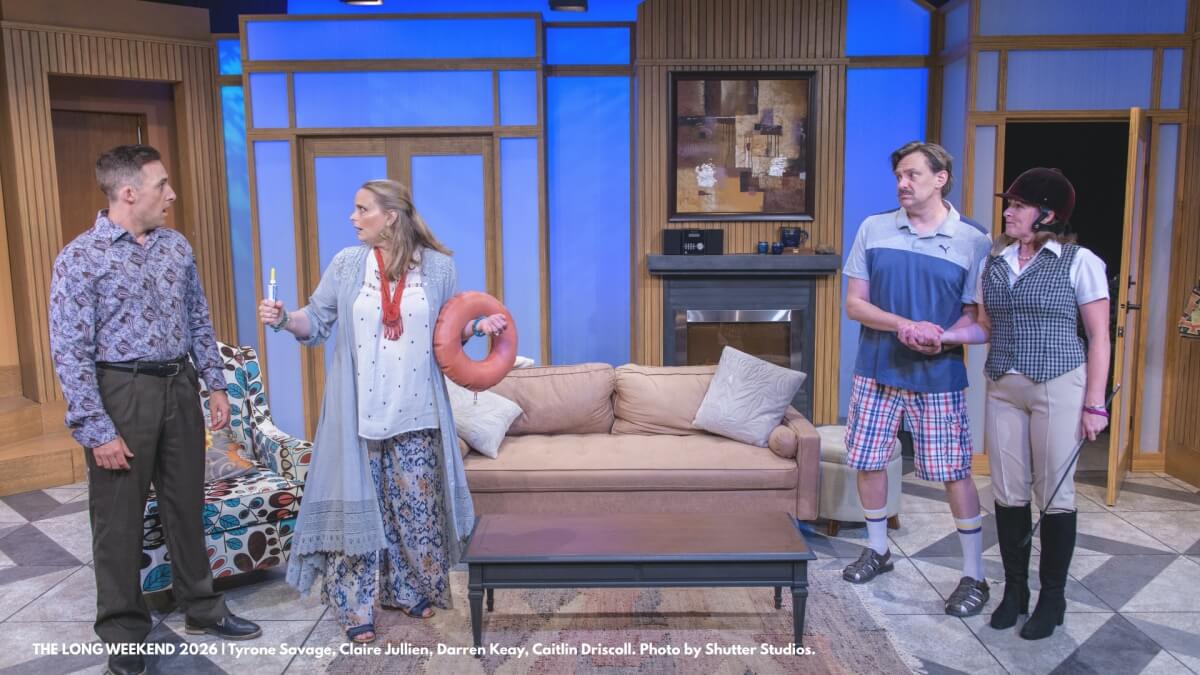
Gilroy’s direction is a model of restraint. There was nothing gratuitous about the staging. She moved her actors only when necessary, allowing Foster’s dialogue to dictate the rhythm and shape of each scene. The result was that the words, rather than busy stage business, carried the comedy.
Gilroy also understood that comedy depends on contrast.
Savage’s Max, the successful lawyer, was understated and quietly controlled, while Roger, the frustrated would-be screenwriter, was far more animated and excitable.
The same contrast existed between the women. Wynn, the psychologist, was more measured and composed, whereas Jullien’s Abby was voluble and larger than life. In fact, Gilroy was unafraid to let Jullien push Abby almost over the top, and the performance benefited from it.
If one were to rank the characters by sheer energy, Abby would be at the top, followed by Roger, then Wynn, with Max at the opposite end of the spectrum.
That variety was essential. Had all four characters occupied the same emotional register, much of Foster’s comedy would have fallen flat.
Gilroy understood that each character needed a distinct comic rhythm, and by balancing those contrasting energy levels, she gave the play exactly the momentum it required.
The Production
Alex Amini, who has designed the costumes for all three Foster Festival productions this season, has done some particularly thoughtful work here.
The costumes chart the characters as deftly as the dialogue.
Wynn looks charming in her neat, understated dress in the first act, while in the second act — without giving anything away—she is dressed remarkably like Abby. The transformation speaks volumes.
Amini is equally perceptive with the men.
Max, the successful lawyer, never changes. He always looks polished, casually affluent and completely comfortable in his own skin. Roger’s wardrobe, on the other hand, subtly traces his transition from high school math teacher to aspiring screenwriter.
It is all in the details, and Amini gets those details exactly right.
Beckie Morris, who has also designed all three productions this season, provides an attractive country home that reflects the Truemans’ comfortable lifestyle.
It is decidedly not a rustic cottage, and Morris furnishes it with telling touches that are part of Foster’s comedy. In particular, a chair becomes the focus of one of the play’s running gags.
Karen Crichton’s lighting bathes the house in warm summer sunshine, creating exactly the relaxed weekend atmosphere that Foster so delightfully proceeds to disrupt.
Finale
Filled with Foster’s trademark wit, sharp observations and perfectly timed comic surprises, The Long Weekend proves once again why he remains one of Canada’s most popular playwrights.
Thank you, Norm Foster, for the laughter.
Are you looking to promote an event? Have a news tip? Need to know the best events happening this weekend? Send us a note.
#LUDWIGVAN
Get the daily arts news straight to your inbox.
Sign up for the Ludwig Van Toronto e-Blast! — local classical music and opera news straight to your inbox HERE.


- SCRUTINY | The Foster Festival’s Production Of The Long Weekend Delivers The Laughs - July 15, 2026
- SCRUTINY | Mirvish’s Water For Elephants Is A Marvel Of Creative Staging, Design & Direction - July 14, 2026
- SCRUTINY | 4th Line Theatre’s Remount Of Leanna Brodie’s Schoolhouse Blossoms On The Outdoor Stage - July 10, 2026