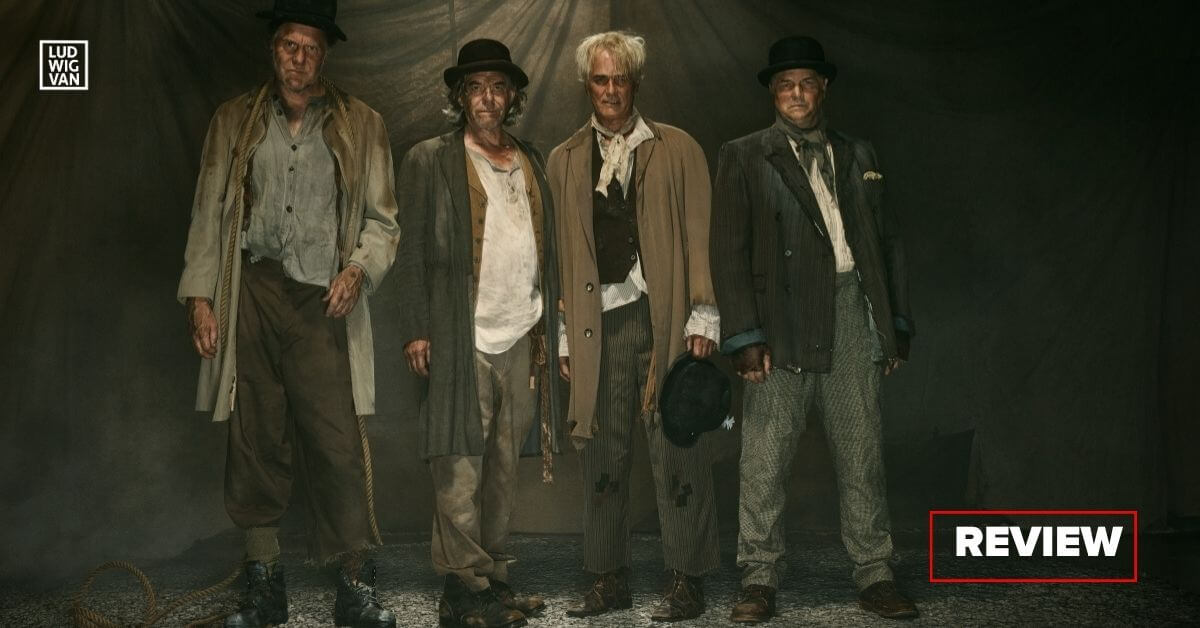
Stratford Festival: Waiting for Godot by Samuel Beckett, directed by Molly Atkinson. With: Paul Gross (Vladimir); Tom McCamus (Estragon); Jonathan Goad (Pozzo); David W. Keeley (Lucky).Continues until July 31, 2026; tickets here.
In Samuel Beckett’s Waiting For Godot, which premiered in 1953, the state of waiting for something, or someone, that will never arrive or exist — which is a state of laying in expectation with a tenuous attachment to anticipation — is a political one, inextricably tied to hopeless despair and radical optimism.
But, to conduct such a generous reading of the play would depend on the dramaturgical choices and social context implemented by any production staging it.
The Premise
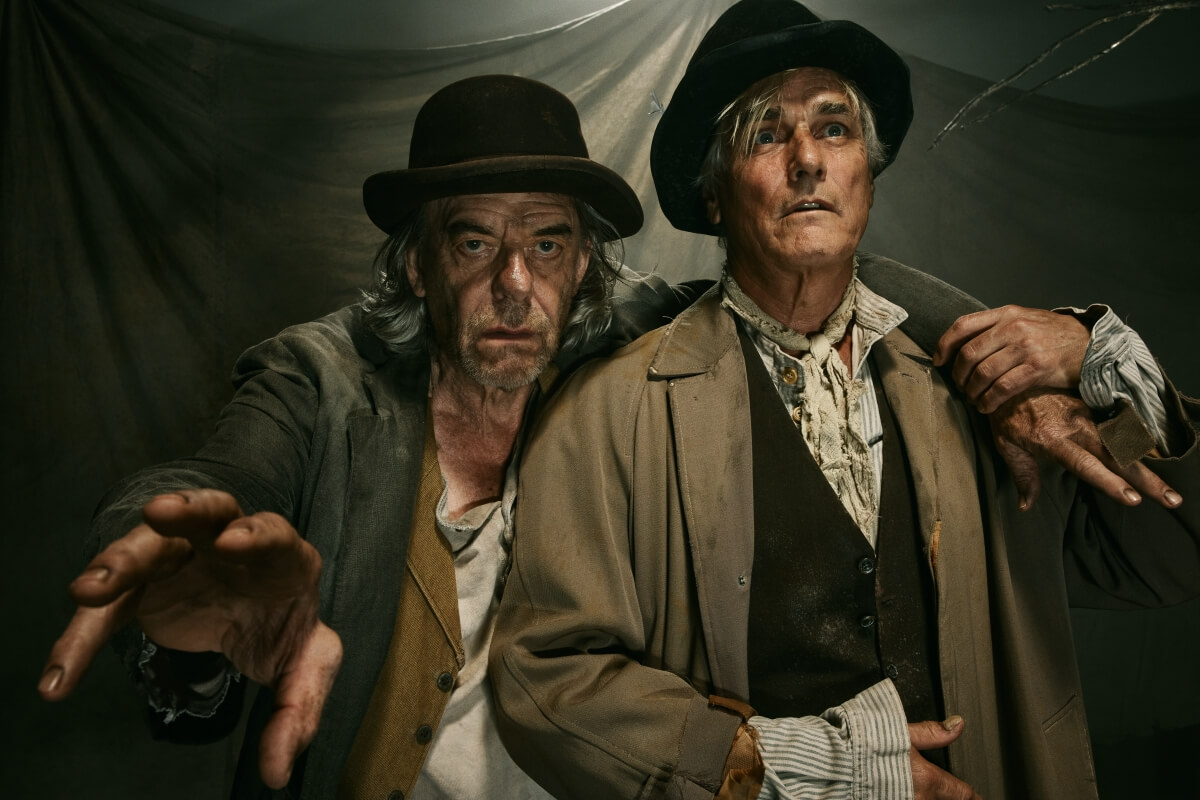
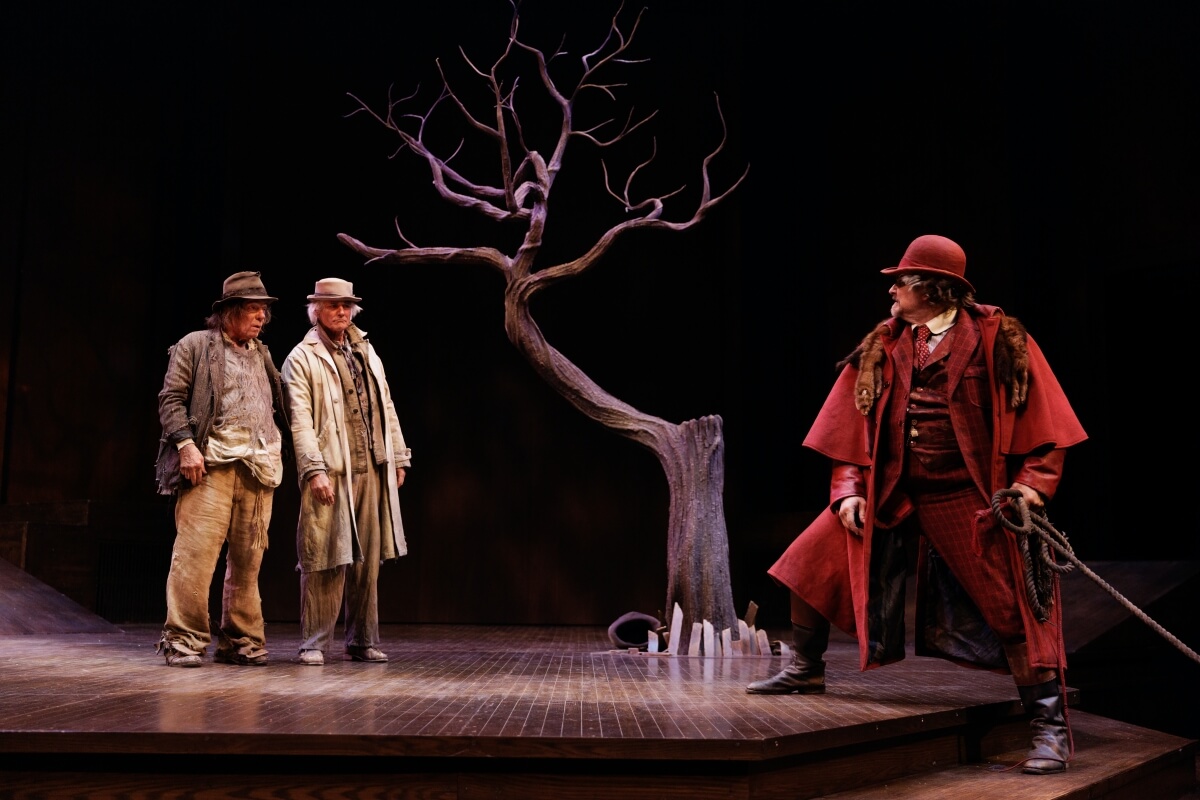
With its infamous tree, whose trunk, judging by the panels of cracked wood at its base, appears to have sprung out of the ground, Stratford Festival’s take on the classic, directed by Molly Atkins, remains faithful to versions past, with a keen focus on emphasizing its absurdist humour. And it’s difficult not to laugh as Vladimir (Paul Gross) and Estragon (Tom McCamus), two old friends and sickly, odorous bums, bicker back and forth at what feels like the end of the world.
“You should’ve been a poet,” Vladimir dryly says.
“I was,” Estragon quips back, looking down at his dirty, tattered clothes. “Isn’t it obvious?”
Gradually, as their reason for being — and thus living — by the tree is made clear, Beckett’s simple language permits the performers to play with various tones ranging from philosophical depth, slapstick humour and existential ruminations that hint at their character’s distant pasts. Gross and McCamus strike the necessary chemistry to convincingly forge a fraternal bond.
The Surprise
What surprised me were the performances of Pozzo, a supposed aristocrat, played by a committedly camp Jonathan Goad, and Lucky, his slave of 60 years with a long rope around his neck, played by the astonishingly affecting David W. Keeley.
The palpable political undercurrents of their power dynamics as master and slave punctured the tedium of the existential and bathetic jabbering that preceded it.
In Lucky’s “thinking” monologue, after a completely mute, animalistic and primarily physical performance, I was seized by Keeley’s incantatory yet incoherent speech, a revelation that lands on a cruel note.
“There is an end to his thinking,” Pozzo declares, bringing an end to his verbiage.
It is not the act of waiting, then, that the insights into the human condition emerged in the play, but in how much one loses oneself to a belief, in an attachment, in the extension of a relation. It is in the thick, long rope of a leash stretching across the Festival Theatre’s thrust stage that any audience member can see themselves, where our mortal suffering and struggling is most lucidly illustrated.
Second Act
The play’s second act is both a repetition and deviation of the first, since, along with a single green leaf that appears at the edge of a branch, characters such as Estragon, Pozzo and a boy (Asher Albert Waxman), who acts as a messenger for Godot, appear to have had their memories erased, which makes for a soporific experience that Beckett actually evidently anticipates.
“This is becoming really insignificant,” Vladimir says; and later, “I’ve been better entertained.”
Direction & Design
That intellectual self-awareness and meta-theatrical genius of Beckett, which draws our attention to the illusive construction of narrative and identity, only appears in this assuredly cost-effective production through the lines, since Atkins seems to have relied on the simplicity of the text and the charisma of its talents to carry the show rather than apply her own perspective to it.
It isn’t helped by Cory Sincennes’s set and costume design that feels rote and uninspired, Jareth Li’s barely perceptible lighting design that fails to meaningfully track the passage of time, and Alessandro Juliani’s atmospheric sound design that is incongruous to Atkins’ uncertain vision.
Why this play? Why now? It’s not that a director must have an answer, but a hypothesis at least.
“I don’t know,” Atkins writes in the director’s notes about who Godot is. “Maybe we are waiting for something to make things better or tell us what we are meant to be doing here,” she says of the character’s state. “Such is life,” she concludes on the topic of the play’s ephemerality.
Final Thoughts
This lack of consideration, and a decision to hide behind the empty profundity of ambivalence, is evident in the production’s vague direction, which presents rather than provokes questions, that stages rather than revitalizes Beckett’s prophetic view, which, without any interpretations, becomes meaningless rather than evoke the sense of meaninglessness within the theatre space.
One must take a risk in order to make a point and for all its potential, at 2 hours and 30 minutes, this is a tedious, expected take on the masterwork that doesn’t know itself beyond its iconicity.
In being beholden to the past, Stratford’s Waiting For Godot renders itself irrelevant to our present.
By Nirris Nagendrarajah for Ludwig-Van.
Are you looking to promote an event? Have a news tip? Need to know the best events happening this weekend? Send us a note.
#LUDWIGVAN
Get the daily arts news straight to your inbox.
Sign up for the Ludwig Van Toronto e-Blast! — local classical music and opera news straight to your inbox HERE.