
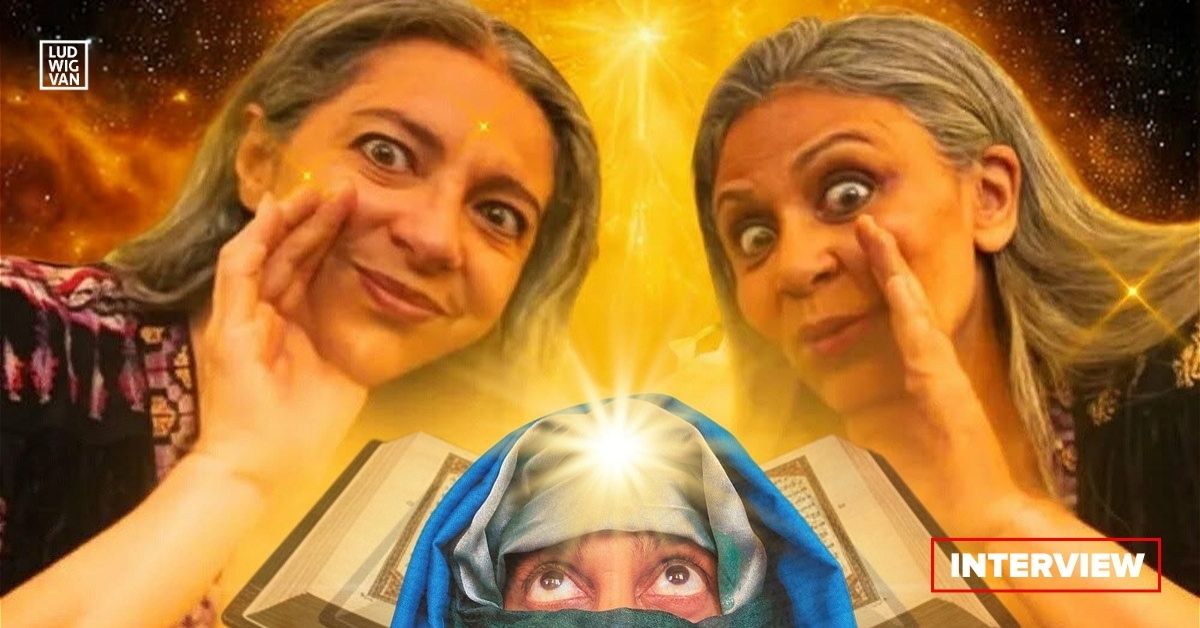
The “Divas of Disruption”— JUNO-nominated Maryem Tollar and Roula Said — make a return to Toronto Fringe with their new genre-defying comedy Book of Ooka: The Immaculate Misconception. The show follows their successful 2025 Fringe run of Very Shady Arab Ladies.
The new production features a mix of physical comedy and live music, incorporating traditional Arabic melodies, and more.
The Story
Best friends Maryem and Roula operate a shawarma shop in Toronto. Roula’s 78-year-old virgin Auntie Ooka (Anand Rajaram, also co-writer and director), comes to her with the story of being visited in her dreams by celestial spirits who tell her she has become divinely pregnant, and needs to go home to Bethlehem to give birth.
Maryem and Roula come up with a plan, and with Auntie Ooka in tow, they travel from Toronto to the River Jordan to fulfill this divine quest.
Book of Ooka centres what they’ve dubbed “Hag Energy”— the power of older women of colour. The story is back by live music, featuring an ensemble made up of Ernie Tollar, Joska Tollar, Yvette Tollar, and Omneya Tollar.
The story builds a “peaceful theatrical bridge” between Toronto and the Middle East, tackling heavy topics thoughtfully, with laughs, and a sense of joy.
LV caught up with Maryem Tollar, Roula Said, and Anand Rajaram to talk about the show.
The Performers
Palestinian-Canadian artist Roula Said is a musician and poet, as well as an actor. Roula sings and plays qanun, piano and percussion to accompany original songs created from Palestinian poetry and her sufi-inspired poems, and sings traditional Arabic songs with her women’s drums and voice band, Tabiba.
Maryem Tollar was born in Cairo, and came to Halifax, Nova Scotia with her family at the age of one. She is known as a singer as well as an actress, performing Arabic songs, often with her husband Ernie Tollar, an acclaimed musician and composer. She sang on CBC’s “Little Mosque on the Prairie” theme, and A.R. Rahman’s Bollywood hit “Mayya Mayya”. Maryem has also collaborated with ensembles such as Tafelmusik and the Winnipeg Symphony Orchestra. She received the Johanna Metcalf Prize for Performing Arts in 2019.
FAOC is the company launched by Roula and Maryem during the pandemic. The two friends would take walks and mimic their mothers’ Arabic accents. The pair began to film short clips, which became so popular on social media that they decided to expand their ideas. It resulted in Beige Christmas, their first live theatre show, in 2024, and in 2025, the Fringe hit Very Shady Arab Ladies.
Improviser, actor, playwright, director, musician, teacher & puppeteer HRH Anand Rajaram is a two-time Dora Award winner for best performance (Buffoon by Anosh Irani and Mustard by Kat Sandler). He adapted and performed in a production of Rohinton Mistry’s The Scream, at SummerWorks (Winner Best Production). He has performed at Second City, Stratford, CanStage, VideoCabaret, among other theatrical companies, and has appeared in many films and TV shows. Anand is also known as a voiceover artist for video games and cartoons, and appears as an occasional panellist on CBC Radio’s Because News.
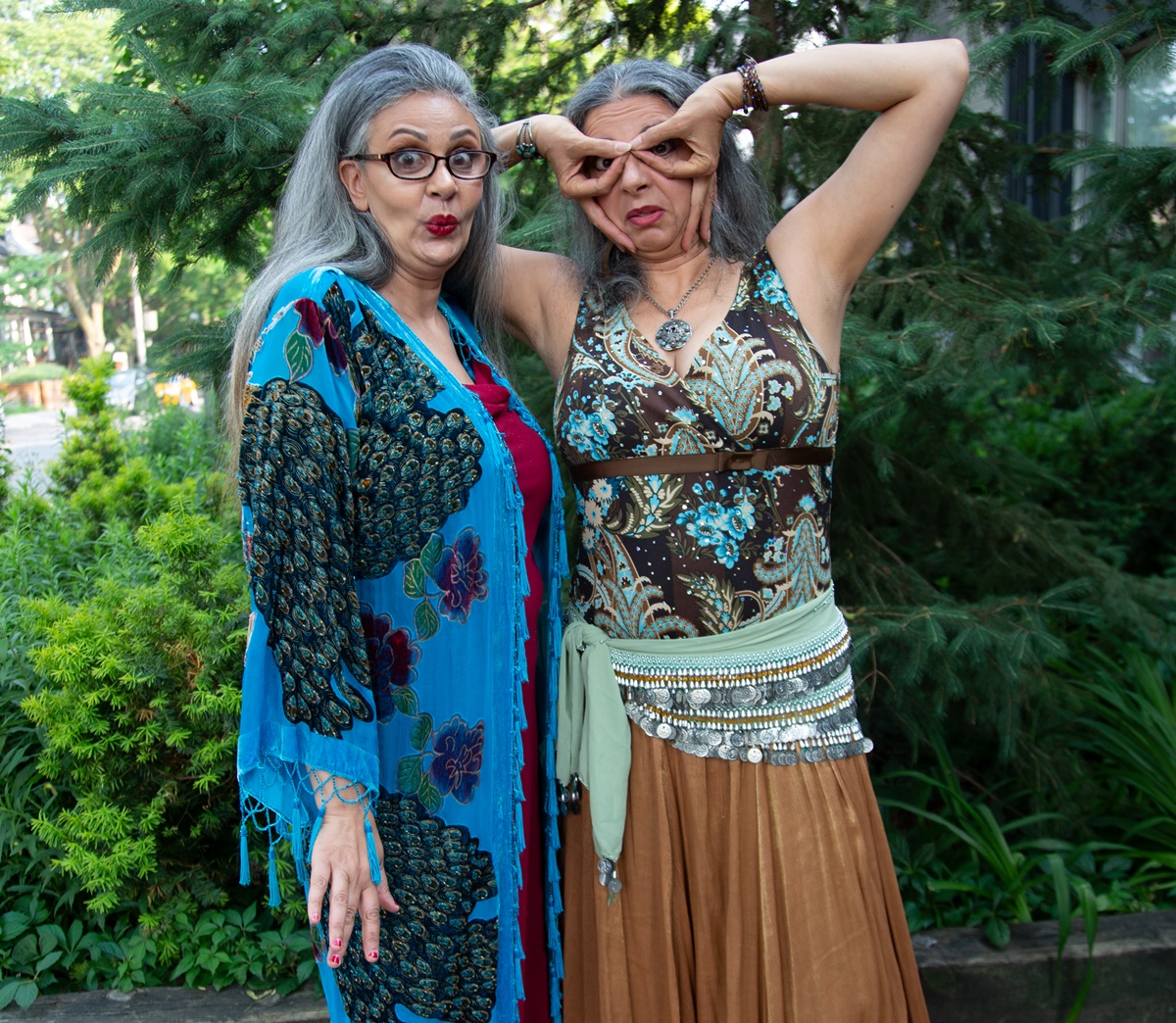
HRH Anand Rajaram, Roula Said, Maryem Tollar: The Interview
How did the new show come together?
“I feel like there’s a lot of streams that feed into it,” Roula begins. “I believe, as we were deciding about whether we’d do another installation of FAOC at the Fringe, I was doing a bit of a dive into Gnosticism, and thinking about those deep stories of the cosmology of the world that I grew up with. And, finding ways to see what, of those teaching and of those stories, what I resonated with, and what I don’t.”
She likens the process to throwing out the bathwater without throwing out the baby too.
“There are things that I received, and the way that I was raised — I was raised as a Christian Palestinian,” Said notes. “I had formed values that I continue to build on and resonate with the world, and thing that I don’t align with.”
Those are the thoughts she brought into their initial conversations, which brought the discussion to those deep stories we grow up with, and how they shape us. “How we work with ideas about what is inspiration, what is received, and what is scientific and provable. What is crazy and what is inspired,” she explains.
As artists, she points out, rote learning from books is not the only means to shaping practice. Often it’s also dreams and meditations that spark inspiration.
“Where I started with this was the provocation that there is a right to return, and Ooka is 78, and we want her to get home before she passes away,” Anand says.
The trick was to find ways to get her there. “Maybe she has a dream and believes she is pregnant with the messiah,” Rajaram adds. “It started with this premise, how do we contextualize how to get her back given the politics that is there.”
As he points out, that politics is in a state of constant development. “We didn’t know how things would be by the time the show came up.” The solution was to create a flexible framework for the story. “To have an open enough framework that the story can fit in kind of regardless of how things are going there,” he continues.
“We are situated it as kind of fantasy,” Anand explains, “a dream on top of a fantasy.”
Toronto Fringe audiences, the trio felt, would already be well informed on the Middle East situation from the constant stream of news. “The audiences is probably hip, and probably exhausted from the amount of information that is constantly coming in from what is going on there,” Rajaram acknowledges. The story adds a different dimension, without talking about what the audience already knows.
As Said explains, the issue of returning home in fraught political circumstances is very real for many immigrant Canadians. “I really had a bad experience with my own grandmother when we came to Canada,” Roula relates. When her grandmother became ill and wanted to go back, it raised a whole set of problems and obstacles.
The World of FAOC
“This is our fourth project working together,” Anand says. The company produced a radio show in addition to the three on-stage performances. “With each collaboration, we all find our own way into it.”
The ideas come via various means.
“Sometimes it’s a question that we’ve been trying to unpack,” he explains.
“We do feel like we’re creating kind of our own world,” Said adds. Book of Ooka is a kind of sequel to last year’s Very Shady Arab Ladies. “It’s just been interesting, because there’s a character, kind of our big bad guy, who makes a return.”
The company is building a world around the distinctive characters they create.
“It has more creative potential, but it’s being cooked in this kind of organic way,” Said explains. “We’re really finding sweet nuggets as we go. Maryam’s entire family is now part of the show,” she laughs. “It happens through relationship and interconnection.”
The Production
Anand notes that their ideas are put together loosely until they receive confirmation, in this case from the Fringe Festival. “We have always worked with, if we get in, then we’ll build something,” he says. “We put things together once we’re confirmed with the Fringe. We had such a rough idea of what the story was going to be. We gave ourselves a provocation.”
“It’s always surprising to me, how these shows come together,” says Tollar. “We always start in one place, and then things evolve,” she adds.
“When Anand first brought it to us, we thought it would be interesting to explore because of the Palestinian right of return that is being denied,” Maryem says. “We were exploring the idea of of two women who wanted to go back.” She says a Jewish friend, who is taking advantage of their own right of return, suggested it to her. The fact she has no similar right put the situation into context.
Music plays a larger role in Book of Ooka than in previous productions.
“The music has really come alive on another level,” Roula says.
“I think the music, for me, it’s a surprise that we’ve become a musical, even though Roula and I come from musical backgrounds,” Maryem says. “Anand brings things out in us, and he always makes things better,” she adds.
“Our strength is music. He really pushed us to add a lot of music to this piece. For me it makes it more fun. In a musical world, you can be a little more magical and playful,” Tollar says.
“This year, we have Yvette Tollar in the cast with us,” Roula says, “who bring her stunning voice, with her jazz and soul capacity — and she’s also hilarious. We’ve got music that’s inspired by the Arabic world that Maryem and I move in, and sort of bringing in an invitation to the mystical beings that are part of the show.” The music also includes elements of Broadway, she notes.
Other elements of the show come from various sources. “We bring in other characters just in [terms of] what we see,” Maryem explains. One of those ideas comes from an Egyptian soap opera about a nurse. “I find it fun, all the different things that we get to bring in.”
“There are whole worlds inside the show,” Roula adds.
Along with the actors, two of the musicians, Ernie and Joska Tollar (bass), will be on stage. Joska is also a character in the play.
“We have a mix of some backing tracks, and some entirely live music,” Said explains. There are also sounds that form part of the soundscape. “It’s a bit of everything.”
Larger Themes
Without giving away too much of the plot, Aunti Ooka does make it back to Palestine. The right of return is examined through a lens of comedy and story.
“I think the music helps with that,” Tollar says. Deeper themes emerge. “Also, I think that we, there’s a deep current of sort of aligning with a loving presence, and a loving intention in the show,” she adds. “In our world, sometimes it’s comedians who speak the deepest truths.”
Humour also tempers the bitterness that is sometimes inherent in realities, as with the current situation of Palestinians and the diaspora. “I was listening to an Indigenous [person] talking about a prophecy,” Maryem says. “This is a time for the sacred clown. I was like, thank you.”
“Part of the art of comedic satire is first recognizing what is actually the thing you are trying to satirize,” Rajaram points out. Rather than presenting the issue as it is, it’s about breaking down the structures surrounding the issue. “How can we find something that is kind of a parallel or analogous?” he asks. “And trust the audience will be smart enough [to figure it out].”
In last year’s Very Shady Arab Ladies, there was a character who was a cosplay Jesus, the leader of an underground resistance movement that is busted up by the police. In the story, they are literally underground, operating under the city of Toronto. It’s an allusion to the stories coming from the Middle East of anti-government organizations operating in tunnels. The allusion can be understood without naming those organizations.
“That’s one of the most fun things, is to create and trust that the audience is smart enough to figure it out,” he says. “To deliver the right amount that they can fill in the blanks.”
“It releases valves around the material that is so charged and hot and painful, without us going in for a real frontal attack,” Roula says.
“We’re not there to convince anybody of anything,” Said adds. “We’re telling stories and bringing things that are of relevance to us. To speak up, without making it about that in a direct or didactic [way].”
The musicians for FAOC – Maryem Tollar and Roula Said’s “Very Shady Arab Ladies” – who also play Officer Trane Wanabi and Officer Jacko – played by Ernie Tollar and Joska Tollar:
Hag Energy
“Maryem and I have been calling each other hags since we met,” laughs Roula.
“We kind of reclaimed the word,” Maryem says. “We say it as a compliment.”
As both explain, it’s simply a woman who really doesn’t care and just says what she thinks.
“I feel like, as we’re engaging and thinking of what people think of as a hag, we think of old women as people who have a lot of wisdom and aren’t afraid to say it,” Tollar adds.
“We’re centring our Aunt Ooka who is even older than us,” Said points out. “She delivers the central message of the piece. [It’s] partly to say, that the elders are carrying the future too in important ways.”
It’s a message delivered with love.
“Sweetness and delight and folly, but also with a lot of depth and respect,” Roula adds.
The trio is hoping the story will talk about those bigger issues in a way that hits home.
“People remember an embodied story better than they will any facts,” Anand says.
Show Details
The Book of Ooka takes the stage from July 5 to 12 at the VideoCabaret – Deanne Taylor Theatre (10 Busy Street). It’s a 60-minute show.
Credits:
- Director: HRH Anand Rajaram
- Cast: HRH Anand Rajaram, Roula Said, Maryem Tollar, Joska Tollar, Ernie Tollar, Yvette Tollar, Omneya Tollar
- Costume Designer: Cass Reimer
- Sound Designer: Ernie Tollar
Find more details, and tickets, [HERE].
Are you looking to promote an event? Have a news tip? Need to know the best events happening this weekend? Send us a note.
#LUDWIGVAN
Get the daily arts news straight to your inbox.
Sign up for the Ludwig Van Toronto e-Blast! — local classical music and opera news straight to your inbox HERE.

- INTERVIEW |Maryem Tollar, Roula Said & Anand Rajaram Talk About Book of Ooka: The Immaculate Misconception At Toronto Fringe - June 30, 2026
- THE SCOOP | TAPA Announces 2026 Dora Mavor Moore Award Recipients - June 30, 2026
- INTERVIEW |Miho Suzuki Talks About The Improper Identity At Toronto Fringe - June 29, 2026