
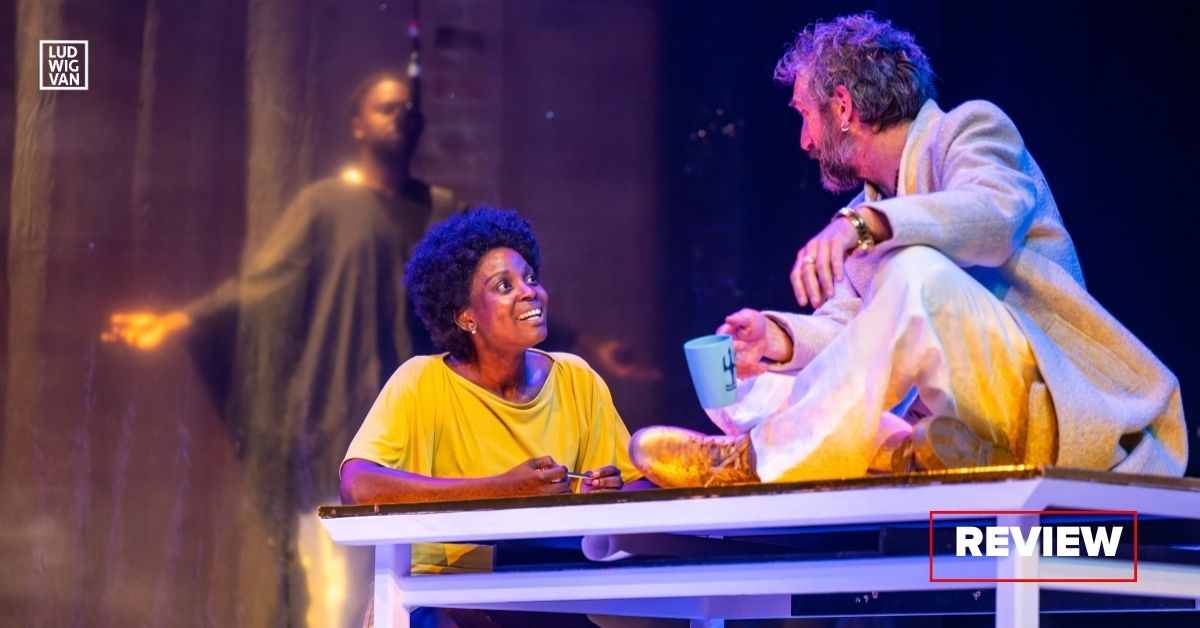
Soulpepper Theatre in collaboration with Outside the March: Medusa by Erin Shields. Directed by Mitchell Cushman, with Oyin Oladejo, Amy Keating, Sasha Khan, Michelle Monteith, Danté Prince, and Gord Rand. Heidi Wai-Yee Chan, sound design; Anahita Dehbonehie, set design; Ming Wong, costume designer; Nick Blais, lighting designer. June 24, 2026, Baillie Theatre, Young Centre for the Performing Arts. Continues until July 12; tickets here.
In the program notes for Medusa, playwright Erin Shields goes over the various depictions of the iconic snake-haired woman of classical Greek mythology. “I thought about all of these interpretations of Medusa while crafting the play you are about to see,” she writes, “but what I kept coming back to was rage.”
Shields goes on to talk about the fact that we live in an era where rage of all kinds is on constant display via social media and media in general. While the story begins with the feminine rage embodied by Medusa, it’s also an examination of unchecked rage in general, from the cleansing fire of righteous anger to pointless eruptions of pique, and the cost it exacts on us all.
It’s a play of ideas embodied by the various characters.
The Play
The story unfolds in two halves, one set in ancient Greece (kind of), and one set in the present day. Nigerian Canadian actor Oyin Oladejo (Is God Is, TomorrowLove, Star Trek Discovery) is Medusa, surrounded by an ensemble cast of Amy Keating, Sasha Khan, Michelle Monteith, Danté Prince, and Gord Rand, who each portray various roles.
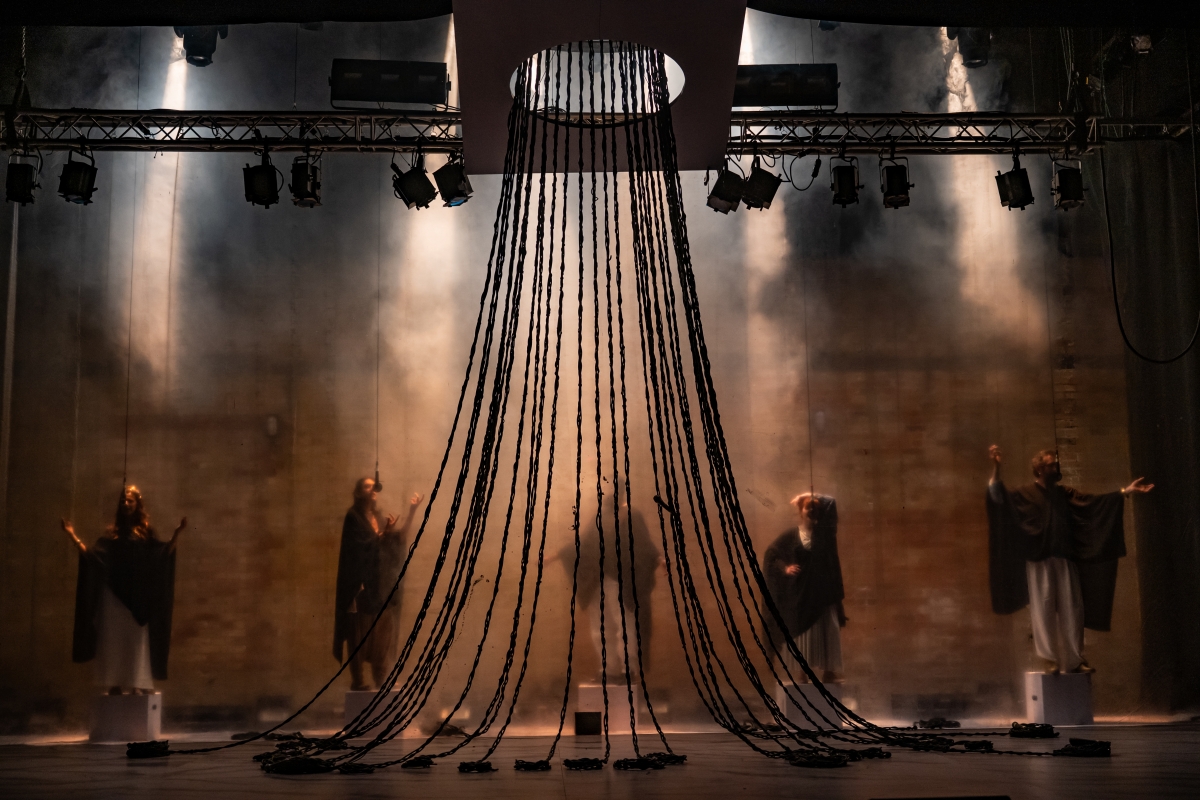
First, though, they are the serpents who whisper out loud all the self destructive thoughts that run through Medusa’s head. Sound Designer Heidi Wai-Yee Chan (Rainbow on Mars, Death of Walt Disney) has created an immersive soundscape that incorporates their whispers, along with wind, and other noises.
They come to the audience via headsets that are attached to the back of each seat. The earpieces are set at right angles to the headpiece, creating a kind of space alien look. It’s an ingenious effect that infuses the first half of the play with layers of meaning. At times, the voices overwhelm the dialogue of the actors on stage, at other times subsiding to the background. They’re a source of humour as well as insight.
As Medusa applies for a job with Athena’s Temple of Innovation, the voices harangue her with the kind of thoughts that beset any woman in modern society. Are you wearing the right thing? Dress formal — but not too formal. Be confident — but not too confident. Athena (Michelle Monteith) is the star of this corporate show, uber-confident and full of wise words like, “Women are trained to be deferential — we have to fight against it”. At the same time, she’s a bundle of nerves dealing with the members of her own powerful family, and stymies Medusa’s projects even as she ostensibly encourages them.
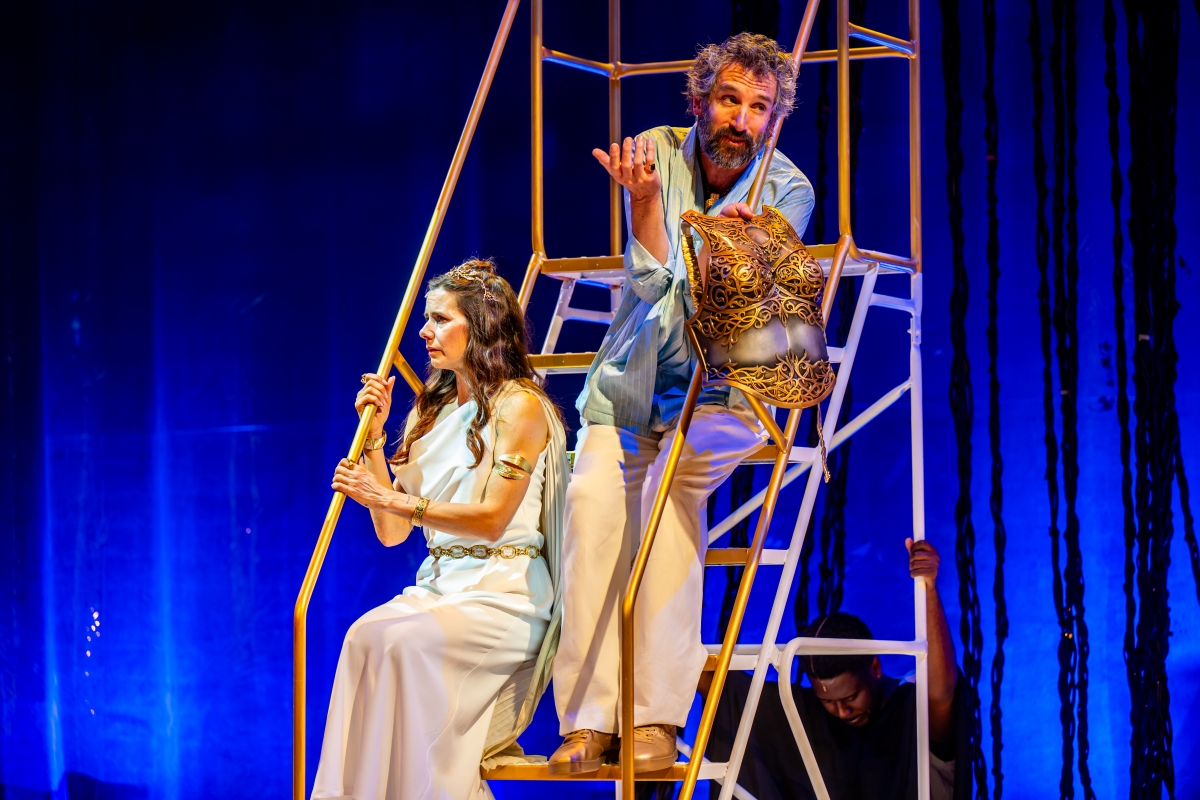
The characters come directly from Greek mythology, but the dialogue is decidedly contemporary, as are their issues. Likewise, the costumes (by Ming Wong) reference the draping of classical Greek antiquity, but other than Pallas Athena and her chitōn (and gleaming aegis), they don’t attempt to recreate their inspiration with any historical accuracy.
Medusa’s story continues in the second half of the play, albeit somewhat obliquely.
The second half is set in the modern era, in the Gorgon Café, where clients, largely women, pay to set up a scenario called a rage, where they take elements of their own lives and unleash their pent up emotion. Some of those scenes have a disturbing edge, even if the “rages” are staged.
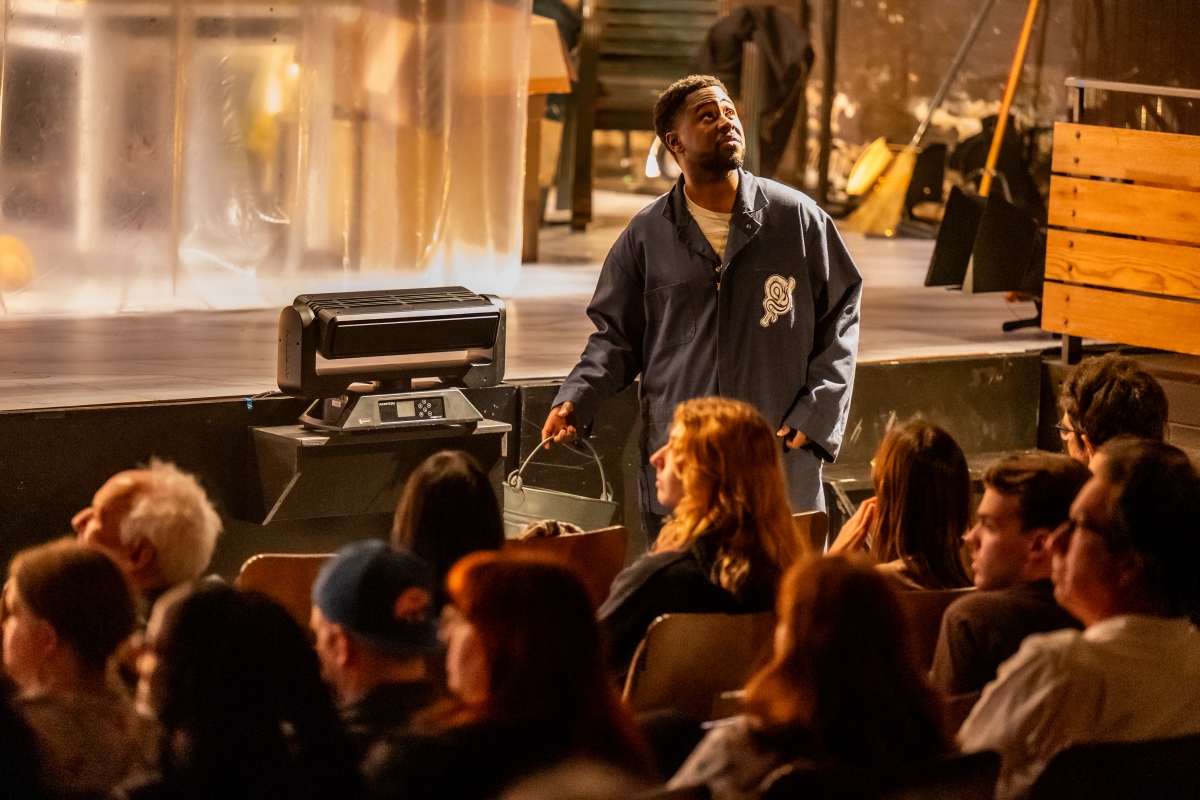
Annie (Amy Keating), is an employee who cleans up after clients smash up furniture, crockery, TVs, and anything else they need to recreate a scene. Percy (Danté Prince), aka Perseus, is a new hire, apparently the first man to work for the woman-led enterprise.
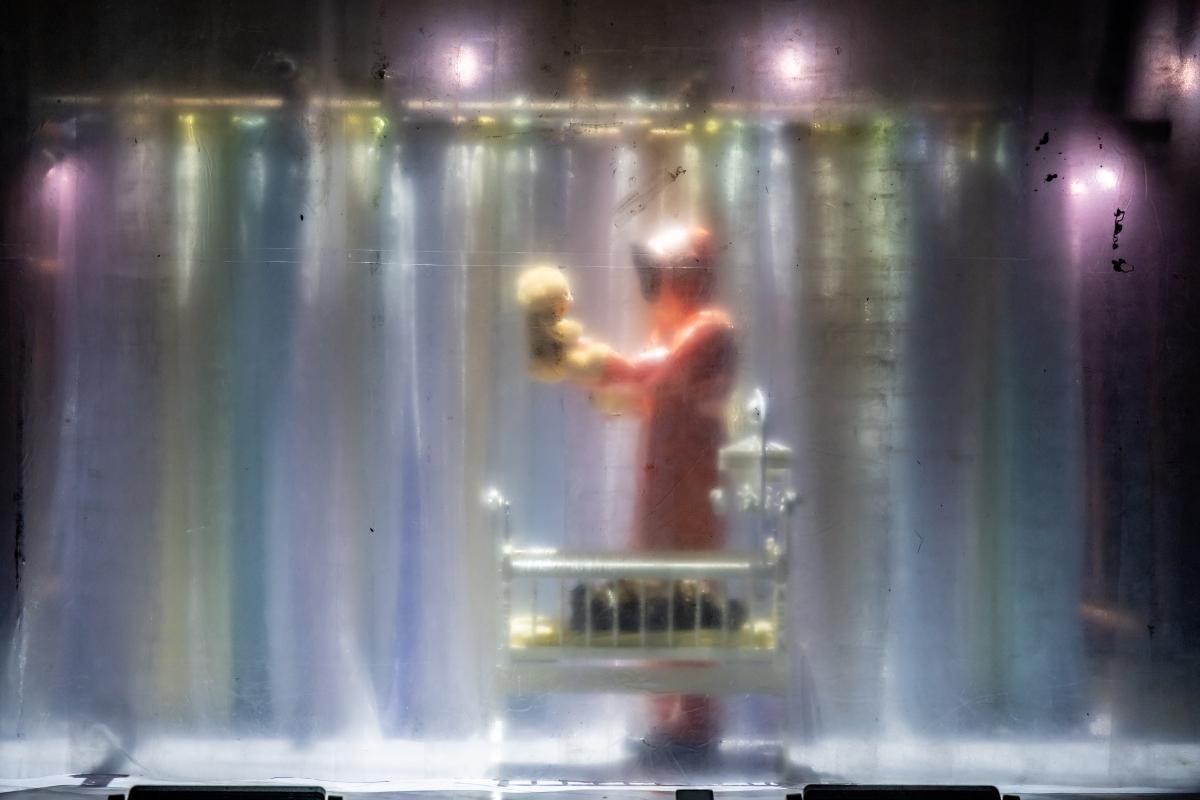
“I do know we live in a time of toxic masculinity,” he reassures Annie. Percy was a baby only mentioned during the first half of the story, set out to sea in a box with his mother by her own father for the crime of getting pregnant by Zeus. Perseus, as any student of Greek mythology (or who’s watched those Clash of the Titans movies), has a specific role when it comes to Medusa, but as Percy, he’s a mild mannered guy just trying to get by.
The various other characters of the first half re-emerge in modern form, similarly modified from their original inspirations. Sticking to the details of Greek mythology would have confined the story in many ways, it’s clear. A modern setting allows it to venture into new directions.
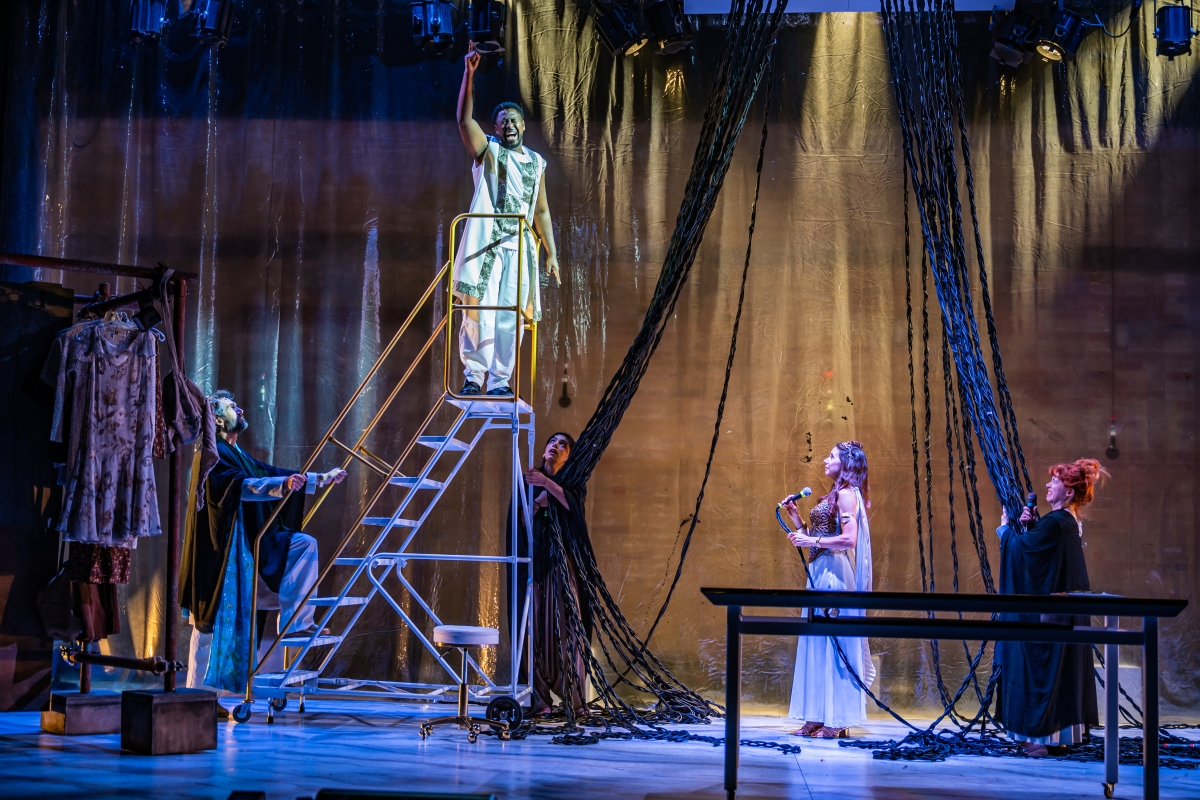
The set design by Anahita Dehbonehie is intriguing. For the first half, a set of braided ropes are suspended from the ceiling in a round configuration; characters both emerge from and disappear into it. The serpents speak from behind a translucent curtain across the back, and the gods ascend and descend from a set of steps in the corner.
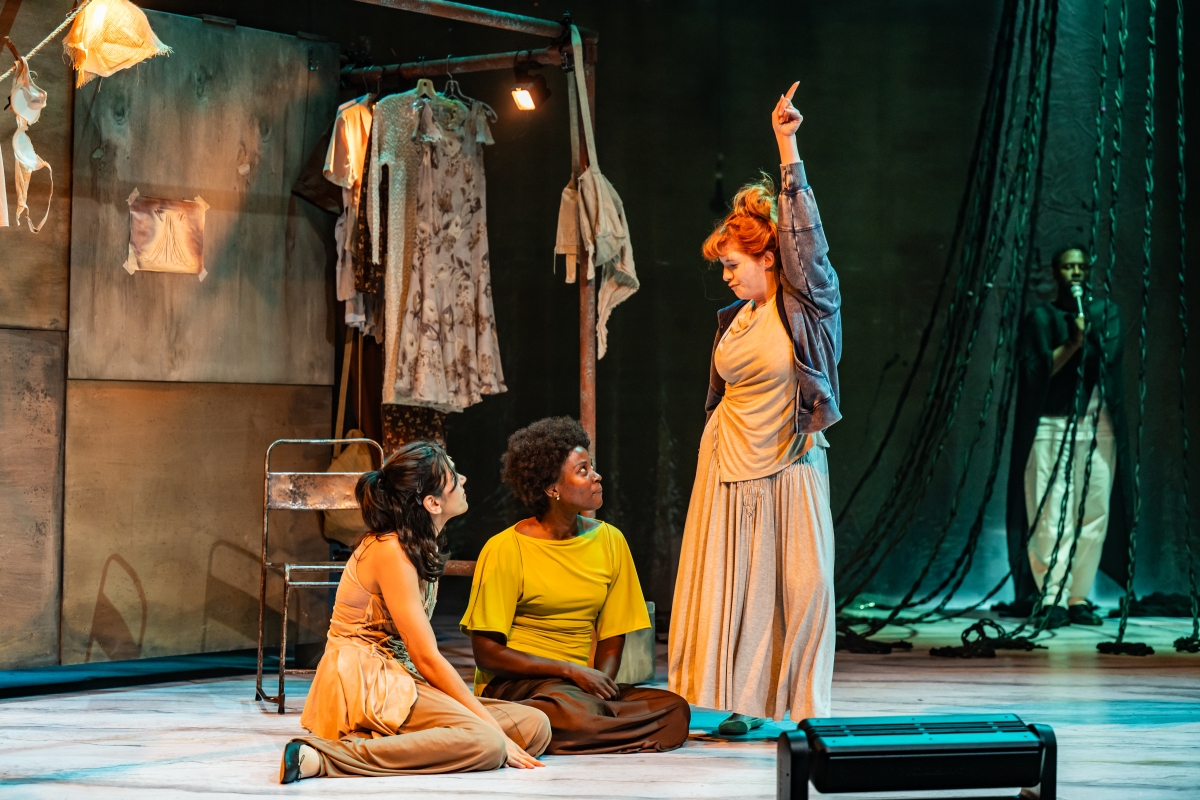
In the second half, the plastic translucent curtain moves to the front, and the board and pipe construction that was home to Medusa and her sisters becomes the backdrop that’s arranged for the Gorgon Café’s clients. It’s both economical and effective.
Putting Two Halves Together
Outside the March’s award-winning Artistic Director, Mitchell Cushman, who directs the play, had a Herculean task in putting the two very different halves together.
Those differences result in something of a disconnect. Medusa is the heart of the first half, but she vanishes for most of the second. She’s a sympathetic character to a point, but doesn’t emerge as entirely rounded — she’s being set up, as we already know from the play’s inspiration, for her moment of humiliation and transformation. Percy and Annie of the modern half are more nuanced and relatable as characters, but lack the stronger emotional base of the first half.
The play veers between what feels like genuine interactions between the characters, even under fantastical and mythological circumstances, and segments where you feel you’re being told how to interpret what’s happening. In the second half, Medusa’s voice serves to announce thematic plot points and analyses of what’s happened. Those genuine interactions are much more effective at getting the message across. It’s also where the humour largely emerges, which is probably not coincidental.
Rage
Rage is presented as an emotion that’s much more complex than it may first appear.
While Medusa’s rage is in many respects justified, it’s also partly fuelled by the pressures of her family circumstances, looking after Stheno (Amy Keating), the eldest of the three Gorgon sisters in mythology, and Euryale (Sasha Khan), the youngest. In myths, Stheno is immortal, and brutally strong. In the play, she’s feckless and freeloading off her sister. Euryale has panic attacks and relies on Medusa for emotional support.
Athena is more corporate boss than goddess of wisdom, someone who, while railing against the patriarchy, nonetheless tends to support it, and uses Medusa as a corporate slave. Poseidon, her uncle (played with delightfully oily toxic male charm by Gord Rand), is a slippery womanizer.
When Medusa finally explodes under the pressure, she directs her ire at Athena, while Poseidon glides away unscathed. Athena knows better, she charges, but supports the system anyway. But, is Athena really the most culpable?
Other characters and scenes suggest that rage, by itself, is no solution.
In the second half, a client at the Gorgon Café flies into a rage when Medusa kicks her out early. And, Athena re-emerges as a woman who’s paid a heavy price for voicing her own righteous anger at work. The subject of Black rage is touched on between Percy and Medusa in little more than a mention.
Male-female relationships are a source of much of the rage fuelling contemporary society. Percy and Annie’s relationship as coworkers, and their developing friendship, reveal some of the ambiguities of those relationships, in contrast to the false clarity of social media talking points as seen through a political lens.
Performances
Strong performances carry the story over its somewhat disjointed halves.
Oyin Oladejo is a strong centre for the play’s first half. She takes us right inside the powerful transformation from timidity to white hot fury with a nuanced performance. When she does appear in the second half, her fury has settled into permanent mode, and sent her over the edge to places so-called civilized society doesn’t tolerate.
The ensemble cast is a showcase of versatility, each of them taking on multiple roles. While they have a much smaller impact in the story, Amy Keating and Sasha Khan create fully rounded and convincing characters as Medusa’s sisters.
Michelle Monteith portrays both Athena’s strengths and her weaknesses. She’s something of an antagonist in the first half of the story, but Monteith gives her enough humanity to suggest she’s also driven by her own set of pressures.
Danté Prince offers enough softness to make Percy sympathetic and likeable, but he’s just as capable of revealing an edge in side that soft exterior, a devil’s advocate who questions Annie’s convictions, and a seething anger that flares up under the right circumstances.
Final Thoughts
There’s a lot going on in Medusa, in other words.
The plot mixes a lot of politics into the story in various ways, from the housing crisis to the manosphere. Systemic oppression is a thread that runs throughout the story, the real root cause of the rage. But, as most of us do, the characters react to the personal and individual rather than taking up arms against the system — even Medusa herself, who begins with high minded ideals about helping society, but in the end takes action on a personal level.
Or, is that the only way we can react? Is that all we’ve been left with in this society?
Medusa offers a variety of ideas and truisms, with no answers to the questions it raises, other than perhaps the idea that, as righteous as it may be, rage only engenders more rage.
Are you looking to promote an event? Have a news tip? Need to know the best events happening this weekend? Send us a note.
#LUDWIGVAN
Get the daily arts news straight to your inbox.
Sign up for the Ludwig Van Toronto e-Blast! — local classical music and opera news straight to your inbox HERE.


- SCRUTINY | Soulpepper & Outside The March Offer A Complex Portrait Of Rage In Erin Shields’ Medusa - June 25, 2026
- PREVIEW | TO Live & Luminato Festival Present Play Dead By Montréal’s People Watching - June 24, 2026
- INTERVIEW | Alexander Shelley Talks About 11 Seasons As Music Director Of The National Arts Centre Orchestra - June 24, 2026