
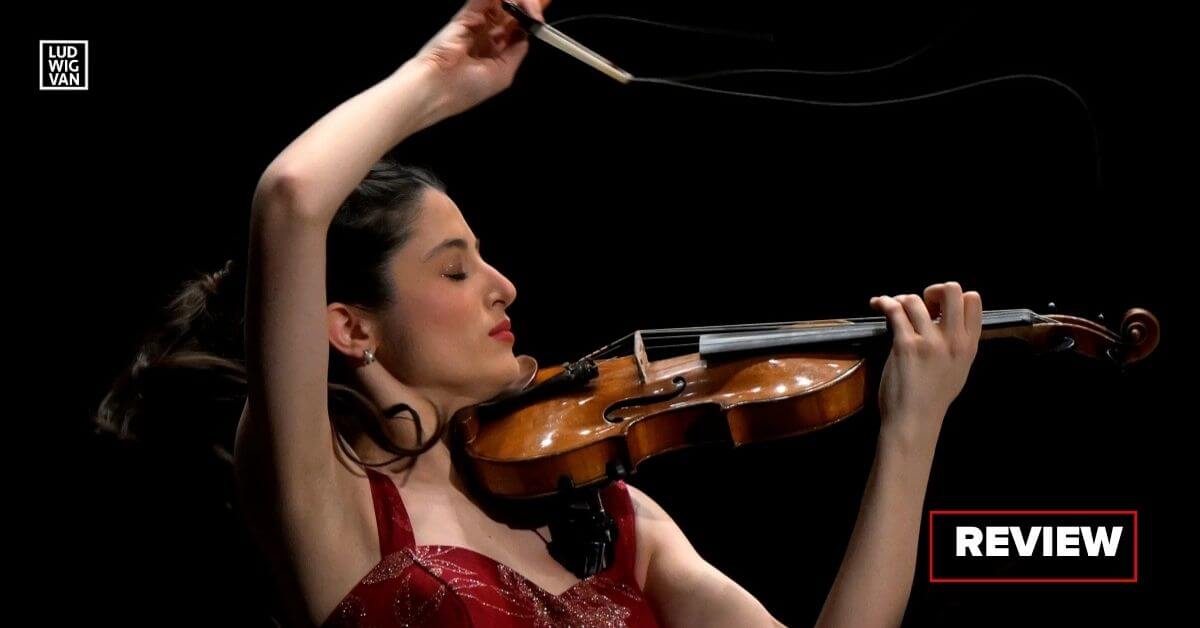
Toronto Symphony Orchestra: María Dueñas Plays Korngold. Herrmann: Suite from Psycho; Korngold: Violin Concerto (María Dueñas, soloist); Bekah Simms: Nostalgie (World Première/TSO Commission); Mendelssohn: Symphony No. 4 “Italian”. June 4 – 6, 2026, Roy Thomson Hall; June 7 2026, George Weston Recital Hall.
Who would have thought that in a concert featuring a rising star violinist and one of the repertoire’s most lavishly romantic concertos, it would be the brief, wistful second movement of Mendelssohn’s Italian Symphony that would emerge as the evening’s most exquisite moment?
Not that the TSO was anything less than first rate in the preceding journey through Hollywoodian nostalgia, psychological suspense, and Korngoldian opulence.
Mendelssohn: Symphony No. 4 “Italian”
To be fair, Gustavo Gimeno and the Toronto Symphony Orchestra were magnificent throughout Mendelssohn’s sun-drenched masterpiece.
From the first movement’s irrepressible vitality and spring-heeled exuberance to the graceful, almost airborne elegance of the third, and a finale dispatched at a breathless pace — yet also astonishingly precise — this was exceptional music-making from first note to last.
Yet, there was something beyond exceptional to that second movement. Here, Gimeno demonstrated that subtlety within restraint can be every bit as compelling as display. His complete trust in his players, and theirs in him, resulted in a performance of extraordinary poise and tenderness. Every phrase seemed to breathe naturally, every line being carried with affection and grace. It was one of those rare moments when musicianship appears to transcend technique altogether, leaving pure music in the air.
Herrmann: Psycho
John Mauceri’s concert arrangement of Bernard Herrmann’s music from Psycho served as a reminder that even the best film music can lose much of its potency when detached from its cinematic function. The score is brilliantly eerie, atmospheric and expertly constructed, but most of its dramatic force depends on visual association.
The audience reacted with a frisson of recognition to the famous shrieking violins of the shower scene — testimony to the power of collective memory. But the economical program notes offered little assistance in guiding the audience through the rest of the piece.
Bekah Simms: Nostalgie
As has become something of a tradition, the evening’s program also featured a world premiere by a Canadian composer.
Bekah Simms’ ten-minute Nostalgie was selected to complement the evening’s cinematic theme. According to the composer’s own note, the work “uses the Golden Era of Hollywood movie music as a lens” to produce a “slightly broken version of warm gooey schmaltz”.
The result is certainly more broken than schmaltzy.
Distorted harmonies and fleeting fragments dominate the opening pages, as though the orchestra is struggling to recall melodies that remain stubbornly out of reach. Yet, once the piece stops resisting its own queasy downward drift, it becomes genuinely captivating. The horns begin to bend and mutate like figures in a Francis Bacon painting, while the rest of the texture gradually softens and dissolves.
Simms cites the sleeplessness of new motherhood as part of the work’s inspiration. In that light, Insomnia might have been an equally apt title. Certainly few contemporary works manage to convey the sensation of utter fatigue with such vivid immediacy.
The audience response was politely restrained, but this is certainly a piece I hope to hear again.
Korngold & Dueñas
The evening’s marquee attraction was Korngold’s Violin Concerto, a work drawing from the composer’s film scores and drenched in the sumptuous romanticism that made him one of Hollywood’s defining musical voices. This is a concerto of unabashed sensuality: lush melodies, glowing orchestration and a seemingly inexhaustible supply of emotional perfume.
At times, however, it is as though the sauce has overwhelmed the beef. By the end, to shift the metaphor back again, the experience resembles an extended soak in an exquisitely scented bath — luxurious and undeniably pleasurable, but leaving one slightly wrinkled.
Maria Dueñas clearly has great affection for the piece. Having taken it on tour across Europe and North America this season, and with a recording reportedly in preparation, she approaches it less as a virtuoso showpiece than as an intimate lyrical narrative. The opening movement unfolded with generous vibrato and flexible rubato, every phrase lovingly moulded and caressed. Her tone has a distinctly sweet-toothed quality, warm and comforting, like a rich cup of hot chocolate.
Yet, what may translate beautifully to a recording studio proved less effective in Roy Thomson Hall. In favouring inwardness over projection, lyricism over declaration, Dueñas’ slender sound was frequently submerged beneath Korngold’s luxuriant orchestral textures. Phrase endings often disappeared just as the orchestra picked up the line, and one longed for a more commanding soloistic presence. The approach worked best in the rapt second movement, where intimacy is more a virtue than a limitation.
The finale revealed that Dueñas has plenty of panache in reserve, as she dispatched its technical hurdles with apparent ease, but here too a degree of starrier projection would have been no bad thing.
Final Thoughts
Gimeno and the Toronto Symphony Orchestra were as superb in partnership as they were with the spotlight all to themselves.
Whether navigating Herrmann’s cinematic shadows, Simms’ fractured dreamscape, Korngold’s gilded nostalgia or Mendelssohn’s inexhaustible inspiration, they delivered with precision, character and complete conviction.
But, it was fitting that the deepest impression came not from Hollywoodian glamour or soloistic display, but from the unaffected eloquence of Mendelssohn, realized by musicians operating at the highest level.
Are you looking to promote an event? Have a news tip? Need to know the best events happening this weekend? Send us a note.
#LUDWIGVAN
Get the daily arts news straight to your inbox.
Sign up for the Ludwig Van Toronto e-Blast! — local classical music and opera news straight to your inbox HERE.

- SCRUTINY | Perfume, Psycho, And A Perfect Mendelssohn: TSO & Gimeno Outshine Hollywood - June 9, 2026
- SCRUTINY | East, West, And Universal: The Toronto Symphony Orchestra Welcomes Anoushka Shankar - May 25, 2026
- SCRUTINY | Of Gods And Prophets: Abel Selaocoe’s Toronto Debut Was A Life Changing Experience - May 19, 2026