
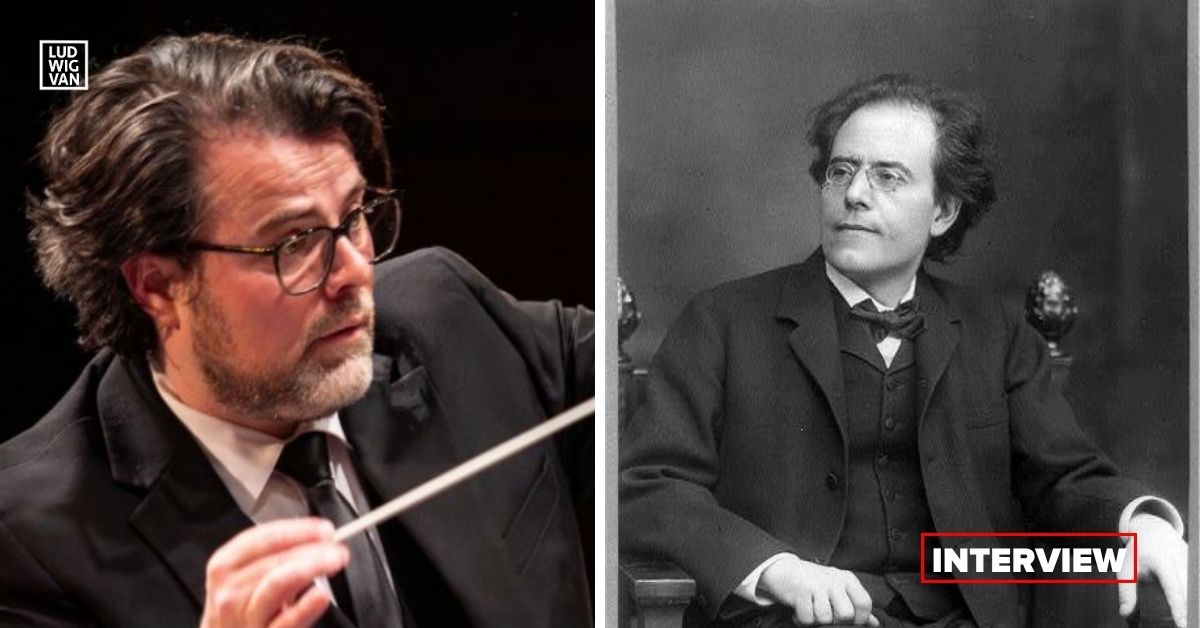
The Cathedral Bluffs Symphony Orchestra will end their 2025/26 season with Mahler’s epic Symphony No. 2 in C minor, Resurrection. Martin MacDonald conducts, and the performance also features soprano Emily Rocha, mezzo-soprano Queen Hezumuryango, and Pax Christi Chorale with Artistic Director Elaine Choi.
The concert takes place on May 30, 2026.
LV talked to Music Director Martin MacDonald, and vocalists Emily Rocha and Queen Hezumuryango about the concert.
Mahler Symphony No. 2 in C minor Resurrection
Mahler wrote his Resurrection Symphony Between 1888 and 1894, and it proved to be one of the most successful works. It was performed for the first time in 1895.
The Resurrection Symphony is a massive work, lasting 80 to 90 minutes. It began as a single movement symphonic poem titled Totenfeier or Funeral Rites, which he completed in 1888. Years went by as he considered whether or not to add to it, making it the first movement of a symphony. He intended on using a chorus in the final movement, and felt that it would inevitably be compared to Beethoven’s iconic Symphony No. 9.
He also searched for the right text for the vocal components. During the 1890s, the composer worked at the Hamburg Opera, where he came to know conductor Hans von Bülow. When the maestro died in 1894, at his funeral Mahler heard a musical setting for Friedrich Gottlieb Klopstock’s poem “Die Auferstehung” or The Resurrection, and he was instantly struck by it.
“It struck me like lightning, this thing,” he wrote to conductor Anton Seidl, “and everything was revealed to me clear and plain.”
Mahler used the first two verses of Kopstock’s poem in his symphony, adding words of his own. Over repeated performances, he developed a narrative program to go along with the work, indicating that the first movement represented a funeral, and asking the question “Is there life after death?” He later removed the program notes, but the mood remains.
From the second movement, the piece moves through happy remembrances to the emptiness of life as a meaningless journey, resulting in the desire to be released from it. The final and fifth movement ends with the hope of renewal and resurrection.
Martin MacDonald: The Interview
The two vocalists were both part of the Canadian Opera Company’s Ensemble Studio, Queen Hezumuryango from 2022 to 2025, and Emily Rocha from 2024, ending her term this year.
“It was sort of by coincidence that, at the time when we selected, they were both in the Ensemble Studio,” MacDonald says.
“Queen, I got to know last summer when she was Carmen at the Brott Music Festival,” he explains. “I had already asked her to be part of this Mahler Resurrection Symphony at that point. She was very excited to take it on.”
It certainly offers a singer a juicy, expressive part.
“This particular symphony for the mezzo soprano, the fourth movement, it’s just one of the most gorgeous pieces of music that has ever been written, to my mind.”
It’s part of the composer’s gift. “Mahler was so equally capable of creating the softest, most delicate passages you could ever create, at the same time as creating the most bombastic.” MacDonald cites Mahler’s control over the orchestra and instrumentation. “[He had] an immense skill for that.”
The Newest Edition
“I kind of made a big deal of playing the most recent edition of this symphony,” Martin says. “This symphony has gone through a few editions over the last 100 years or so. Mahler liked to change things during rehearsals.”
The composer enjoyed conducting his symphony, as MacDonald explains, and often made notes on the fly. “Changes would not always get transcribed into the parts, or get taken down properly,” he says.
“We went to expense of renting the parts from Europe. And it’s really paid off — we don’t spend oodles of time in rehearsals fixing tiny mistakes from previous editions. These tiny changes that he would make — like starting a diminuendo earlier — it changes the trajectory of the phrase,” he adds, “similar with all his symphonies.”
The European up to date version was an investment. “I got the score, the most recent edition, and it cost a small fortune. But it came with an annex, a second book that is 206 pages long of 10 point font explaining all the changes to the work,” MacDonald continues.
“It saves time,” he says, “especially when you’re dealing with a piece as big as this. The last movement is like a symphony of itself. The first movement is like a symphony of itself. There is so much emotional weight, and things to consider.”
Collaborators
Soprano Emily Rocha will be at the Brott Opera this summer, where she’ll also be working with MacDonald.
“And then of course, Pax Christi Chorale. We had them sing our Beethoven 9 at the opening of last season, and it was such a really lovely partnership in every way. Musical and otherwise,” he says. “As soon as we started thinking about the Mahler, we thought of Pax right away. Elaine, their director, is really lovely.”
The regular orchestra will be bolstered with additional musicians to create the massive sound Mahler envisioned.
“The orchestra is huge. We’re lucky. This is our 40th season closing concert, and there’s no better way to close an anniversary season,” MacDonald says.
The orchestra will be augmented by musicians who’ve previously guested with CBSO, as well as new players.
“It’s a huge brass section, and a massive wind section — and you need enough strings to balance that out. It’s everything and the kitchen sink,” Martin says. “It’s a nice way to end the 40th season by being able to invite so many friends back to celebrate.”
It wasn’t hard to persuade people.
“The other thing too is, Mahler’s Resurrection Symphony, it doesn’t matter who you speak to musician-wise, whether it’s seasoned veterans or amateur musicians […] everybody says, yes, I’d love to play that. There are so many epic moments.”
When he was making the video, MacDonald came to a realization.
“It dawned on me, that this is my favourite piece of music of all time. For me, Mahler Resurrection is my absolute favourite piece. It’s kind of travelled with me for four decades now.”
He relates that he first played it in the Nova Scotia Youth Orchestra at age 15. “This piece absorbed every part of me. I was cello no. 13 in a section of 13,” he recalls. “The only place they could find that could hold us all was the field house at St Mary’s University.”
In his 20s, at McGill University, he served as assistant conductor for a performance of Mahler 2. In his 30s, he prepared it as associate conductor.
“Now that I’m in my 40s, I finally get to conduct it,” he says. It’s a piece that occupies a special place in his musical life. “If I’m between scores, I’ll pull it out and study it again. It’s that one piece that really grabs you,” he adds. “It’s a tour de force to conduct. It’s that kind of a piece, you have to throw yourself into it lock stock and barrel. It doesn’t let up.”
Mahler and His Music
“Mahler came from the unique perspective of conducting his own music,” MacDonald says. “He was obsessive about it. It had to be exactly to his wishes,” he adds. “Every symphony comes with a German-English dictionary so you can decipher his lengthy instructions.”
Mahler’s Second is a marathon for the musicians.
“It starts at minute one, and at minute 80, you’re still going without a break,” he says.
Mahler dealt with ill health throughout his lifetime, and died in 1911 of endocarditis, a bacterial infection. He’d also dealt with many tragedies, including the death of siblings as well as his own daughter at age four. As MacDonald points out, many scholars feel that his search for meaning and spiritual salvation came in part from his own existential demons.
“It starts off so dark, that first movement is so dark, and it goes to that brightest possible moment in the last movement,” he says.
“At the end of the day, we’ve had a great season,” Martin says. “To finish off with Mahler, there’s no better way to do it.”

The Vocalists: Emily Rocha and Queen Hezumuryango
Neither featured vocalist has performed the work previously.
“This will be my first time,” says Emily Rocha. “I’m very excited though, it’s an epic work. I love Mahler.
It’s amazing opportunity.”
LV caught up with both singers a few days before rehearsals began.
“I think it will be really interesting starting the whole rehearsal process, because my part is at the end,” says Rocha. “A lot of my part is with the chorus. I’m keeping my approach flexible. I don’t want to stick out too much in those parts, but I want to merge with that sound.”
Both vocalists have been listening to multiple versions of the work in preparation for their parts. “That video of Joyce DiDonato doing this piece, I actually found it really helpful,” Rocha shares. It’s a deep dive into the work from a diva who’s performed it multiple times.
“I learn so much by watching how other people prepare,” adds Hezumuryango.
While the soloists’ parts occur in the final movement, it’s still necessary to gain a feel for the arc of the work as it progresses prior to that. It’s important to be part of the work as a whole.
“Especially a piece that is so established in the canon, and has meant a lot to a lot of different people over the years,” adds Queen Hezumuryango.
Mahler’s philosophical quest resonates with us all, as Hezumuryango points out. “The questions that humanity has been asking themselves forever — life after death. There’s that big question through this whole piece — what is the purpose of life? What do we live for? And when we die, where do we go?” she continues.
“In the aria that I sing, my text speaks about returning home to the creator, to God,” Queen says. “Obviously this is very specific to Christian religion. And I don’t want to ignore that, but I also think that we can have a broader approach to it.” She mentions the natural world, and other canons of spirituality.
“It’s very big themes, and I think that’s why a lot of people can feel the emotions that come form listening to this piece.”
Both vocalists are looking forward to the performance.
“I’m really, really excited because I thought I wouldn’t get to sing this until way later in my career,” Hezumuryango says.
The music’s message is part of the appeal.
“The Resurrection Symphony it’s called,” Queen adds. “It’s the end but not really. The end, but also the beginning. It’s always a nice kind of message, but especially at a time like this.”
For Emily, the timing of the offer early in her career was also a factor in her yes answer to MacDonald’s email invitation.
“It’s a privilege to work on this piece,” Rocha says. Finding out a fellow COC Ensemble Studio alumna was also in the ensemble was icing on the cake. “Working with friends is the best.”
Cathedral Bluffs Symphony Orchestra: A Community Orchestra
Both singers enjoy the prospect of working with a community orchestra like Cathedral Bluffs.
“I haven’t heard them before, but I do really enjoy collaborating with local orchestras,” says Rocha. “I find it really rewarding. The passion of the players is really inspiring.”
“Me as well,” adds Queen. “From my experience of working with smaller and community focused companies in Toronto, there is always that passion, that spark that is very different from working with companies that are bigger and more established in a different way. The priorities are different,” she explains. “There’s a lot of passion of course at COC, but it’s very different.”
Community orchestras are naturally run on different terms
“People wear many different hats,” Hezumuryango notes. “Everyone has to be flexible and give so much. I feel like our first rehearsal together […], I feel like I’m going to be able to feel that energy.
We really care about this concert.”
“I’m really excited to be working with Pax Christi Chorale again. Elaine is wonderful,” Rocha adds. “You can feel it.”
Both vocal parts involve singing with the choir, as well as in a solo role.
Queen grew up singing in children’s, then teen choirs in Kitchener. She recalls the real sense of community and commitment.
“It’s so different than the professional world,” she says. Where community choirs and orchestras rehearse for a few concerts all year long, in the professional realm, there are a couple of rehearsals, a show, and the experience is over. “The bonds are very strong,” she says. “The music making process is very different.”
At then end, they will all sing together.
“For Mahler’s music again, it calls for us to be very, very loud, and then very quiet, but all together,” Queen explains. They’ll even be breathing together.
“We’re really lucky to be doing something like this,” she adds. “It contributes to my mental health.”
Concert Details
Cathedral Bluffs Symphony Orchestra’s Darkness To Light takes place May 30, 2026 at the Chinese Cultural Centre of Greater Toronto.
- Find other details and tickets [HERE].
Are you looking to promote an event? Have a news tip? Need to know the best events happening this weekend? Send us a note.
#LUDWIGVAN
Get the daily arts news straight to your inbox.
Sign up for the Ludwig Van Toronto e-Blast! — local classical music and opera news straight to your inbox HERE.