
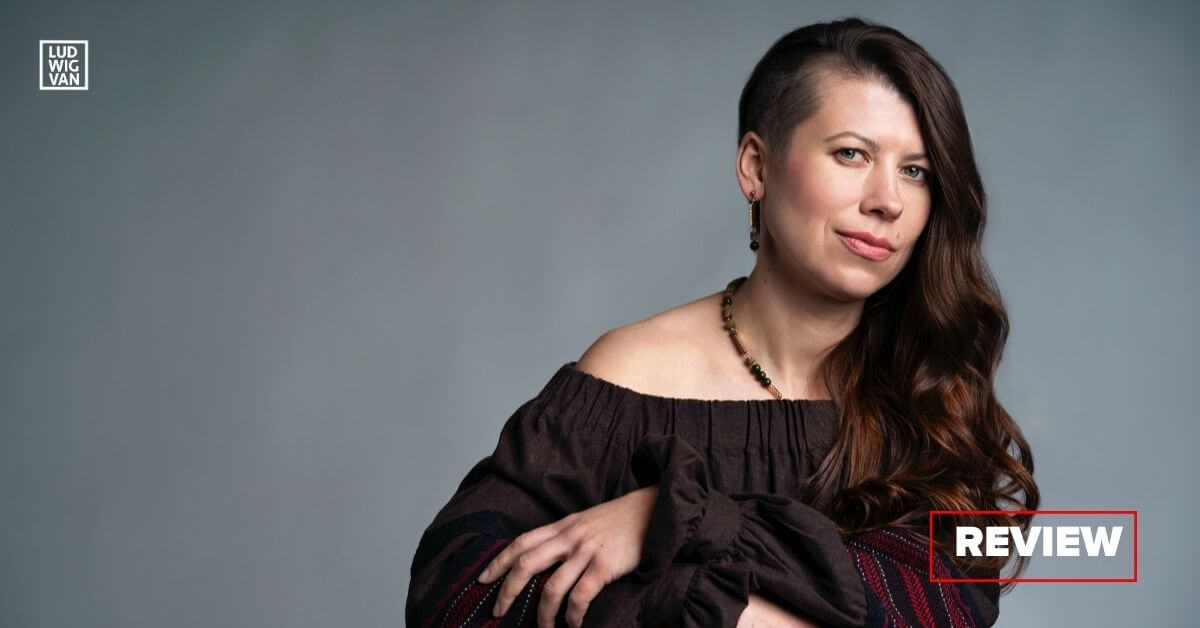
Soundstreams: In Terra Pax. Ensemble Soundstreams: Stephen Sitarski, violin I; Noa Sarid, violin I (Dior Quartet); Carol Fujino, violin II; Astrid Nakamura, violin II (Dior Quartet); Barry Shiffman, viola; Ronen Shifron, viola (Dior Quartet); David Hetherington, cello; Joanne Yesol Choi, cello (Dior Quartet); Travis Harrison, double bass; Matti Palonen, kannel & Tania Miller, conductor. With: Anna Pidgorna, vocals; Natalya Gennadi, soprano; Steven Dann, viola; Anna Sagalova, piano. Jane Mallett Theatre, May 9, 2026.
In Terra Pax, Soundstreams’ final season concert, curated by Anna Pidgorna, was a provocative wander through the emotions of anguish, sadness and yearning, extracted painfully through the unavoidable violence that permeates our history — from old days, and from now.
Pidgorna brought much inspiration from her sphere, of the Russian-Ukraine war, displaced persons, and the sense of loss against violence, and tonight’s musical selection from Tõnu Kõrvits, Benjamin Britten, Oleksiy Voytenko and Kelly-Marie Murphy, along with a new work, Black Crow by Pidgorna, felt new yet familiar.
The program successfully illustrated the common human experiences that go beyond cultural, geographical, and time barriers — especially concerning the things that we love, and have lost.
Veljo Tormis: Tasase maa Laul: Song of a Level Land ,arr. Tõnu Kõrvits & Benjamin Britten: Lachrymae
The concert started with a gentle summoning of the vast openness through atmospheric strings and hypnotic strumming from the kannel (a zither) by Matti Palonen. Tõnu Kõrvits’ arrangement of Veljo Tormis’s ‘Tasase maa Laul: Song of a Level Land’, an Estonian favourite, builds haunting melody from “peace and stability” on the plains of one’s home — a place where many, including that one, simply belong.
Pidgorna, doing triple duties today as curator, composer, and singer, brought a calm vocal line over the ensemble; the foreign language, the faraway land of Estonia, all the things that make this music new, felt familiar as the music expressed a shared sorrow and yearning for home. The Ensemble Soundstreams’ blending was particularly elegant for this.
Steven Dann’s performance of Britten’s Lachrymae was beautiful and effective. The various permutations of John Dowland’s “flow my tears” had plenty of character, especially when the viola’s pizzicatos contrasted against the shimmering string accompaniment. Britten’s string writing, requiring technical excellency and emotional depth, from lush openness to the most private reservations, was well-executed. The glassy transparency of the ensemble, along with the rich solo viola melody, was especially memorable.
Oleksiy Voytenko: Lento
The third piece, Voytenko’s Lento, opened with a nearly static duet between piano and bass. Anna Sagalova, a pianist who had to flee from burning Karkiv, brought beautifully understated sonority from the piano, and Travis Harrison on the bass was well-synched in timing and expression, creating a beautiful foundation for this slow, lateral building piece.
Voytenko’s funeral march, with its repeating subjects, was effective in its provocation; the repeated subjects and ostinatos, clearly asking and seeking solace, felt genuine — with certain sadness. Sagalova’s muted piano single notes against the strings — steps carrying the weight of a life, of lives, against death — kept the emotion moving forward, despite the inertia of that heavy weight.
It’s a true richness to encounter a foreign, new narrative, yet understand it immediately as a human expression: the work was well-chosen and superbly played.
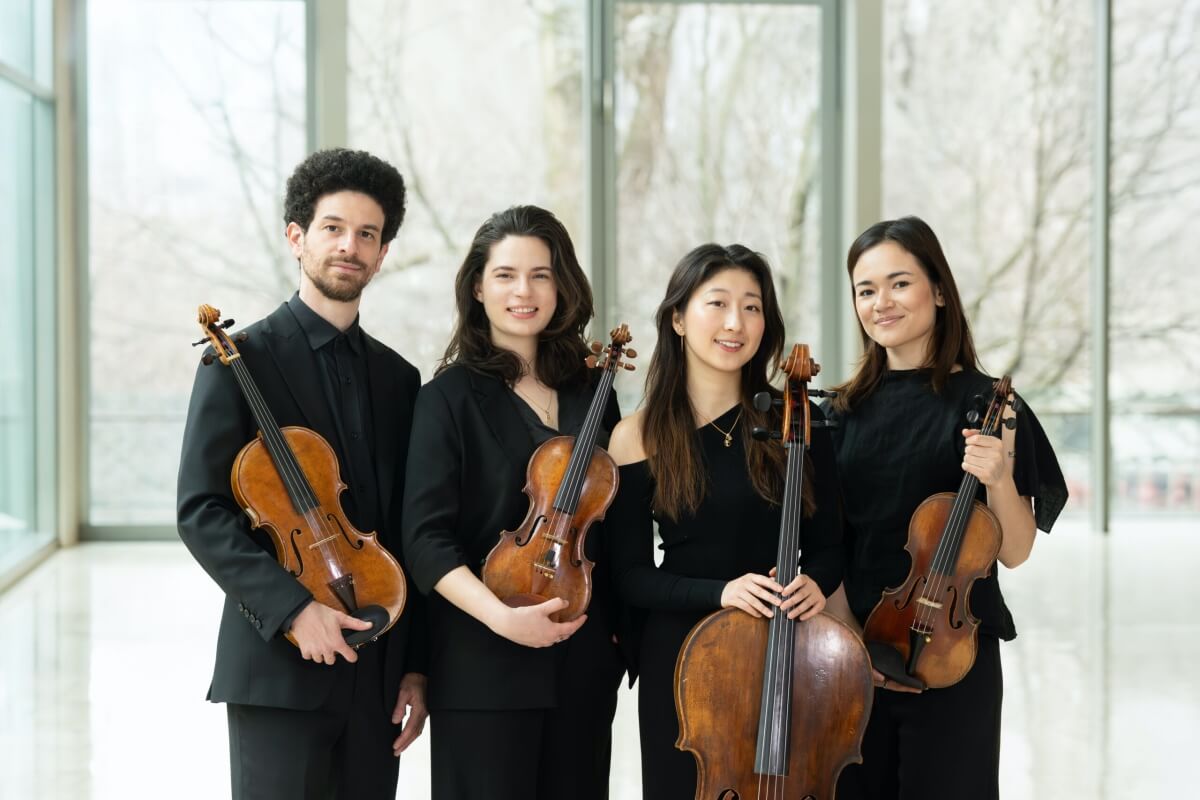
Kelly-Marie Murphy: Ashes
After the intermission, the Dior Quartet performed Kelly-Marie Murphy’s ‘Ashes’. A work inspired by firestorms, the technical demands were met with finesse by the quartet. The quartet, with two newly appointed members, brought plenty of energy; the solo passages, especially from violinist Noa Sarid, were brilliant and sonorous against the backdrops, capriciously switching between chaotic kinetic, and nearly static moments.
The intonation and execution were excellent: however the performance left a yearning for truly ugly moments — the Fort McMurray fire burned for 15 months, burning so violently that it created its own weather system.
Pidgorna parallels the ashes in her mind with the brutal bombings in Ukraine, literally tearing lives and lands apart; and though artists strive hard for beauty in all corners, often it’s the spitting consonants and grinding, cracking, and splitting — unconventional and ugly — that can further amplify the expressive depth. After all, it’s complete annihilation that may bring new life to tabula rasa.
Anna Pidgorna: Black Crow
The highlight of the evening, Pidgorna’s Black Crow, explored Ukrainian women’s tradition of lamentation, Holosinnia. The work featured two voices, Pidgorna and Natalya Gennadi, and the construction of two parallel scenes in alternation was an interesting take.
The opening was vibrant and colourful, as a short motif was exchanged among the strings against an omniscient resonant piano backdrop; following the evocative opening, Gennadi sang with clarity and conviction, soaring over the formal Western classical string orchestral accompaniment.
Pidgorna’s sections, accompanied by Sagalova, exploring the women’s job in the face of death — lamentation — felt genuine and sincere. Her body language and folksy inflections took us away from the formality of Western classical music at times, and felt oddly familiar. Perhaps it’s not odd at all, as birth and death are such clear definitive life events that no-one escapes, that we do have shared connections through collective memory somewhere, wherever it’s stored, through generations.
Final Thoughts
The word ‘curator’ comes from Latin cura, to care. This program brought many common human emotions, though it focused on the experiences of facing violence on a scale that most of us in Canada have not experienced directly. Yes, this is a true blessing, a lucky draw in the game of geopolitics and the whims of madmen.
From sorrow to yearning, from the words of others to newly written works, the evening covered many shades and nuances, and it was exciting to see such care in planning and execution on this evening’s stage.
Are you looking to promote an event? Have a news tip? Need to know the best events happening this weekend? Send us a note.
#LUDWIGVAN
Get the daily arts news straight to your inbox.
Sign up for the Ludwig Van Toronto e-Blast! — local classical music and opera news straight to your inbox HERE.

- CRITIC’S PICKS | Classical Music Events You Absolutely Need To See This Week: June 22 – June 28 2026 - June 22, 2026
- CRITIC’S PICKS | Classical Music Events You Absolutely Need To See This Week: June 15 – June 21 2026 - June 15, 2026
- CRITIC’S PICKS | Classical Music Events You Absolutely Need To See This Week: June 8 – June 14 2026 - June 8, 2026