
The Canadian Opera Company will present Massenet’s Werther after a three decade absence from the Toronto stage. Russell Thomas sings the role of Werther, with mezzo Victoria Karkacheva as Charlotte in the new production directed by Alain Gauthier.
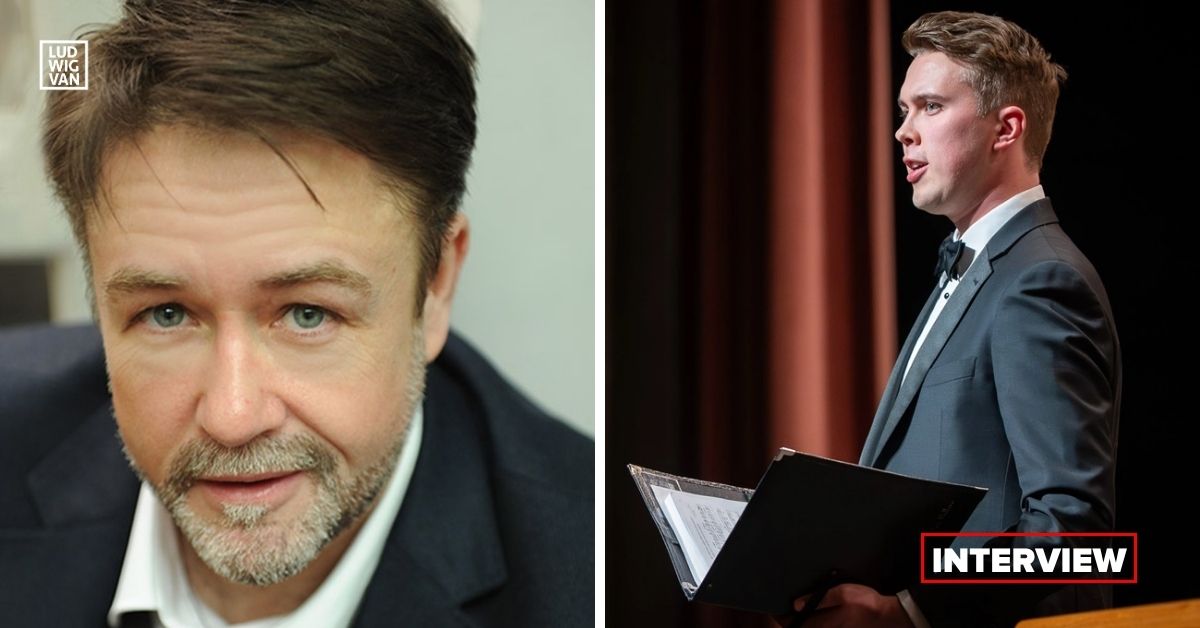
LV talked to tenor Michael Colvin and baritone Ben Wallace, who portray supporting roles in the opera. Both vocalists came to the Four Seasons Centre mainstage via the Canadian Opera Company’s Ensemble Studio, but decades apart.
Werther: The Opera
Un amour impossible, obsession, and despair. Werther, by French composer Jules Massenet, tells the story of its titular character, a young man, a poet who develops a romantic obsession with Charlotte, a woman who is already pledged to marry another man. She promised her dying mother that she’d marry Albert, and she intends to keep her word.
The opera based on a novel by Goethe, with a French libretto by Édouard Blau, Paul Milliet and Georges Hartmann.
As his obsession with Charlotte grows, the story sees Werther spiral into despair, and tragedy. Charlotte has feelings for him too, but a stronger sense of duty. It’s only when it’s too late that she confesses her love.
It is, in short, a classic basis for an operatic tragedy.
Massenet’s music was composed over a period of several years before its premiere in 1892, and includes gorgeous arias, preludes, and interludes. It’s dramatic and romantic in its nature, using several recurring themes that speak to the underlying emotions of the story.
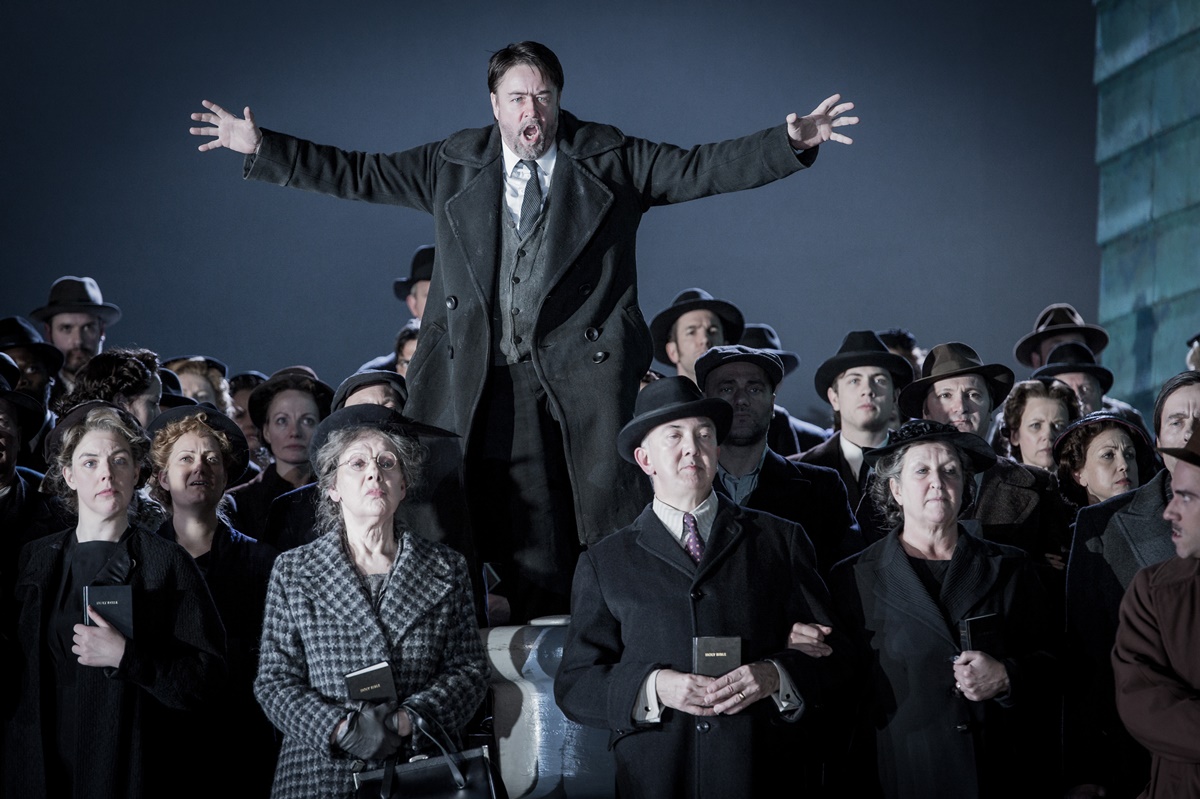
Michael Colvin, tenor
Irish-born, Canadian-raised tenor Michael Colvin has enjoyed a decades long international career. He’s made his name via roles such as the Duke of Cornwall in Reimann’s Lear at Opéra National de Paris, Teatro Maggio Musicale di Fiorentino and Salzburg Festival; Monostatos Die Zauberflöte, Bardolfo Falstaff and Rodolphe in Guillaume Tell at Royal Opera House, Covent Garden; The Witch Hansel and Gretel and Monostatos Die Zauberflöte at the Canadian Opera Company; Herod Salome, Bob Boles Peter Grimes, and Painter/Second Client in William Kentridge’s acclaimed production of Lulu for English National Opera. He’s been closely associated with ENO as well as the COC throughout his career.
His professional career began when he joined the COC Ensemble Studio, in 1998 and just after completing university.
Michael Colvin: The Interview
“I was in the Studio Ensemble from 1998 to 2000,” Colvin recalls. “And then I sang at the COC for many years after that,” he adds. “I’ve been back — I think almost every year with gaps over the years.”
It’s a valuable professional relationship he looks to maintain. “The Ensemble and those early years with the COC really launched my [career],” he says.
“I live in Toronto, so that was a pretty easy choice. In this business we don’t always get a chance to work at home,” he explains.
But, even far from home, the Canadian connection comes up often. “There’s so many fantastic Canadian opera singers. Everywhere I’m singing, there’s always fellow Canadians. In all these foreign cities, there are colleagues you can hang out with.”
A Big Break
Richard Bradshaw became the artistic director of the COC in 1994, and was named the general director of the company in 1998, a position he held until his death in 2007.
“I was there during the Richard Bradshaw years,” Colvin says, “and Richard was famous for literally throwing singers on stage.”
In 1999, the COC presented The Barber of Seville, with Russell Braun as Figaro and Isabel Bayrakdarian as Rosina. Colvin had been slated to play the Officer, but Bradshaw called him in to take over the role of Count Almaviva instead.
“As we got closer to the performances, it was clear that the tenor was struggling,” Michael says. There were health issues involved. “I’d been coaching it with Liz Upchurch,” he recalls.
“I had memorized all of Act I. We got to the rehearsal before the dress rehearsal, and Richard said, okay, can you go on and sing Act I?”
Colvin obliged, and at the end of that rehearsal, Bradshaw told him he’d be singing the role at the dress rehearsal. His dilemma — he didn’t actually know anything beyond Act I off book. He turned to Liz Upchurch, the long serving head of music of the Ensemble Studio, for help. Together, they crammed the rest of the opera in time for dress rehearsal.
“Liz Upchurch and my colleagues basically saved my ass,” he says. “I ended up doing six of seven shows. That launched me. I sang Almaviva in the States after that.”
Lesson learned: “If you can cover an assignment, you make sure you know it inside and out,” he says. “It was one of those situations where I got the chance. I got the chance to pull it out of my butt at the last second.”
The experience came in handy when he was covering Peter Grimes, and years later, at the English National Opera, was called upon to sing in a few of the performances.
The Ensemble Studio gave him a solid base for the professional career he’s built since then. “I had a really wonderful and interesting experience,” Michael says. “The great thing about the program is that they treat you like a professional. In the real world, you’re doing rehearsals at Paris Opera at 10 in the morning.”
He also points out the European success of Ensemble Studio alumni like Ambur Braid, Gordon Bintner, and Joel Allison.
“There’s been a lot.”
Character Roles
“I’ve graduated officially out of lead roles, and I’m full […] in character roles,” Colvin says. “These roles I can sing without worrying about them at all.”
It’s part of the trajectory of any singer’s career. “It feels like an easy transition, as long as you’re singing healthily.”
As he points out, character roles play are a crucial component of operas in general. “If the character roles in the opera aren’t great, it can bring down the level of the show,” he says. “It’s all about the collaborative effort of the art form,” he adds.
“My thing with the opera career is that some of my favourite experiences happen in the rehearsal hall,” he notes. “I’m really loving being at this stage in my career. To be honest, I’ve had more international success in that repertoire than I have with lead roles.”
Character roles, as he points out, can also be quite challenging. “Bob Boles in Peter Grimes is a ball breaker.”
Werther: Schmidt
He likens the role of Schmidt in Werther to to Verdi’s Falstaff. In the story, Schmidt is a friend to Le Bailli (the Bailiff) and Johann.
“If you look at the music, these guys are basically drinking buddies,” he says. “They spend a lot of time philsophizing. You could almost see them sitting on the park bench out side the church.”
He notes that they are down to earth, everyday characters who contrast the other roles.
“I also feel like Schmidt, […] I think he fancies Charlotte as well.” Schmidt and Johann are older characters than the leads. “Maybe things have passed them by in life,” Colvin says.
“[They are] fun characters to play.”
He’ll be reunited with an old friend on stage — bass Alain Coulombe, who plays Johann.
“Alain and I were in the Ensemble together back in 1998, it’s almost like art imitating life,” Michael says. “It’s going to be fun. It’s going to be very natural.”
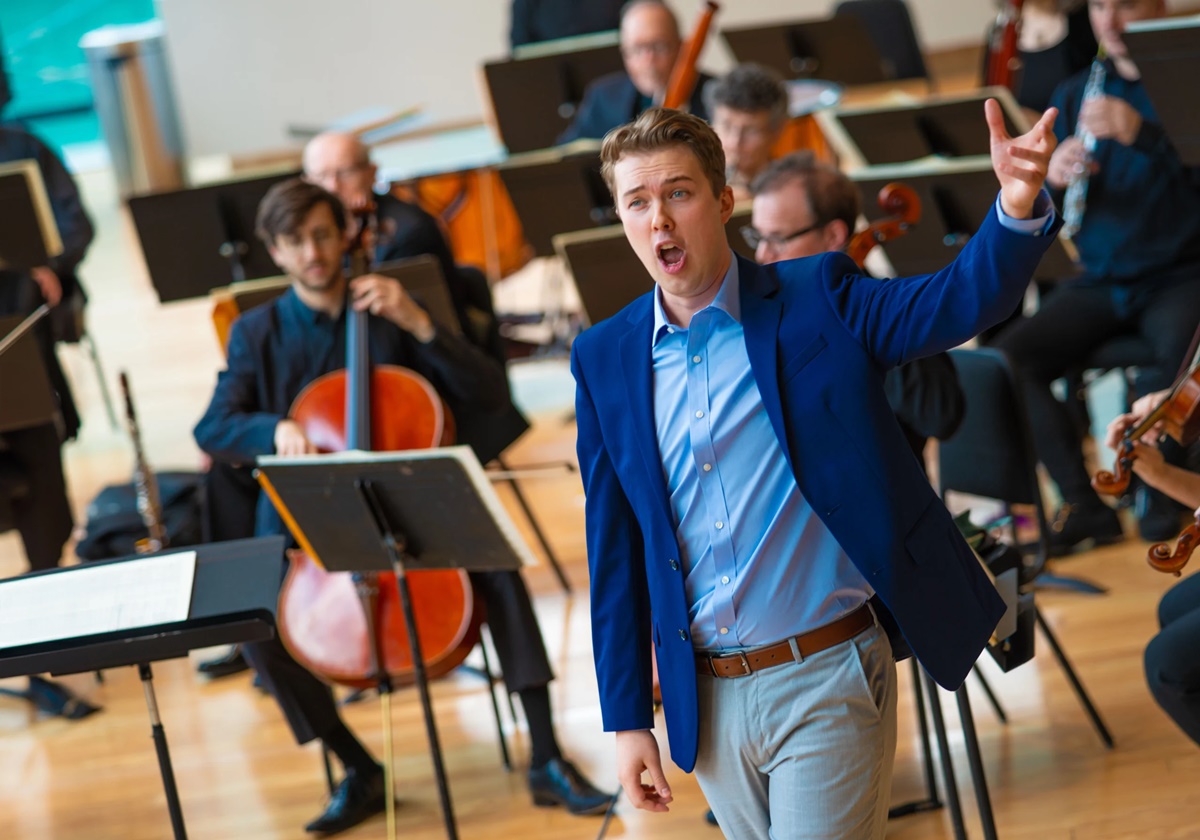
Ben Wallace, baritone
Baritone, conductor, pianist, and teacher Ben Wallace is a graduate of Wilfrid Laurier University, and is currently studying towards his Master’s degree at the University of Toronto with none other than Alain Coulombe.
He’s also a current member of the Ensemble Studio, having joined in the 2025/26 season.
Ben has performed with Highlands Opera Studio, Toronto City Opera, UofT Opera, Opera Laurier, Southern Ontario Lyric Opera, and the Kitchener-Waterloo Symphony. He founded a chamber choir and orchestra in 2022 which has so far premiered four choral works by Canadian composer Justin Lapierre. Ben has also served as music director for several musical theatre productions.
During summer 2026, Ben will be a resident artist at the Glimmerglass Festival, where he will cover the roles of Curly in Oklahoma! and Tommy McIntyre in Fellow Travelers.
Ben Wallace: The Interview
“I grew up listening to a lot of classical music,” Wallace says. He was introduced to the art form by his mother and grandmother.
“I remember seeing Messiah, I think I was in grade two or three when I first went.” It became an annual event. He also remembers seeing a production of The Magic Flute when he was a boy.
“My first big role was the Pirate King,” he recalls. It came in a production of Gilbert & Sullivan’s The Pirates of Penzance. “I got into musical theatre in high school.”
When he got to University, he studied piano at Laurier. “During my first year, I made lots of friends with singers,” he says. “I’ve always been really drawn to the theatre.”
Shifting his focus to opera seemed a natural step.
The Ensemble Studio Experience
Ben joined the Ensemble Studio in August 2025. “It’s been an absolute blast,” he says. “We arrived here in August, and that meant moving to Toronto for me.” He had been living in Guelph previously. “I kind of hit the ground running in August.”
With about two weeks of Ensemble Studio training, he became involved in a full fledged opera production. “I was plunged into my first opera.” It came in the COC’s production of Roméo et Juliette. “I was playing Paris. I didn’t have a huge number of lines, but it was my first opera.”
He notes that the Ensemble Studio training is comprehensive, and includes diction, breath, body work, and other aspects, along with singing.
“I was already getting used to these new trainers, and new ideas. Roméo et Juliette was a fantastic first experience.” He met singers he’d only seen previously on stage, from the audience’s perspective.
After that first production, it was back to intensive training, along with concerts in the Richard Bradshaw Amphitheatre. The Ensemble Studio members presented a version of The Barber of Seville.
“As a baritone, of course the Barber of Seville is one of my favourites,” he says. He’d performed it with the Highland Opera Studio previously. “That was probably a highlight of the year back in February.”
Wallace also covered Rigoletto early in 2026.
Werther: Brühlmann
In Werther, Wallace plays the role of Brühlmann. While he’s a minor character, Brühlmann plays a significant role in that he contrasts Werther’s journey in his romance with Käthchen.
“There are some fun scenes between Brühlmann and Käthchen,” Wallace says. “In Act I, they’re totally in love, and totally oblivious.”
By Act II, though, he’s broken off with Käthchen. “In Act II, Käthchen has left, and he’s hanging out with drinking buddies,” Ben explains.
But for Brühlmann, the split isn’t a tragic calamity. “He’s been that joyful guy, totally oblivious to sorrow. Then we see him again, and he’s really upset.” However, the emotion never reaches the dark depths of the titular character. He’s a kind of foil to Werther’s tragedy, while setting up the theme of love lost in the story.
Wallace is enjoying working on Massenet’s music. “I would say that I’m a big fan of French opera.” He points out that one of his first big roles at UofT was in the composer’s Cendrillon, as Cinderella’s father. “Getting to learn Massenet for the first time was something I really enjoyed,” he says.
“He’s very specific with his instructions. Sometimes it can be daunting how much detail he gives,” Wallace says. He’s found much to love in Werther and Massenet. “The romantic beauty of his musical language,” he mentions. “His approach to text.”
He points out that, while Cendrillon is based on a fairy tale, Massenet’s opera emphasizes the psychology of the characters. “When we think of the Disney Cinderella, we think of singing mice,” he says. “There’s a lot of emotional depth. Of course, that is evident in a much bigger sense in Werther.”
Next Steps
“I have so many goals in mind,” says the young artist. “Really what I’m trying to do, as much as I can, is view these two years as an enormous gift.”
It’s a chance to devote himself to vocal performance, and progress with the Ensemble Studio is constant. “There’s no shortage of new ideas that are presented to us,” he says.
Next season, he’ll have a new slate of role assignments, including working on Ariadne auf Naxos, and covering roles, including in the premiere of Empire of Wild.
“This summer I’ll be heading to the Glimmerglass Festival,” he says. “I’m very excited to have the opportunity to jump into various types of roles over the next year,” he adds.
“That’s the thing with opera. There are endless things to learn. As soon as you think that you’ve figured out your voice, something else will [come up],” he says.
“Progress is anything but linear.”
Performances
- Find tickets and show information for the Canadian Opera Company’s production of Werther, May 7 to 23, 2026, [HERE].
- Michael Colvin, Alain Coulombe, and Liz Upchurch will be reuniting on stage for a noon-hour performance at the Richard Bradshaw Amphitheatre on May 11; find details [HERE].
Are you looking to promote an event? Have a news tip? Need to know the best events happening this weekend? Send us a note.
#LUDWIGVAN
Get the daily arts news straight to your inbox.
Sign up for the Ludwig Van Toronto e-Blast! — local classical music and opera news straight to your inbox HERE.