
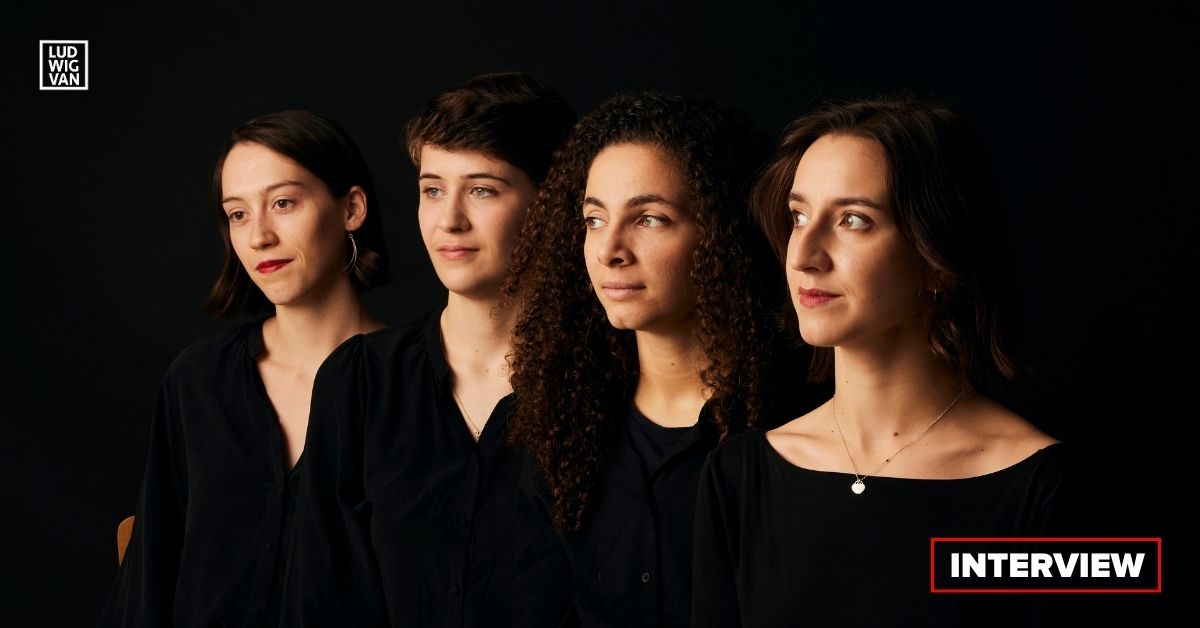
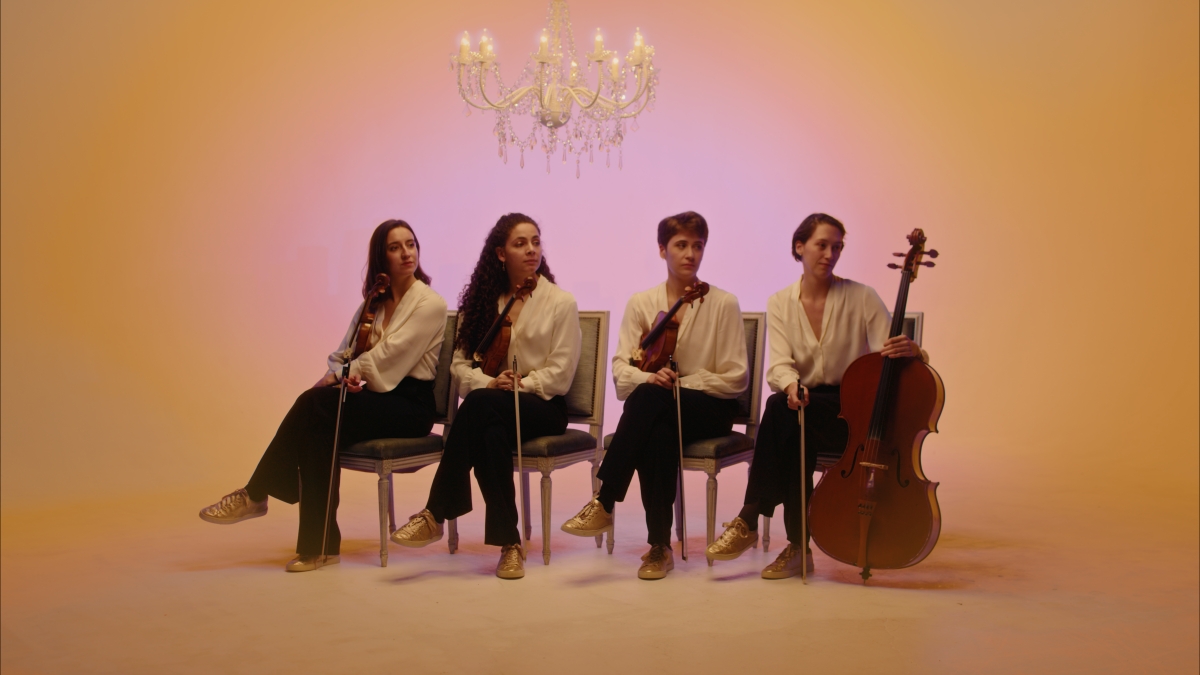
Quatuor Magenta is based on Paris, France, and was formed while the founding members were students at the Conservatoire National Supérieur de Musique de Paris (CNSMDP). The Quatuor is: Ida Derbesse (violin), Elena Watson-Perry (violin), Claire Pass-Lanneau (viola), and Fiona Robson (cello).
Robson is a native of London, Ontario, where she first studied music, and found her passion for chamber music at the Forest City School for Talent Education. She completed her Bachelor of Music in performance, with a minor in music theory, at the Schulich School of Music at McGill University in Montréal. She followed up with a Master’s in cello performance at the Conservatoire National Supérieur de Musique de Paris.
Quatuor Magenta is embarking on a Canadian tour — their second — that kicks off April 22 in Kitchener-Waterloo, and takes them to London, Hamilton, Ottawa, Montréal, and Cobourg before hitting Toronto on May 3. After that, they’ll head east to Halifax and Fredericton to finish the tour on May 9.
LV caught up with Robson to talk about the tour.
Tour Details
Quatuor Magenta was formally founded in 2021, and their performance calendar quickly filled with engagements across Europe. They were finalists at the International Joseph Haydn Chamber Music Competition in Vienna in 2023, and participated in the Geneva International Music Competition the same year. The Quatuor has studied with the Quatuor Ébène at their quartet academy at the University of Music and Performing Arts Munich, with the Quatuor Modigliani in the new Élite program at the École Normale de Musique de Paris, and with Rainer Schmidt of the Hagen Quartett at the Basel University of Music.
Program
The program for the tour reflects the multicultural roots of its members, and includes music by Polish, Canadian, German and French composers, with a spotlight on the work of women composers.
The tour program consists of:
- Dinuk Wijeratne (b. 1978): Two Pop Songs on Antique Poems (‘A letter from the Afterlife’ & ‘I will not let the go’)
- Grażyna Bacewicz (1909-1969): String Quartet No. 5
- Raphaël Merlin (b. 1982): La Jeune Fille
- Fanny Mendelssohn (1805-1847): String Quartet in E-flat major
and also:
- Joseph Haydn, String Quartet op.33 no. 2 in E-flat (Kitchener)
- Johannes Brahms, Piano Quintet op.34 in F Minor with Maxime Alberto, piano (Toronto)
Tour Dates
- April 22, 2026: Kitchener-Waterloo, ON, Kitchener-Waterloo Chamber Music Society
- April 24, 2026: London, ON, Metropolitan United Church
- April 26, 2026: Hamilton, ON, HCA Dance Theatre Performing Arts Sunday Series
- April 28, 2026: Ottawa, ON, Ottawa Chamberfest
- April 29, 2026: Montréal, QC, Concerts de la Chapelle Historique du Bon-Pasteur
- May 2, 2026: Cobourg, ON, Les AMIS Concerts
- May 3, 2026: Toronto, ON, Syrinx Concerts
- May 6, 2026: Halifax, NS, The Music Room Chamber Players Series
- May 9, 2026: Fredericton, NB, New Brunswick Summer Music Festival
Fiona Robson: The Interview
Quatuor Magenta first came together during the COVID pandemic.
“It was just after the first COVID lockdown that it started,” Robson recalls. She and first violinist Ida Derbesse are founding members. “I think we were all very starved for connections at that time.”
A string quartet is a close knit group. “It’s the most intimate way of playing,” she says. “We rely on each other. It’s as integrated as you can get.”
The pandemic may have been the catalyst, but the idea of being in a quartet had already been forming for some time. “All of us, in our own ways, had been dreaming about forming a string quartet,” Fiona says. She says she’d been considering it since her days at McGill University.
For a string player, there are multiple advantages.
“There’s so much amazing repertoire. All the flexibility, but it’s much more personal,” she says. It’s also a group where everyone plays a part. “It’s a little democracy.”
Canadian Tour
The current tour is their second in Canada. “25% of Quatuor Magenta is Canadian,” she points out.
Back in 2024, Robson says they performed six concerts in Ontario, Quebec, and Nova Scotia. The 2026 tour adds to the agenda.
“This time it’s nine,” she says. “New Brunswick will the new province on the tour. Which is fun because they’re also French,” she adds. “One of my proudest accomplishments is becoming fluent in French.”
Planning a tour in Canada brings its own set of challenges. “Canada always has that geographical problem,” she laughs. Still, they’re planning on extending their reach the next time around. “Hopefully next time — it’s in the works for 2028 — we’ll work in the west coast,” Robson says.
The Quatuor did make it to Banff in 2025, where they competed in the prestigious Banff International String Quartet Competition.
“That was incredible. It was the quartet’s second visit to Canada It’s a really magical place. It’s so beautiful and the facilities are fantastic. And the competition is the most well organized and kindly competition that we have ever experienced.”
The congenial atmosphere included lunching and hiking with other competing musicians. “We were practising, and there were elk outside the window,” she recalls.
Fiona says the audience members made the trip from both Canada and the US. “The audience that makes the pilgrimage out to Banff to see the competition is so incredible. It reinforced our wish to continue to meet these Canadian audiences.”
Repertoire
“There’s a few special reasons behind all these different choices,” Fiona says of the music they’ll be playing on the tour.
Raphaël Merlin’s La Jeune Fille is a new work. Raphaël Merlin is the founding cellist of the Quatuor Ébène, and mentor to the Quatuor.
“It’s our first commission as a string quartet,” she says. Merlin completed it at the end of 2025, and the Quatuor premiered the piece in Paris in January. “Raphaël is an amazing composer, he’s also the founding member of the Ébène Quartet. They are some of our most important musical mentors. Raphaël was one of our first teachers when we were just a baby quartet.”
The work is a special commission for Quatuor Magenta. “It’s very cool playing music written by a string quartet player,” Robson says. “And it’s a very interesting piece.”
It was written in an homage to Winnaretta Singer, daughter of the founder of the Singer sewing machine empire, who lived in Paris at the turn of the century. Fan of Beethoven, and friend to people like Nadia Boulanger, and Gabriel Fauré, Winnaretta married a prince and became Princesse Edmond de Polignac. A vocalist herself, she ran a famous musical salon, and commissioned many works, including Ravel’s Pavane for une enfant defunte.
“When she died, she left her home, this mansion in Paris, to a foundation,” Fiona says. It’s now the Singer-Polignac Foundation. “We entered into a residence in Paris there through Raphaël.
He was inspired by her and the music that she loved.”
She notes that La Jeune Fille quotes music from both Beethoven and Fauré, while also incorporating Merlin’s own jazz-influenced style. The title is a reference to Schubert’s La jeune fille et la mort.
“It’s the maiden without the death,” she says. “Un homage to Singer’s generosity and love of music.” The Quatuor Magenta just finished recording the work.
Dinuk Wijeratne’s music is included not only for his Canadian link. “We really love contemporary music,” Robson says. The program features pieces that reflect the backgrounds of the quartet’s four members, as well as linking to the places they will perform.
Robson met Wijeratne a few years ago. She’s looking forward to playing his pieces. “It’s a lot of fun. In the music, he wrote a little forward, the idea was to use the instrument of the string quartet to find the groove and rhythm.”
By coincidence, Wijeratne’s piece is also melodically inspired by Schubert’s Death and the Maiden. They had already added the piece even before Merlin had written his. “He really riffs on them as if they were jazz,” she says. “It ended up being a really perfect combination.”
Grażyna Bacewicz’s piece was added simply out of love. “We are absolutely in love with it. It’s not played enough,” Robson says. “She wrote seven string quartets. It’s very unique and beautiful, and well constructed.”
Bacewicz, as she points out, was a violinist herself. “It has a lot of similarities with a lot of music from the 20th century,” she notes, at the same time pointing out its unique colours and rhythms. The Quatuor plans on including more of her string quartets into their repertoire in the future. “We’re working on our second and third.”
Fiona says it’s about learning the composer’s musical language. “It really does feel like learning a language. It gets richer and more fun, the more we learn it.” Learning all seven of Bacewicz’s quartets is the end goal. “It’s our major project right now.”
Fanny Mendelssohn is gaining in popularity as a composer, finally receiving her due. “Obviously she’s more over shadowed by her brother Felix,” she says. Fanny was one of the first women composers to be accepted into the classical canon.
For Toronto’s recital, the Quatuor Magenta will also include Brahms’ Piano Quintet, performed with pianist Maxime Alberto. “With that, we’re collaborating with Maxime Alberto, who’s a French pianist,” she says. The connection comes via concert organizer Syrinx Concerts.
Performing in Canada
Comparisons are often made between Canadian and European audiences, but Robson sees both as being quite similar.
“I think, it’s pretty similar to what we hope people will get from all of our performances,” she says.
Quatuor Magenta will preface each piece with a short description that adds context.
“In this particular program, I feel really hopeful in the ways that the pieces sort of dialogue with each other,” she says. Each certainly has its own fascinating backstory. Robson feels that it’s a good way to help audiences dive into contemporary works.
“Modern pieces […] when contextualized and played with a lot of spirit and energy, which is how we plan to play them, I think people will love them,” she says.
“I’m just really excited to introduce people to music that they’ve never heard before.” Each of the new works, she mentions, comes from a composer who is fully cognizant of the history and continuity of work that they draw from.
The quartet are also excited to be performing on a new set of instruments courtesy of French foundation Musique et Vin au Clos Vougeot. “We’re excited. We recently got loaned a set of instruments.” They’re made by German luthier Stefan-Peter Greiner.
“They commissioned Greiner to create four instruments to be performed together,” she explains. The wood for all four instruments was taken from only two old trees. She calls it a dream to perform on instruments made from wood that has grown and matured side by side over the decades.
“Now we’re making it vibrate with music. It’s a pretty profound feeling.”
Details
- Find tour dates, with ticket links, [HERE].
- Ticket information about their May 3 Toronto concert [HERE].
Are you looking to promote an event? Have a news tip? Need to know the best events happening this weekend? Send us a note.
#LUDWIGVAN
Get the daily arts news straight to your inbox.
Sign up for the Ludwig Van Toronto e-Blast! — local classical music and opera news straight to your inbox HERE.