
Game On! at Toronto’s Aga Khan Museum looks at games, and the myriad ways they enter into our lives, cut across cultures, and human history.
The exhibition takes its inspiration from the Toronto’s role as co-host of the FIFA World Cup this summer. It includes more than 100 artifacts and works of art, culled from major institutions in the United Kingdom, United States, Europe, Malaysia, including the British Library, the Art Gallery of Ontario, the Metropolitan Museum of Art, the Los Angeles County Museum of Art, and the Islamic Arts Museum Malaysia, and the Museum’s own collections.
Contemporary art works, including commissioned pieces, add to the perspective.
What they have in coming is the notion of the game — how they’re conceived, how they’re played, and how they’ve developed and evolved across world cultures. The items on display represent centuries of gaming.
The exhibit opened in early April, and runs all summer through September 7, 2026.
Games
Games are a universal part of human experience — yet, we tend to downplay their importance or significance. It’s just a game, after all…
On a closer examination, though, they serve a lot of important roles, and have throughout human history.
“[That’s] one of the reasons that we thought it’s a good idea to focus on a topic of games. It’s such a universal language. It’s a space that kind of connects us together, no matter of our background — it doesn’t only connect us with one another, but throughout history, so it’s a way for us to look back at our roots and history, and also today, it brings that shared space, that equal space for us to come together,” explains Aga Khan Museum curator Bita Pourvash. “But, also there are so many other things that games do for us in life. So there’s a way of teaching life skills, values, passing on heritage, passing on basically that knowledge that one generation passed to the other.”
Leslie and Gareth “Play It By Trust” (Ono, 1966-2009) at the Imagine/Peace John Lennon and Yoko Ono exhibit in Montreal in 2009:
What You’ll See
The exhibition is organized into three broad themes, including “The Board,” “The Quest,” and “The Arena”. It looks at various games, including their origins, where they’ve travelled across the globe, how they’ve changed and adapted.
Yoko Ono’s Play it by Trust greets visitors after they climb the stairs to the second floor, specially decorated with snakes and ladders and other game specific visuals.
Ono’s work is essentially an all-white chessboard on an all-white table and chairs. Ono created the work as a response to world events back in 1966, when the Cold War still raged.
“So imagine if you’re playing that game after a while while you lose track of which pieces belong to whom. And then from that point on, you have to just talk it through, and then with collaboration and trust, you continue the game,” Pourvash explains.
The exhibit then examines the various parts of a game, and the different types and formats. There are physical games, for example, which can involve board games. An Indian manuscript dating back to 1470, on loan from the British Library, depicts children playing a stick game that uses wood and other easily found items, pointing out that games can be created without a lot of materials.
There are centuries old drawings and illustrations of wrestling and horse races from Iran and Pakistan, a painting from India ca. 1805 of women playing chess.
“But we talk also about values in game, fair play, equality within the game and how games create that equal space for us that we have to constantly watch to make sure that equality within this game also remains,” Pourvash says.
The Board
The exhibition unfolds in three sections, each examining specific games in depth.
Board Games talks about mancala, chess, and backgammon. Mancala is a simple game that can use a board, or simply be created with shallow holes dug in the ground, along with stones, seeds, or shells. Large scale photographs emphasize the social aspects of the game — people gather around to both play and watch. One photo depicts a large group of children playing in Ghana in 1959.
“But then again, the same game has inspired so many artists to create wonderful game boards,” Pourvash says.
There is a beautifully intricate wooden board from Sri Lanka from the late 19th century carved into the shape of a fish, on loan from the British Museum. Another wooden board dates back to historic Palestine in 1910.
The exhibit branches into a round area that lets you explore chess and backgammon in the order you choose as you turn either left or right.
Chess dates back to at least the 6th century in India, known as chaturanga. From there, it travelled to pre-Islamic Iran, then through the Muslim world until it reached Europe. Plaques on the walls of the museum briefly describe the variations of each game, while historical artifacts are displayed throughout the space. There are also two modern chess sets where visitors can sit down and play.
An Iranian set dating back to the 12th century is one of the earliest surviving complete chess sets. It’s on loan from the Metropolitan Museum of Art in New York. Other chess sets and pieces come from 12th and 13th century Iran and Egypt. There are sets created in silver, and carved in wood and ivory.
As it travelled, the game took on different qualities. “[We look at] the global journeys of these games, and how through that journey they connect us also throughout different times and different communities, and then how each community added their own marks to these games and then they turn out to be the games that we know today,” Pourvash explains.
She points out that the Queen piece only came into existence once the game reached Europe. Before that, the pieces had different roles and names. Today’s chess players generally use the Staunton set designed in 1849.
According to literature, when chess journeyed from India to Iran, it came as a royal challenge. In response, the Iranian royals came up with backgammon in about the 7th century. The role of dice was introduced, which adds elements of chance. As Pourvash points out, however, dice have also been used to explore notions of probability, and in other scientific studies.
Along with pieces like a gorgeous Syrian backgammon board made of wood, veneer, bone, and mother of pearl inlay, a painting from Jan Steen is put together with a 16th century painting from the Museum collection, and a photograph from 19th century, all depicting gatherings of people, from little European girls to old men with pipes halfway across the world, all gathered around to enjoy a game.
An interactive display lets visitors explore the history of each game, trivia, and play. QR codes, displayed throughout the exhibit, allow for a dive into various topics as they come up.
There’s a Canadian connection with music, and composer John Cage. Reunion is an electrified game board conceived by Cage, who reached out to a student at the University of Toronto to create it. The chessboard is equipped with light sensors, and is electrified. When it was first presented in 1968, Cage invited French-American artist and professional chess player Marcel Duchamp to Toronto. Musicians played, guided by the movement of the chess pieces. While the musicians themselves remained in the same spot, the sounds were redirected to different points within the space. Cage’s experiment used the element of chance, as it exists within the game, to create music.
The Quest
This section looks at “games of virtue and growth”. Some of these games don’t require physical boards or set ups.
“There are three games that are highlighted here. One is the game of poetry, which is still very much common in Persian and Arabic speaking countries,” Pourvash says.
In one of the exhibit areas, a wall of poetry and word games teaches visitors how to play. Pourvash points out that this type of game serves an important purpose in preserving language and culture across generations.
Snakes and ladders is a game with an interesting history that dates back to 13th century India, based on the Hindu and Jain traditions. The game represents choices made in life, with the ladders depicting virtues, and the snakes, vices.
It was later adopted by the Sufi tradition as Shatranj-i ‘Urata, or “chess of the gnostics”. The goal is for a player to build themselves up with virtue to become closer to the divine. That moral centre carried through to Europe in the Victorian era, where the game was about moving down the board for negative acts, and moving up with the positive.
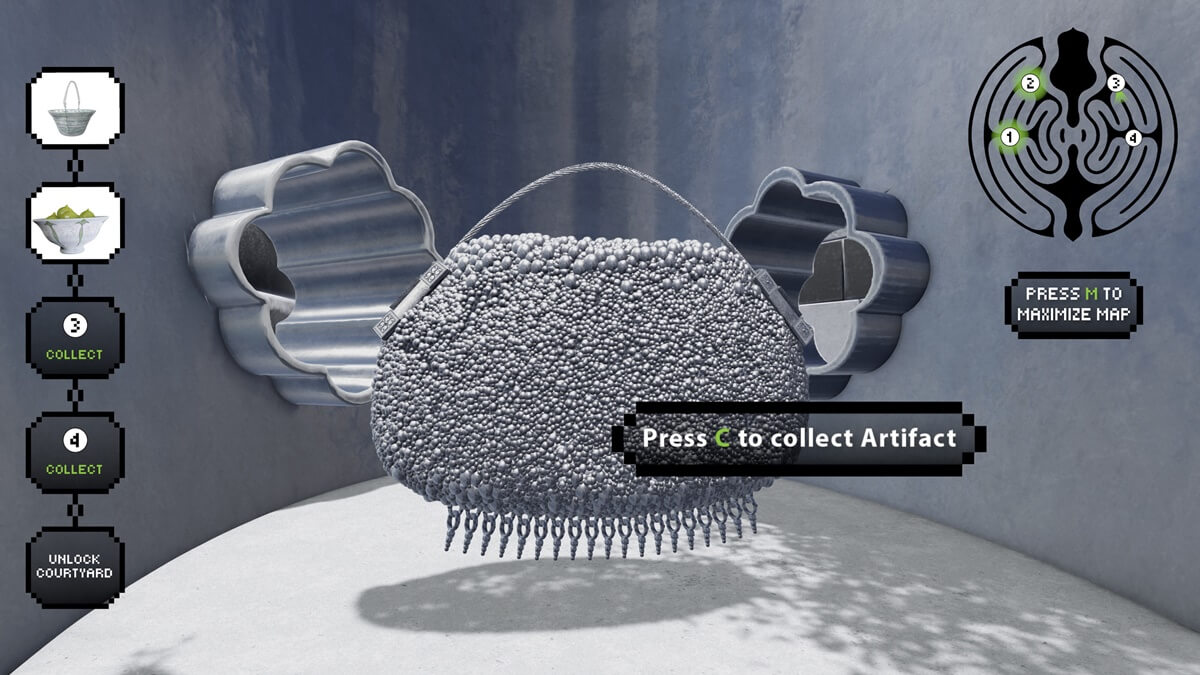
This area includes Damask Rose by Canadian-Syrian artist Jawa El Khash, a work that was commissioned for the exhibit. It’s a digital game that uses storytelling and exchange via a live simulation, based on reimagining the 18th-century fountain of the Azem Palace in Damascus.
There are two stations set up where visitors can play. The game presents a maze, which uses an idea based on historical documentation. People would place rose petals in the waters of the fountain, and the winner was decided by how the petals moved. In the game, you collect Syrian artifacts inspired by pieces in the Museum’s collection. As you do, a prompt appears, and if chosen, El Khash shares observations and memories about her upbringing in Syria. Players come to know her through her culture and heritage.
She created the game with a realistic soundscape that she recorded on a real world visit to the palace, including bird and water sounds, among others.
The Arena
This section looks at physical games, including wrestling and polo, along with falconry.
There are illustrations of wrestling from 16th century Uzbekistan, and 15th century Iran. The figures wrestle other humans, their enemies, and demons. A contemporary art work depicts the concept of Zurkhana, the traditional Persian “house of strength” (aka gym), first practicing wrestling as a martial art, but later adding elements of Sufi spirituality.
As Pourvash points out, it creates the idea of a hero-champion that resonates today. A decorative leather armband, adorned with a gemstone and borrowed from the British Museum, was given as a gift in recognition of a wrestler’s strength and character. Quranic verses inscribed on the leather are meant to keep the wearer safe from harm.
Ceremony and ritual has always been a part of wrestling, even in Western commercialized versions like the WWE.
Polo is a courtly sport, another game that crosses cultures. A 16th-century folio from the “Shah Tahmasp” Shahnama (Book of Kings) by Firdausi, depicts Prince Siyavush in a royal polo match before King Afrasiyab.
Polo is one of the earliest ball and stick games, and team sports. The exhibit includes figurines and manuscripts from ancient Iran and India that show women played polo with men, breaking from the usual separation of genders.
Horsemanship is obviously part of the game. Detailed manuals from 14th century Mamluks and onward describe how to train and take care of horses for the purposes of polo. The animals were often gifted to royalty or diplomats.
It’s similar in many respects to falconry, for which there are also numerous examples of historical manuals. Along with the books, the exhibit displays some of their accoutrements, including hoods, bells, and other decorations. Falconry has existed for about 4,000 years, and is recognized by UNESCO as an “intangible cultural heritage”.
Falconry journeyed from Central Asia, where it is believed to have originated, and eventually came to Europe. It represents many things, among them, the companionship between human and bird. The fact that the falcon can fly free, but always returns to his handler, has been used as a metaphor for everything from just rulers and kings to the free spirit of Sufism.
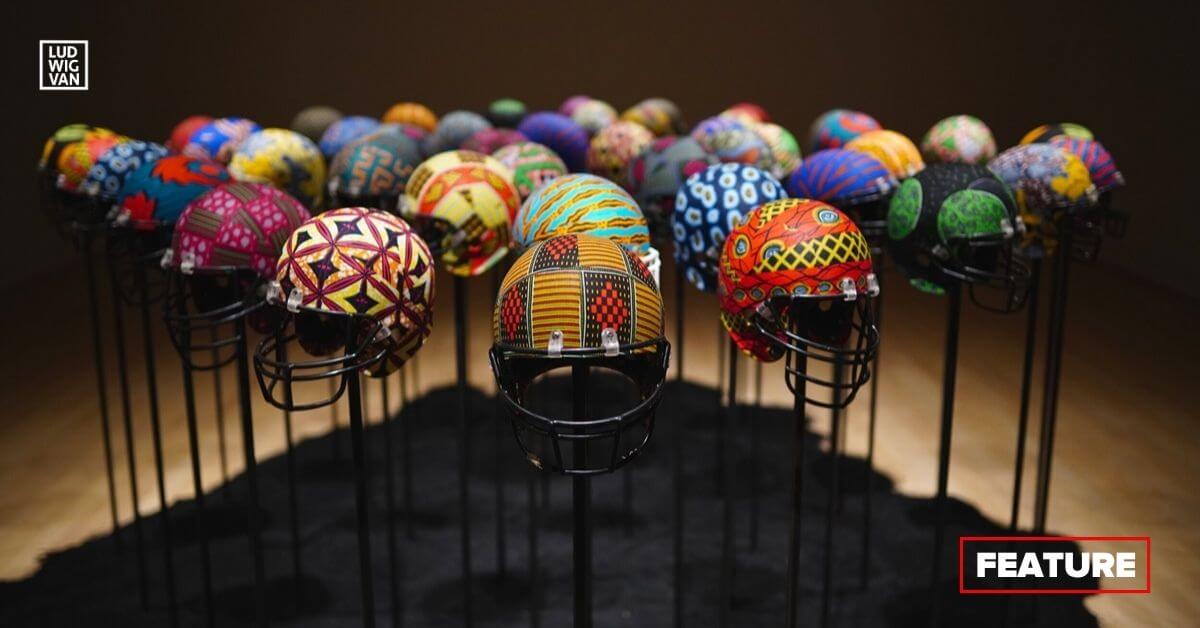
After falconry, the exhibit closes with a contemporary work, Glorious Bones (2019) by Esmaa Mohamoud. It’s an installation that draws attention to the fact that, while games can create equal space, there is no guarantee of equality within them.
“Her work is made from 46 football helmets, that she removes the padding so there’s no protection involved,” Pourvash says. They’re placed on poles. “But then, the helmets are covered in this textile that kind of makes them glorified,” she adds. The textiles are based on various African patterns. “No matter how you enter that space, they’re always having their eyes on you.”
Special Events
- If you check out the exhibit between June 16 and July 12, you’ll also see the Great Canadian Jersey, a hockey jersey handcrafted by former OHL player and designer Cameron Lizotte. It depicts the seven Canadian NHL franchises, along with some of the notable players. Find out more here.
- On July 1, you can also check out the Rhythms of Canada Festival, offering a global smorgasbord of music frm 10 a.m. until 5:30 p.m. Find out more here.
- Find more details about the Game On! exhibition [HERE].
Are you looking to promote an event? Have a news tip? Need to know the best events happening this weekend? Send us a note.
#LUDWIGVAN
Get the daily arts news straight to your inbox.
Sign up for the Ludwig Van Toronto e-Blast! — local classical music and opera news straight to your inbox HERE.


- SCRUTINY | Guild Festival Theatre: Brontë: The World Without Offers A Portrait Of The Lives, Trials & Triumphs Of The Brontë Sisters - July 20, 2026
- INTERVIEW | Violinist Mark Fewer Talks About His Upcoming Release Of Bach Solo Sonatas & Partitas, Canadian Luthiers, And More - July 17, 2026
- PREVIEW | The Mandle Philharmonic Offers Mahler’s Resurrection Under The Stars - July 17, 2026