
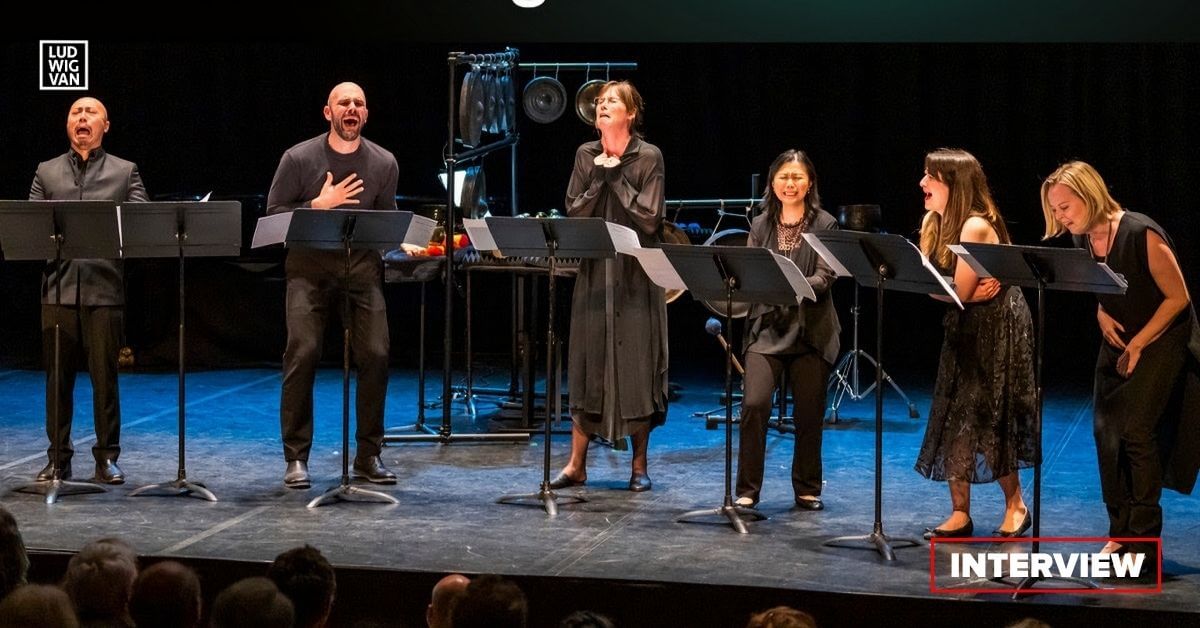
Soundstreams’ next concert is titled I Want To Tell You Everything: An Anthology of Love Songs. Featuring seven singers, piano, and percussion, the concert explores notions of love, identity, connection, and expression through the works of Canadian composers Nicole Lizée, Thierry Tidrow (who wrote the title song, a world premiere), Claude Vivier, and Ana Sokolović.
It takes place April 9, 2026, emphasizing vocal storytelling with the talents of Vania Chan (soprano), Carla Huhtanen (soprano), Lindsay McIntyre (soprano), Robin Dann (mezzo-soprano), Bud Roach (tenor), Keith Lam (bass), and Alex Samaras (bass).
On the program:
- Claude Vivier’s Love Songs and Shiraz — inspired by his travels through Japan, Indonesia, and Iran.
- Ana Sokolović’s Dring! Dring! — an imaginative work that turns smartphone obsession into musical satire;
- Nicole Lizée’s Want Want Want, Ironic Butterfly, and Break-Up Music — excerpts from her Karappo Okesutura, Vol. 3, which draws from pop culture and music, and nostalgia;
- Thierry Tidrow’s I Want To Tell You Everything — the world premiere of a work that pushes the sonic envelope.
The performance includes David Fallis, Music Director, Gregory Oh, piano, and Noam Bierstone, percussion.
LV caught up with composer Nicole Lizée to talk about the work.
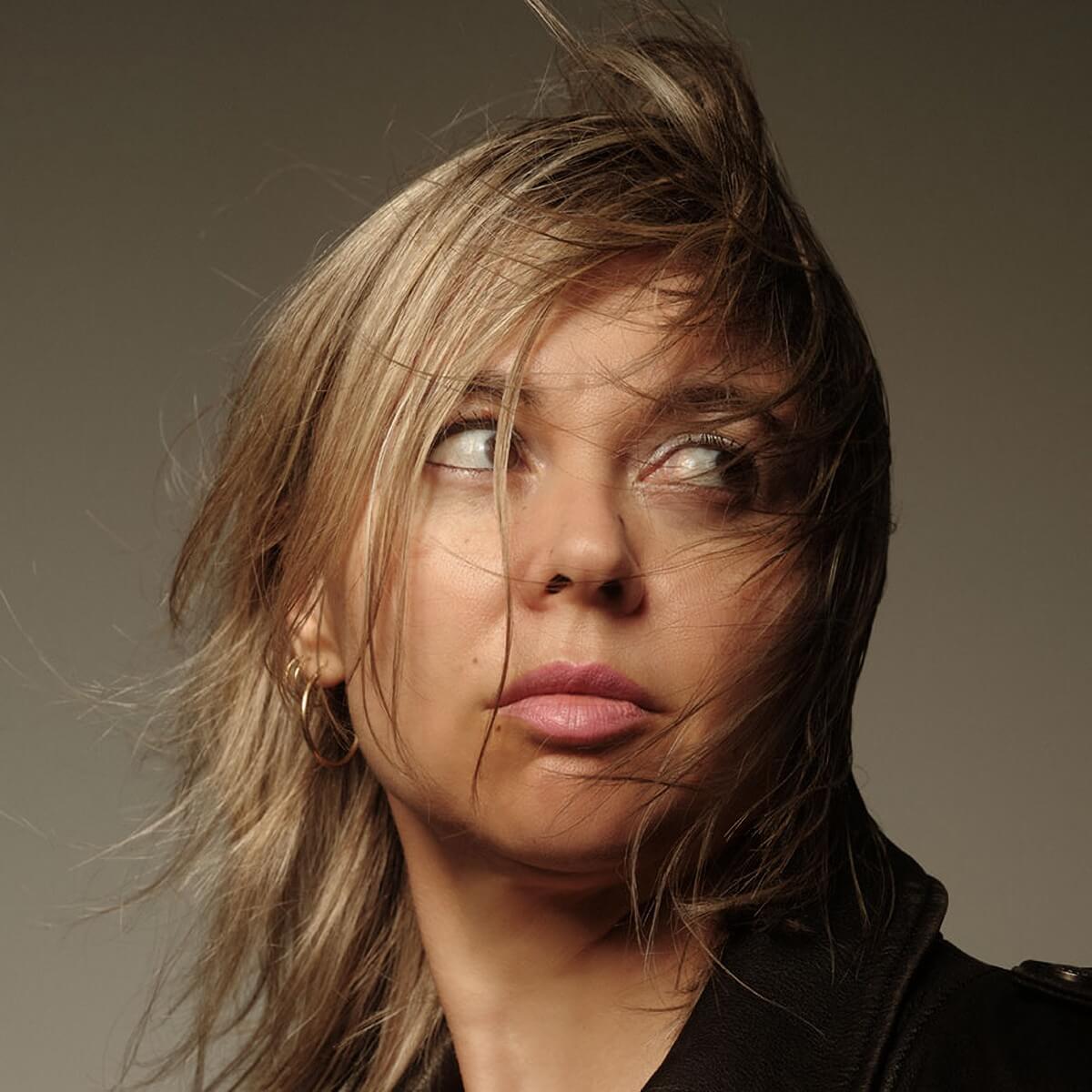
Nicole Lizée
Canadian composer Nicole Lizée was born in Gravelbourg, Saskatchewan. She earned a Master of Music degree from McGill University, and is now based in Montréal.
Lizée has built an international reputation with imaginative compositions that often take their inspiration from diverse pop culture sources such as films by Alfred Hitchcock and Stanley Kubrick, rave culture, and MTV videos.
Her works have been commissioned by the Kronos Quartet, the San Francisco Symphony, the National Arts Centre Orchestra, the Toronto Symphony Orchestra, the Montreal Symphony Orchestra, the Gryphon Trio, the Société de musique contemporaine du Québec, and Eve Egoyan, among others.
Nicole Lizée: The Interview
Karappo Okesutura Vol 3 was commissioned by the Australian Art Orchestra, her third commission from the ensemble. But, Karappo Okesutura first began back in about 2005.
In an interview with David Jaeger about the project, she describes it as something like singing karaoke with a broken machine.
“That’s exactly it,” says Lizée. “I’m really drawn to events and phenomenons or microcosms that are sociological,” she continues. “Karaoke — it requires equipment and it requires preparation. It’s very serious.”
When her fascination with karaoke began, it was still gaining popularity in North America as a widespread entertainment option.
“At the time, Karaoke was such an experience,” she says. The organized, even ritualized, aspects of it became a point of interest. “The fact that karaoke tapes and tracks exist primarily for those events — but I could also order them.”
She began amassing a collection of karaoke tracks.
“When i started collecting them, certain things happened.”
Without the lead vocals, she explains, the songs take on a different identity. Any melody can be superimposed on it.
“I started to mess with the tapes and splice them. The identity of the song was still there, but it went down a portal.”
The original track was transformed, and elements like the back-up vocals and other supporting musical lines that would normally be obscured by the lead vocals, came to the fore. Live performance brings it back to its original purpose.
“At the end of this, I wanted to place the karaoke singer, the star of the event, back into the equation,” she says.
The vocalist sings over a “deeply flawed and problematic tape”, but in the end, keeps up with all the changes. “It touches on the identity of the songs, and also the performance. The songs are still there, but it takes on a whole new shape.”
As Nicole explains, the primary elements that make up the song are still present, but the live performers reinterpret and reharmonize the melody. She also like to take elements of the original song that were present, but in the background, and put them in centre stage. “The background harmonies became the lead roles.”
Other include elements can include hand claps, which, along with the ooohs and aaahs of background vocals, were carefully crafted, she points out.
With three volumes of the work, the karaoke inspiration has obviously proved a fruitful source. “I went down a huge rabbit hole,” she says.
Karappo Okesutura, performed in 2015:
Where It Began, How It’s Going
As her fascination grew into a collection of altered and transformed karaoke tracks, Lizée looked for a performance opportunity.
“I wanted to have a karaoke night to showcase all the research I’d done. My obsessions!” she laughs. She says the first karaoke night was supported by a number of organizations.
“It was really well received. Nothing had been done like that at the time,” Nicole says. “It led to Volume 2.”
Like Volume 1, the effort was supported by multiple organizations, and was essentially an extension of Volume 1. Volume 2 was performed at a few locations. Volume 3 was directly commissioned by the Australian Art Orchestra in 2019, and developed at Banff Centre for Arts in early 2020. It was premiered by Soundstreams in Toronto, and subsequently released as a recording in 2025.
“They had performed Volume 1 and 2, and they really wanted their own,” she explains.
The decision was made to focus on karaoke tracks of Canadian and Australian pop songs of the 1990s. It was a return to the music of her teenage years.
“My favourite bands were Canadian, and as it turns out, Australian as well.” She notes that both Canadian and Australian pop songs had a distinctive presence and character. “It was a no brainer.”
Choosing The Tracks
“There’s always a very extensive, very laborious process of narrowing them down,” Nicole explains.
For the purposes of the AAO commission, Volume 3 was to be about 90 minutes long. Along with the transformed karaoke tracks, Lizée incorporated excerpts from Canadian films.
“To select those songs was very, very difficult. I create a pile of many, probably 100 songs, and go from there. It’s a very painful process,” she laughs.
Choosing the final list boiled down to what worked best. “[I] just went with what took shape, and I could imagine the singer and the ensemble. Honestly it could have been three hours long.”
Want Want Want, Ironic Butterfly, and Break-Up Music are the excerpts that Soundstreams will present as part of the concert. The titles may or may not refer to the original song.
“Part of this is also that I create my own titles. When they come out the other end, I don’t use the original title.” As she explains, with the background vocals taking over from the original track’s lead, with missing parts and disrupted rhythms, and the electronic glitches she often inserts, they really can’t be presented as the original song.
She bases her titles on the finished product. “After that process, what do these mean to me?”
It also refers back to the original idea — the various elements that go into a karaoke night in a club.
“It also taps into the fact that, when you go into a karaoke night, you don’t know what the next song will be,” she says. “That’s part of the surprise. Sometimes it’s wrong on the screen too.”
Lizée adds to the effect by introducing other unexpected elements like duets.
“I do always like the idea of a special guest. There has always been a special guest, an audience member [or other person].” She notes the prominence of duets in pop music of the 1970s and 80s. “There’s something very beautiful about that. You don’t know who the guest is, or when they’ll come in. There’s always that element of mystery and surprise.”
For Ironic Butterfly, she pushes the role of the bass line. “I wanted to take that supporting bass line and put it in the forefront.”
Final Thoughts
The Karappo Okesutura project in all its iterations has been a hit with both audiences and performers. Volume 3 has an added appeal.
“[It really resonates], sonically and with people. I think there’s a lot in Canadian music and Australian music that’s very meaningful.”
Volume 3 also takes the idea into new dimensions.
“It was important for me, with each subsequent volume, I wanted to delve deeper and do something different.” That means more damage and alteration to the original track.
“There’s the aspect of virtuosity,” she says. “What does it mean to have to synchronize and dialogue and harmonize with an increasingly glitchy machine?” she asks.
“Essentially, everything became more difficult and virtuosic. It really showcases the skill set of the performers, and the singers.”
The music sometimes skips beats, and the singers have to keep up with all the changes. “I didn’t want to smooth over any of the glitches,” she says.
In Karappo Okesutura, the live performers add the human element to the modified track. “What it means for a human performer, a fantastic performer, what it means to exist with a machine — to transcend the machine,” Lizée says.
“At the same time, I wanted to keep the spirit of the karaoke tape.” Karaoke, as she points out, is about connecting with other people, and allowing yourself to become vulnerable. “There is definitely a support system, and a judgment. It’s an emotional experience,” she says. There is an element of ritual and ceremony about a karaoke night that goes beyond what its original creators imagined. “It’s like nothing else.”
It’s an experience that continues to inspire her.
“Now, I want to go and do karaoke,” she laughs.
- Find tickets and show details about Soundstreams I Want to Tell You Everything on April 9 at Jane Mallett Theatre [HERE].
Are you looking to promote an event? Have a news tip? Need to know the best events happening this weekend? Send us a note.
#LUDWIGVAN
Get the daily arts news straight to your inbox.
Sign up for the Ludwig Van Toronto e-Blast! — local classical music and opera news straight to your inbox HERE.

- THE SCOOP | Sistema Toronto Teams Up With NB Distillers For A Fundraiser - April 8, 2026
- INTERVIEW | HPO Executive Director Kim Varian & Music Director James Kahane Talk About The Centre For Musical Leadership - April 8, 2026
- PREVIEW | London Symphonia Presents The Brahms Effect With Tom Allen - April 8, 2026