
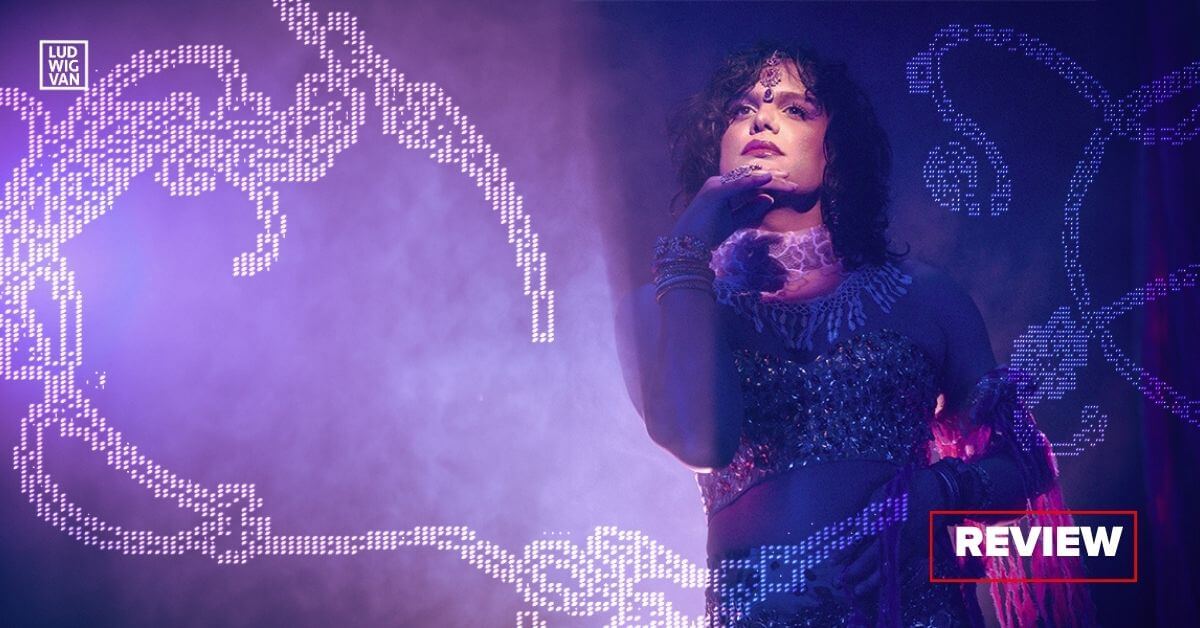
House of Beida Inc and Buddies in Bad Times: Kainchee Lagaa + Jhooti: The Begging Brown Bitch Plays. Created by Zaiba Baig, with Angel Glady, Praneet Akilla, Xina, Zaiba Baig, directed by Tawiah Ben M’Carthy. April 6, 2026, continues until April 19; tickets here.
While watching The Begging Brown Bitch Plays, a double-bill written by Zaiba Baig now playing at Buddies in Bad Times, I recalled a line by the critic Hilton Als.
“Part of the excitement for the artist who longed to be seen and not was living in a world of secrets,” he wrote of the late Diane Keaton. “If you have secrets, you get to pretend you don’t.”
That sentiment courses through these two closely-related plays: the 75-minute Kainchee Lagaa — an Urdu phrase meaning “struck by scissors”— and the 60-minute, one-person show Jhooti — a word for a woman who lies.
Directed by Tawiah Ben M’Carthy, and co-produced by House of Beida, the show marks Baig’s return to the Toronto stage since their 2018 debut play Acha Bacha and the critical acclaim of their 2021 CBC TV series Sort Of.
“This is my reintroduction to the world as the angry, deeply sad person I am right now,” they recently said in an interview. “The nice girl in me died.”
Kainchee Lagaa
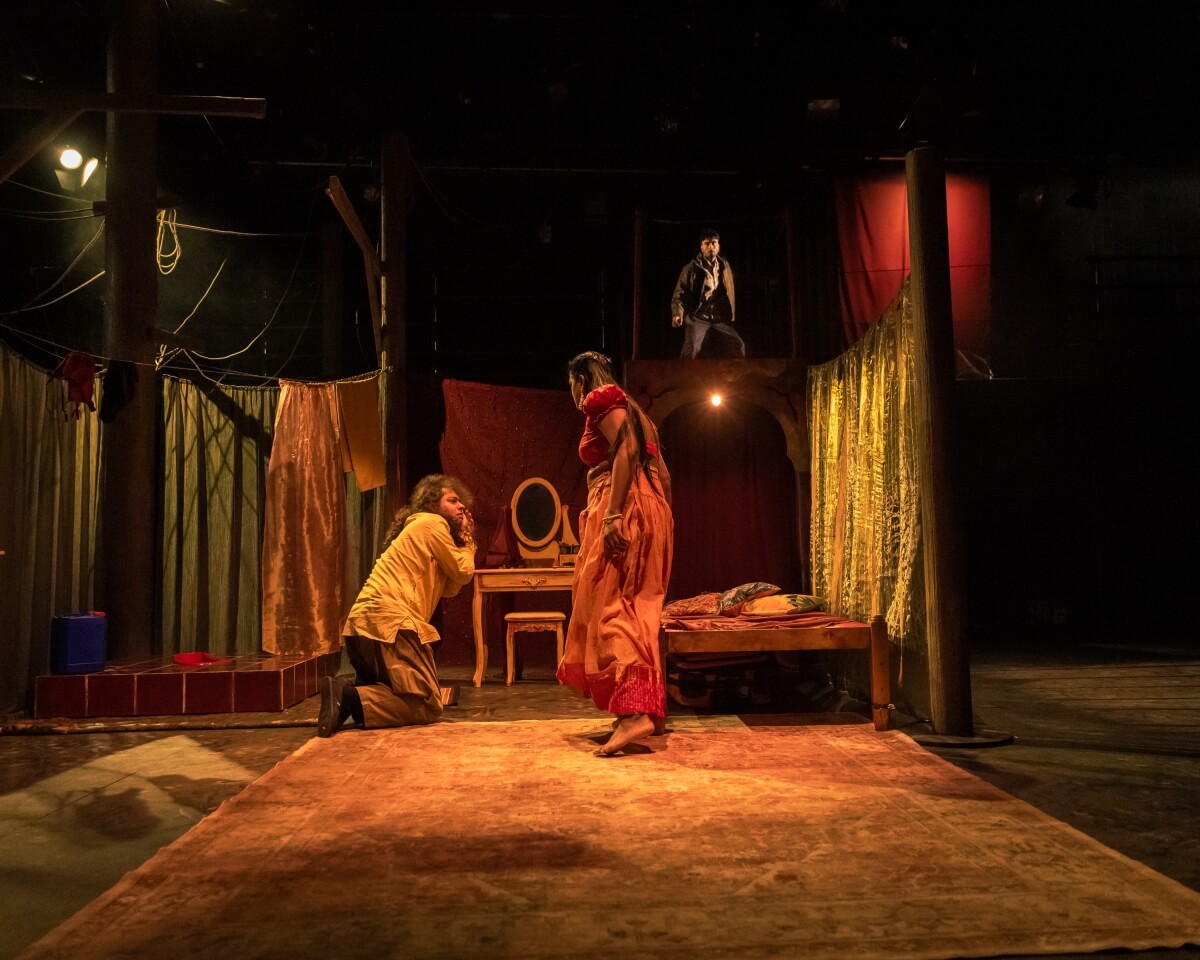
Kanichee Lagaa alternates between two souls gradually making their way to each other: Billo (Angel Glady), a feisty sex worker trying to leave Lahore’s red light district and Arsalan (Praneet Akilla), a jittery second-generation man riddled with doubts in Etobicoke.
Rachel Forbes’s set renders Billo’s cramped flat through pillars draped in silk curtains, containing a florid kitchen, bathroom and bedroom, while Arsalan’s scenes unfold in the gallery above marked by concentrated lighting (André du Toit) and disorienting sounds (Dasha Plett).
One after the other, from below to above, they address an audience, who serve distinct purposes to each of them. For Billo, they are a “tourist friend” who, if not participants, are witnesses to her waxing poetic about the pleasures of tandoori chicken and dreaming of an escape. For Arsalan, they are a figment of his imagination in whom he feels a deep need to confess his depraved desires, his nagging sense of disconnection, and a childhood trauma that re-surfaces.
Only when Araslan recounts a sexual encounter online does the possibility of their connection emerge: that they are perhaps siblings separated in childhood — one having remained in a toxic culture of silence and the other having escaped and re-imagined their identity elsewhere.
“I end when you end,” Arsalan says to her.
The alchemy between Glady’s brazen charm and Akilla’s paranoid wit is palpable when the troubled firecrackers finally intersect, since there is an ambiguity of their relationship that is satisfying, as when a pair of scissors (harkening back to the title) appears in both realms — a gift in one and a weapon in the other.
Baig’s script does the work to dramatize the encounter and actually explore the frictive implications that arise from the juxtaposition, with Julia Dyan’s fight direction eliciting gasps in the audience.
Kanichee Lagaa is not merely provocative, but the consciousness it unabashedly brings into the space refreshingly emerges from the darker regions of one’s mind. It gestures towards ideas and depictions that are taboo and so seldom seen, but are intimately queer. It retains the sardonic ingenuity that is Baig’s trademark, informed by a culture unequipped to make sense of them.
“Is this real?” Araslan asks.
“None of this is real,” Billo replies.
For all the laughs, the tenuous tessellation of these two characters attests to the fact that certain ties — imagined or not — cannot be struck by scissors.
Jhooti
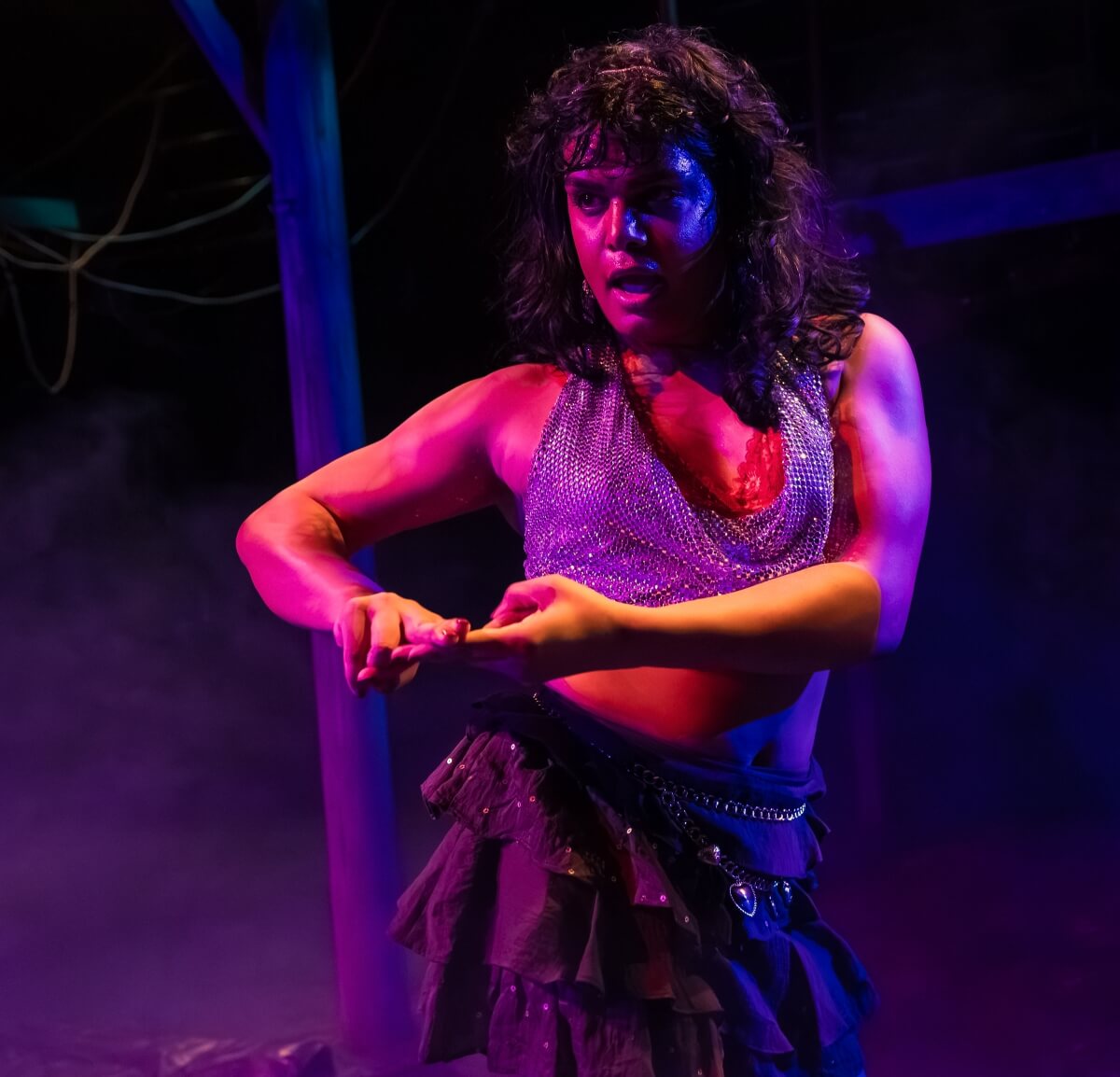
After an intermission, the stage shifts; now added pillars double as telephone poles and the dirt of a metropolis cakes the stage. Without warning, Sakeena (Baig) comes storming in.
“How can he chop,” they yelled, out of breath, to a man off-stage; a syntax echoing the viral “How Can She Slap” clip from an India reality TV series in 2008.
As with their predecessors, Sakeena — who, among other signifiers, considers themselves a poet, dreamer and thinker — directly addresses the audience, whom they consider an angel who will protect them at their weakest moment.
From their experience of being a trans body under attack, to the green thread and needle reminding them of their mother, to the plastic bag they carry around like an anchor to this world, we are privy to their pressing fears and pathetic hopes.
At well-paced intervals, Sakeena will break into song and dance in the style of Bollywood films, complete with smoke and featuring Hasheel and Lady Pista’s original music. This progression tracks a heroine’s archetypal journey: unbridled joy, pangs of a desire, and their insurmountable grief, which is further accompanied by two waterfalls cascading over their undulating body.
Then a switch takes place, the Urdu-inflected accent falls away, and they break the fourth wall of the fourth wall.
“I can’t keep doing this,” the character confesses.
They reveal to the audience that rather than talk about what they wanted to talk about — an assault that happened to them — they had created this fiction in order to communicate it, but that that had reached its limit.
“I am a monster,” they declare, furiously shaking their head.
Instead, they tell of another tall-tale, one that is more violent and seems like a confession, as if pulled from the creator’s life, but then, at the end of it, we are told that that is false too. The play opens up a new dimension, then, where narrative and audience expectations are repeatedly thwarted and challenged.
It is thrilling to watch Baig turn the dial, verbally blood-letting the anger and pain living inside of them. It felt like watching someone turn their insides out, like watching something real taking place — someone pretending they don’t have a secret to tell.
Mining humor from the trauma, Jhooti — a lie that brings us closer to an unattainable sense of truth — indicts the expectations placed on artists from the margins that feel the pressure to reduce themselves to palatable subjects that assuage the discomfort of their unknowability.
The Begging Brown Bitch Plays is an audacious, visceral, subversive mirror that makes us look — as Billo says — more closely and purely to the dead nice girls that give life to great theatre.
By Nirris Nagendrarajah for Ludwig-Van.
Are you looking to promote an event? Have a news tip? Need to know the best events happening this weekend? Send us a note.
#LUDWIGVAN
Get the daily arts news straight to your inbox.
Sign up for the Ludwig Van Toronto e-Blast! — local classical music and opera news straight to your inbox HERE.


- SCRUTINY | At Buddies In Bad Times, The Begging Brown Bitch Plays Accumulates Its Lies To Explosive Effect - April 6, 2026
- CLASSICAL CHARTZ | The Top Ten Classical Music Albums For The Week Of March 23 To 29 2026 - March 23, 2026
- CLASSICAL CHARTZ | The Top Ten Classical Music Albums For The Week Of March 16 To 22 2026 - March 17, 2026