
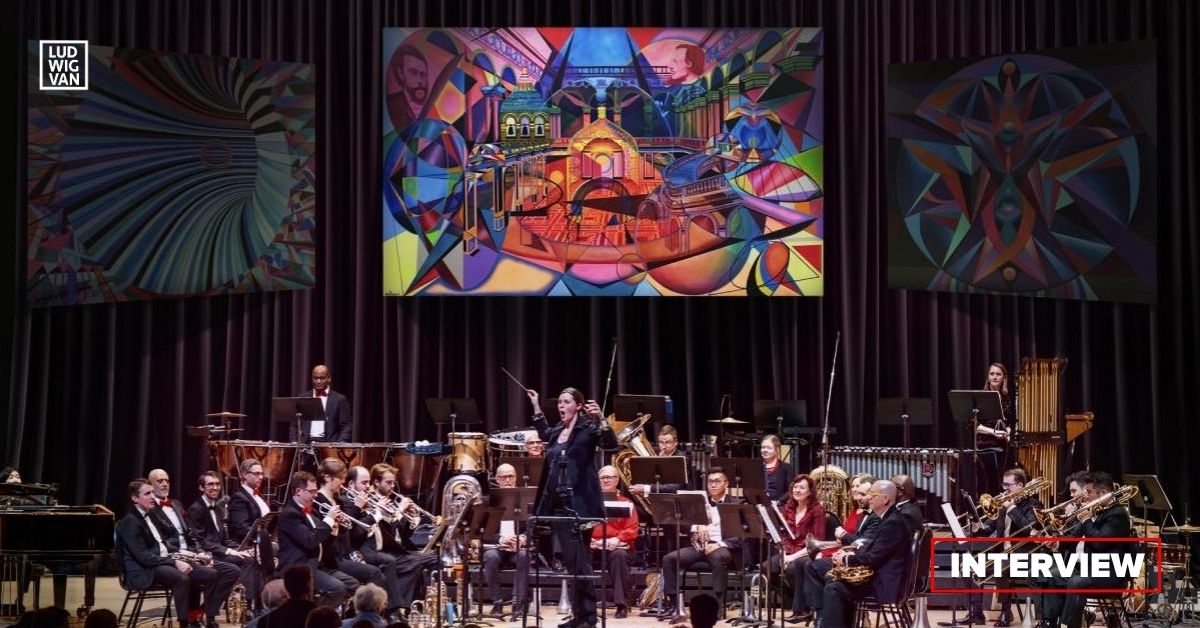
Toronto visual artist Paula Arciniega, the Hannaford Street Silver Band, conductor James Sommerville, and pianist Jamie Parker come together for a unique event. On April 12, HSSB will perform Mussorgsky’s iconic Pictures at an Exhibition while paintings by Arciniega, inspired by the music, are displayed above.
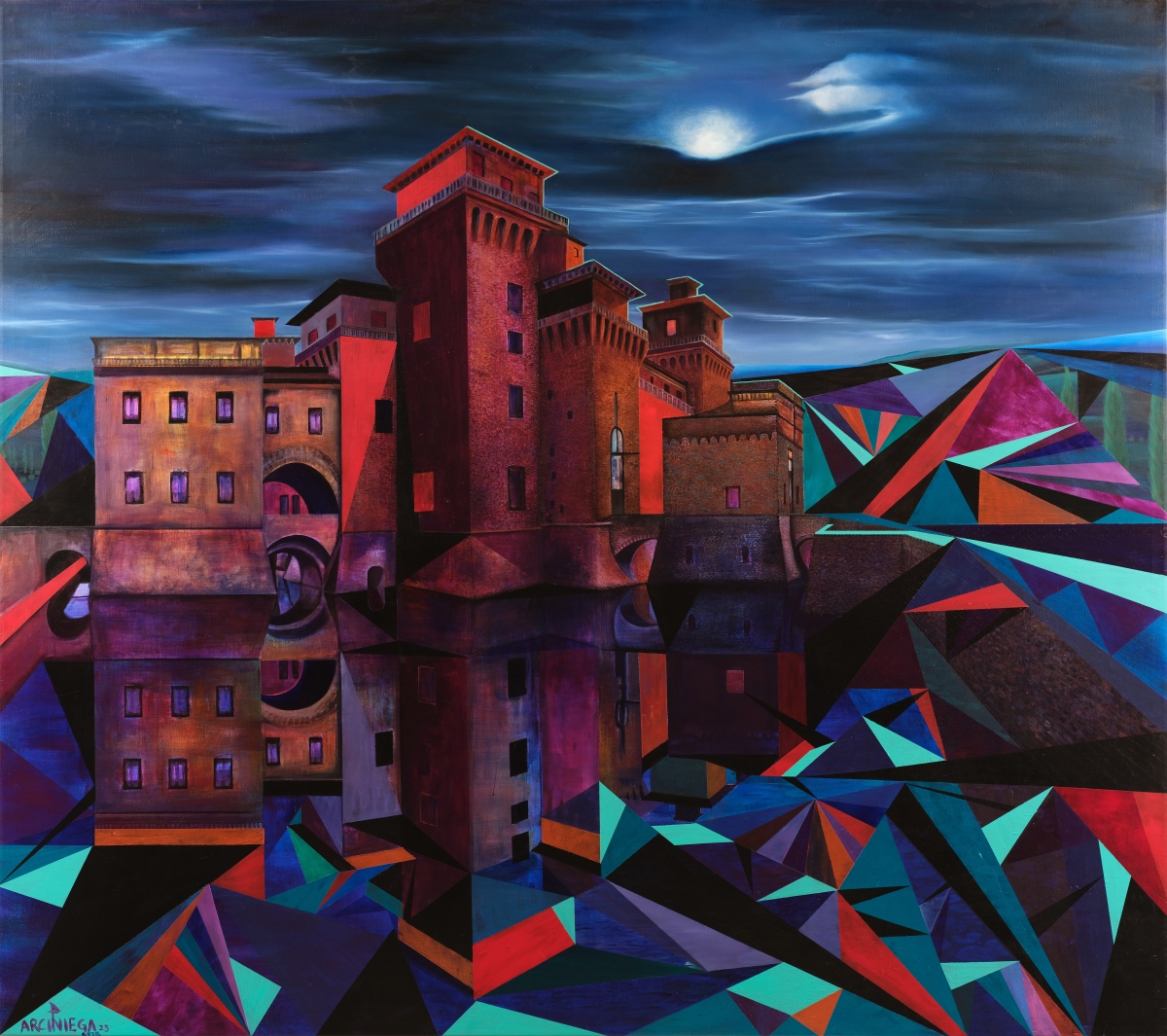
The site-specific performance features 15 large-scale paintings, along with the music of the 30-piece brass band.
Renowned Canadian hornist and conductor James Sommerville leads the ensemble. Pianist Jamie Parker will open the event with a performance of Gershwin’s Rhapsody in Blue with a companion piece by Arciniega.
HSSB’s Executive Director Jen Stephen comments on the project in a statement. “This artistic collaboration expands what a classical performance can be, and reflects our shared commitment to pushing artistic boundaries,” she notes. “It’s about presenting something that honours the original work while inviting audiences into something innovative, immersive and deeply collaborative.”
LV caught up with unique musician and artist Paula Arciniega to talk about the project, and her work.
Paula Arciniega: The Interview
Artist Paula Arciniega is based in Toronto, where she creates works based on the intersections of sound and imagery. She is a trained classical singer, having earned a Master’s degree from the San Francisco Conservatory of Music, and is inspired as a painter by music. Paula also paints landscapes in a realistic mode that requires observation, as well as figurative work, and abstract series.
Paula Arciniega’s paintings are often inspired by music. Much of her body of work finds its roots in melodic lines and visual impressions. “It’s often, just listening to music,” she explains. “My first project was the Mahler Symphonies, and it’s just my joy in listening to these beautiful pieces of music.”
Mussorgsky’s Pictures at an Exhibition is, of course, a work that was originally inspired by an exhibition of paintings. Mussorgsky had toured an exhibition by a friend of his, architect and artist Viktor Hartmann, who had died a year before, and wrote the work in 1874 based on his experience.
“It’s just the potential of what I could do with it,” Paula explains. “The inspiration hit my heart, and it was not a matter of how, but when.”
The Paintings
The works she completed for the project draw on a range of styles and techniques. Many of Hartmann’s works have been lost, leaving only the composer’s impressions to go on today.
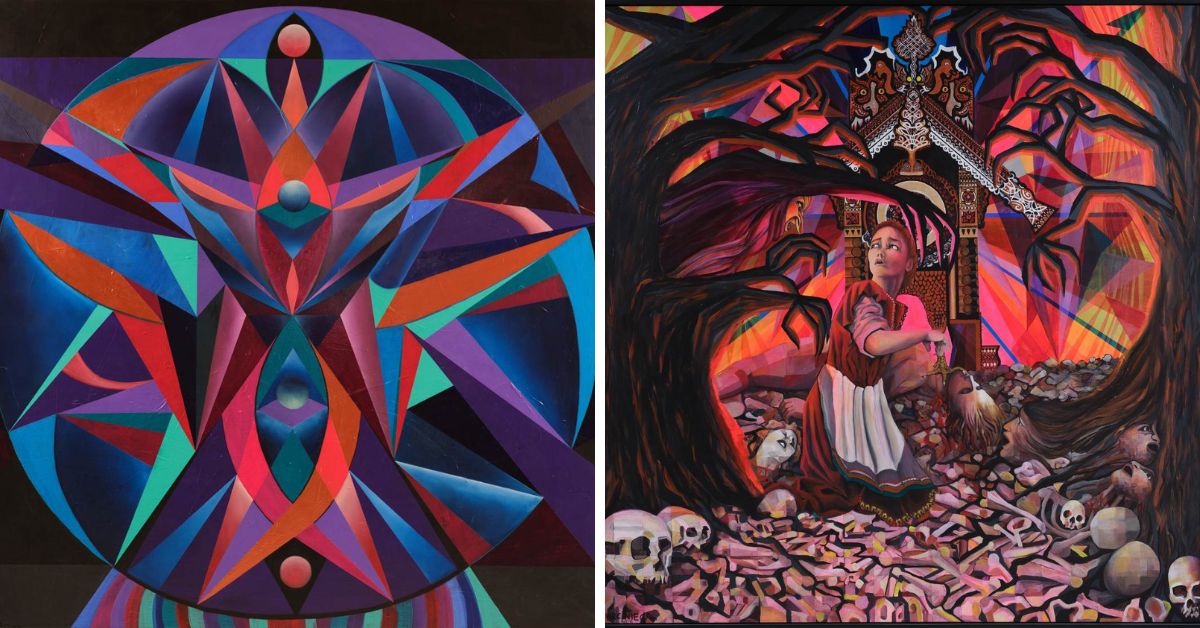
“I looked at it as a whole,” she says of the collection of paintings. She approached each type — the promenades, the various movements — in different ways to support the idea of walking through the exhibition. The spheres, and works with a geometric design, correspond to the promenades.
“They are directly related to act of moving between the narrative pieces,” she explains. “The promenades are visually and rhythmically the line that runs between all of them.”
Though most of Hartmann’s original paintings have been lost, she points out that a few sketches remain, such as the clock he created to go along with the painting of Baba Yaga. Baba Yaga is an unusual figure found in Slavic folklore. She is most often depicted as an old witch who lives in a hut that’s held up by giant chicken legs.
Paula took what information there is available and constructed a narrative around it.
“It was challenging because it doesn’t offer a literal narrative,” she says. “I had to create a story that would showcase my artistic oeuvre, for lack of a better word.”
Some of the pieces are inspired by Russian folklore, but others find their roots in French, Italian, or Polish traditions. She looked for ways to balance her artistic vision within a visual world that honours both Mussorgsky and Hartmann.
The promenades were a unique component. “That for me was really exciting and fun. I was thinking of the 12 tones of the scale, and the vast potential we have with those tones.” She reflected on elements like the quantum universe and much more in creating the paintings.
“It’s really endless,” she says. “That’s how I landed on the sphere as being that really universal symbol for the viewer.”
Music And Colour
“I geek out,” she laughs. “Different keys hold different vibrational frequencies. There’s a different resonance.”
She correlated her impressions of the music with colours.
“I’m not confined by what I paint, because I’m not a trained artist. I really do correlate it to what I experience listening to music.” That includes the way she approaches colour, tones, and shapes.
“That’s how I experience music. It’s almost impossible for me not to include the spectrum. It’s a kaleidoscope.”
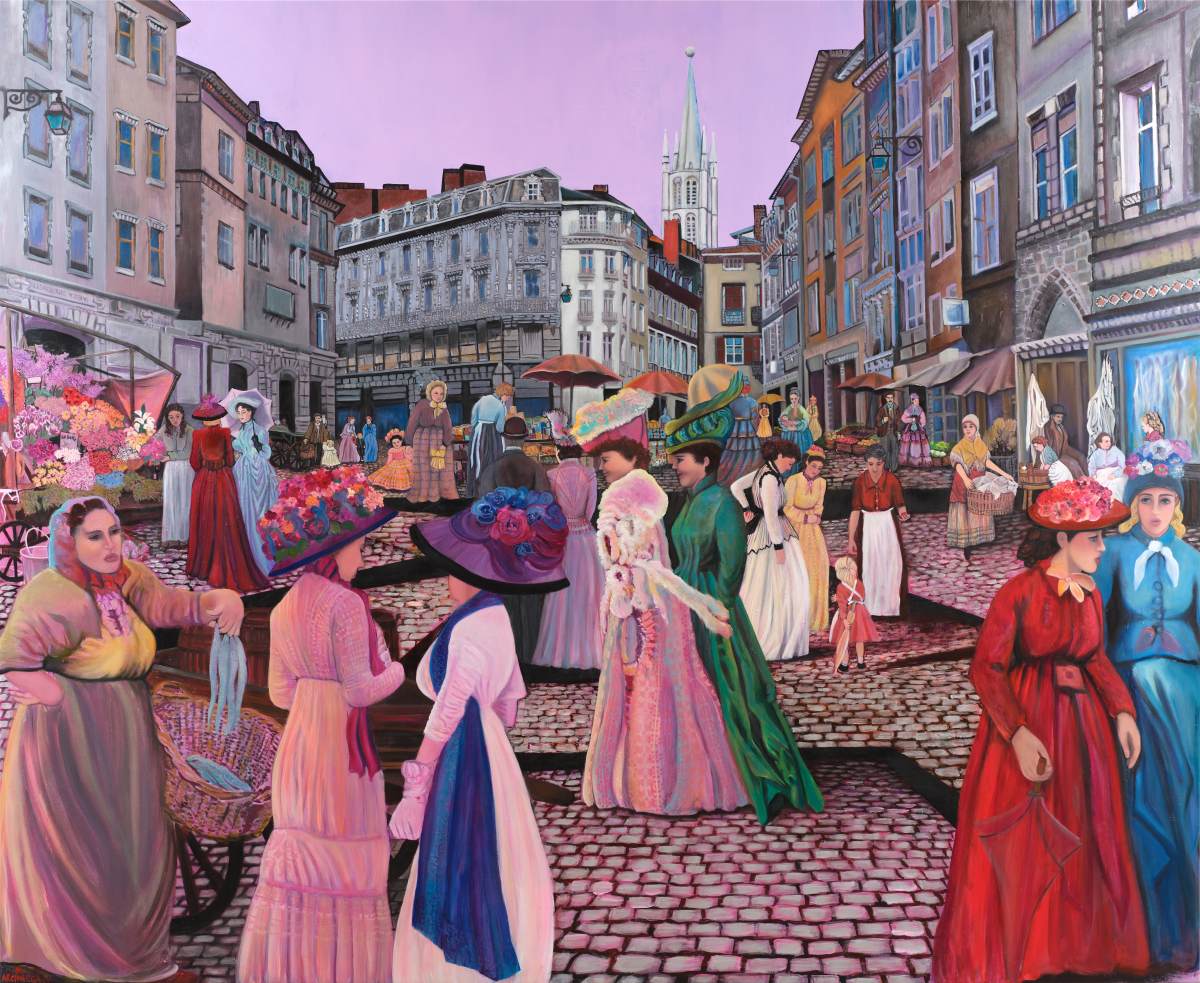
Against the geometric abstraction of the promenade pieces, the paintings that depict the various movements of the music are at times fairy tale-like in approach, at times more realistic, such as the Marketplace at Limoges.
“I was worried — I didn’t want it to be too literal,” Arciniega says. “How do I create within it a freeform without being confined too much with realism?” she wondered.
She aimed for a process that ensures a more spontaneous reaction. “I visually see these before I create them, but very rarely do I sketch them. For me, it feels too fixed. I really have to allow for that grace of the flow when I’m listening to the piece. It opens my imagination to more ideas.”
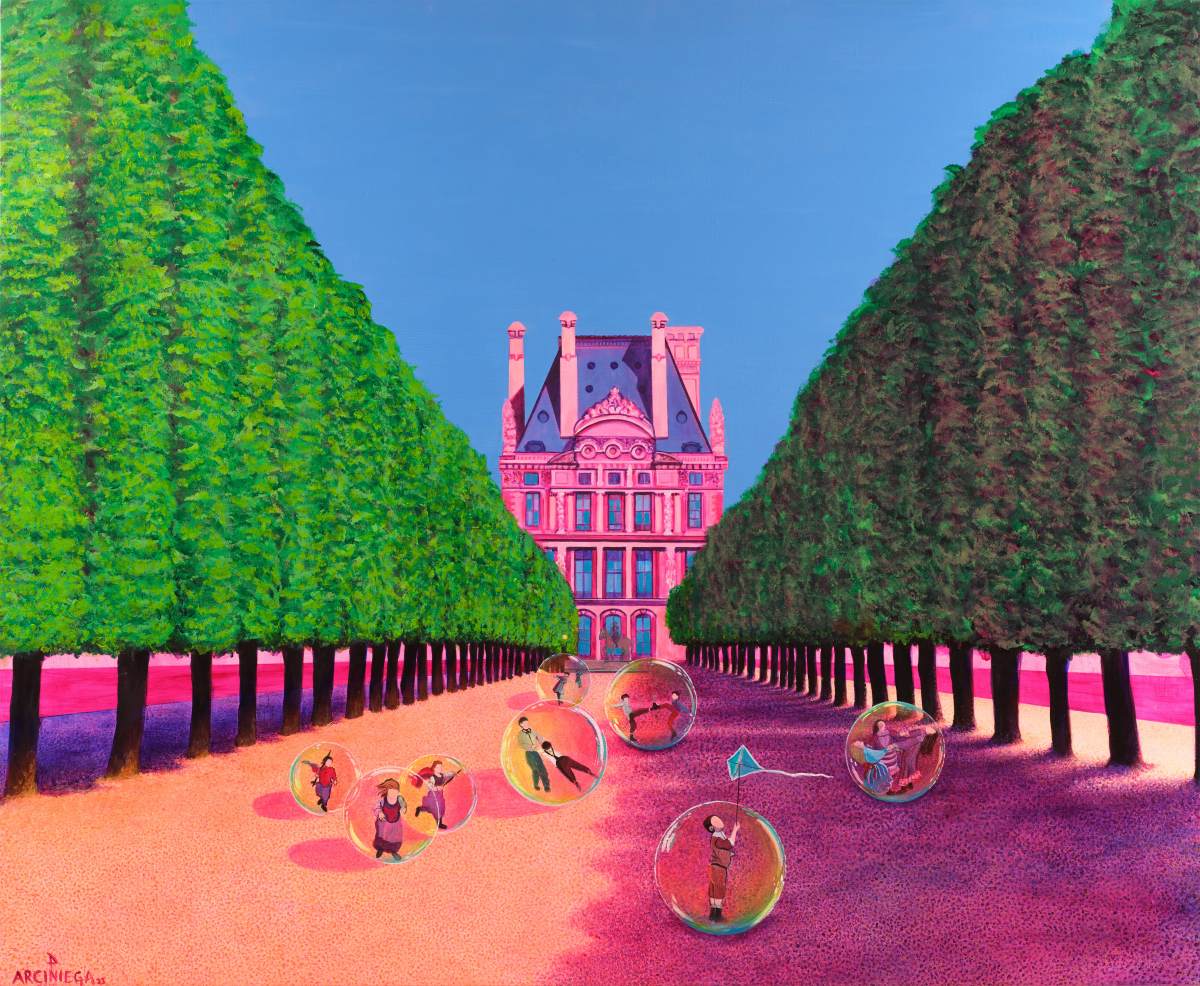
For The Tuileries, for example, she painted children playing, but then put them inside bubbles, and within a vivid colour scheme.
“There’s an unexpectedness,” she says. She mentions that she’s drawn to abstract expressionism.
The Project
As she explains, the paintings will be suspended from the ceiling above and to the edges of the orchestra as it plays. A lighting designer will add another level of drama and design to the performance.
“This is why this project has been so incredibly inspiring I think for all of us. It’s a collaborative,” she says. “The whole is greater than the sum of its parts. It requires the experience of all these talented participants.”
It goes towards a larger purpose: to inspire people, especially younger generations, by both the music and visual art.
“So many people don’t know these works — how can we bring audiences back to these incredibly beautiful pieces of music?”
Music can guide and heal its listener, she feels. “Music is able to do that. It reminds us that we are a collective.”
She’s hoping the addition of paintings can draw people farther into the performance. “The visual gateway I feel is such an incredible way for people to enter.” As she points out, younger audience members, in particular, are conditioned to live in a world that is saturated with visual stimuli.
“How do I engage a younger audience? We’ve got to bring the younger generation to these wonderful pieces.”
- Find tickets and show details for the April 12 performance of Pictures at an Exhibition at Daniels Spectrum [HERE].
Are you looking to promote an event? Have a news tip? Need to know the best events happening this weekend? Send us a note.
#LUDWIGVAN
Get the daily arts news straight to your inbox.
Sign up for the Ludwig Van Toronto e-Blast! — local classical music and opera news straight to your inbox HERE.

- INTERVIEW | A Symphony Of Sight And Sound: Mussorgsky’s Pictures At An Exhibition Reimagined - March 30, 2026
- CLASSICAL CHARTZ | The Top Ten Classical Music Albums For The Week Of March 30 To April 3 2026 - March 30, 2026
- PREVIEW | Toronto City Opera Celebrates Their 80th Season With The Viva Voce Gala & Fundraiser - March 27, 2026