
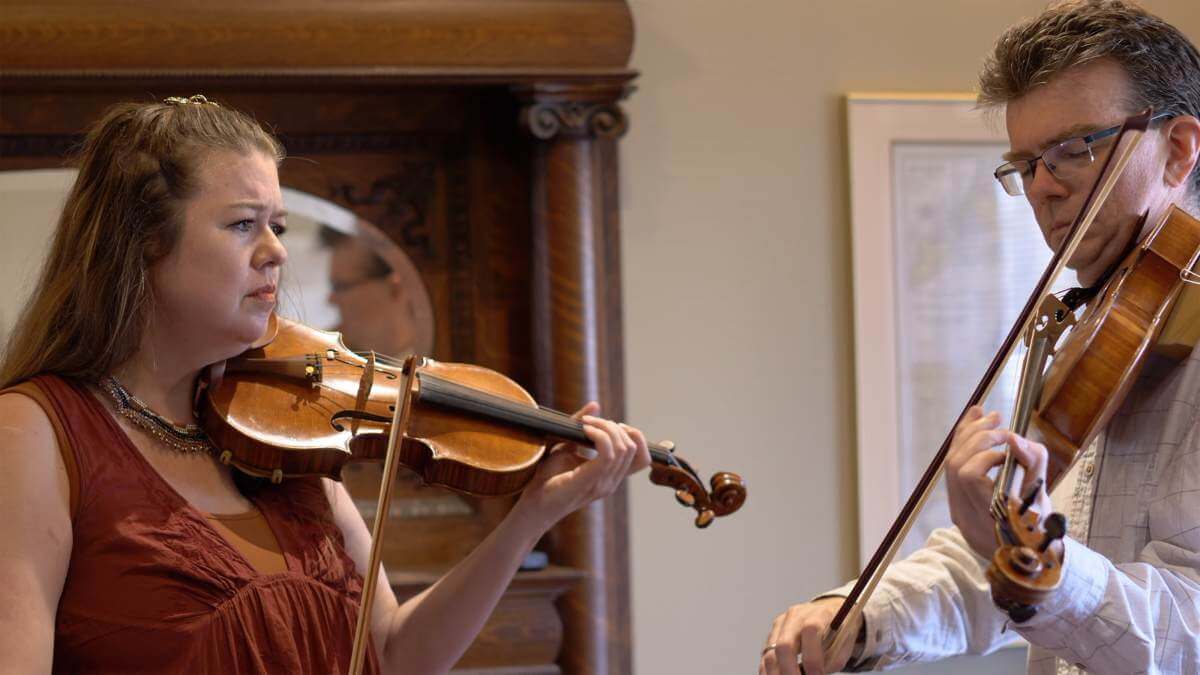
Acclaimed Canadian musician Lara St. John recently premiered her first feature documentary at the prestigious Santa Barbara International Film Festival.
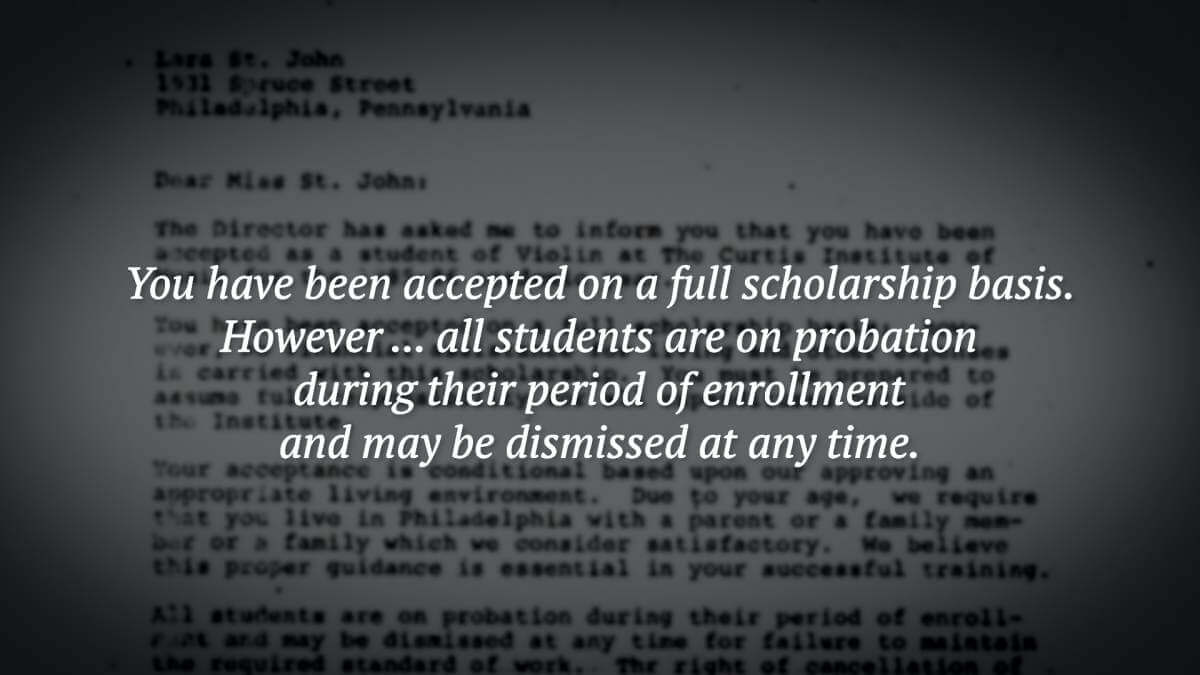
Dear Lara, directed by St. John, produced by Patrick Hamm and edited by Christie Herring screened four times to enthusiastic audiences there and was in contention for the Audience Award. It’s a film about a central event in St. John’s life, and too many others: sexual abuse in the classical music world.
Film critic Mark Ziobro hailed the film in The Movie Buff, “Dear Lara is a powerful and hard documentary. And necessary.” Ziobro goes on, “Dear Lara — named after the many letters Lara received after going public with her abuse — is not about her. It’s about the countless women this happened to and finally giving them a voice and support.”
St. John demonstrates her survival skills with her on-going advocacy for abuse survivors, which will be furthered with this film as an instrument for change in her musical realm.
Background
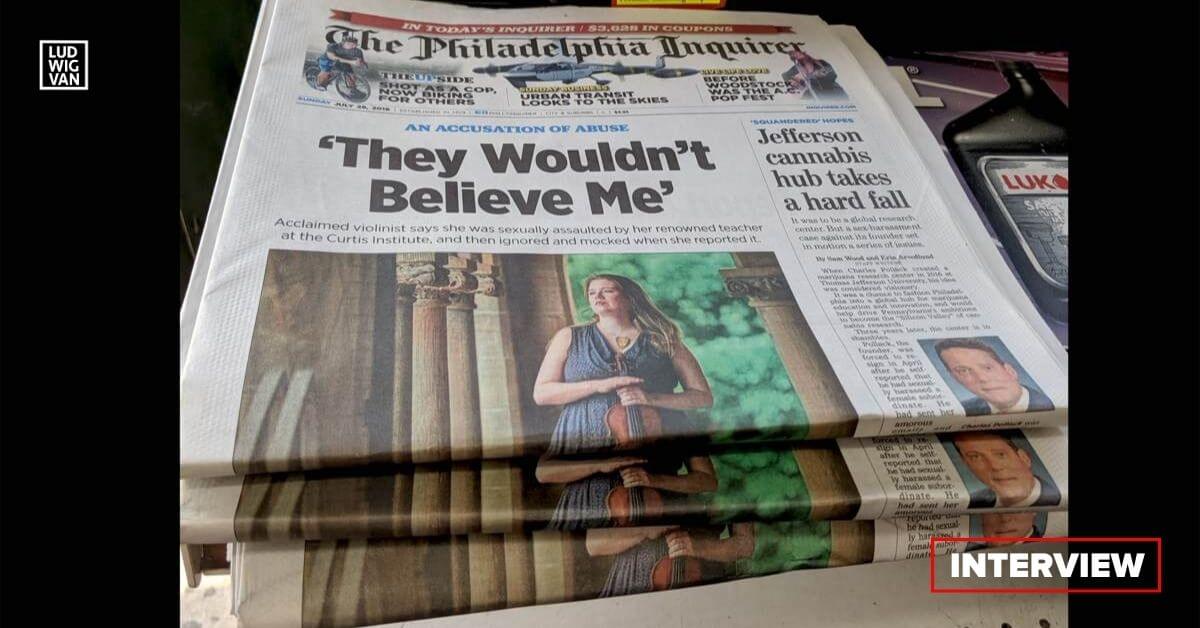
St. John, who was raped as a 14-year-old by her 78-year-old violin teacher Jascha Brodsky in 1985 at the Curtis Institute of Music, didn’t receive an apology from the eminent music school until she went public in 2019.
The film came about after her courageous stand made other survivors feel compelled to share their stories with her.
Dear Lara shows that there is a pattern of abuse, with men in positions of high authority in orchestras and schools taking advantage of young people with talent and no power. What they do is an injustice that affects their lives permanently. St. John’s film is a clear-eyed attack on this terrible situation that is still ongoing, and not just in the classical world.
Dear Lara shares the true stories of musicians who have survived abuse — Lusiana Lukman, Lisamarie Vana, Mascha van Sloten, Heather Bird, Zeneba Bowers, Samuel Schultz — and includes supportive journalists Anne Midgette and Sammy Sussman as well as Amsterdam Conservatory administrator Okke Westdorp and Lara’s brother Scott St. John.
A key figure in the film is Katherine Needleman, an oboist who, along with St. John, is leading the fight against the abuse that is still taking place.
It’s an ongoing battle that, according to a Washington Post article by Geoff Edgers entitled “The Most Dangerous Woman in classical music”, has left Ms. St. John with the very real situation of being sued for libel by someone who harassed Needleman.
It shows that there is a price to be paid for not staying silent in this contentious era.
Still, Lara St. John stands tall and is now equipped with something valuable in the fight, a brave no-holds-barred documentary.
LV’s Marc Glassman (LV) spoke with Lara St. John (Lara) during the Santa Barbara Film Festival, where the film made its premiere.
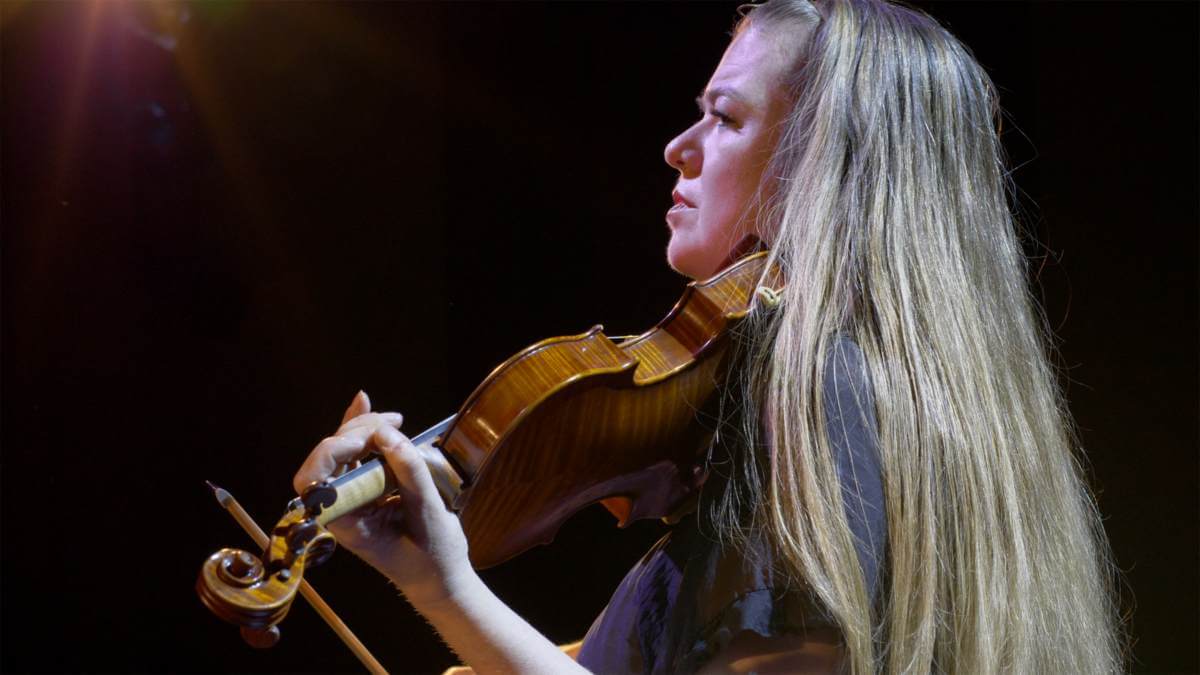
Lara St. John: The Interview
LV: How did it feel for you to premiere the film at Santa Barbara?
Lara: It was really something else to finally show the film. It’s strange in some ways. I’m showing the worst thing that ever happened to me in front of a bunch of people who are watching it on screen.
LV: What did the festival organizers think?
Lara: The festival had already scheduled Dear Lara three times, and they decided to put on a fourth screening thanks to it being voted as one of the Santa Barbara Festival’s most popular films. That’s kind of astonishing considering the subject matter. I was really touched that a lot of people came from across North America. Some were people that I didn’t know that well; they just thought our film is really important.
LV: Who came and how did the audience respond?
Lara: Many people from Dear Lara were there — Katherine Needleman, of course, and the writers Anne Midgette and Sammy Sussman. And, my brother Scott and Toronto’s own Lusiana Lukman, of the Classical Music Conservatory, whose story was also reported in the Toronto Star that very weekend.
We were given 20 to 25 minutes for Questions and Answers (Q&As) after all of the screenings. Many audience members were from the music world. On the second day I had a woman who tried to ask a question and couldn’t because she burst into tears and said, “I also was a violinist, but I didn’t become one because the same thing happened to me.”
There were academics especially from the West Coast and people who work on soundtracks in Los Angeles. I saw people that I had lost touch with over the years who made giant flights to come out. I was really touched by how many people made a real effort to be there. Many people stood out; one of the many who impressed me was Thula, the violist and composer whose full name is Nokuthula Ngwenyama, who travelled from the East Coast to be there. We hadn’t seen each other in years.
LV: What was the reaction from regular festival goers?
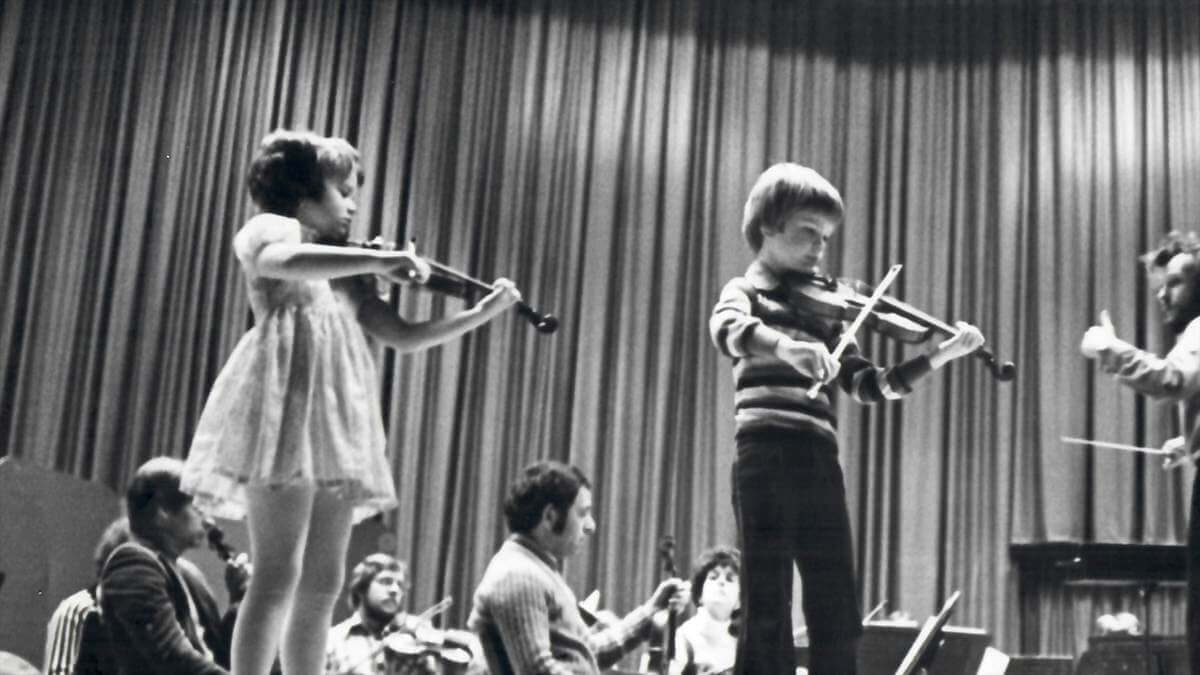
Lara: The people who don’t have anything to do with classical music are shocked. I think we have this reputation of prancing around playing pretty tunes on instruments from 400 years ago, which is not entirely untrue, but they just never guess the fact that there might be this extraordinarily sordid underbelly beneath the music.
It’s funny that they don’t, because you get this kind of problem when you have adult men in positions of great power over women and children. I know there are a lot of really great male conductors, concertmasters and teachers out there. But, this kind of dynamic attracts those who want to abuse that power. We’ve seen it in the Boy Scouts and the Catholic Church, especially, and in gymnastics recently. We’ve got to shine a great big spotlight on this.
LV: I heard you played a short concert after one of the screenings.
Lara: Yes, I played for about 12 minutes after the Sunday matinee. I played a short Bach gigue and then Schubert’s Death and the Maiden Fantasia. (It’s a solo violin arrangement of both the song and quartet by me — and it’s a recurring theme in the film). I heard a few sniffles in the theatre.
LV: Does it feel different showing a film than doing a live concert?
Lara: Yes, it does. For the third screening, I was only able to show up for the Q&A, and I realized that audiences would see the film without my being there. It was a weird feeling.
LV: For the first screenings, did you have your main crew members there?
Lara: Yes, my producers were there, including the two who worked so hard on the film, Patrick Hamm, who shot a lot of it, and Christie Herring, who was my editor. They’re so important to me.
I had taught myself how to shoot and edit music videos years ago because I was really annoyed at editors who couldn’t manage to synchronize violin playing properly. So, I wasn’t starting from nowhere with the film. But after COVID, when I started to concentrate on it again, I found my producer, Patrick, who was really instrumental in making the shoots happen more professionally.
With Lusiana’s interview in Toronto, for example, he was there with me helping with the cameras and everything — the lights, the sound. A lot of the early interviews I did alone, it was just me setting up cameras, lighting, and shooting the person. But with Patrick, it just got a lot easier because then I could just concentrate on the interview and their story.
Then Patrick introduced me to Christie. I’m new to features, and I’ve got to say that documentary editing is the hardest. With Christie’s help, we managed to create a story arc. After lots of discussions and viewing many cuts, there’s a compelling reason for every shot that’s in the film.
It’s glued inexorably together now. One of our major points, for example, was to make it clear how global this terrible situation is, and I think that’s obvious now. A lot of people remarked that they never lost interest even once, though at 93 minutes it’s a long film for a documentary.
Musicians came up to me and said, “Thank God, you’re shedding light on this.” That’s really nice to hear.
Christie handled all the post production work and did all the preparation for fair use in what was said in the interviews. She worked with the privacy lawyers. There is no way I could have done that.
LV: In order to get the film out to festivals and the public, you need representation. Has that happened?
Lara: Yes, we’re now represented by Blood, Sweat and Honey, who handle independent films. It’s run by Alex Nohe and a Sundance veteran, Jeff Dowd. Annie Jeeves is our publicist. We’re working together to figure out a strategy with how we present the film.
As a first time director, I am learning about how you premiere films at festivals and then work for theatrical distribution and streaming. I know now that’s usually followed by special screenings at schools and events.
I’ve already been approached by over 20 schools, which is really great. It’s crucial that people know about the sexual and gender abuse that is dominating the classical music world. Katherine (Needleman) is in the orchestral vanguard of it and I’m the one to take on the educational sector.
For me it’s about prevention, as much as it is justice. I just don’t want this to happen anymore. And I know that it’s still happening. Some of the schools that have approached me about showing the film have had many cases of abuse. There’s an extraordinary amount of damage that has been done that should be stopped.
LV: Can you talk about how important this film is to you?
Lara: I used to have a Manhattan apartment on the Upper West Side, and now I have a documentary. Mind you, I did have help from my husband and others, but I didn’t want to have grants and be beholden to others. I wanted to make the film as freely as possible.
LV: Now that you’ve exposed the evil practices that are endemic in the classical world, what are the solutions?
Lara: In the film, some very good practices are suggested through the Amsterdam Conservatory. One of them is team teaching. It diminishes the power of a teacher over a student if there are two mentors.
Another is to get rid of locks on doors when a young student is being taught one on one. At the Amsterdam Conservatory, everything is glass; there are actually no doors.
Music schools and orchestras should insist on doing background checks on new staff members. They should be asking why people have been allowed — or forced — to resign from their previous institutions.
When parents tour schools, they should make sure there are windows in all studios and offices where their children will have to interact with their mentors. Isn’t that a reasonable thing to ask?
LV: What’s your biggest hope with this film and ongoing campaign against systemic abuse in the classical music system?
Lara: I want to clean this profession up so that women and children can have an equal and healthy time in it and be happy. Things should change so that people like Lusiana won’t be put in a situation where she can be abused by Boris Berlin and he can get away with it. The sheer neglect on the parts of music administrations and academic institutions is ridiculous.
Marci Hamilton, who is in the film, is the former director of Child USA, which is a think tank focusing on child abuse. I’m working with her on adapting a gold standard, a points system, which schools are being persuaded to adopt. There’s a prototype, and we’re going to tweak it a bit for music schools.
I put Curtis through the existing prototype, and they came out with 21%. Parents should be looking at things like that. If we can construct a school standard and have a website where people could go to and say, “This looks like a really safe place for my daughter to go”, I’d be happy about that. Then I think we’d really have accomplished something and make the profession a lot safer.
There is a website right now called We Had No Idea. The woman who runs that flew down from San Francisco for the premiere. She’s doing what she can. The site lists perpetrators and the schools and orchestras where they have worked. There’s always the possibility of legal ramifications, so she only puts them on if she can cite at least two articles or if there’s been an investigation or sentencing. We know that there are hundreds more, so the work has to continue.
LV: How about in Canada?
Lara: I’ve been in conversations with The Gatehouse, an Ontario organization, which supports survivors of sexual abuse. They help them reclaim their voices. I recently attended a reading by Ghrian Shine at the Gatehouse, from her book about intergenerational sexual abuse called Breathing the Night Out. It was an intense, but ultimately uplifting event.
I think The Gatehouse is doing great things. Certainly, I’d like to be part of making change happen in Canada.
By Marc Glassman for Ludwig-Van
Are you looking to promote an event? Have a news tip? Need to know the best events happening this weekend? Send us a note.
#LUDWIGVAN
Get the daily arts news straight to your inbox.
Sign up for the Ludwig Van Toronto e-Blast! — local classical music and opera news straight to your inbox HERE.

- INTERVIEW | Violinist— And Now Filmmaker — Lara St. John Talks About Dear Lara - March 2, 2026
- CLASSICAL CHARTZ | The Top Ten Classical Music Albums For The Week Of March 2 To 8 2026 - March 2, 2026
- CLASSICAL CHARTZ | The Top Ten Classical Music Albums For The Week Of February 23 To March 1 2026 - February 23, 2026