
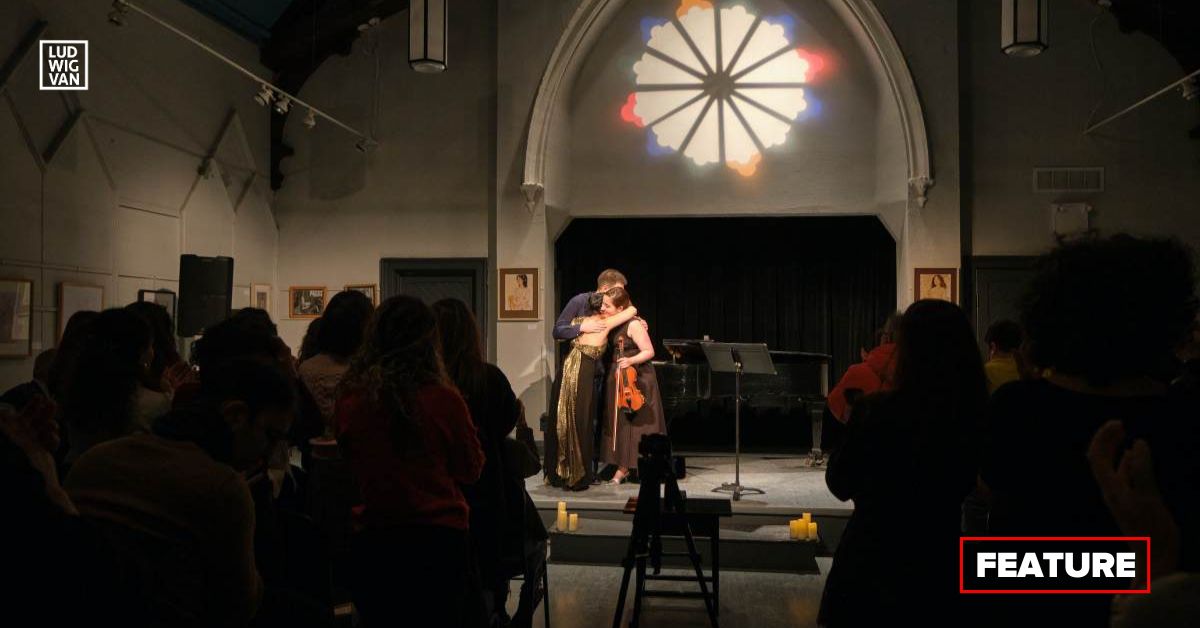
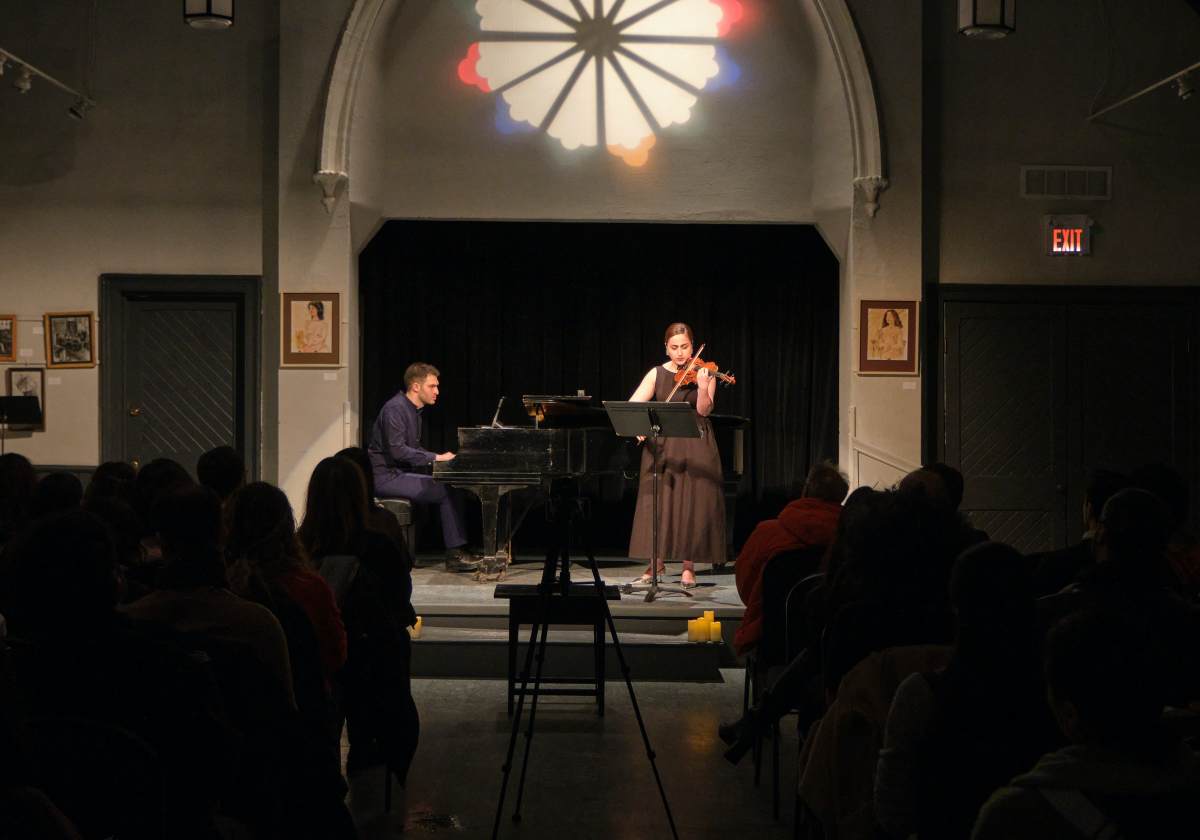
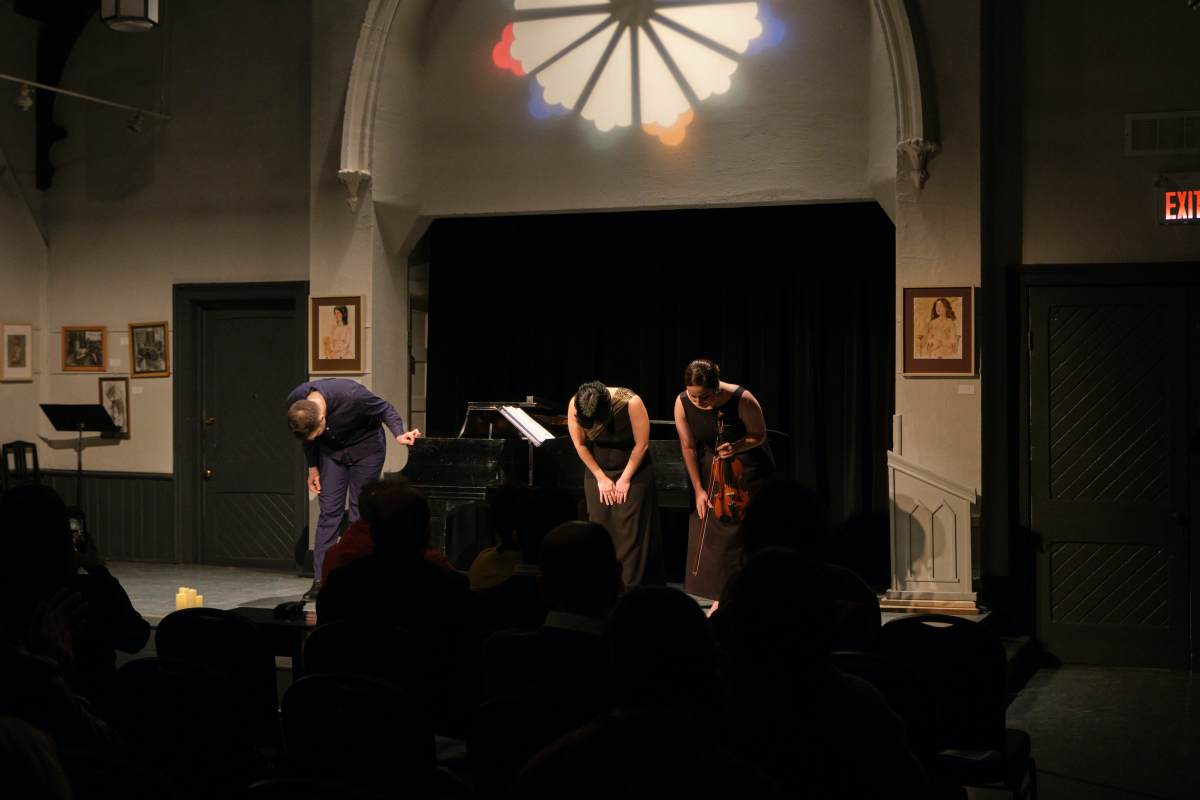
The Roots and Ruins concert took place in Toronto earlier in February 2026. Some of Toronto’s talented Iranian classical music community, including violinist Saba Yousefi, soprano Bahar Harandi, and pianist Narek Abrahamian, performed in front of a sold out crowd at the Heliconian Club.
But, the concert almost didn’t take place at all.
“It was really great. It was different in a kind of way,” says Yousefi. “I didn’t expect it. The performance anxiety — you always have it, but you try to transform it so that you perform it better.”
The Iranian community in Toronto packed the venue, and emotions ran high, as she relates. Living under the shadow of a threatened invasion of Iran is taking its toll.
“You could feel the sadness and the sorrow. After performing for many years, it was very new.”
The performers came to tears on stage, hugged each other back stage, then went back to performing.
“It was different,” she says. “But I’m really glad that I didn’t cancel the concert.”
As she explains, it’s a frequent discussion among Iranian musicians working in Toronto right now. “This is a debate,” she says. “Should we cancel?”
Is it the appropriate to keep going, keep performing, in a fraught political climate? Yousefi says that she’s heard of some Iranian theatrical performances cancelling or postponing till better times come around, and ticket sales slowed for performances that do take the stage as planned. Roots and Ruins was also supposed to tour.
“We wanted to have this concert in Toronto and Vancouver.” The Vancouver date was cancelled.
“Three weeks before that, I was like no, we have to believe in the power of music. It’s a community,” she says. Still, with the situation worsening as the date grew nearer, doubts began to grow. In the end, they decided to make concert tickets free of charge, to encourage even more people to come.
“Let’s cry together.”
Music became a way of expressing themselves as a community. “I prepared a piece that’s historical in Iranian culture It’s about revolutions. I printed all the poems of the piece as well.” The text was distributed throughout the audience. “The last piece that we performed, we all sang together with the audience.”
The shared experience was cathartic. “That was really helpful, when we sang together,” Saba says.
“This is what music is really about.” She points out that the ensemble performed music by Saint-Saëns and other Western composers, along with Iranian music per se.
It’s a situation that seems surreal. “It’s a really, really strange time.”
Iranian Music in Toronto
As Saba points out, the community of Iranian artists in Toronto, and in Canada overall, has been growing significantly over the last few years. Many were not able to perform in their home country due to its religious restrictions.
“We’re really happy that we have this community in Toronto.”
She says it’s a community that consists of many specific fields and genres, and many individuals are multidisciplinary artists, including traditional musicians, ethno-musicologists, classical and contemporary musicians, theatre artists, composers, and others.
“Many, many collaborations are happening with Toronto artists,” she says.
Poetry and music, in particular, figure prominently in Iranian culture. “Most of them are active,” she says of the Iranian arts community in Toronto. Like many Canadian artists overall, they often balance their time between teaching and performing.
“They’re trying to make a bridge between east and west.” Many incorporate training both in Iran and Canada, combining practices, and collaborating with artists in the Western traditions.
Saba says that when she came to Toronto about 15 years ago, she knew of one other Iranian music student, and one composer. “Now, there is so many Iranians,” she says. “It reduces my homesickness as well. We have two countries in one country,” she adds.
Collaborating with Canadian artists creates a shared space in their new home. “That’s a really beautiful thing about being an artist,” she says. Over the last five or six years, in particular, she’s seen the rise of Iranian/Persian based performances, and multidisciplinary projects.
Traditional sound worlds are brought forward into modern-day Canada. “I think it’s less about preserving the [traditional art forms], it’s more about reinterpreting it,” she says. In Canada, she points out, artists can create from a place that reflects on history and tradition, but with a modern sensibility.
“We are really grateful to be here, because of the chances that you have.”
Creation in Difficult Times
“I was thinking about the history of my country,” she says, “what was going on from many years ago. Are we going to grow out of these difficult times?” As she points out, however, the history of Iran is one that includes the Mongol invasions, and many turbulent times. “The cultural life did not disappear.”
She notes that some of the most famous Persian poets, like Rumi (Jalāl al-Dīn Muḥammad Rūmī, 1207 – 1273), and Saadi Shirazi (1210 – 1291), wrote during the Mongol conquest of Persia and Mesopotamia.
“It’s the same spirit,” she says. “Art becomes a way of processing collective experience. We can all grow out of this, and create more work, and create meaning out of it.”
She says she encourages people to take the time to go to concerts, take a poetry class, and otherwise involves themselves in the arts.
“Not to escape the grief, but to experience it together through music. We should trust music to do its job.”
Are you looking to promote an event? Have a news tip? Need to know the best events happening this weekend? Send us a note.
#LUDWIGVAN
Get the daily arts news straight to your inbox.
Sign up for the Ludwig Van Toronto e-Blast! — local classical music and opera news straight to your inbox HERE.

- FEATURE | Iranian In Toronto: Violinist Saba Yousefi Talks About Toronto’s Iranian Musical Community - February 25, 2026
- INTERVIEW | Composer & Musician Robert Humber Talks About His Release Into Air - February 24, 2026
- FEATURE | Daughters Of Donbas Release Debut Album To Coincide With Premiere Of Documentary Film 4.5.0. - February 24, 2026