
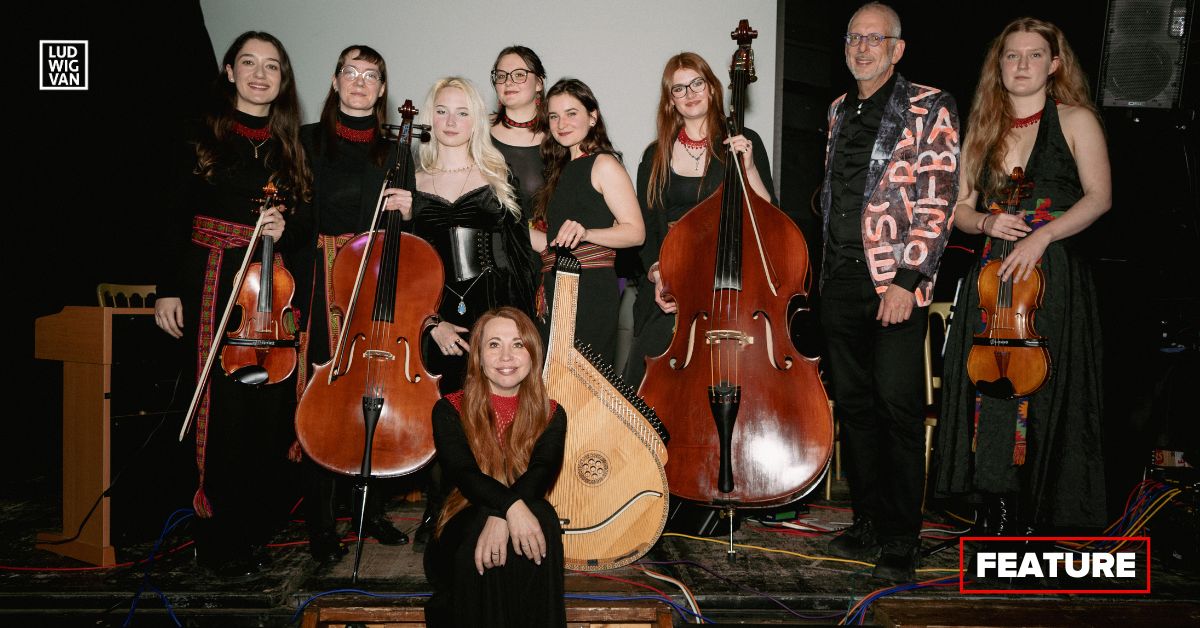
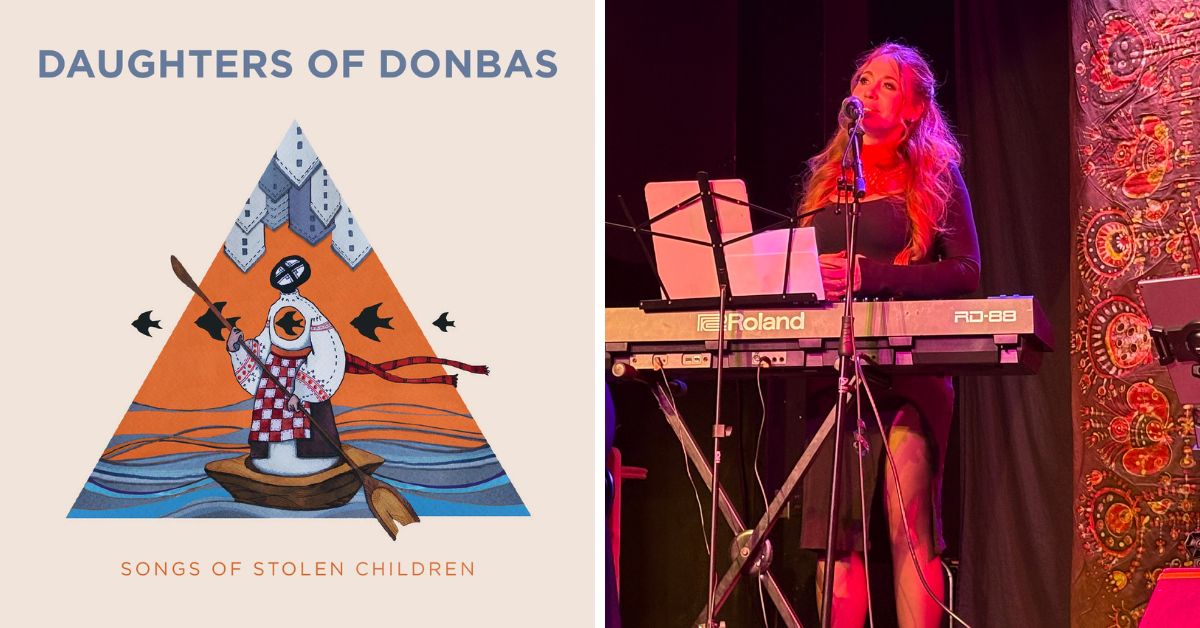
On February 20, an event launched both the album Daughters of Donbas: Songs of Stolen Children, and the documentary film Code 4.5.0. Both projects are inextricably linked; Marichka, leader and composer for Daughters, is the protagonist of the film by director Olena Tumanska/ECG Productions.
Marichka, a Ukrainian-Canadian, is a musician, activist, war correspondent, and battlefield medic. In a 2025 interview with LV, she talked about dividing her time between creating music in Canada and traveling embedded with a Ukrainian tank battalion on the battlefield, documenting the lives of the soldiers, and bringing a sense of humanity to the conflict. She also acts as a field medic.
Daughters of Donbas: Songs of Stolen Children, takes its name from the documented practice of kidnapping children from their Ukrainian parents perpetrated by Russian forces. It’s estimated that about 20,000 children have been taken to Russia from Eastern Ukraine since the conflict began. They’re taken to so-called “filtration camps” with the goal of eliminating their resistance to Russian rule.
The ensemble just got back from a trip through Europe and the UK, and their guest on tour (known only as Lisa) was one of the few Ukrainian kids who managed to escape from Russia.
Code 4.5.0.
As director Olena Tumanska mentioned prior to the film screening, “Some of the people [in the film] are no longer alive.”
Marichka is the heart of much of the film, beginning with packing for a trip to Ukraine. She talks about some of the items she’s putting into her suitcase, including a belt that was a memento from one of the soldiers, and her work there.
“My mission is to help those that acted, to show that there is another side to war.”
One of the things she packs is a series of hoodies. The sleeves are embroidered with traditional Ukrainian designs, and they’re sewn into knit fabric hoodies. Another is jewelry crafted with gemstones and spent bullets from the Donbas region.
We meet the artisans later in the film, both of them trying to create meaning from living in a war zone.
She talks about folk psalms, a type of traditional piece that is often sung a cappella. They blend spirituality from the Book of Psalms with Orthodox theology, folk melodies, and themes that often revolve around disaster and rescue. They are often sung at funerals and other solemn events. In the film, Marichka relates that she and a group of women began singing folk psalms in Ukraine, bringing tears to the eyes of a military commander. He then refused to bring the group into the combat zone, insisting they stay behind.
“This is what we are fighting for,” he told them.
Marichka talks to the soldiers as she films, and they talk about their experiences, including losing war comrades to shells and bullets. They also joke.
“I always dreamed about riding a tank,” one says. “I didn’t know I’d have to fix them too!”
Another calls his girlfriend three times a day.
The soldiers become vulnerable young men, and Marichka joins them as they travel, during downtime, and as they take shelter from shots and shells.
When we meet the jewelry maker, he explains that people send him spent shells from all over the region. He works together with his wife, and the couple raise their children in midst of the uncertainty.
“Making good from evil,” he says. “You have to do the best with what’s available to you.”
Resilience emerges as a theme that runs throughout the documentary.
4.5.0. as the film explains, is the military code used when everything’s fine, no casualties or deaths reported. It’s the message you hope for when the radio buzzes.
Marichka returns to Canada, navigating the ups and downs of her own life with a new perspective. Her own troubles pale in comparison to those she’s witnessed; she stays in contact with the soldiers.
The embroidery artist is a Hutsul, an ethnic group within what is now Ukraine, and was very briefly its own republic following WWI. He had no plans to work in any kind of fashion industry; today he employs some of the many refugees who’ve flooded the mountainous region.
“I think most of all, we’re fighting for who we are. Because, if we are conquered, then who will we be?”
Visually, the film juxtaposes the realities of being shot at, and industrial landscapes like train stations and city streets, with the rural landscape of Western Ukraine in what looks like late summer and early autumn. The tanks roll through fields of pretty wild flowers. Children play on concrete next to destroyed houses.
Daughters of Donbas: Songs of Stolen Children
The music from the album enters into the film. Marichka was writing songs as she traveled around Ukraine.
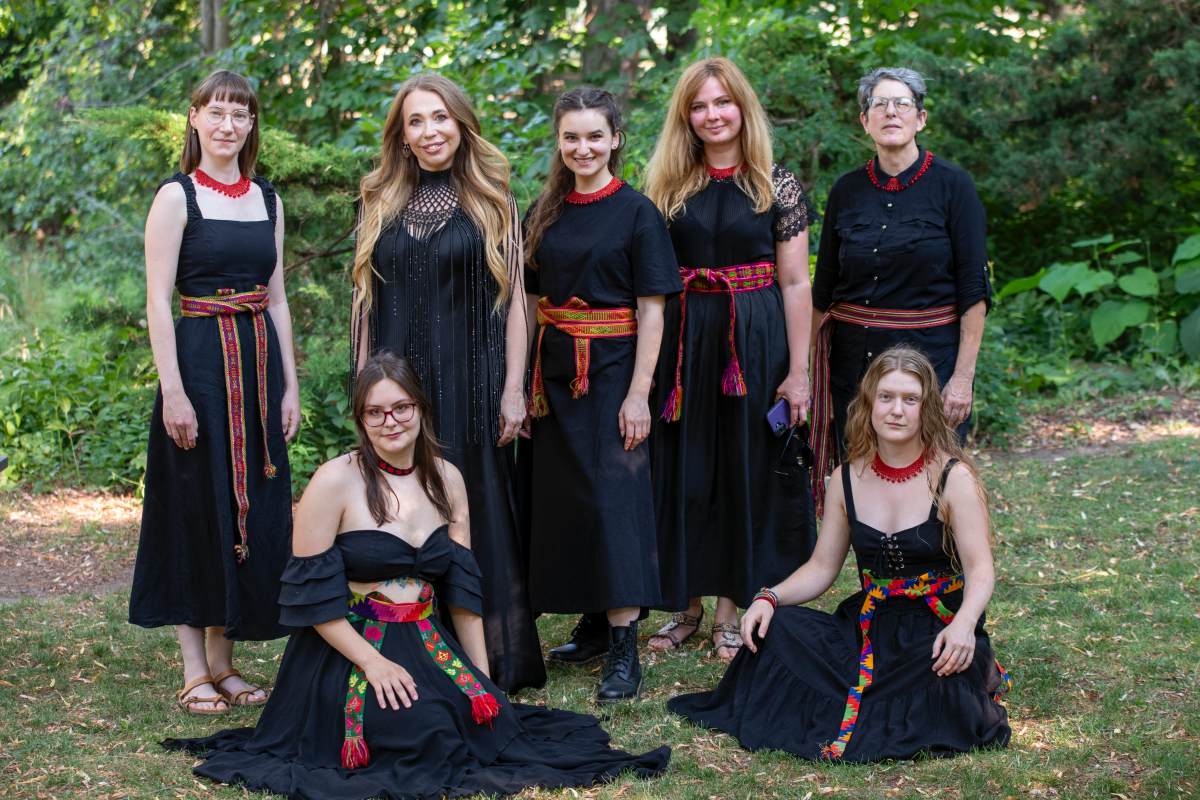
She is a trained pianist, and incorporates a string quartet into her band. The music is imbued with distinctive Ukrainian elements and harmonies, often in minor keys. It’s haunting, though sometimes hopeful. Producer Daniel Rosenberg mentioned that, on their recent tour, one of the group mentioned that their voices can be weapons.
“It’s what ordinary people can do,” he said.
“My perception of life changed significantly,” Marichka noted.
Along with Marichka and the string quartet, Alina Kuzma (vocals and bandora, a stringed instrument), and singer Zoe Santo took the stage.
Some of the songs are traditional folk tunes, like the 1000-year old song about mermaids, or Rusalka, epitomizing feminine strength. On some tracks, she’s collaborated with contemporary Ukrainian poet Izdryk. Marichka’s own compositions often deal directly with the stories she encountered — like that of the father who persevered until he found the three children the Russian soldiers had taken from him. She wrote the song Remember, I Believe In You for them.
Musically, she incorporates sophisticated writing for strings, including non-traditional techniques for sound effects, and lush two- and three-part vocal harmonies. Some use time honoured traditional vocal techniques.
It’s beautiful music with a message.
Next Steps
From Toronto, the Daughters of Donbas appeared at in Vancouver at the Rogue Folk Club on Feb 22 and they’ll be in Tokyo on March 2. From there, they will head to WOMADelaide in Australia from March 6-9, and they have been invited to present the program in The Hague in April, 2026.
- Find Daughters of Donbas: Songs of Stolen Children on Apple here, and on Spotify here.
Are you looking to promote an event? Have a news tip? Need to know the best events happening this weekend? Send us a note.
#LUDWIGVAN
Get the daily arts news straight to your inbox.
Sign up for the Ludwig Van Toronto e-Blast! — local classical music and opera news straight to your inbox HERE.

- PREVIEW | Director Robert Lepage And Choreographer Guillaume Côté Bring Back The Tragedy Of Hamlet: Prince Of Denmark - April 10, 2026
- THE SCOOP | Benevolence Opera Project & Redwood Theatre Present Don Giovanni To Support The Redwood Women’s Shelter - April 10, 2026
- PREVIEW | The Guitar Society Of Toronto Presents The 2026 Toronto Guitar Weekend - April 9, 2026