
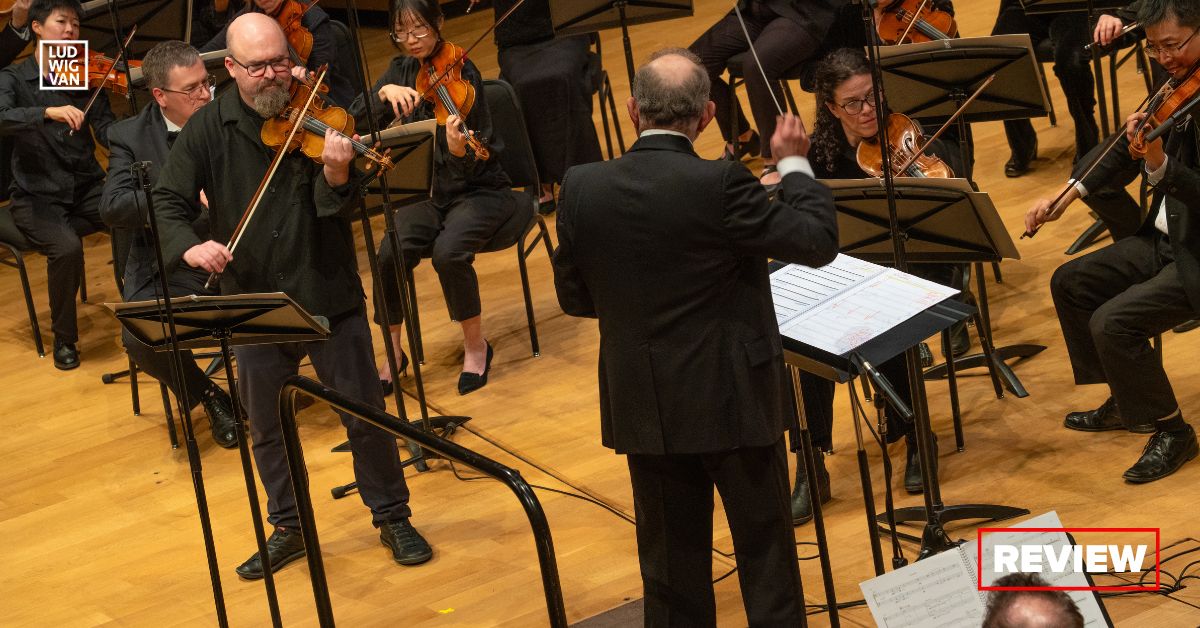
Esprit Orchestra: Superstrings V. Alex Pauk Conductor; Mark Fewer Violin — Arvo Pärt: Silhouette* (2009/15 – Canadian premiere) & Cantus in Memory of Benjamin Britten (1977); Anders Hillborg: Bach Materia (2016/17, Canadian premiere) (Mark Fewer Violin); Andrew Norman: Gran Turismo (2004) for 8 violins; Jimi Hendrix: Purple Haze, Arr. Steve Riffkin; Alexina Louie: O Magnum Mysterium: In Memoriam Glenn Gould (1982, version for 34 strings by John Rea, 1999). January 29, 2026, Koerner Hall.
“That was a tour de force!” declared the gentleman seated to my left at Koerner Hall last night. It doesn’t matter much which piece he was referring to; the (mostly) string orchestra on stage, along with soloist Mark Fewer, won over the crowd with an overall display of virtuosity.
When it comes to the complexity of contemporary music, and the sheer variety of ways modern composers approach their work, it can be easy to forget the technical skill that’s required to perform it at this level. Sometimes those long, slow or even the hyper-kinetic passages or can sound relatively easy to pull off. But, from flawless intonation to crisp timing and inventive improvisation, there wasn’t a false step to be heard.
Alex Pauk and his Esprit Orchestra truly comprise some of the most talented classical performers in the city.
First Half
Arvo Pärt’s Cantus in Memory of Benjamin Britten kicked off the evening, one of the composer’s most popular pieces globally. One percussionist playing tubular bells opens a piece full of long, achingly sweet lines that rise and fall, gradually augmenting in volume and layers of intensity. The bells subtly punctuate the piece to add emphasis. It’s a piece that requires superb control and discipline. There was some nice work from the cellos in driving the rising intensity; a bell rings out at the end.
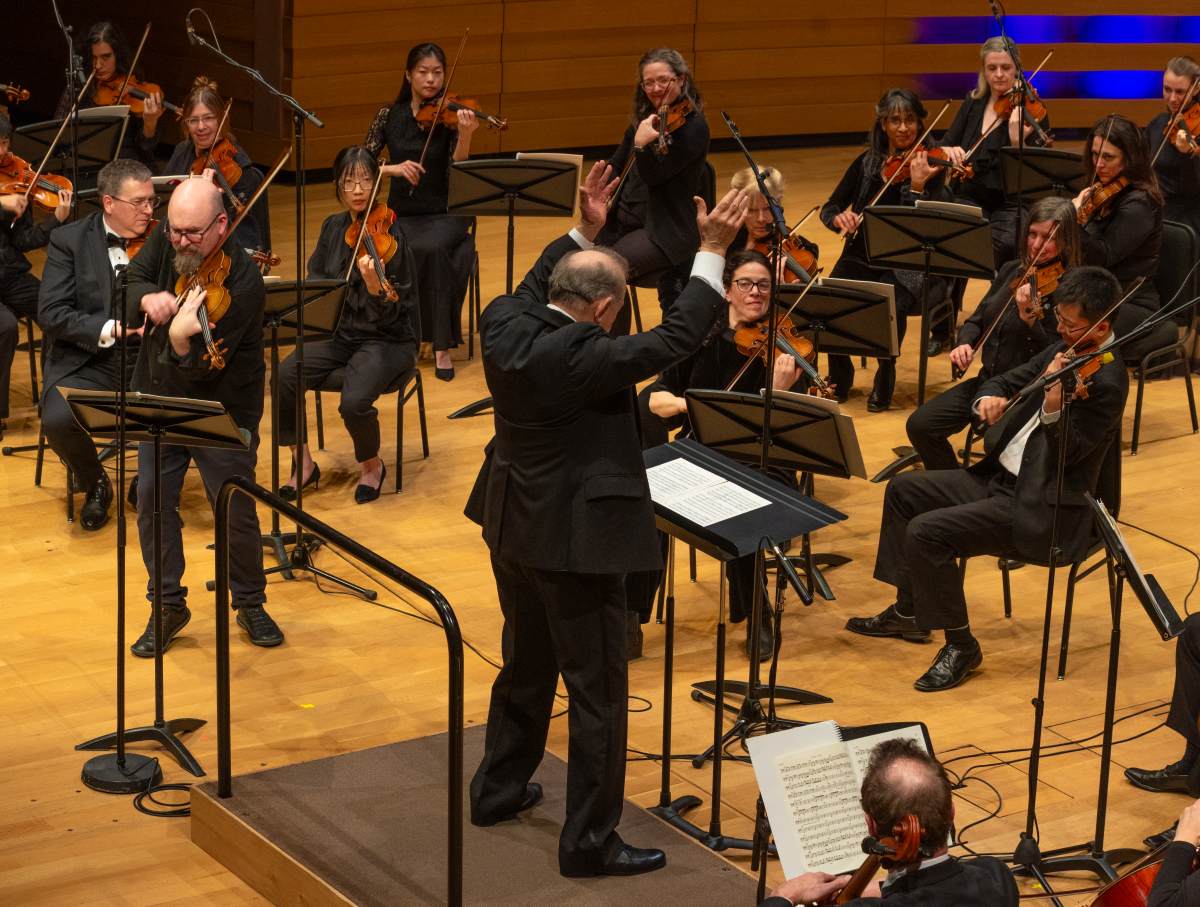
Alexina Louie’s O Magnum Mysterium: In Memoriam Glenn Gould followed. In her pre-concert talk, Louie described receiving the commission for the McGill University student string orchestra back in 1982 as a young composer. It was originally written for 44 divisi strings, i.e. with an individual part for each instrument — something Louie did, as she shared with a laugh, in order to ensure that all 44 student musicians would show up for every rehearsal. The version performed at Koerner Hall was a 1999 revision by John Rea created for 34 strings.
As she began work on the commission, Louie heard about the massive stroke suffered by Gould, which would end his life at just 50. Shocked and grieving, she wrote what she still calls one of her most personal and emotional works.
You didn’t need to know that, however, to appreciate the music and its multi-layered textures. It begins quietly and ranges through a wide variety of moods and sounds, from squeaky sounds to melodic (or melody-adjacent) lyrical passages, to quotes from Bach works. Louie said Bach was her solace while she was working on the composition, and of course the ties to Gould’s work are obvious. They appear singly and in a disjointed kind of layered approach in the work — almost as if the passages of Bach were heard from another room, while the rest of the orchestra expresses her sense of dislocating grief with kinetic lines and a moody, dark cello tone.
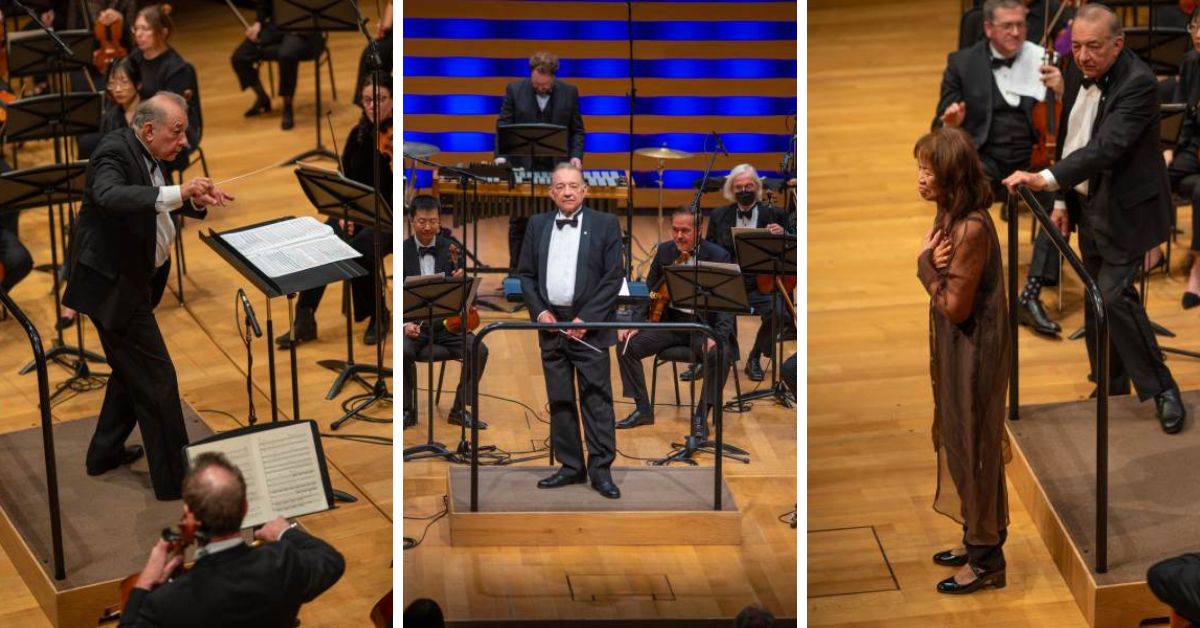
As a whole, the work is an absorbing inner journey. Both the work and the composer herself received loud applause.
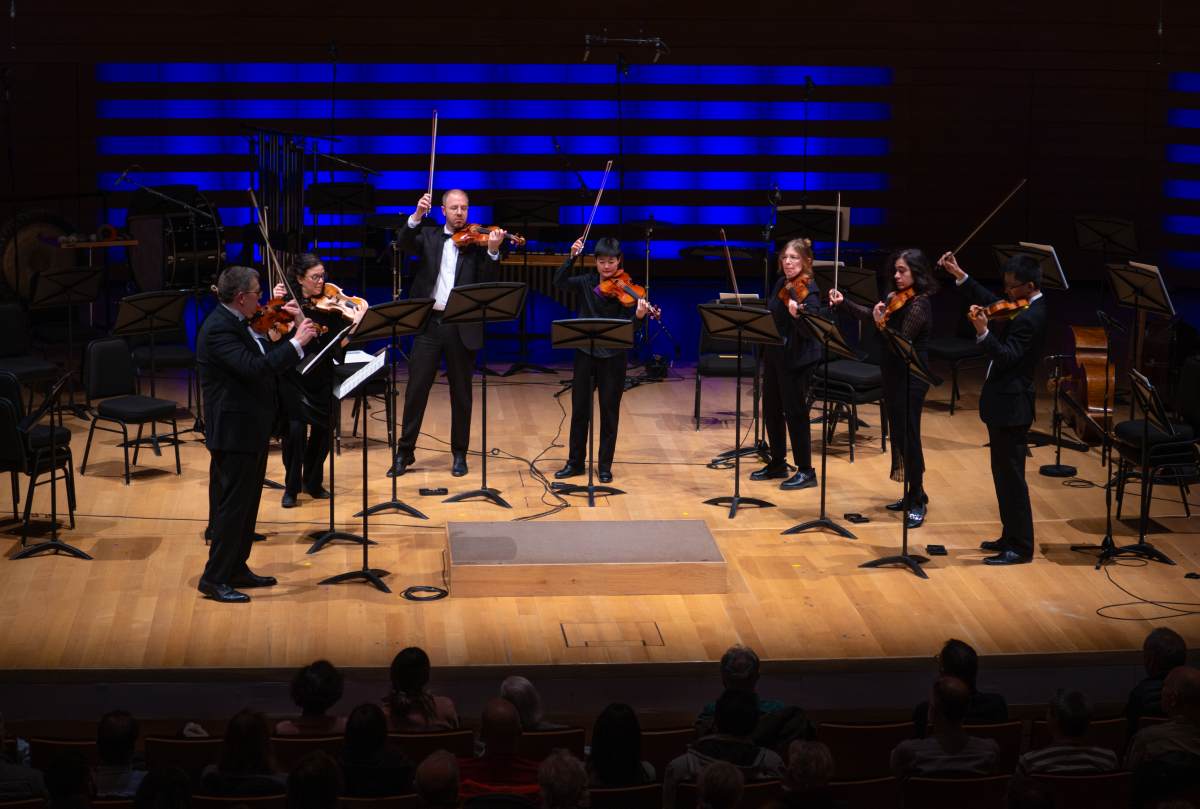
The first half of the concert ended with American composer Andrew Norman’s 2004 work Gran Turismo. It’s subtitled “for eight virtuoso violinists”, and was ably performed by Corey Gemmell (who was guest concertmaster for the evening), Jung Tsai, Bethany Bergman, Patrick Goodwin, Hee-Soo Yoon, Elizabeth Johnston, Aysel Taghi-Zada, and Calvin Cheng, without a conductor. Norman was, according to the program notes, inspired by similarities he found in the approach to Italian futurism, the Baroque concerto grosso, and race car video games, and once again, you didn’t need to know that to feel the hyperkinetic energy of the piece.
It certainly is a virtuosic piece as described, one that demands brilliant timing and execution by all eight musicians, each of whom took the spotlight on occasion. As the work unfolds, two, three or four different parts were in motion at any one time, with rare moments of unity. It requires the ability to pass the torch, so to speak, in rapid fire fashion, and won an enthusiastic round of applause from the audience.
One did fear for their bows, however.
Second Half
The Canadian premiere of Arvo Pärt’s 2009/15 work Silhouette opened the second half of the concert. Like his other work, it involves percussion — including a gong played with a bow — as well as the string orchestra. It’s a work marked by contrasts. Rhythmic plucked violins are set against long cello lines, and peppered with percussion, which took on a more prominent role than in the other Part work the orchestra played, flowing in turn into a lyrical section. The harmonies were gorgeous.
Swedish composer Anders Hillborg’s Bach Materia, also a Canadian premiere, was a highlight of the evening. The imaginative work featured violinist Mark Fewer as soloist. It had been written with Pekka Kuusisto in mind, and was dedicated to him. Like Kuusisto, Fewer is not only a virtuosic violinist, but one adept in the art of improvisation. The work begins with the orchestra’s energetic improvisations (while conductor Pauk waited patiently), and incorporates three sections where Fewer was given free reign.
The piece contrasts lyrical and dramatic, sweeping passages, back and forth in a kind of ebb and flow. At times, the orchestra accompanied Fewer’s long lines with soft, high sounds. Fewer’s improvisational passages masterfully kept within the sound world of the composition, including non-traditional sounds, lyrical lines, and the general dynamism of the work as a whole.
Hillborg composed a second movement to Bach’s Brandenburg Concerto No. 3 at the request of Thomas Dausgaard, who premiered the work. He interpolates some of that material, largely dynamic arpeggiated passages, into the mix.
There are also bluesy/jazzy passages, where Fewer played against a walking bass line played by first a single cello, then a single bass. It was an interesting mix of sounds and moods, often delivered with a playful sensibility.
Fewer looked like he was having fun with the material, as did the orchestra, and their enthusiasm made it both spirited and entertaining. Both the orchestra and Fewer received a well deserved standing ovation.
Final Thoughts
Maintaining the momentum, the concert closed with an orchestral arrangement of Jimi Hendrix’s seminal Purple Haze (1967). Steve Rifkin’s arrangement drew out the rhythms and harmonies into a contemporary classical mode that didn’t erase Hendrix’s original intentions, but expanded on them instead.
Mark Fewer delivered the violinist’s version of a Hendrix guitar solo with aplomb.
Despite the extreme cold and the week’s earlier miserable weather, the orchestra level of Koerner Hall was near capacity with a multi-generational crowd that left satisfied and satiated with an excellent menu of contemporary music.
Alex Pauk’s genius as a programmer isn’t talked about nearly enough.
Are you looking to promote an event? Have a news tip? Need to know the best events happening this weekend? Send us a note.
#LUDWIGVAN
Get the daily arts news straight to your inbox.
Sign up for the Ludwig Van Toronto e-Blast! — local classical music and opera news straight to your inbox HERE.

- PREVIEW | Toronto Mendelssohn Choir Presents Bach’s St. Matthew Passion - March 17, 2026
- INTERVIEW | Conductor Matthew Jones & Bassist Joel Quarrington Talk About Dramatic Metamorphosis - March 17, 2026
- PREVIEW | The Gallery Players Of Niagara Plays Host To Musicians From Tafelmusik Baroque Orchestra - March 17, 2026