
Native Earth Performing Arts presents Niimi’iwe Dance Double Bill from February 5 to 8 at Toronto’s Aki Studio. The Double Bill features Conversations: Hidden Stories by Vanguardia Dance Projects & Aanmitaagzi, and Spine of the Mother by Raven Spirit Dance.
Both dance works explore various facets of Indigenous identity, and the performances will be followed by talkbacks with the artists after each show.
“We are honoured to present this double bill of works exploring connections to land, body, and space within the North and the South; story weaving ancestral memories through a contemporary Indigenous lens,” said Joelle Peters, Artistic Director of Native Earth Performing Arts in a statement.
“Allow these works to transport you through time and place, and witness the power of these incredible artists as they share the Aki Studio stage.”
Conversations: Hidden Stories by Vanguardia Dance Projects & Aanmitaagzi
Director and choreographer: Olga Barrios
Creators: Norma Araiza, Penny Couchie, Animikiikwe Couchie, Lilia León, Olga Barrios
Dancers: Norma Araiza, Lilia León, Olga Barrios
Guest Dancers: Lucia Llano, Maria Riaño
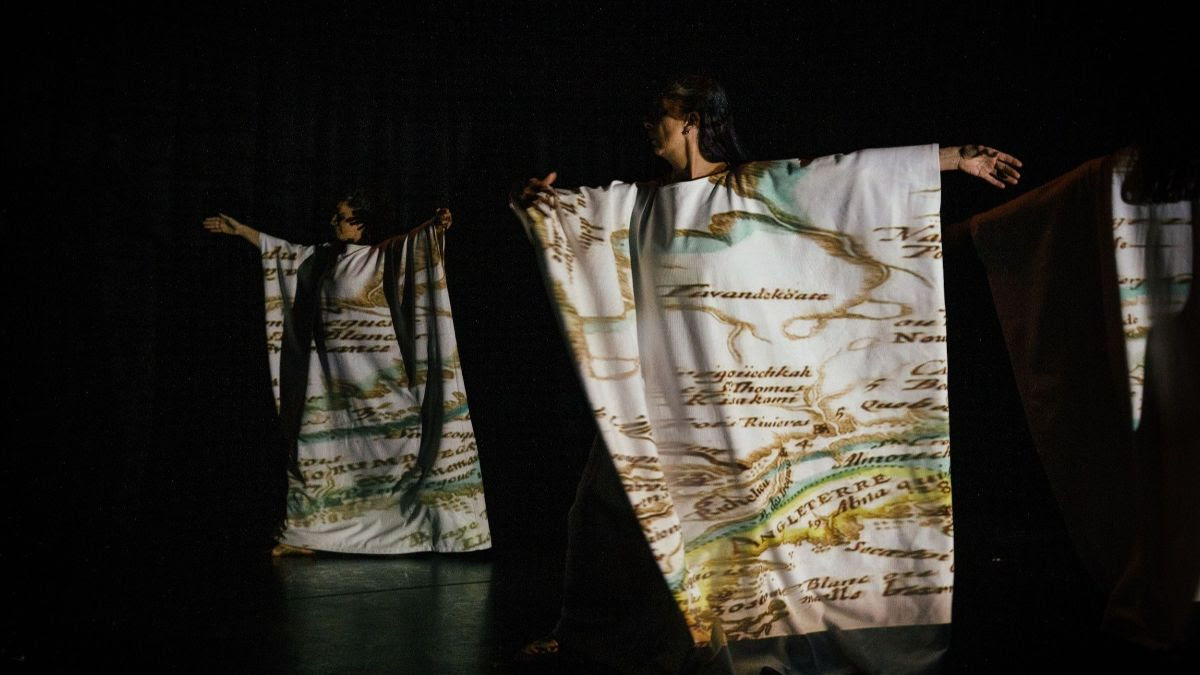
Conversations: Hidden Stories delves into the concept of body and territory as conceived by Colombian-Canadian choreographer Olga Barrios. Barrios, and other women of many colours, look for connections with ideas that have been essentially erased from history. Conversations is a journey that examines stories of displacement and erasure through soil, fabric land, and water. What separates Indigenous women from themselves, and from each other? The right to ancestry and its connections through history into the future is a sovereign right.
Spine of the Mother by Raven Spirit Dance
Choreography by Starr Muranko
Performed by Tasha-Faye Evans and Marisa Gold
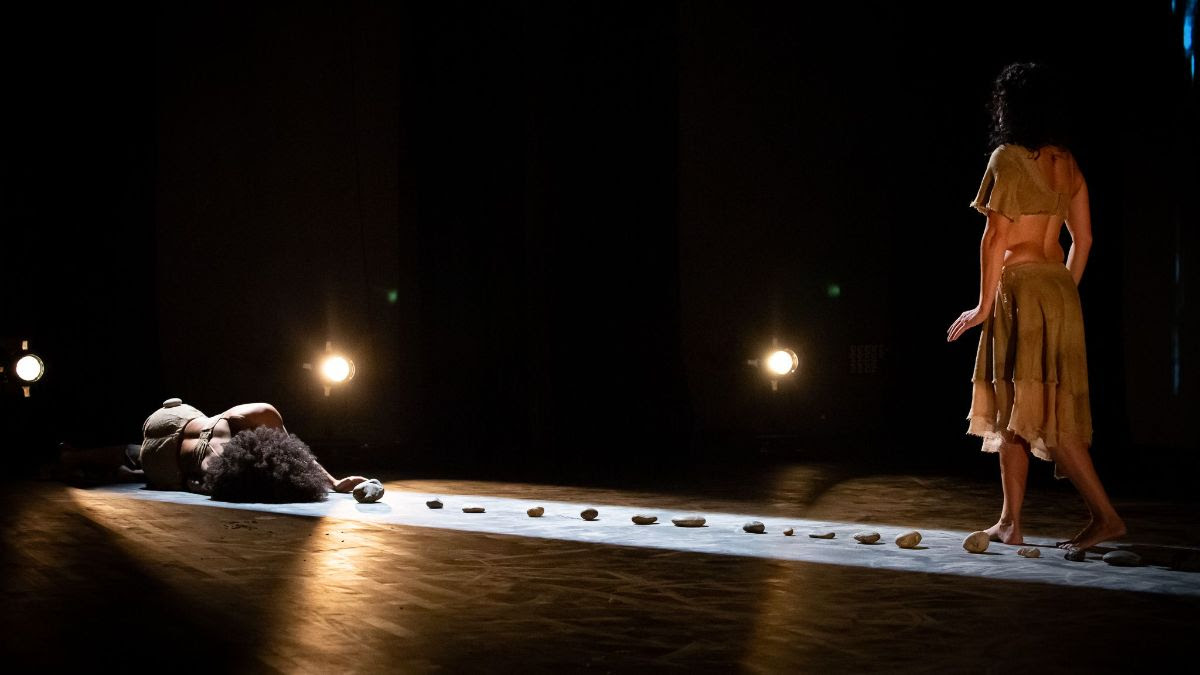
The bodies of women have an interior as well as an exterior aspect. Breath, impulse and memory are used to create energy and movement, a ritual that ranges along the spine of the mountain range known as the Andes. Indigenous Elders in South America have called the mountain range, which finds its base in Argentina, and stretches through the Americas to end at the tip of Alaska, the Spine of Mother Earth. The dance work by the same name uses the body as a landscape which, like the mountain range, connects North and South.
Spine of the Mother began as a collaboration between Indigenous artists in Canada and Peru about a decade ago. Since its inception, it’s been performed across Canada and most recently internationally at the Kia Mau Festival in Wellington, New Zealand as part of Raven Spirit Dance’s 20th Anniversary tour.
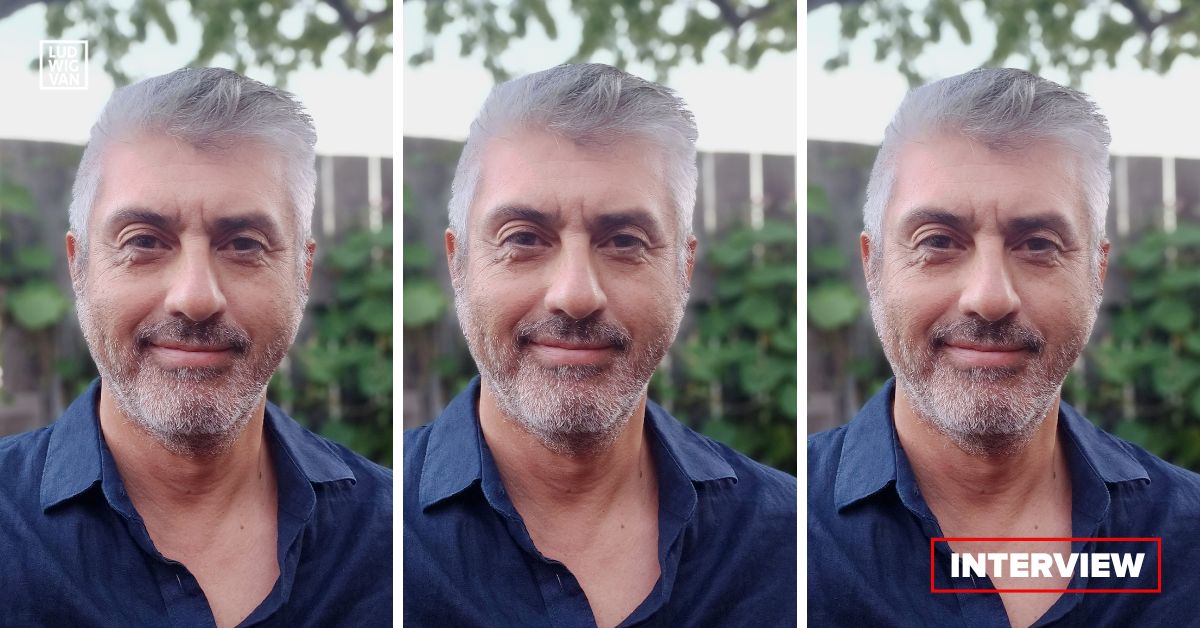
Edgardo Moreno is the composer and sound designer for both pieces of the Niimi’iwe Dance Double Bill, and LV caught up with him to talk about his work.
Composing for Dance: Edgardo Moreno
Composer and sound designer Edgardo Moreno’s background includes Western classical music, along with Latin American and electro-acoustic music. His work blends music and soundscapes. He’s created scores and audio experiences for a variety of media, including films and interactive installations, as well as contemporary dance.
Composing music for dance is always dependant on the choreographer and their own working methods.
“Every choreographer works very differently,” Moreno explains. Some don’t want to think about music until the choreography is essentially finished. That often happens in more abstract modern dance works. Others prefer to have the music develop alongside the dance work.
“We have meetings about the themes. I try to get sort of a script of the arc of the piece.” Often, that includes delineating the various sections of the dance piece.
For Moreno, who creates soundscapes as well as music, it means a lot of listening.
“I work in electroacoustic music,” he says. During the initial discussions related to a dance project, he’s listening for any and all cues that relate to sound. For example, the choreographer may mention that they first came up with the idea for a project in a specific location, like a forest or in the city. Those spaces already begin to suggest sound worlds.
“I think about sound worlds before I create the music,” he explains. “The music is to elevate the sections that need emotional subtext.”
The music may come and go throughout the performance, and take on varying degrees of significance and prominence. “I prefer to work with a lot of sound designs.” Rhythms are one of the key elements when it comes to defining the process.
“What is the sonic world that you want to be in?” he asks the choreographers.
If a work revolves around the experience of being a mother, for example, he wonders what it sounds like to be at home with your children. There may be a clock ticking on the wall, a dog barking from a neighbour’s yard, and so on. Let’s say that the figure of the mother in the piece becomes exhausted, or agitated. The clock will be amplified, perhaps there are now multiple clocks ticking, and the barking dog becomes more insistent. “That’s how I like to create tension,” he explains. The soundscape supports and helps to create the atmosphere of the piece.
“Most people will have a story,” he says. That’s where the dance piece begins — with a story. Some dance makers are very organized in their approach, and can tell him where the various sections begin and end. “That’s always helpful.”
His job initially is to gather information. “I listen very carefully to what people say,” he says.
“You ask choreographers, what kind of music do you listen to?” Moreno will ask for musical references to get an idea of what they’re looking for. “I try to figure out, what is it about that particular music?” He listens to hopefully identify what works and what doesn’t for the project.
“I always ask about tempo.” Dance makers will give him a tempo in beats per minute. Is it a brisk walking pace? Or something much slower? It’s all about trying to translate their needs in terms of movement into musical terms.
“These things are important, because a lot of non-musicians don’t think in those terms,” he says. “Sometimes it’s very hard, because we don’t share a common vocabulary.” Choreographers may or may not be conversant when it comes to music. “I have to kind of figure it out. Sometimes it’s hard if they’re not clear about ideas.” Movement, as he notes, can be very abstract in nature, with the emotional underpinnings unclear.
Electro-Acoustic Soundscapes
“I tune into subtleties,” he says. When he’s established a place or space that relates to the dance work, he begins to collect the sounds. “I’ll go out and record these things,” he says. As a result, he’s collected a library of recordings that he uses in his work, including natural sounds as well as street sounds — even subway sounds. “Sometimes that sound can transform.” It begins as something recognizable, then he uses electronics to transform it. He may also add a piano or guitar.
Through experience, he’s learned to ask some very specific questions.
“I just realize I need to ask choreographers — what instruments do you really hate?” For one project, he relates, he incorporated a gorgeous flute line, only to find that the dance maker hated flutes.
“It’s hard to get into all of those things,” he acknowledges. He’ll ask what kinds of sounds they prefer, i.e. gritty or sweet?
Working with dance has its challenges. “It’s fun, it’s challenging,” Moreno says. Most of the time, he’s referred to artists who are already at least somewhat familiar with his work. “When people come to me, I think they’ve already seen my work.”
The stress generally lessens once he’s gotten a first draft together, and it’s received a thumb’s up.
“I usually get a lot of video,” he says. The choreographers will send videos of the rehearsals. “Sometimes on a daily basis.” When he’s composing to the video, he likens the process to working on a movie score.
“You don’t want the music to be too distracting,” he explains. It should carry the emotions of the dance without overwhelming it.
Niimi’iwe Dance Double Bill
Along with other clues, Edgardo tunes into the emotional aspect of the dance work. Are the dancers overwrought, or angry? Does a specific section carry more power that the rest?
“One of the pieces that I’m working on for this show, there’s a section called women as animals,” he says. In it, the dancers yell and shout. He adds a strong rhythm to add to the effect.
The Spine of the Mother has been touring for years.
“Spine of Mother is a 14 year old piece,” he says. “It’s really nice to be able to work within the Indigenous community.”
Edgardo has worked with choreographer Starr Muranko for many years. “The same with Olga Barrios. We’ve worked with each other and collaborated on many projects,” he says. “I actually introduced these two women.”
The double bill of both works began to take on a life of its own, united by themes that revolve around Indigenous heritage and ancestry.
The Spine of Mother has a personal connection for Moreno, who grew up in Chile. “I would look at the Andes mountains every day in Santiago,” he says. “I spoke to Starr about this. It was such a presence in our lives.”
- Find show details and tickets for the Native Earth Performing Arts presentation of Niimi’iwe Dance Double Bill — Conversations: Hidden Stories by Vanguardia Dance Projects & Aanmitaagzi, and Spine of the Mother by Raven Spirit Dance [HERE].
- For Indigenous Group rates, email boxoffice@nativeearth.ca
Are you looking to promote an event? Have a news tip? Need to know the best events happening this weekend? Send us a note.
#LUDWIGVAN
Get the daily arts news straight to your inbox.
Sign up for the Ludwig Van Toronto e-Blast! — local classical music and opera news straight to your inbox HERE.

- PREVIEW | Classical Guitarist Alexandra Whittingham Makes Toronto & Ontario Debuts - March 13, 2026
- PREVIEW | Soundstreams Presents Quatuor Bozzini: With Strings Attached - March 13, 2026
- INTERVIEW | Award-Winning Librettist & Against The Grain AD Royce Vavrek Talks About Canuck Cantatas - March 13, 2026