
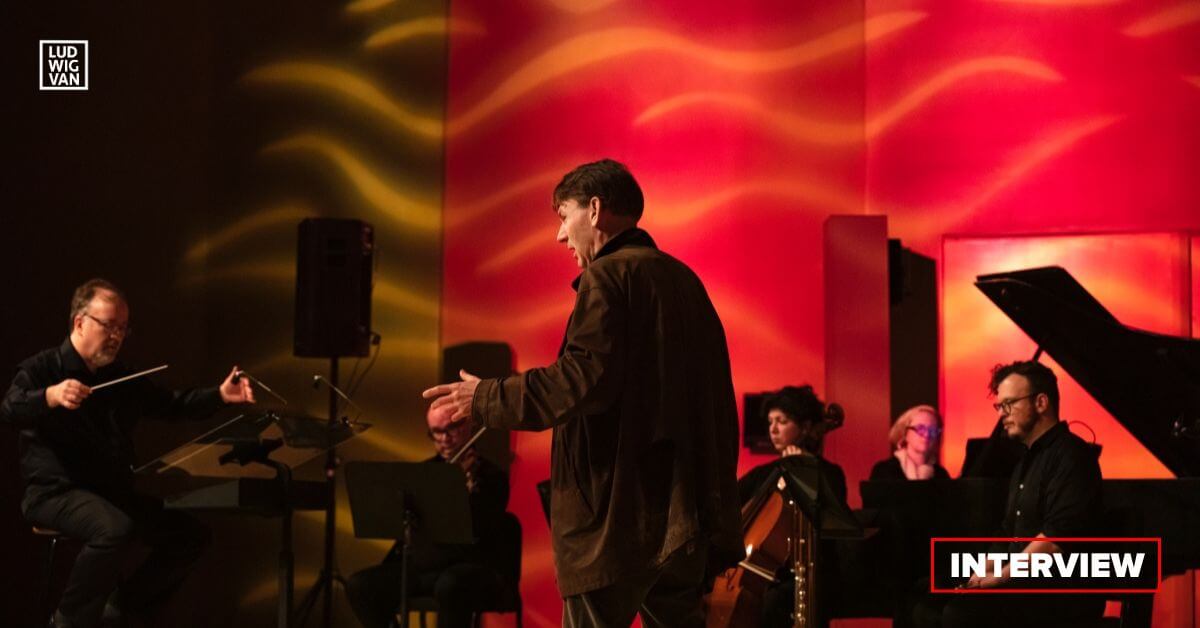
A legendary Welsh prince and a post-apocalyptic story about environmental renewal — it’s the heart of Madog, a one-man opera by composer Paul Frehner and librettist Angela J. Murphy. Horizon: Madog will be released on the Navona Records label on January 16, 2026.
Madog is a trilingual opera, written in English, Welsh, and French. Montréal’s Ensemble Paramirabo perform on the album alongside baritone Jeremy Huw Williams.
The album includes the full opera along with ‘Un pont sanguin’, an additional piece for sextet by Frehner.
The Story
The story is set in a future world where the planet has been virtually destroyed by climate-driven flooding. Communications systems have collapsed across the globe.
Enter Madog, descendant of the legendary Welsh prince of the same name. Madog ab Owain Gwynedd is a figure in Welsh folklore, a prince who was said to have sailed across the ocean to the Americas in 1170 — three centuries before Christopher Columbus’s voyage. According to the legend, Madog (also called Madoc) was said to be the son of Owain Gwynedd, a real historic figure and the Welsh King from 1137 until 1170. Madog fled Wales because of the prevailing violence of the era.
The Madog of the opera rejects harmful technology and promotes an earth-first philosophy.
In the future world of the opera, people are gradually beginning to rebuild their societies. Madog looks to discover his own heritage as he works to unite the emerging present-day cultures around shared values.
In contrast to the more pessimistic environmental message of so many works in various media, Madog examines the ways that diverse communities can work together for create a better future.
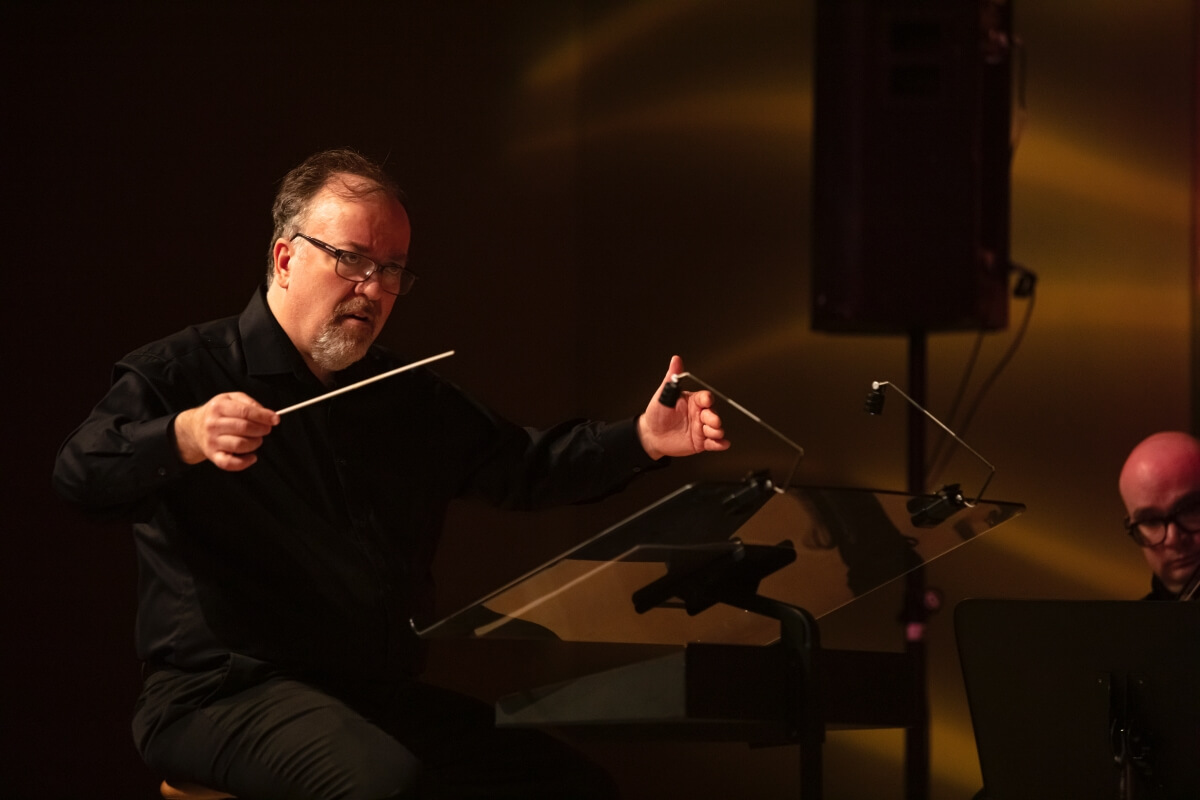
The Artists
Paul Frehner
Composer and conductor Paul Frehner is a native of Montréal. He’s become known for a diverse catalogue of works that incorporate elements of rock, folk, jazz, and progressive music, along with literature, science, and the natural world. He has composed orchestral and chamber music, opera, choral works, and electroacoustic music.
Paul’s music has been widely commissioned and performed across the globe, and his accolades include First Prize in the Prague Philharmonia’s Third Millennium Composition Competition. He is an Associate Professor at Western University, where he teaches composition and directs the CEARP electroacoustic music studio.
Angela J. Murphy
Angela J. Murphy is based in Montréal. She graduated from both the Theatre program at Dawson College, and the English and Creative Writing program at Concordia University. People and human nature form the heart of her creative work.
She first collaborated with composer Paul Frehner as a librettist in 2003 on the opera Sirius on Earth. The work was produced in London, England, and funded by the Genesis Foundation. Sirius is also set in a future world, but with a darker and more dystopian flavour. Humanity has been cured of its sadness, but the result is a detriment to the very essence of what it means to be human.
Jeremy Huw Williams
Welsh baritone Jeremy Huw Williams studied at St John’s College, Cambridge, and at the National Opera Studio in London. He has performed in more than 70 operatic roles since making his debut with the Welsh National Opera in a production of Così fan tutte. Jeremy has performed on prominent stages across North and South America, as well as in Australia, China, and India, and in Europe, including at the Wigmore Hall and Purcell Room, and at many major music festivals.
Along with live performance, he is a recording artist with a catalogue of more than 50 commercial recordings, including about 20 discs of solo songs, and he frequently records for BBC Radio 3. He is dedicated to new music, and has commissioned many works.
Among his many accolades, he was awarded an Honorary Fellowship by Glyndŵr University in 2009 for services to music in Wales, the Honorary Degree of Doctor of Music from the University of Aberdeen in 2011, the Medal of the Order of the British Empire in the 2021 Queen’s Birthday Honours, and the 2022 John Edwards Memorial Award, a non-competitive award given in Wales for services to the nation’s music.
Paramirabo
Ensemble Paramirabo take their name from a work by composer Claude Vivier. The group met in 2008 at the Conservatoire de musique de Montréal, and flutist Jeffrey Stonehouse has been their artistic director since then.
Known for their dedication to contemporary music, and the work of Canadian composers, their innovative approach looks to push the boundaries of the traditional concert experience. They have toured internationally, and been invited to perform at music festivals in Belgium, England and Mexico.
Accolades include the OPUS 23rd edition — Performer of the year Prize, and a 2020 JUNO nomination. The ensemble has over 80 premieres and commissions to their credit.
Paul Frehner & Angela J. Murphy: The Interview
How did this work come about?
“The singer, Jeremy Huw Williams, he contacted me and suggested maybe we can work on an operatic project with a solo singer,” Frehner says. Williams suggested a trilingual piece, and also incorporating a connection between Wales and Québec.
“Angela and I had worked together previously,” Paul continues, “Jeremy sang on that project years ago.”
When it came to considering an ensemble who could handle the music, Frehner went with a group he’d been thinking about for some time. “I had considered approaching Paramirabo for a while, and they were very enthusiastic.”
The outlines of the story were also largely the result of Jeremy’s input. “Again, that was Jeremy.”
As he explains, the parameters of Madog’s historical story may or may not be entirely real. Among the many rumours and legends attributed to the original Madog is that he explored North America when he arrived there, creating a connection between Wales and Québec.
Frehner was intrigued by the story. “Maybe somehow we can reimagine that story. The story is not about him, but a descendant.”
“Or, he sees himself as a descendant,” Angela adds. The world of the opera is not so far off from where we are now in today’s world, with the direction that modern society is taking.
In the opera, Madog the descendant is motivated by the past — the present of today. “Because of the decisions made in the past,” she explains, “it took on a role in his mind, in order to perpetuate a positive future, he has to act.”
It’s not that he rejects all technology, as she notes. The opera’s Madog uses a radio, for example.
“There’s a hubris thing,” she comments. “No matter what you do, there’s no perfect way of living, no perfect way of being.”
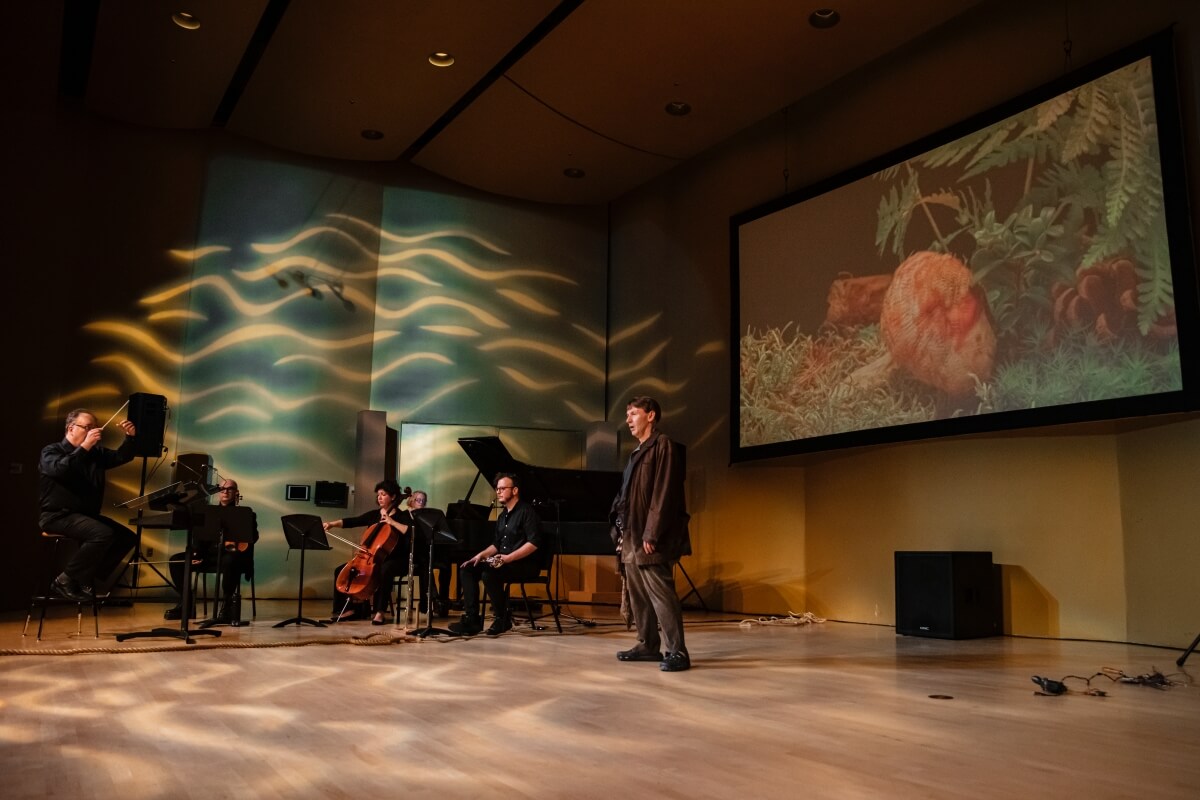
A Trilingual Opera
“Jeremy’s idea was that it would be in three languages, the opera, but Angela came up with how to set the text,” Paul explains.
Angela’s idea was to come up with a scenario that would allow for the inclusion of all three languages. In the post-apocalyptic world of the opera, the people Madog encounters originally come from different places. “They speak a fluent dialect where the three languages are interwoven.” It results in a constant back and forth between English, French, and Welsh.
As Murphy points out, it’s not so dissimilar to the Chiac she was exposed to during her childhood via her grandmother. Chiac is a unique dialect of Acadian French that is largely spoken in parts of New Brunswick. It blends French with English, with a distinctive use of grammar and rhythm, and a unique vocabulary.
“Québec French, as you know is very much its own dialect,” Angela notes. “It’s really grown to be its own thing. The Welsh have a very historic and (unique) language,” she adds, drawing a comparison between current efforts to teach Welsh in schools and Québec’s Bill 101.
Language is key to culture. “There’s no getting away from it here,” she says.
“Jeremy, before the performances, he would always speak of the importance of the Welsh language,” Paul recalls. The Welsh government’s efforts to teach the language in schools is an effort to preserve a heritage that is in danger of vanishing. “English is the dominant language in Wales still today. It’s very much an ongoing issue.”
While the language of the opera constantly fluctuates, the style of the music doesn’t necessarily follow. “In a way, no,” Frehner says. He says he considered setting the Welsh text with music in a kind of ambient mode, but then thought better of the idea. “I thought the music would just end up sounding kind of bonkers,” he says.
“I tried to capture in the passages […] an overall feeling of the particular moment, and then try to let the words be delivered in a natural way, for whatever the language was.”
He’d never worked with a Welsh libretto before, and consulted with Williams about the rhythms of the lines. “Jeremy was tremendously helpful,” he says. His input included, for example, details such as avoiding high notes on certain syllables.
“The libretto is vastly poetic,” Murphy says. “He loves hearing himself use words. It works in that sense.”
She emphasizes that the goal was to allow for the emotions to come through clearly, no matter what the language.
At times, the specifics of each language came into play. “I love the way that Québec language can sound when you’re angry,” Angela says. “When he’s talking about the ocean, it’s more Welsh,” she adds, noting the language’s dreamier, meditative feel.
“The English feels more like the mediator between the two,” she says.
Music
Like much of Frehner’s work, the music for Madog incorporates multiple influences. “Someone might listen to and hear maybe allusions to this style or that style,” he says. “It might seem pluralistic in the way that the libretto is pluralistic.”
The opera opens with a radio broadcast, then segues into the music. “It’s rather driving,” he says. When Madog talks about the land, the mood changes, and becomes more reflective. “It’s quite different.” As he explains, the differences aren’t necessarily stylistic, but rather linked to interpretation.
“The opening melody that the ensemble plays when it first comes in, it’s heard […] throughout in various ways,” he explains. Each iteration is chromatically different. “It’s hopefully a bit of a unifying element.”
“It’s like a comforting mantra for himself,” Angela says.
“It’s throughout that final section that he’s singing […] ‘We are the gods’ — it’s not really a leitmotif, but this omnipresent melody throughout,” Paul says.
Collaborators
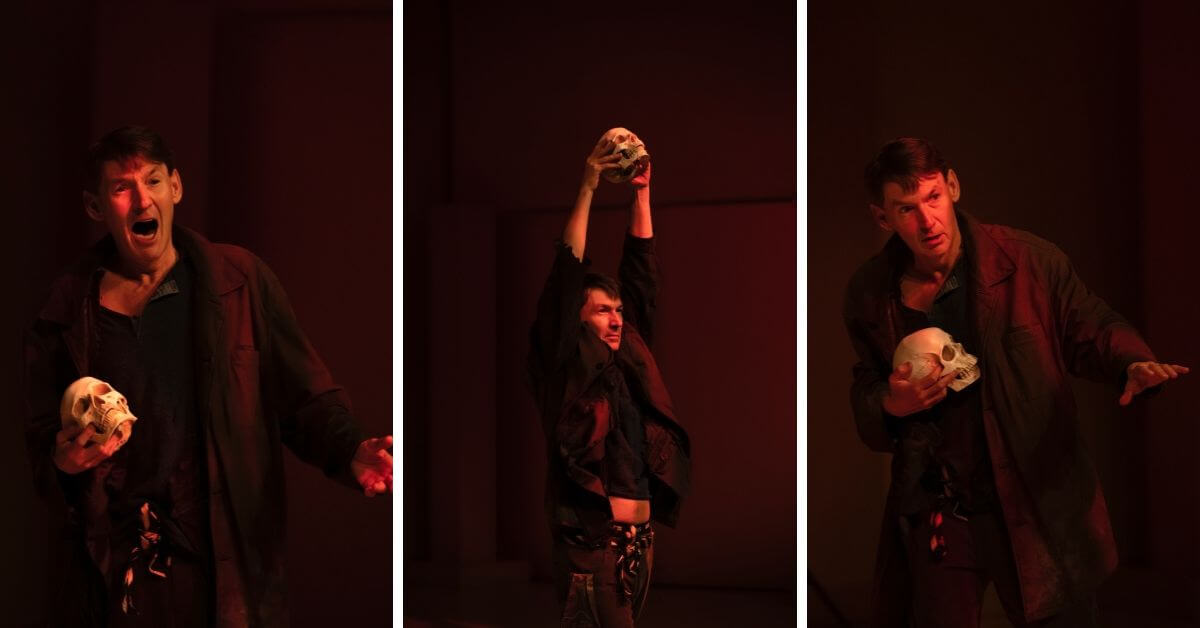
Jeremy Huw Williams is, of course, a vital element to the opera.
“He’s a tremendously engaging performer, and a very dramatic baritone with a lyrical voice. He’s really able to transfer from one language to the next, to the next,” Frehner notes. “He’s a wonderful singer to work with on a project like this.”
“He’s 100% invested in understanding this character,” Angela adds.
As she comments, the initial presentation to Williams was a barebones sketch of the opera. “He really created his [character],” she says. “It was created over the period of a week.” Jeremy had memorized the work, and come back with a working character. “It’s just fantastic to work with someone so dedicated.”
“We started rehearsals on a Monday, and the first performance was on Friday,” Frehner says. He explains that Williams had not only memorized the music, but the blocking and other details.
The initial live performances took place in 2024, including one each in Montréal and London, Ontario, and another three in Wales.
“All the stage directions that Angela was given, it was important to know why,” Paul comments. “He’s really wanting to understand the history of the character.”
“The text bounces from one thing to another,” Angela comment, “so [it was] not necessarily obvious what happens from one moment to the next.” Williams created the connections from moment to moment.
“He understood that the character is torn between wanting to stay with his people, and the call to find his homeland and to pass on their message,” Paul explains.
“It’s almost an inner drama,” Angela notes. At times, it’s not entirely apparent whether the character is talking to himself, or addressing someone else.
Ensemble Paramirabo also became an integral part of the opera.
“Just how great Paramirabo was to work with,” Paul recalls. “They had a very much shoot first, ask questions later approach.”
He notes that, while they’re a new music ensemble, chamber opera is not their usual territory.
“They totally embraced the project,” he says.
“It’s a dark piece, certainly a lot of quirkiness there,” notes Angela. While the overall tone is serious, the opera does include a few laughs. “They enjoyed watching him,” she adds. “It gives you the sense they’re creating with us.”
“They were very much collaborators,” Frehner says.
The Recording
“We recorded this piece in Wales right at the end of the tour,” Paul notes. At that point, the work was well rehearsed and perfected by all of the artists.
‘Un pont sanguin’, the companion on the piece, was written for Paramirabo, and recorded in Montréal.
- Find Horizon: Madog on Navona Records, available for pre-save now, and set for release on January 16, 2026 [HERE].
Are you looking to promote an event? Have a news tip? Need to know the best events happening this weekend? Send us a note.
#LUDWIGVAN
Get the daily arts news straight to your inbox.
Sign up for the Ludwig Van Toronto e-Blast! — local classical music and opera news straight to your inbox HERE.

- PREVIEW | Pianist Eve Egoyan Presents In Stone, A Composition Written For The Armenian Genocide - March 6, 2026
- PREVIEW | Tafelmusik Presents A Bach Celebration, Featuring Rarely Heard Works From His More Than 200 Cantatas - March 5, 2026
- SCRUTINY | Mohsin Zaidi’s Gut Wrenching The Surrogate At Crow’s Theatre Offers No Easy Answers - March 5, 2026