
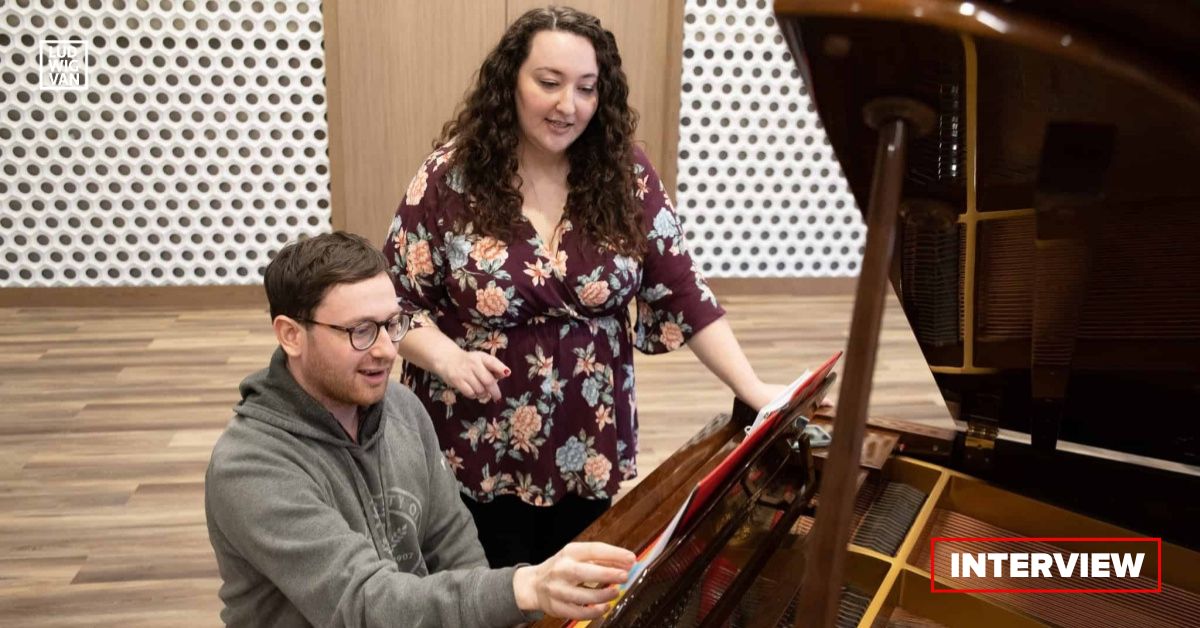
Soprano Jaclyn Grossman and pianist/composer Nate Ben-Horin are the founders of the Likht (ליכט, “light”) Ensemble, dedicated to uncovering and exploring the music composed in the ghettos of Europe during the Second World War. Their focus is on works by Eastern European Jews, including music from Poland, Lithuania, Germany, and the Czech Republic.
They’ll be performing their program The Shoah Songbook at the Toronto Holocaust Museum on January 10 as part of the JCC Chamber Music Series.
LV asked Jaclyn and Nate a few questions about the music.
Jaclyn Grossman & Nate Ben-Horin: Q&A
The duo answered a few questions together as the Likht Ensemble (LE).
LV: What can you tell me about the kind of research that goes into uncovering this music? What kind of sources? Is there a particular story about uncovering these works that you think epitomizes this effort?
LE: There is a small but passionate community of researchers and musicians dedicated to Holocaust repertoire, so we do our best to find and contact those people, and we also have spent a fair amount of time poring through online and physical archives. Last year we visited the United States Holocaust Memorial Museum (USHMM) outside Washington D.C., and spent several days just photocopying everything we could get our hands on. This March, we’ll be visiting the ExilArte Center in Vienna (an organization dedicated to music that was labeled “degenerate” by the Nazi regime) to give a performance and explore their archives.
An important part of our uncovering work is reconstruction. Many if not most of the songs we come across are field recordings or field transcriptions of unaccompanied vocal melodies. Part of Nate’s job is to notate these melodies and create instrumental accompaniment parts from scratch so that these tunes can be performed in a classical recital setting.
The most dramatic stories of music discovery come directly from the source. We frequently perform a set called “Three Lithuanian Songs” by the composer Edwin Geist. Geist was trapped in the Kovno ghetto, and as conditions deteriorated around him he made an ultimately unsuccessful escape attempt and was shot shortly thereafter. Before the authorities could confiscate his belongings, his musician friends broke into his apartment and rescued his musical manuscripts so they wouldn’t be destroyed. These songs are still unpublished, but scans of the handwritten scores ended up on the USHMM website, which is how we found them.
A lot of the pieces we perform have similar backstories. Another one is that the Polish composer Szymon Laks, who was the conductor of the Auschwitz orchestra, discovered a scrap of paper on the ground which was “crumpled, and smelled of fish” on which were printed three Polonaise (a type of Polish dance) melodies by an unknown composer. The orchestra’s job was to play patriotic German music and work tunes, so he orchestrated and rehearsed these Polonaises in secret. Then, after the war, he transcribed them from memory, and we have programmed them in a version for violin and piano.
LV: The project is an ongoing effort, so I understand. How many works have you uncovered and showcased so far, and how many more do you think there might be?
LE: We’ve developed approximately three 20-minute video recitals (focusing on music from Czechia, Lithuania, and Poland respectively) and three full-length concert programs so far. We have a couple more ideas in the works, including a program of cabaret songs.
It’s hard to say how much more music is out there. We have hundreds of scans from the USHMM that we haven’t yet analyzed in detail because translating (from Yiddish, Polish, German, et cetera) and arranging them takes so much time. We also find pockets of new music in unexpected places like university archives or private collections. Some of the composers in our roster have extensive bodies of work that would take years to master, and pieces in different permutations like voice-and-piano, chamber ensemble, voice-and-orchestra. So, we don’t expect to run out of material anytime soon.
LV: How would you describe the music — are there certain elements of style or genre you can mention?
LE: Our music generally falls into two distinct categories — classical art song and folk music.
The classical song occupies a fascinating stylistic niche within the Germanic tradition, situated between the serialists of the Second Viennese School (Schönberg, Berg, Webern), who in many ways sought to break with Romantic harmonic and emotive tradition, and present-day composers who tend to re-inhabit that tradition rather than avoid it. The camp composers are interesting because their music almost sounds like a missing link between these two periods, and indeed, if they had lived to achieve the cultural prominence they deserved, some of them would have probably come to be regarded as canonical figures in the lineage of German art music.
The folk music is just as interesting. These are mostly beautiful, lyrical, approachable melodies whose simplicity frames an extreme emotional directness about the experiences in the camps. This comes in many flavors — lullabies, klezmer tunes, Yiddish tango… It was common practice to take the melody of an existing folk song from one’s culture/language of origin (usually Polish or Yiddish) and replace the lyrics with new ones about life in the camps — we have many examples of this. The directness of the folk song is a great contrast to the density of the classical song, so we always feature both categories in every concert.
LV: What do you think inspired these composers to continue to create even in such a hostile environment?
LE: That’s a huge question. For many of them, it seemed to be almost a matter of survival. Many prominent artists and musicians were held together in the Bohemian camp Terezin in particular, and they formed a highly productive creative community. Viktor Ullmann, who is probably the most recognized of the camp composers, was enormously prolific during his time in Terezin, and wrote of that period, “By no means did we sit weeping on the banks of the waters of Babylon, and our endeavour with respect to arts was commensurate with our will to live.”
Szymon Laks, who I mentioned earlier, had a dissenting opinion. In his memoir Music from Another World, he writes about his experiences as the camp conductor in Auschwitz, and describes Nazi-organized music making more as a form of torture than of pleasure or self-expression. And yet, he risked his life to rehearse his Polish pieces there.
The one thing that’s clear is that it wasn’t just one or two people who made a special effort to be creative in the camps and ghettos. There is a huge amount of music from the camps that runs the emotional and stylistic gamut from deep mourning to humour to wild joy; lullabies and love songs and string quartets and symphonies. It’s a dark mirror to everyday life as we ourselves know it.
- Find concert details and tickets for the January 10 performance [HERE].
Are you looking to promote an event? Have a news tip? Need to know the best events happening this weekend? Send us a note.
#LUDWIGVAN
Get the daily arts news straight to your inbox.
Sign up for the Ludwig Van Toronto e-Blast! — local classical music and opera news straight to your inbox HERE.

- INTERVIEW | Composer Aziza Sadikova Talks About The Toronto Premieres Of Her Music With Esprit Orchestra - March 19, 2026
- PREVIEW | Caelis Academy Ensemble & Thirteen Strings Orchestra Perform Matthew Larkin’s Passion Play - March 19, 2026
- THE SCOOP | Elton John Names Mezzo Emily D’Angelo As The Glenn Gould Protégé Prize Winner - March 18, 2026