
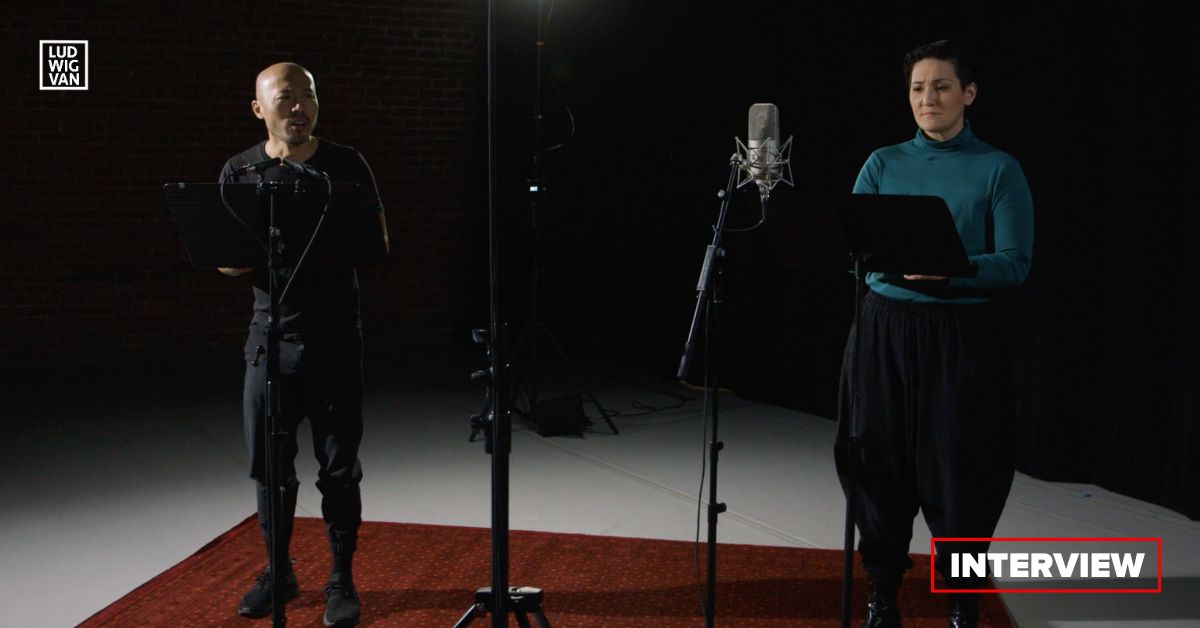
Toronto composer Njo Kong Kie and librettist Douglas Rodger have teamed up for a digital opera project titled The Futures Market.
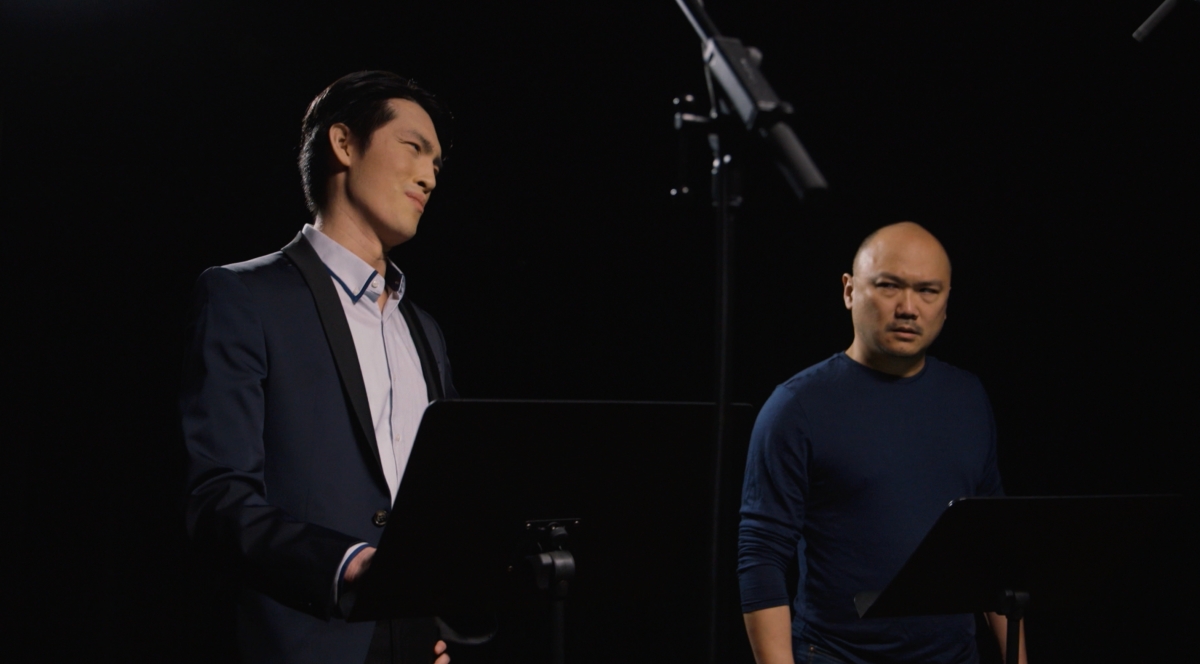
With music composed by Njo Kong Kie and Douglas Rodger’s libretto, the opera features performers Teiya Kasahara, Derek Kwan (who also serves as dramaturg), Keith Lam and Wesley Hui, along with sound engineer Brandon Wells, and videography by Blake Hannahson. The episodes were filmed at Toronto’s Citadel Theatre and Array Music Studio.
The Futures Market was original released in episodic format, with new episodes dropping each weekday between November 17 and December 4.
- You’ll find the whole playlist here.
LV caught up with Njo Kong Kie and Douglas Rodger to talk about the opera series.
Douglas Rodger
Douglas Rodger is a veteran of the theatre scene, having spent a half century in various roles that include playwright — notably, How Could You Mrs. Dick — dramaturg, librettist, and screenplay writer, including episodes for ABC, CBC, and Global, as well as feature films. He’s worked with Theatre Terra Nova, Phoenix Theatre, NDWT Company, Actor’s Lab, Theatre Passe Muraille, The Evelyn Group, Theatre Aquarius, among others. As a librettist, he’s collaborated previously with composer Njo Kong Kie on the one act opera Shattered Glass, which premiered at Buddies in Bad Times theatre.
Njo Kong Kie
Toronto based Njo Kong Kie (Music Picnic) is a composer, pianist, and creator of musical theatre projects. His works include the comic opera knotty together (with Anna Chatterton) which premiered at SummerWorks, Picnic in the Cemetery, a concert-theatre work that premiered at Canadian Stage, the play with music The Year of the Cello (with Marjorie Chan) which premiered at Theatre Passe Muraille, and the musical theatre work Mr. Shi and His Lover (with Wong Teng Chi), among others. He’s composed music for dance for Aszure Batron (Nederlands Dans Theater, Hubbard Street Dance Chicago), Shawn Hounsell (Ballet BC), and for Anne Plamondon, as well as collaborating on many theatrical projects.
Njo Kong Kie and Douglas Rodger: The Interview
“It’s mostly a product of the pandemic, really,” Kie begins. As he describes it, The Futures Market took shape in fits and starts because of the lockdowns. “We kind of put it aside.”
The pandemic, however, did offer one way forward.
“During the pandemic opportunities came up for online projects,” Kie explains. “Ultimately, we were successful in getting some funding.”
When they considered how to disseminate the finished project, the duo came up with the idea of releasing it in a series of episodes rather than a single full length opera. It required a somewhat different approach to the writing.
“We’re going to have different episodes, and we can play with the techniques,” Kie says. That meant things like playing with time shifts in the story, and withholding information from the audience at specific points.
Rodgers talks of the “stacks of drafts” that he wrote. “In the various stages […] it was much bigger, with many more characters involved,” he says. Boiling it down to what was doable created the final result. “It’s always the art of the possible.”
The story was condensed to four characters, and the details that were necessary to preserve the essence of the story. Their approach was similar to that of creating a three act opera, but with more time to develop themes and other elements.
“That created other aspects that were challenging,” Douglas says. “You’re really reliant on the text. There’s no shortcut to telling certain things,” Rodgers adds.
The Advantage of Episodes
“I liked the format, and I also like the ability to produce something […] essentially for people who don’t like or know opera,” Douglas says.
The episodic release allows people to try the medium out, and then ideally become engrossed enough in the story to continue. “I feel like this is a very important stage,” Rodgers adds.
Njo notes that, while a staged version isn’t planned at the moment, they both see the streaming project as a stepping stone. He also points out that Dean Burry’s Baby Baby Kintyre, which was recently staged as half of the Glenn Gould School’s fall 2025 double bill, began its life as a CBC commission and a radio serial opera and CD back in 2007.
A digital work available on YouTube also makes it available to use when they want to contact producers and presenters.
Douglas’ background came in handy. “I actually wrote radio drama,” he says. He recalls submitting scripts for consideration back in the days when radio stations commissioned such works. “You never knew whether anyone was going to read it,” he says. “I feel like this is an interesting development.”
Online, anyone can find it, and social media can extend its reach indefinitely.
“It will be out there for quite some time,” Kie notes.
Rodgers says that, on a recent trip to Berlin, he was able to introduce it to a number of people via the web.
Collaboration
Vocalists Teiya Kasahara, Derek Kwan, Keith Lam and Wesley Hui did more than show up for shoots. “They have been very supportive, [with] a lot of engagement,” Kie says. “We were kind of writing as we go.”
The tight filming schedule during a busy season for performers meant handing them scores on the fly. Njo acted as vocal coach and music director as well as composing the music. “They really were committed.”
Douglas adds, “Honestly, I have to say that if you’re a playwright, or in this case writing as a librettist, working with the performers and being the room and listening — you’re able to fix your errors,” he laughs. “We’ve managed to make a lot of improvements just through the process of rehearsal.”
“As I’m writing, I already knew their voices,” Kie says. That meant being able to highlight their individual strengths. “We have a good rapport.”
The creators also took their advice. “We also ended up working quite extensively with […] Derek,” Kie says. Derek Kwan, an actor and singer, ended up as dramaturg. “He’s very versatile in all kinds of media.”
He was able to advice Rodgers and Kie on using the musical from for storytelling purposes, as well as operatic techniques.
“It’s quite transformative in terms of how we thought of structure and clarity, and the text, and deliver what we were aiming for,” Njo says.
Douglas points out that he doesn’t have an academic background in music. Derek’s encyclopedic knowledge of opera proved more than useful. ”Those kinds of leads were very valuable to me. It allowed me to open up the potential of what this art form can do.”
The Story
“There is definitely a romantic relationship there, but probably in the sense of it being well established,” Rodgers says of the story.
It’s essentially about a woman who’s trying to save the life of her husband via an organ transplant.
“What lengths would we go to to save our life, and the life of someone we love?” Rodgers says.
“I’m part of a very privileged demographic in this world,” Douglas notes. He’s conscious of the great inequality that exists when it comes to the trade of human organs globally. “Initially it began as more of an exposé,” he adds. “I became more interested in the moral dilemma. “
The setting of the story was modified multiple times during development, and ended up at a point not too far into the future.
“It’s maybe not what’s happening now,” Rodgers adds. “It’s more about the moral dimensions of the characters and the dilemmas of them.”
Kieadds, “Also, we deliberately set in in a location that is somewhere near by.” The events in the story, though, have already taken place elsewhere. It’s based on stories of human organ trafficking that have already taken place.
“We imagine the story that is closer to home,” Njo says. Ultimately, it’s a human story. “It’s not meant as an exposé; it’s a story looking at our implications in that setting.We just wanted to tell a good story.”
It leaves room for the audience to draw their own takes on the issues involved.
The Road to Opera
Rodgers worked in Hamilton for years. That’s where he wrote How Could You Mrs. Dick? — a stage play about the infamous 1946 murder in that city. “I started working in opera as a stage hand in Hamilton when there was an opera company,” he says.
Kie notes that the two met as participants in Tapestry Opera’s opera creation program. “We met because we did LIBLAB with Tapestry,” he explains.
In the end, creating opera has to come from a place of artistic — rather than material — satisfaction.
“I do think that the process, it really has to be the reward,” Rodgers says.
- As well as on YouTube, you can find the entire 14 episode opera series [HERE].
Are you looking to promote an event? Have a news tip? Need to know the best events happening this weekend? Send us a note.
#LUDWIGVAN
Get the daily arts news straight to your inbox.
Sign up for the Ludwig Van Toronto e-Blast! — local classical music and opera news straight to your inbox HERE.

- PREVIEW | Kindred Spirits Orchestra Presents Operatic Rhapsodies February 7 - January 28, 2026
- INTERVIEW | Music Director Martin MacDonald & Violinist Stephen Sitarski Talk About Cathedral Bluffs & Romeo And Juliet - January 28, 2026
- THE SCOOP | Toronto Musicians And Composers Recognized By Six JUNO Nominations For 2026 - January 27, 2026