
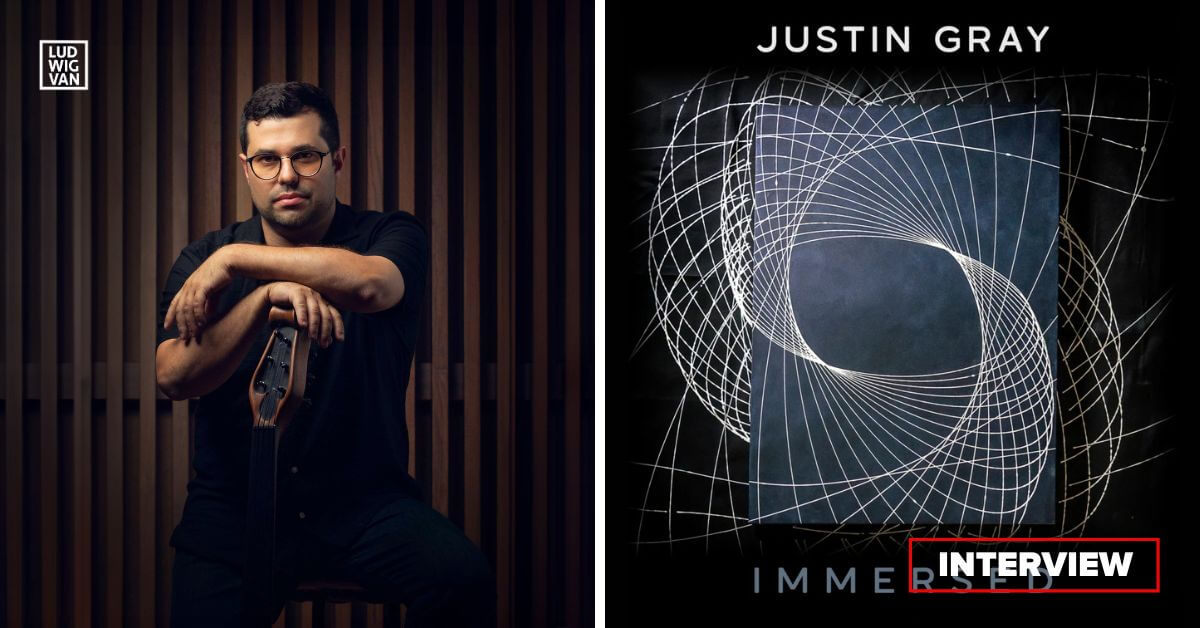
Toronto native Justin Gray has become the first Canadian to be nominated for a GRAMMY award in the category of Best Immersive Audio Album for his release titled (appropriately) Immersed.
Justin grew up in the Beaches, and went to Balmy Beach, Glen Ames and Malvern Collegiate. He still lies in the neighbourhood with his wife Natalie Tabone and two children.
Gray began playing music while he was at Balmy Beach, and make the switch from Bass at Glen Ames. He took bass lessons at Scarborough Music on Kingston Road, and following high school, attended the music program at Humber College.
He’s now a full-time professor of music production at Humber.
The cinematic album incorporates the contributions of 38 musicians from around the world, and uses cutting edge recording techniques.
Justin Gray: The Interview
The project is obviously large and complex, and took some time to put together. Did he have the end result in mind when he started, or was it more of an organic process that added to itself?
“In this particular one, I really did have kind of where it ended up in mind at the beginning,” Gray says. “But, since it is quite grandiose in that way, if we consider from the writing, and the preproduction, and the planning stage, all the way to when it was released, or now, it’s a four year period.”
It’s another step in his career.
“Essentially, my work in the field as a creator and of course also as an audio engineer, specifically inthe immersive audio area, I’ve had a lot of experience in working on a lot of projects. “
Immersed can be experienced in a variety of ways. That may include movie theatres and festivals in the future, but for now, he’s developed it as both stereo audio and with 64 channels in Dolby Atmos, along with the visual elements.
“That takes an immense amount of planning to not get surprised,” Justin says. “During the writing phase, I’m already considering the technical phase,” he explains.
“The primary piece of art, to a degree, if we could see it that way, is in a physical Blu-ray. We’re able to contain the video, we’re able to contain the high resolution, both immersive audio and stereo, in a variety of different codex formats, specifically Dolby Atmos, in aural 3D, and so I kind of see that piece of physical media as the real primary master version of this particular expression. That’s been available since August,” he adds.
The Blu-ray version, he points out, includes art, liner notes, photos, and credits.
“I think as an artist I still see that physical media as the container for the thing that contains everything.”
As for film festivals, he’s been working with Dolby on the possibility, which will be curated on a one by one basis.
“I’m absolutely open to the idea of screening it.”
The Music
“I think at its core, there are two really core musical genres that I play here, not always at the same time,” he says. “That is jazz and Indian classical music. That said, I also have a lot of experience with AfroCuban music, with Flamenco music, with Iranian, Persian music, with chamber music, with electronic music. This is just all a part of my history either as a bassist, as a composer or as a producer,” he continues.
“I think ultimately this is, as vague as its sounds, this is a contemporary instrumental album.”
He adds that there are vocals towards the end of the work. Global jazz, as he points out, is already a vague and ill-defined term.
“The aspect of jazz, at least, of contemporary jazz that I still hold on to is the idea of improvisation, the idea of wide breadth of instrumentation, the idea of through composed music that’s written around improvisers, is coming from the compositional tradition of jazz music. But, then there really are no stylistic rules outside of, I think what inspires me specifically on this project, is I really write music for people.”
He wrote the music around the musicians he’d selected for the project — a total of 38 musicians he’d already known and worked with for years, some of them two decades or more. He’s played on and produced many of their own recordings.
“It really is a big musical family. I kind of write to their strengths.”
For the track Repose, for example, he wrote for DORA award-winning, twice JUNO-nominated world/fusion vocalist Suba Sankaran.
“I think of Suba Sankaran, and what she is able to do, and then I write music around that.”
With each additions, he imagines how the individual contributions will blend into the other sound worlds he’s incorporated into the project.
“A lot of this is strictly written,” he notes. He imagines how each musician will interpret and play with what he’s composed. “I think of what she can do, and I write music for that. You’re essentially writing forms for them to interpret. With improvised players, you’re always looking for their interpretations.”
The Influence of Classical Music
“From a classical standpoint, I would say that the way in which I’ve approached the orchestration o f this record, especially when it comes to brass and strings, and larger orchestrations, is absolutely drawing from that world of chamber music writing for me, and also just as an appreciator of chamber music,” Gray says.
Classical music recording, as he points out, has been at the cutting edge of creating spatial music and 360 degree sounds.
“As we get into the spatial aspect of the music, and the way it’s been recorded, it’s 100% drawing form the classical music tradition,” he explains. “First, it starts with imagining the perspective that you want the listener to be in.”
It’s a contrast with the usual concert experience, where the musicians are on stage, and project the sound outwards in one direction towards the audience. As he points out, its typically the most common and also practical way of recording.
“It has been very embedded in our psyche as to what we think about hearing music.”
He chose his collaborators carefully to move towards spatial sound.
“One of the co-producers in this project, Morten Lindberg, is one of the most celebrated classical producers and recording engineers of our time.”
The Norwegian sound engineer and music producer specializes in classical music productions, and has been nominated for a GRAMMY himself dozens of times, winning the award in 2020 for Best Immersive Audio Album for the release Lux, with Nidarosdomens jentekor, Trygve Seim and TrondheimSolistene.
Lindberg’s method is to record performers in the round, with the goal of capturing the experience of being inside a kind of circle of music.
“He’s very much a pioneer of that concept. I’ve been a great admirer of that work for more than a decade now.
As he points out, during the Renaissance, it was quite common for musicians to perform in different locations of a hall, including choirs who sang from the rafters. It’s also common with the early electroacoustic composers of the early 20th century.
“This has been done,” he says, noting that today’s technology can reproduce that sound very accurately.
“By adding space to that concept of orchestration, it really opens up a whole new lane of blend, of timbre, of focus, of just counterpoint — spatial counterpoint.” As with every component of the large undertaking, it began in his imagination.
“Ya, I want this part to be in front of me, I want this point to be behind me, I want this part to be beside me.”
Where microphones are placed becomes a crucial detail.
“I’m using microphone techniques that are inspired by classical recording in a really modern way, in that I’m using it on individual instruments rather than the whole ensemble, so that I can capture the close sound of the instrument, but also the reflections, and the space, that help us to localize the instrument, let’s say to the side, or to the back, or to the front.,” he explains.
“What it does is, in the mix, it really allows us to capture a sense of realism for where that instrument is placed, just as if we had had all these instruments playing in a circle. It allows us to capture a sense of realism.”
As he points out, there are practical considerations that don’t necessarily allow for a simple performing in the round situation. For example, putting drums and kalimba together, or synthesizers and strings, won’t do justice to all the individual sounds.
“In an acoustic setting, it wouldn’t capture those specific sections,” he notes. “It allows me to capture that.”
It means that the strings should sound as if they’re playing in a big hall, but the sound of the kalimba should be close and intimate in nature.
“It’s really a modern approach to making records, more drawing on film scores or pop music, but at the source, trying to record everything acoustically, in the way that we do in classical music.”
A background in audio engineering as well as performing and composing music allows him to imagine the end result.
“Ultimately, this project is the first time that we see in history this particular approach to doing it. Now, I really dislike the idea of things being completely innovative, because it’s all based on history,” he adds. “I really have tried to bring a whole bunch of influences together specifically for this music.”
Gray attended the Tonmeistertagung conference in Düsseldorf, Germany in November. The attendees represent the highest level of classical music recording personnel in the world, and included many people he admires.
“I was presenting the project to them,” he says. “Even though the music is very uncommon to be presented in that conference, my kind of thesis with it is that this world of acoustic recording that’s been so well thought out through the classical world is absolutely the right step for immersive music in a contemporary context.”
It’s using the techniques of classical music recording for different genres of music.
“It’s been a blast to get to share that and kind of contribute back to the evolution of the art form.”
The GRAMMY Nomination
Was he surprised by the GRAMMY nod?
“Always. The world of art and awards, ultimately, art is subjective,” Gray says. “As artists, of course we’d be excited about recognition,” he adds.
“But, […] I’ve learned throughout my career to have a healthy relationship to it. The recognition externally doesn’t value or devalue it more.”
It’s just a moment in time, he mentions.
“It is a shock. I’ve trained myself over time to basically expect that it won’t happen. This is the first Canadian record ever nominated in this category ever. It’s such an honour.”
As he points out, it’s a selection made by his peers, and people passionate about music and recording.
“Even the nomination is a recognition by your peers.”
Making It Accessible
While the Blu-ray is his medium of choice, it was important to sure that Immersive can be accessed in various ways.
“When we talked about the flexible ways in terms of how people hear this, as much a technology is at the forefront of this […] there is also a stereo reproduction of this project,” he says. “At its core, the music is number one,” he adds.
“I also made a conscious decision that I don’t want the technology to be a barrier to accessing it. I didn’t want that to be a reality,” he says.
“It’s been fun. It’s been a way to reach a much wider audience than would have ben able to access it.”
- You can experience Immersed in various formats [HERE].
Are you looking to promote an event? Have a news tip? Need to know the best events happening this weekend? Send us a note.
#LUDWIGVAN
Get the daily arts news straight to your inbox.
Sign up for the Ludwig Van Toronto e-Blast! — local classical music and opera news straight to your inbox HERE.

- PREVIEW | Classical Guitarist Alexandra Whittingham Makes Toronto & Ontario Debuts - March 13, 2026
- PREVIEW | Soundstreams Presents Quatuor Bozzini: With Strings Attached - March 13, 2026
- INTERVIEW | Award-Winning Librettist & Against The Grain AD Royce Vavrek Talks About Canuck Cantatas - March 13, 2026