
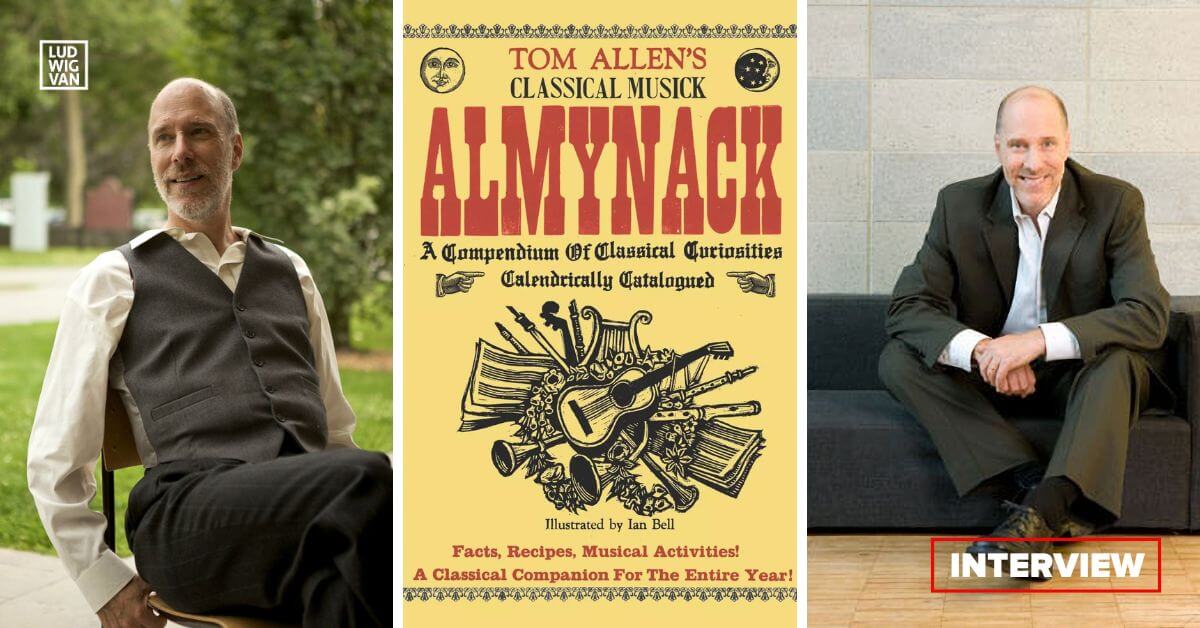
Tom Allen’s Classical Musick Almynack — A Compendium of Classical Curiosities Calendrically Catalogued — is a new book by the veteran broadcaster. It aims to offer tidbits, inspiration, activities (including recipes), and more, all based on nuggets gleaned during his many years as a musician, concert host, and author.
Organized by month, each section begins with a proposition. January’s for example, is “Can Classical Music Get Me In Shape?”Along with whimsical illustrations by Ian Bell (which permeate the book), a flow chart offers tidbits like Beethoven and Mahler’s walking habits, and athlete Bruny Surin’s classical piano career (which includes recent performances with the Laval Symphony), among others.
There are cartoons based on anecdotes about various composers and other figures, recipes, a timeline of significant dates during the month in question, anecdotes, suggested musical activities, and more.
LV spoke with Allen about his new venture.
Tom Allen
Born in Montréal, Allen studied music at McGill University, Boston University and Yale University. He worked as a musician for several years, playing bass trombonist in New York City, and going on tour with the Great Lakes Brass.
Tom began working for the CBC on his 30th birthday, and has hosted a variety of shows with the broadcaster, including Fresh Air, Weekender, Music and Company, Radio 2 Morning, Shift, About Time, and This is My Music, as well as filling in on a number of prominent current affairs programs.
Alongside his radio career, he’s been involved in several initiatives related to Western classical music over the years. That includes hosting ten seasons of concerts with the Kitchener-Waterloo Symphony, and another ten seasons of the Toronto Symphony Orchestra’s Afterworks series, among others. He helped to created Eight Days In June, a music festival, with Peter Oundjian. He’s published several books, including Toe Rubber Blues (1999), Rolling Home (2001), and The Gift of the Game (2005).
He’s married to harpist Lori Gemmell, and with her, has presented a series of storytelling shows, including JS Bach’s Long Walk In The Snow.
Tom Allen: The Interview
The Almynack consists of notes and facts, some that were only noted in his memory, collected over decades in and around classical music. When did he realize he was collecting material for a book?
“At no point, honestly,” Allen says. “I think collecting is too active a verb. I’m a storyteller. Without even knowing, it, I’m collecting stories.”
Over time, he realized what a wealth of material he possessed.
“That’s really how this book came into existence.”
His attention was drawn to the quirky and unusual. He includes many of those gems in the flow charts that begin each month. “Should I eat these mushrooms? Should I marry my sweetheart’s sibling? That was a good one.” The former comes with the month of August, and includes notes like the fact that composer Johann Schobert, his wife, four friends, the maid, and one of their children all perished after eating poisonous fungi he’d collected that fateful morning in 1767.
June, devoted to weddings, includes both Should I Marry My Sweetheart? and Should I Marry My Sweetheart’s Sibling? “There were varying degrees of success with that,” Allen notes. Surprisingly, many of the sweetheart sibling unions were quite successful, including the marriages of Mozart and Dvořák. “Haydn was the terrible failure,” he adds. “I had that flowchart from years ago.”
“Should I quit my day job? That was a fun one.” That flowchart appears in September, and let’s just say, the answer is a mixed bag.
“In November, its when will my brilliance be recognized? and the answer is kind of never,” he laughs. “And the cost of being recognized is huge.”
Ludwig Spohr (1784 to 1859) was a popular composer and conductor in his time. “In some ways, in the model for big conductors as we see it [today],” he says. “And he’s completely forgotten.”
That, despite the fact that he invented the chin rest, as well as a way of notating scores with sections to make rehearsals easier.
Compiling the Book
Sometimes he took notes of the facts and stories he came across. Many pieces of the puzzle, however, came only from his memory.
“It’s just the way my memory works. I hang on to things I find interesting,” he says.
Putting the book together took several months. “It probably took the first half of this calendar year.” From January till June, Allen was digging out facts, and trying to figure out how to incorporate them in various formats in the book. Some of the information was used his radio programs. “For example, in the August segment there’s a little entry with John Cage getting lost in Saskatchewan woods.” He turned that tidbit into a radio show during the pandemic.
When it came to formatting, he worked closely with illustrator Ian Bell. “He has a couple of old printing presses,” Allen notes. That includes a 19th century press with wooden letters, and hand printed fonts with wooden letters. “So that they’re imperfect.”
It adds to the charm of the book. “The ink is not uniform and there are all sorts of imperfections.” One month was printed as a trial run.
He had such a wealth of information that many items were condensed. “That was months of work,” he notes of the John Cage in Saskatchewan story. But, it takes up only seven lines in the book. “It’s kind of unfair how reduced everything was.”
Bell contributed many ideas on how to put everything together. “We collaborated on the format and how it would work.” Allen appreciated Bell’s sense of humour. On page 29, for example, there’s a story about Peter Maxwell Davies, who was Master of the Queen’s Music in 2005. One day, a whooper swan flew into the electrical lines where he lived, and it died. Davies collected the bird’s corpse, using the feathers for a costume, and made a terrine out of its liver. He was observed, though, and wildlife authorities came to his door to ask about his handling of the protected species. Davies, in turn, asked if they wanted some of the terrine.
Bell’s illustration is of the terrine with the swan’s feet sticking out.
Where It Began
It all began, as Allen mentions in his introduction, with a music class he took in 1982 with professor John Daverio at Boston University. “He’s a wonderfully engaging historian.” Previously, Allen had viewed the world of classical music history as somewhat boring in nature. The professor’s story about the music director of St. Mark’s Cathedral in Venice in the 16th century, who wrote a note to his choristers warning them to stop feuding with each other — they were throwing meat and bones at each other during the service — changed his mind.
“That’s the first time that classical music history seemed very human to me.”
He notes that in the 1980s and 1990s, there was a tendency to view the classical music world with a kind of pretentious reverence — that the music somehow existed beyond the confines of daily life. He uses a Mozart symphony as an example. “Mozart’s 41st symphony is a work of astonishing complexity,” he says. “But he was also human, and greatly flawed. It makes this work of great art even more astounding to me,” he adds.
“In every other respect except making this music they were just like you and me. My whole approach to music and storytelling is that producing extraordinary things is possible within very ordinary lives.”
Getting the Word Out
Allen reports that the book, published in fall 2025, has proven to be popular. “There’s demand for the book across the country,” he reports. “People are looking for it.”
He’s entered into a partnership with music retailer Long & McQuade, where his Almynack will take its place among the music scores and student exercise books.
“It’s created kind of a fun intersection of communities.”
Are you looking to promote an event? Have a news tip? Need to know the best events happening this weekend? Send us a note.
#LUDWIGVAN
Get the daily arts news straight to your inbox.
Sign up for the Ludwig Van Toronto e-Blast! — local classical music and opera news straight to your inbox HERE.

- PREVIEW | Fidelio Presents Pianist Haiou Zhang In An Intimate Solo Recital In Toronto - March 12, 2026
- INTERVIEW | Balancing Act Executive Director Susie Burpee Talks About The Art Of Care - March 12, 2026
- PREVIEW | North Wind Concerts Presents Playlist For Louis: Intimate French Baroque - March 11, 2026