
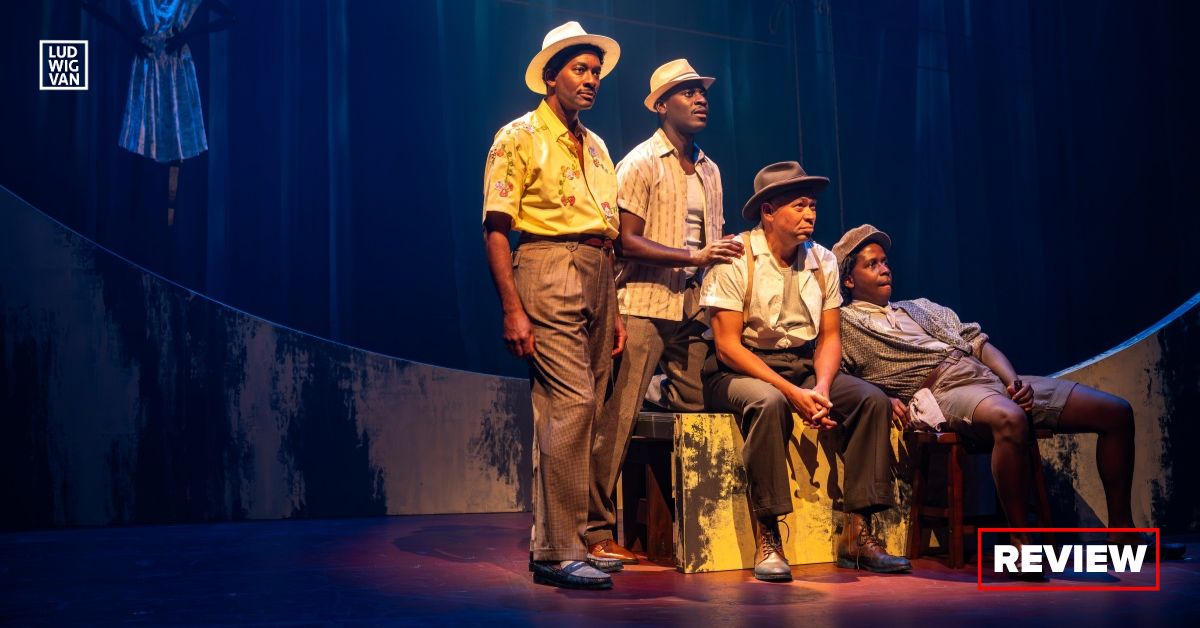
Necessary Angel Theatre Company Production in Association with Canadian Stage and Tarragon Theatre: Moonlight Schooner (world premiere). Kanika Ambrose, playwright; Sabryn Rock, director; with Nehassaiu deGannes; danjelani ellis; Daren A. Herbert; Tony Ofori; Jamie Robinson. Thomas Ryder Payne, sound designer; Shannon Lea Doyle, set designer; Raha Javanfar, lighting designer. Berkeley Street Theatre, November 26, 2025. Continues until December 14; tickets here.
It’s 1958, and a group of Black sailors are stranded on the island of St. Kitts after a storm washes them ashore. Their ship, the titular Moonlight Schooner, needs fixing, and their futures are undecided — but it’s also May Day. Everything is closed, and a celebration invites them to throw away their cares for at least one night of fun.
They talk, they argue, they reminisce, and more than one fight breaks out, and through it all, their stories begin to flesh out a portrait of a generation set adrift, figuratively and literally. Both their sympathetic and darker sides emerge as the events of both the past and present unfold.
It’s not entirely necessary to know the full historical background, but let’s delve into it.
Historical Context
When the HMT Empire Windrush docked in Tilbury, Essex in 1948, it would become the first of many ships that brought passengers from the Caribbean to the UK. Many had served in WWII for the UK, and they came at the invitation of government officials to help rebuild the country after the ravages of the Second World War.
As a point of fact, the British Nationality Act of 1948 had given people from British colonies the right to live and work in the UK. Countries across the Caribbean were struggling, and many people took them up on the offer, looking for jobs and a better life. Most became drivers, cleaners, and other manual labourers, in addition to nurses in what was then the newly established National Health Service (NHS).
It’s estimated that more than half a million UK residents were born in a Commonwealth country (dubbed the Windrush generation), and arrived in the UK before 1971, when the new Immigration Act gave those citizens the right to stay.
As a side note, in 2018, it was revealed that many of those new arrivals were not given the proper paperwork to prove their right to stay, and close to 100 were wrongly deported. While it’s peripheral to this play, it underscores the situation of those Black Commonwealth citizens who were given the right to come to the UK, but never afforded true equality.
The Story
The story begins with the storm that washes the men ashore in St. Kitts. The characters begin to emerge through their conversations, the stories they tell, and their interactions. Shabine (Jamie Robinson) is central to the story. He’s something of a poet and writer, jotting his thoughts down in a notebook he keeps in his pocket. He’s also got a white grandfather who gave him lighter skin, something the other three remark on — but it doesn’t, as they observe, give him any more opportunities in life than the rest of them.
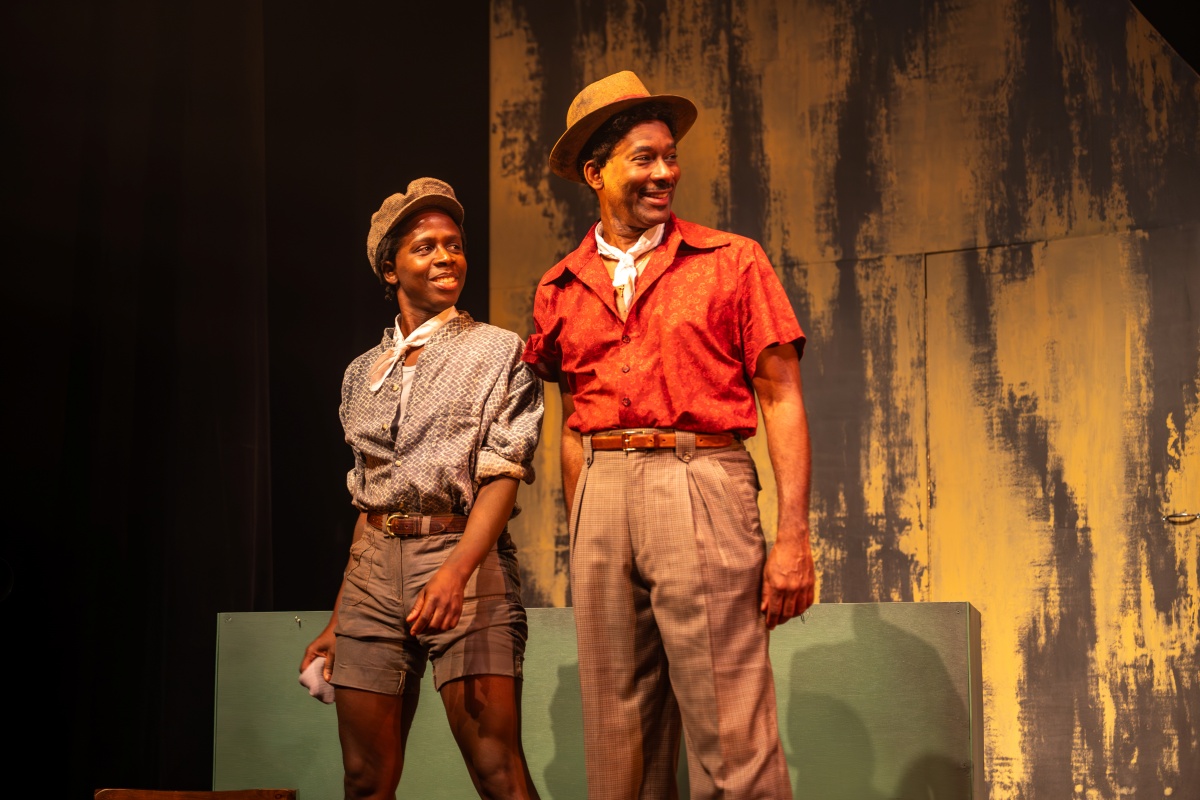
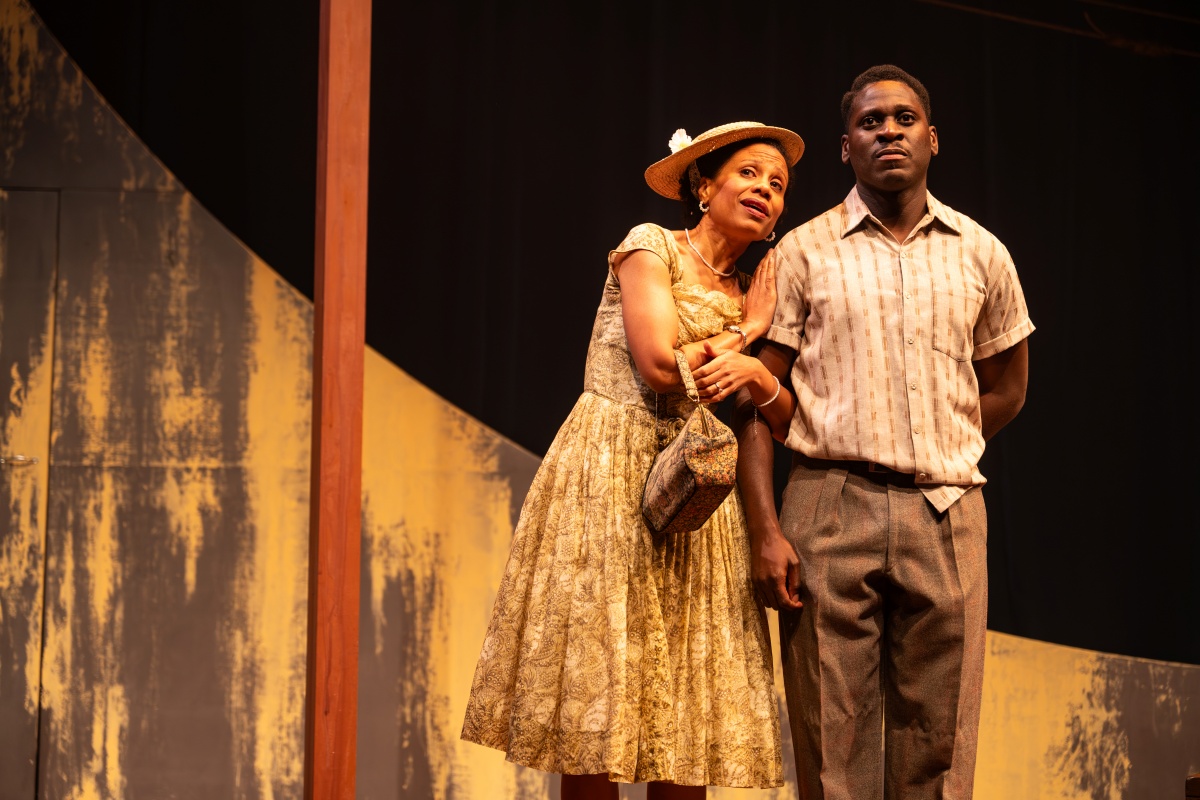
danjelani ellis is Vincy, the youngest. He comes across as feckless, living only for the next drink, at least at first. Daren A. Herbert is Timothy, feisty and swaggering, and Tony Ofori is Lyle, the local who’s invited the three to stay in the home he shares with his mother, Janine (Nehassaiu deGannes). As Janine points out, it’s a large house on a hill, with plenty of land, thanks to her husband who’s been sending money back from England. Kudos to dialect coach Peter N. Bailey, who’s created a distinct style of speech and accent for each character. Shabine’s dialect is downplayed, in contrast with Timothy and the others.
It begins with the camaraderie of survivors. Vincy vomits, both from the disaster at sea and all the alcohol he drank the night before.
“I’m lucky I live to take the smell of your bring up,” Shabine tells him.
When Vincy wants to keep drinking, Shabine scolds him, and tries to take away the booze. He’s the wiser, older man of the group. But Vincy reveals the shrewd assessment of his situation that underlies the partying and careless behaviour. Because, where does the alcohol come from? England, of course.
“The one thing they would never stop sending Black man is drink,” he tells Shabine.
There are fireworks early on between Shabine, who sees himself as the more cultured and erudite of the trio, and Timothy.
The stories they tell each other, and their conversations, are shot through with moments of humour. But, as the stories unfold, a much more complicated reality comes to the fore. When Shabine reminisces, it sometimes sparks a flashback scene where the truth emerges. Maria, the wife he opines over in poetic writings, is seemingly either pregnant or nursing a newborn on a continuous basis.
Is he really the more educated, thoughtful man he presents?
How to better your lot in life, how to better yourself, becomes a recurring theme. There are few options in St. Kitts or anywhere in the Caribbean, and anything that has a material value, from the land Janine and Lyle live on to the tweed cloth her husband sends back, comes from England. Hopes, desires, dreams are thwarted, with only the ever present spectres of imperialism and colonial history to offer a way forward.
Shabine wants to get back to the ship and help rebuild, but it’s May Day, a national holiday when everything’s closed, and a big and public celebration beckons. Eventually, even Shabine is convinced to take a break from their reality with a day and night of celebration.
But, reality has a way of intruding.
While the protagonists are all male, Ambrose’s play doesn’t shy away from depicting the plight of women in this world. Janine, with her heels and stylish dresses, has found a way of making the best of a situation that has taken her husband far away in order to provide for the family. When Lyle wants to make the same trip, she tells the truth.
“So much young men leaving, and they say they’re coming back — but they never do.”
When Vincy wonders why the young, strong, vibrant women he meets in their 20s become bitter and burdened by the time they’re in their 30s, Shabine knows the truth. It’s the constant procession of babies, and waiting around for the men in their lives to show up that weighs them down.

Performances
Jamie Robinson is the heart of the story as Shabine. He embodies the duality of his character — older and perhaps wiser than the others, but only because he’s already done everything he argues against. He seems tortured by his past, even as he glosses over it in his writing, the poet who seemingly writes everything down, even as he skirts his own truths. Robinson is exceptional in a role that demands subtlety and multiple layers of intention.
Tony Ofori is a naive Lyle, eager for adventure — anything that will take him away from his mother’s house, and an environment where he can’t get ahead otherwise. Daren A. Herbert is a testosterone fuelled Timothy, the one who’s unrepentant about his attitude, or what he does in pursuit of a good time.
danjelani ellis’s Vincy alternates between the influence of Shabine and Timothy, but he’s also clear-eyed about his reality. When Shabine tries to persuade him not to join in with the others’ hedonism, he points out it’s the only way to get through their directionless lives.
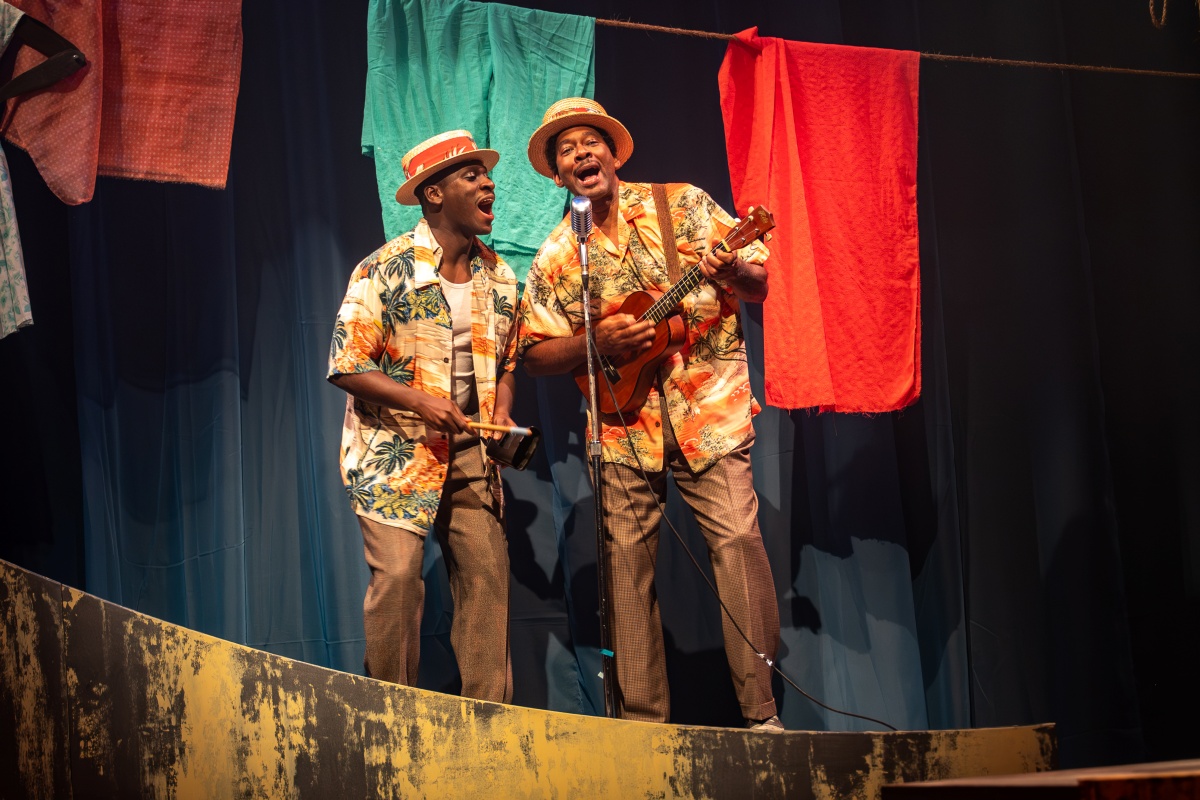
Ofori, Herbert, and ellis also double in other roles. ellis is hilarious as one of Shabine’s kids in the flashback scenes, and Ofori as his much-pregnant wife Maria. Ofori and Herbert also become a Calypso duo who perform musical interludes during the course of the play, including a song about a woman who works for an old white lady, and another, ‘The mosquito has a right to bite’.
Nehassaiu deGannes makes a strong case for Janine. Though she has the least time on stage, her careful elegance comes in stark contrast to the men around her. Late in the play, cleaning up after Lyle and the other’s party, she reveals the thin nature of that veneer.
Stagecraft
The set design by Shannon Lea Doyle is both atmospheric and ingenious, enhanced by Raha Javanfar’s lighting, with a billowing blue lit curtain at the back that represents the ever present ocean. Wooden structures on either side of the stage offer depth, and a variety of locations. It’s amazing how a few adjustments of furnishings, two doors, and a set of stairs at the back, can switch between Janine’s large home, a bar, a car that Lyle drives to take them to town, and even the ship itself.
Special kudos go to sound designer Thomas Ryder Payne, who adds dimensions to the set with a range of effects, from the sounds of the relentless tides that permeate the theatre before the play even begins, to subtle bird songs and the May Day crowds in the background, to the thunder of the storm, and more.
Final Thoughts
Ambrose’s play offers a nuanced portrait of the Caribbean during the Windrush era, and complicated characters who offer no easy answers or scapegoats other than the looming shadow of imperialism, and the leftovers of a war fought far from those island shores.
It may be hard to call it a redemptive or even a warm hearted story. Instead, it’s a multi-layered portrait of what happens in a society where dreams and aspirations are so thoroughly crushed, and diverted to a path not their own.
Are you looking to promote an event? Have a news tip? Need to know the best events happening this weekend? Send us a note.
#LUDWIGVAN
Get the daily arts news straight to your inbox.
Sign up for the Ludwig Van Toronto e-Blast! — local classical music and opera news straight to your inbox HERE.


- INTERVIEW | Composer Ana Sokolović & Director Michael Hidetoshi Mori Talk About Love Songs At Tapestry Opera - March 16, 2026
- CRITIC’S PICKS | Classical Music Events You Absolutely Need To See This Week: March 16 – March 22 2026 - March 16, 2026
- PREVIEW | Classical Guitarist Alexandra Whittingham Makes Toronto & Ontario Debuts - March 13, 2026