

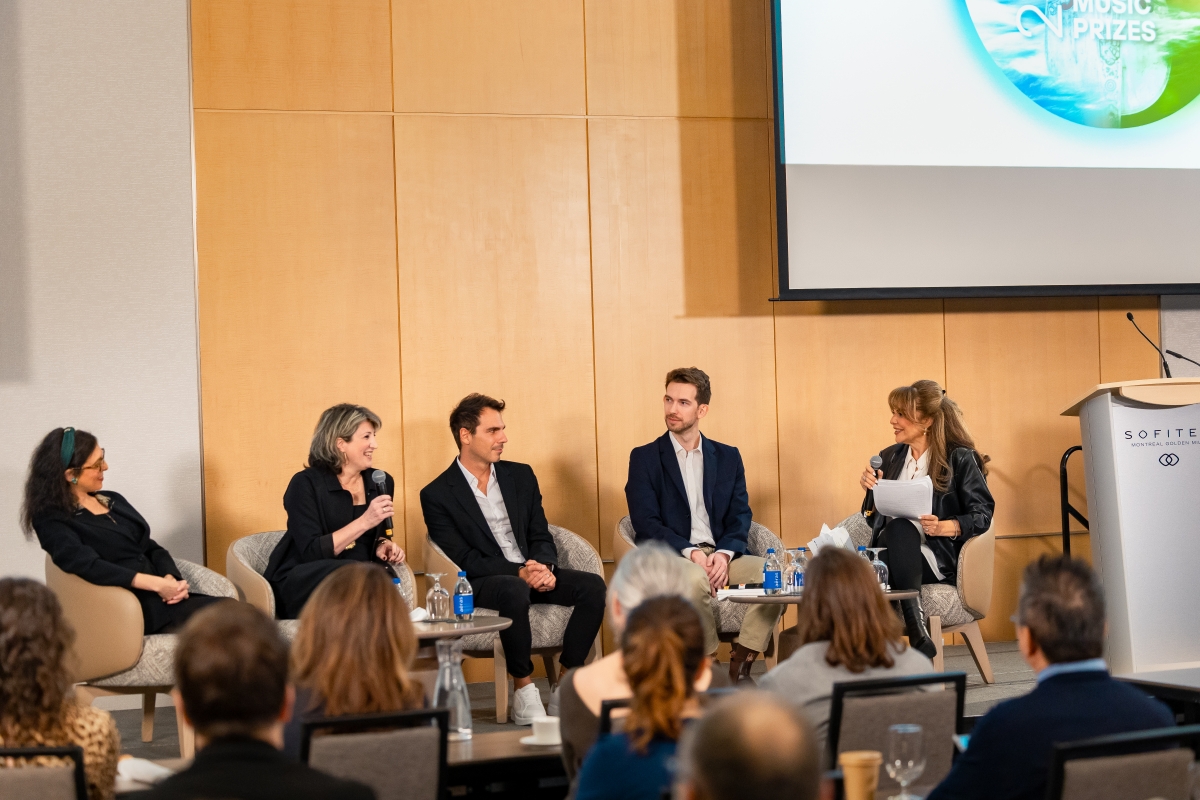
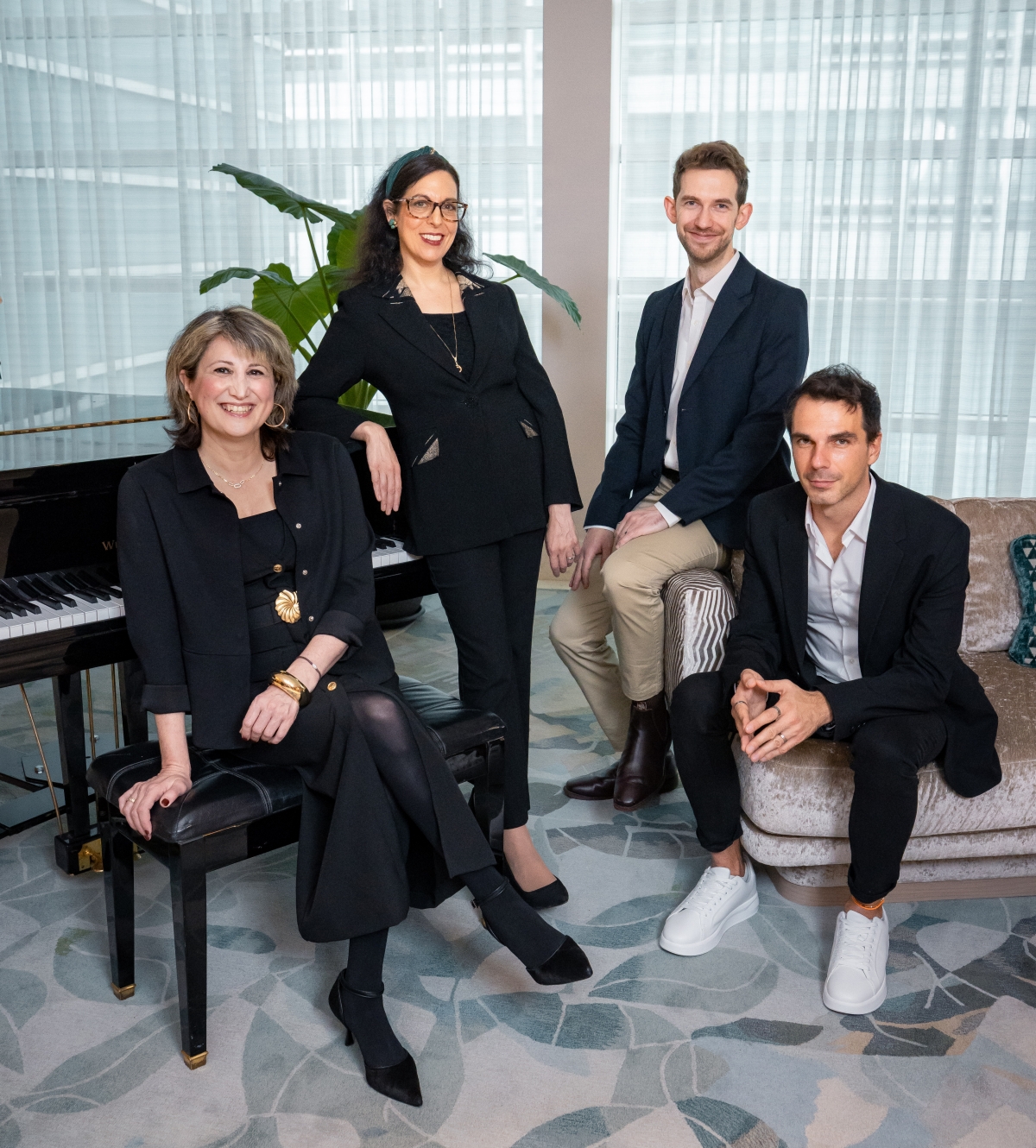
Earlier this month, the Azrieli Music, Arts and Culture Centre (AMACC) named the four Azrieli Music Prize Laureates for 2026. They are: Hana Ajiashvili, (the Azrieli Prize for Jewish Music); Dalit Hadass Warshaw, (the Azrieli Commission for Jewish Music); Nicholas Denton Protsack (the Azrieli Commission for Canadian Music); and Adrian Mocanu (the Azrieli Commission for International Music).
The Azrieli Music Prizes were created in 2014 as a biennial celebration of excellence in music composition. Each AMP competition cycle focuses on a specific instrumentation category. For 2026, the focus will be on works for choir with orchestra and optional soloists.
Each laureate will receive a prize package that is valued at $250,000 CAD, making it the largest music composition competition in Canada, and one of the largest in the world. It includes:
- A cash award of $50,000 CAD;
- A performance of their work by the Orchestre symphonique de Montréal and OSM Chorus, conducted by Asher Fisch, at the AMP Gala Concert on October 15, 2026;
- Two subsequent international performances;
- A commercial recording of their prize-winning work, also featuring the OSM.
Three jury panels scrutinized the proposals and works, including composers, musicologists, conductors and producers. For the 2026 prize, they were Barbara Assiginaak C.M. O.Ont., Ofer Ben-Amots, Gisèle Ben-Dor, Chaya Czernowin, Margareta Ferek-Petrić, Jonathan Goldman, Daniel Kidane, Neil W. Levin, Samy Moussa, Steven Mercurio, David Pay, Colleen Renihan, Ana Sokolović, Na’ama Zisser and past AMP Laureates Avner Dorman and Kelly-Marie Murphy.
The Composers & Works
Dr. Hana Ajiashvili — Azrieli Prize for Jewish Music
The Azrieli Prize for Jewish Music is awarded to a composer who the judges feel has written the best undiscovered work of Jewish music. Georgian-Israeli composer Hana Ajiashvili’s 2022 work Riddle is based on the words of medieval poet Yehuda Halevi, and revolves around themes of persecution and resilience.
Q&A
LV: How did you come to discover the poetry of Yehuda Halevi?
HA: I discovered Yehuda Halevi’s poetry while searching for a Hebrew text from the medieval period. I wanted something concise but powerful — a text that carries both mystery and emotional depth. When I encountered this short riddle by Halevi, I immediately felt its intensity.
Even though it consists of only a few lines, it opens an entire world: philosophical, symbolic, full of silence and hidden meaning. I felt an instant connection to it, and I knew I wanted to build a musical universe around these words.
LV: What quality in their work inspired you to compose music around it?
HA: What inspired me most in Halevi’s text is its ability to say so much with so little. The riddle speaks about something soft, delicate and silent — yet powerful enough to “kill people quietly.”
According to some rabbinical interpretations, the answer to this riddle is the quill — the feather used to sign orders that determined life or death. In the Middle Ages, such a quill could be used to sign decrees against Jewish communities during times of persecution.
This idea struck me profoundly: that something so light and silent could carry such destructive power. And unfortunately, this theme still resonates today. Wars continue, violence begins with a decision, a signature, a single gesture.
This contrast — between fragility and brutality, silence and force — became the emotional core of my musical response. It is what inspired me to build a musical world around Halevi’s words.
LV: What does winning the prize mean to you and the work itself?
HA: Winning this prize is an enormous honor for me and for the piece itself. Riddle is a very personal work, rooted in history, philosophy, and deep emotion, so receiving this recognition feels incredibly meaningful.
For me as a composer, it is a moment of encouragement — a confirmation that the artistic risks I take, the colours I search for, the dialogues I create between past and present, truly reach people.
And for the piece, this prize gives it a new life. It brings the work into a broader international context, allows it to be heard by new audiences, and opens a space for the ideas behind it to resonate globally.
I feel grateful, inspired, and deeply moved.
Adrian Mocanu — Azrieli Commission for International Music
The Azrieli Commission for International Music is awarded to a composer whose proposed work focuses on cultures that are relevant to their lived experience. Romanian-Ukrainian composer Adrian Mocanu’s proposed work is titled de l’encra escafada (“from faded ink”), and looks to reestablish the voices of the trobairitz, who were women troubadours in medieval Provence. The work uses complex choral textures, and four violas da gamba, and is inspired by the one song that survives from composer Beatriz de Dia.
Q&A
LV: How did you come to know the work of Beatriz de Dia (her single surviving work)? Was it the result of your own research?
AM: Yes, it was the result of my research, so to speak. Basically, I was just listening through bunches of recordings of early music ensemble Hespérion XXI (one founded by Jordi Savall, a legend of historically informed performance), and once I stumbled upon the recording of “A chantar mer…” written by de Dia. I was so moved by it, mostly because the vocal part was sung by Montserrat Figueras (another legend), whose interpretation was stunning. So it just stuck in my head and I was listening to it on repeat. That was a very long time ago. When I came across the Azrieli, it just popped out in my head and in one moment I had it clear, what my application and the idea would be about and what material I wanted to work with.
LV: How do you view the trobairitz, i.e. what do you know about them, and how will this translate into music?
The trobairitz are a quite obscure phenomenon in music, not that much of their legacy was preserved. This one song yes, as the notation survived and it was reinterpreted by a few of early music ensembles. When we speak about troubadour art, the first thing that appears in our mind are male troubadours like Giraut de Bornelh, Raimbaut de Vaqueiras, Peire Vidal — and I worked with some of their texts in my earlier works. If we speak about early music female authors, it is mostly Hildegard von Bingen as the most renowned example (whose legacy has been addressed to in contemporary music by many composers), but not the Provençal trobairitz. With my work, I want to draw more attention to them.
As for my new piece, of course I will not be another interpretation of the Medieval original — it will be a journey departing from the interpretations that exist, and the focus will be on working with the text, with Occitan language, with deconstructing it, working with it phonetically in choral textures. The same applies to musical quotes — they will become raw material for filtering.
LV: What can this music, this piece, offer to modern audiences?
AM: First of all, I want to bring a fresh perspective on early music female authors, and an understanding that female composers did exist in Medieval times. Also to bring attention to the decline of Occitan language and the need to preserve it
And, of course, the piece itself would bring an emotional experience to the audience, a moment of suspense, of discovery.
Dalit Hadass Warshaw — Azrieli Commission for Jewish Music
The Azrieli Commission for Jewish Music is awarded to the composer whose proposed work answers the question “What is Jewish music?” in a creative and engaging way. American composer, pianist and thereminist Dalit Hadass Warshaw’s proposed work Letter From Across the River is inspired by the true story of her great-grandfather. In Poland during WWII, he swam across the Bug River in order to send a good-bye letter, before returning to his family, and his fate.
Q&A
LV: How do you propose to tell your great-grandfather’s story via music? i.e. what qualities in the music will express the essence of that story?
DHW: Through this work, I explore the profound internal struggle that I imagine my great-grandfather to have experienced during a crucial, existential moment of choice, as he swam across the River Bug not once, but twice: first, from Nazi-occupied Poland to Soviet Ukraine, in order to mail a farewell letter to his sons (who were fortunate enough to have emigrated before 1939) and, second, his return traversal to rejoin his family, fully aware of the fate that awaited them and their community. I convey the story through literary allegory, utilizing the Biblical scenario of Jacob wrestling the Angel as a foil for my great-grandfather’s own wrangling with self, and ultimate test of will. Musically, I embody this through highlighting potentials for contrast, not merely within the story itself (the choice between life and certain doom, freedom versus love and loyalty), but through my use of multiple languages (English, Hebrew and Yiddish), and the various ways that the instrumental and choral forces, and the soloists, relate to — and spar — with each other.
At various points I have the Yiddish and Hebrew vie with each other in the evocation of Jacob’s battle with the Angel, pitting the original Biblical Hebrew against the early-20th-century Yiddish translation by Solomon “Yehoash” Blumgarten. At other times, the solo baritone wrangles with the chorus, that assumes the role of the River. The two vocal soloists oppose each other as well, in terms of their voice types, and the languages they sing: the baritone (representing my great-grandfather and singing in both English and Yiddish, at that time considered the mameh-loshen or “mother tongue”) and coloratura soprano (representing the Angel, singing solely in Hebrew, the loshen-koydesh, or the “Holy tongue”).
(Of personal significance to me, as a female composer, was the decision to reverse the traditional gender associations that were in place for each language at the time: in the shtetl, Hebrew was almost exclusively a men’s language, used solely in scholarly and religious contexts; women, due to their traditional lack of education, read and wrote solely in the vernacular Yiddish.)
LV: Is this a project you already had in mind, or did you create the concept in response to the prize submission?
DHW: Yes, this was a project I already had in mind for quite some time, heightened in recent years by the need to understand my own background and identity, and the elements that comprise who I am as both human and creator. I was seriously researching the premise behind this work even before I knew what musical forces I would use: aside from the familial anecdotes, I scoured memoirs of survivors and “Yizkor” (Remembrance) books from that particular area of Poland, locating accounts of surviving members of the Jewish community in Dubienka who recalled my great-grandfather and left behind detailed descriptions of his character and influence. I studied photographs. I read monographs on the history and sociopolitical climate of the interwar period leading up to these events, literature from prominent writers of the time, and even embarked on a serious study of Yiddish (through the YIVO Institute for Jewish Research).
As a composer, one is conditioned to economize and often compromise in the practical interest of enabling a performance. When I read the criteria for the prize submission, it felt as though the most ideal situation was being presented to me, especially as my initial conception indeed had been for the instrumentation made available: chorus, orchestra, and vocal soloists. I feel so grateful to have such a large forces accessible to me, so that I can explore my ultimate vision for this work.
LV: What do you hope audiences will take away from the experience of hearing the piece?
DHW: With every work of mine, my hope is to enfold the listener into the experience that I am depicting, both airing the specific story and universalizing its elemental human aspects. While this particular story is very unique to a certain time, place, and culture, it is nevertheless a universal one that has tremendous relevance in our current times. A sublime power of music is that it reaches beyond such confines of language and history: it overcomes boundaries, and therefore unifies and enables empathy. An ultimate crux of this particular story, I think, is the existential question of choice. My hope is that the listener can be pulled into my great-grandfather’s experience in facing this question, and thus, the heartrending weight behind his sacrifice and ultimate message of blessing that he leaves behind.
Nicholas Denton Protsack — Azrieli Commission for Canadian Music
The Azrieli Commission for Canadian Music is awarded to a Canadian composer whose proposed work engages with the notion of composing concert music in Canada today in all its complexities. New Zealand–based Canadian composer and cellist Nicholas Denton Protsack was chosen for his proposed piece Height of Land for orchestra, chorus and solo cello. His piece will reimagine the idea of composing Canadian music in the context of environmental listening and renewal.
Q&A
LV: How will your piece reflect the themes you would like to centre — the environment and renewal?
NDP: The intention of Height of Land is to reimagine the orchestra and chorus as not a musical ensemble, but a living and interdependent sonic ecosystem; the audience members are not a group of passive observers, but active participants in that ecosystem; finally, the solo cello will not be a soloistic ‘main character’ of the work, but a supporting character that uses its voice to affirm that the environment is in fact the main character. Without giving too much away, this will be achieved by restaging the orchestra and choir such that portions of it are interspersed within the audience, utilizing percussion instruments derived from natural or everyday materials one might encounter in their environment, and calling upon the ensemble and audience to consider the work not as a depiction of Canadian environments but one that is intended for their advocacy.
LV: Will it focus on specific features of the Canadian landscape, or offer a more generalized focus?
NDP: A specific focus will be placed upon Canadian environments that I am highly familiar with, which are predominantly in the west and north-west. The focus will not be exclusively on their features, however, but also on the difficult nature of their history: one fraught with cultural genocide, violence, and extraction.
LV: How does sound reflect ecology — i.e. what elements will you use to bring your concept to life?
NDP: There are perhaps limitless ways in which this can be achieved, a number of which will be drawn upon in Height of Land. Musically collaborating with the more-than-human world is something that I have come to call ‘musical ecopoiesis’ which is a term that I developed during my doctoral studies. This can include straightforward devices, like the musical imitation of natural sounds (birdsong, thunderstorms, rivers, etc.), and more complex ones, like the musical representation of physical, environmental features or even the translation of scientific data into music.
Congratulations to the winners, and we’ll look forward to hearing their music.
Are you looking to promote an event? Have a news tip? Need to know the best events happening this weekend? Send us a note.
#LUDWIGVAN
Get the daily arts news straight to your inbox.
Sign up for the Ludwig Van Toronto e-Blast! — local classical music and opera news straight to your inbox HERE.

- PREVIEW | New Adventures In Sound Art Celebrates Their 25th Anniversary With An Open House March 12 - March 6, 2026
- PREVIEW | The Arcady Opera Showcase: Mini Musical Dramas Featuring 2026 Emerging Artists - March 6, 2026
- PREVIEW | Pianist Eve Egoyan Presents In Stone, A Composition Written For The Armenian Genocide - March 6, 2026