
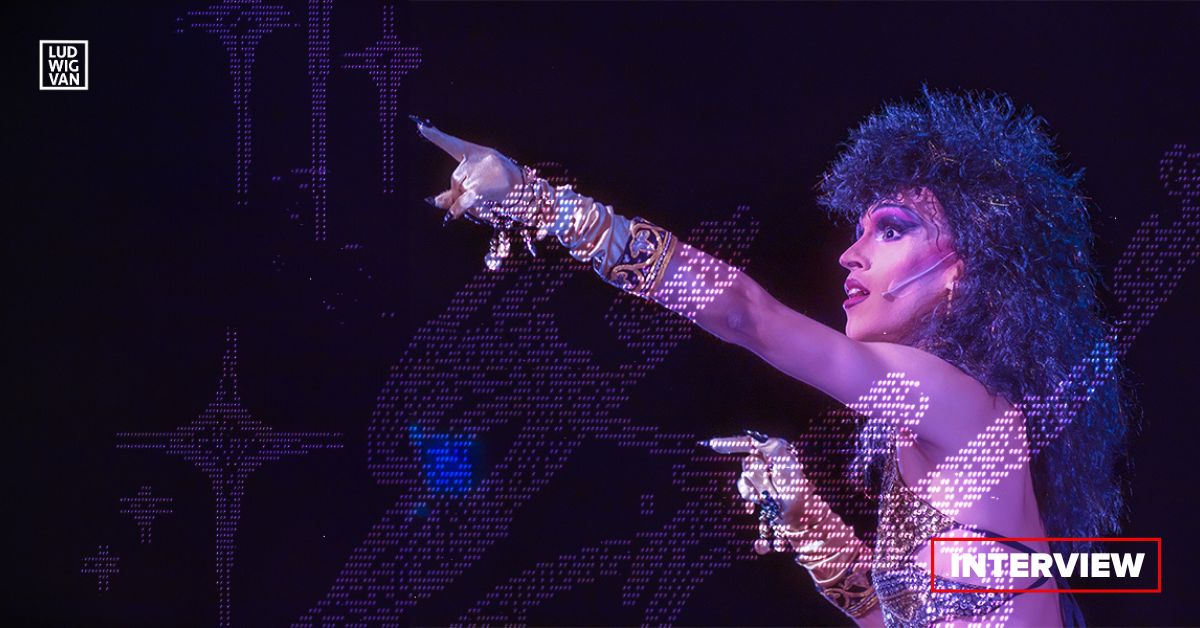
Gabriel Dharmoo is a performer, composer, and experimental vocalist. He’s bringing his show Bijuriya, revolving around drag artistry, South Asian culture, and identity, to Buddies in Bad Times with performances November 26 to 29.
Gabriel and Bijuriya are two facets of the same individual, and the performances delves into the dualities and hybrid layers that they share. As he explains in a statement,
“My drag refers to classical/traditional musics of South Asian origins, Bollywood music, and experimental sound practices that seek to push the boundaries of music. I want my drag to reference my intersecting musical identities without compromise, and to be generous, honest, and subversive.”
LV spoke to Dharmoo about the show.
Gabriel Dharmoo
Dharmoo is a Montréal-based artist whose practice spans multiple disciplines, including musical composition, drag artistry, vocal performance, and research, among other things. He explores mixed identities, brownness, queerness, and satire, often with a playful edge.
His musical compositions have been performed across North America, Europe, Australia, Singapore, and in South Africa. His works has been recognized by multiple awards, including the Canada Council for the Arts Jules Léger Prize for his chamber work Wanmansho (2017) and the Conseil québécois de la musique Opus Award for his opera À chaque ventre son monstre (2018). His most recent album of chamber music, Vestiges d’une fable (2024), was recorded in collaboration with the National Arts Centre Orchestra.
Gabriel Dharmoo: The Interview
In the show, he uses song, speech, and lip-syncing to a variety of musical genres from original pop songs to Bollywood soundtracks. He plays cello, steel pan, and harmonium, and is also responsible for sound design for the show.
“I’m mostly a musician. I started with cello as a kid,” Dharmoo says.
Studies in composition and analysis followed at the Conservatoire de musique de Montréal, a Bachelor’s degree from Université Laval, and a PhD in research-creation from the Individualized Program of Concordia University.
“I’ve been involved in the music scene for some time,” he adds. “I think that if there’s a chapter of life that’s kind’ve training in music and musical education, I’ve been immersed in the Western musical world,” he continues.
Parallel to studies in that world, however, he was also involved with bands and experimental music.
“I’ve always been on both sides of that fence.”
His experiments with vocalism stem from the intersections of those worlds. “The experimental, more underground, vocal improvisation is something that’s been developed and nurtured over a long time.”
Either side would take precedence over time. He focused on contemporary composition for years, and tried to fit into the world of Western classical music. “After finishing school, I’ve rekindled that interest and practices that are more grungy.”
He became more and more involved in underground subcultures that took him farther away from the music he’d studied. “They aren’t necessarily linked to Western classical,” he explains. “I still kind’ve have feet in both.” His 2024 album Vestiges d’une fable, for example, is orchestral music. “But I’m putting more heart and effort and growing more in an interdisciplinary practice.”
Voice and music will always be part of his artistic life.
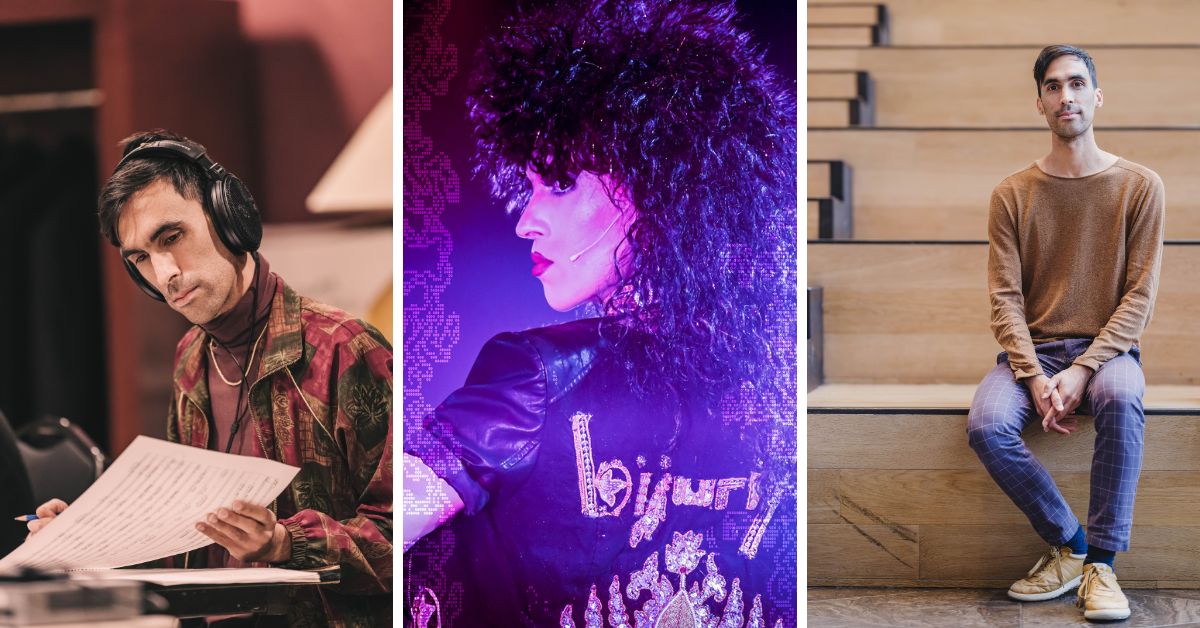
Bijuriya
“I’ll just preface this […] there’s something about this piece, it has different entry points.”
People familiar with his work may think of it as outside his usual performances. “They might think that it’s very different, but it’s very connected to my duality as a drag artist and a composer.”
He says his audience these days often discovers that he’s a composer by coming to see his shows. And, while he notes that audience members tend to come from a broad swath of backgrounds, he wants more musicians to be among their numbers. “It’s been three years; I feel like not enough musicians have felt like they should come.”
Along with the music, of course, comes a story, and while his material revolves around his identity as a brown queer man, there’s more to it than that. “It’s touching on a lot of things that could be relatable. It’s a huge expansion on that, and it’s a departure.”
There are funny moments, but it’s not entirely optimistic. “It’s other things.”
Sound Design
“Sound design is a big part of the show,” he says. “My sound design is stuff that I’ve done with my musician brain.”
A few of the numbers in Bijuriya are chamber or orchestral works. He’s using archival recordings that he’s remixed for the show. Interspersed with the music, at times, is recorded dialogue between him as Gabriel and as his drag Bijuriya persona.
“With hindsight, I know that those references weren’t necessarily legible to South Asian ears,” he says. “So, what I’ve done is taken these recordings but, sometimes if there was an element of Indian influence […] I’m reinfusing new life into these works.”
Reusing his works is a luxury he didn’t often experience in the world of classical composition. “One of my biggest frustrations as a composer is just how we’re fooled to believe that it’s for posterity,” he says. “The effort is disproportionate for the reality of one performance,” he explains — often the fate of so many contemporary works. “Nobody cares,” he adds. “There’s a part of it that’s disillusionment.”
Along with his orchestral music, he’s added other elements. “Bollywood music and carnatic music is sometimes part of the sound design, also mainstream pop — but in sophisticated arrangements.”
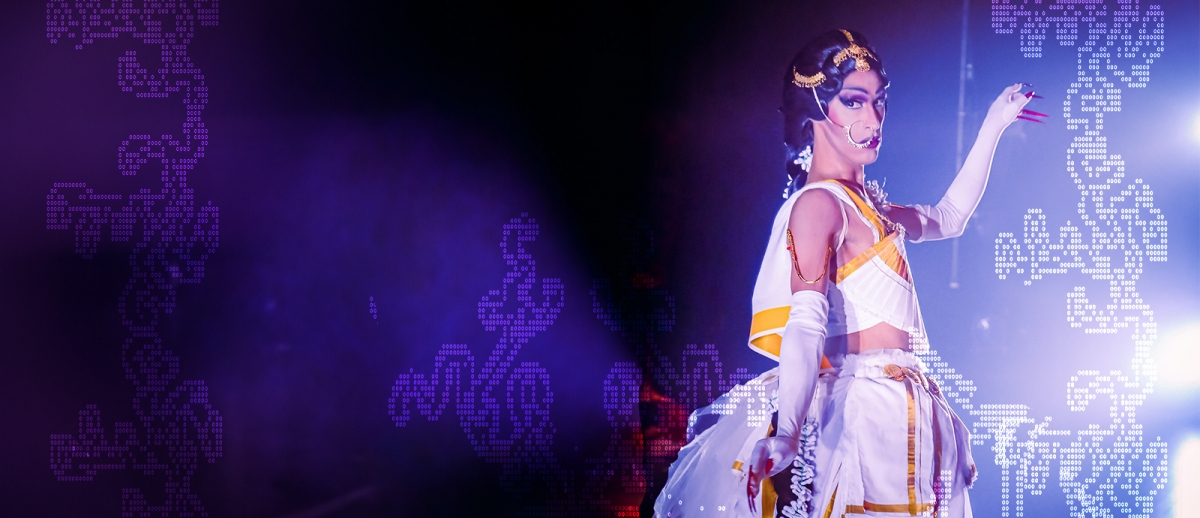
The Show
Bijuriya unfolds in a series of episodes. “There’s different parts to the show. Some of them are the performance of the pop songs, the drag songs, the original songs.”
Those segments are presented as fairly straightforward song performance, with a similar energy. “There are parts that are more character based. And then there’s what I would call broadly performance, exploratory performance.”
At times, he explores the idea of lip syncing, but not in a typical way. “I call them porous lip syncs.”
Vidita Kanniks contributes the vocals for those segments of the show. “She comes to represent my drag performer’s ideal voice.”
It’s an authentic classical Indian interpretation, with its characteristic ornamentation. “The songs that I’ve chosen are either Bollywood songs or classic carnatic songs that I’ve learned.”
Gabriel says he often feels imposter syndrome, and via lip syncing, reclaims his voice. “Sometimes her voice is erased from the time line, and my voice takes over,” he explains. “There’s this play around voices and bodies. One of the themes that’s explored is around that.”
Drag artistry plays into that theme.
“We often think of drag as a way to change our image and change our body to create an illusion of gender,” Dharmoo says. “But there’s vocal drag too.”
He explores the idea of transformation through voice.
“I think that’s something that happens when people lip sync, but it’s not been theorized that way,” he says. “Something that’s interesting about lip syncing is that it’s associated with drag performance, but in Bollywood there is also the playback singer.” The playback singer records the song, which is then lip synced by the actor in the film.
Dharmoo also teaches vocal performance. “I give lots of vocal exploration workshops,” he says. “Everyone has a voice. If you’re breathing, you’re living. Any way you look at it from the angle of ability and disability, if you have an airway, you have a voice.”
His workshops aren’t about teaching the right or correct way to sing. It’s more about exploration. “It can really unlock stuff.”
He points out that many people who don’t have a particularly appealing way of singing often still have something to say, and connect to their audience via meaning. “It’s not always the highly trained voice that people [react to].”
Drag Artistry
Drag is an endlessly creative field. “I feel like I can get away with a lot,” Gabriel says. “Something I’ve always liked as an artist is to have both playfulness and intelligence and thoughtfulness, and a critical stance. To have those coexist is amazing.”
He notes that all of those elements rarely come together in the world of classical composition. “As a trained composer, the playful part was often disavowed,” Dharmoo says. “I am playful as a person.” That quality doesn’t always come across strictly with music. “That’s why I started doing more work as a composer performer, and the more interdisciplinary work.”
In drag, he can do anything — such as meowing his way through Bach arias (a highlight of a previous performance).
“It feels like something the teenager me would say, hey you’re doing great,” he laughs. “I wouldn’t do it as Gabriel out of drag. It feels like having a character that can be yourself, but also an extension of yourself. It’s also bravery. If Gab was doing that meowing thing, he’d be accused of being disrespectful,” he points out. Add makeup and costuming, and it’s a different vibe. “People can enjoy it for what it is. It can be just stupid, and that’s okay.”
Drag allows him to expand his artistic practice, and be brave in ways he wouldn’t have attempted before. “Even one character can be very different.”
More than gender exploration, the basis of many drag performances, his is more theatrical — more of an alter ego. “It just becomes a character that allows me to explore, to make it queer.”
It’s part of his post-school evolution. “I started drag I was in my late 30s. I feel like the drag is an expansion of [it], as well as a critique.” It allows him to add social justice and other ideas to his music performance.
“I think a lot of people are in that boat,” he says. It’s about making his performance part of today’s world. “Grappling with it artistically.”
Shows
- He’s performing the show in Peterborough tonight (November 18) at Energy Performance prior to the Toronto dates; info here.
- He’ll be at Buddies in Bad Times Theatre November 26 to 29; details and tickets here.
Are you looking to promote an event? Have a news tip? Need to know the best events happening this weekend? Send us a note.
#LUDWIGVAN
Get the daily arts news straight to your inbox.
Sign up for the Ludwig Van Toronto e-Blast! — local classical music and opera news straight to your inbox HERE.


- PREVIEW | New Adventures In Sound Art Celebrates Their 25th Anniversary With An Open House March 12 - March 6, 2026
- PREVIEW | The Arcady Opera Showcase: Mini Musical Dramas Featuring 2026 Emerging Artists - March 6, 2026
- PREVIEW | Pianist Eve Egoyan Presents In Stone, A Composition Written For The Armenian Genocide - March 6, 2026