
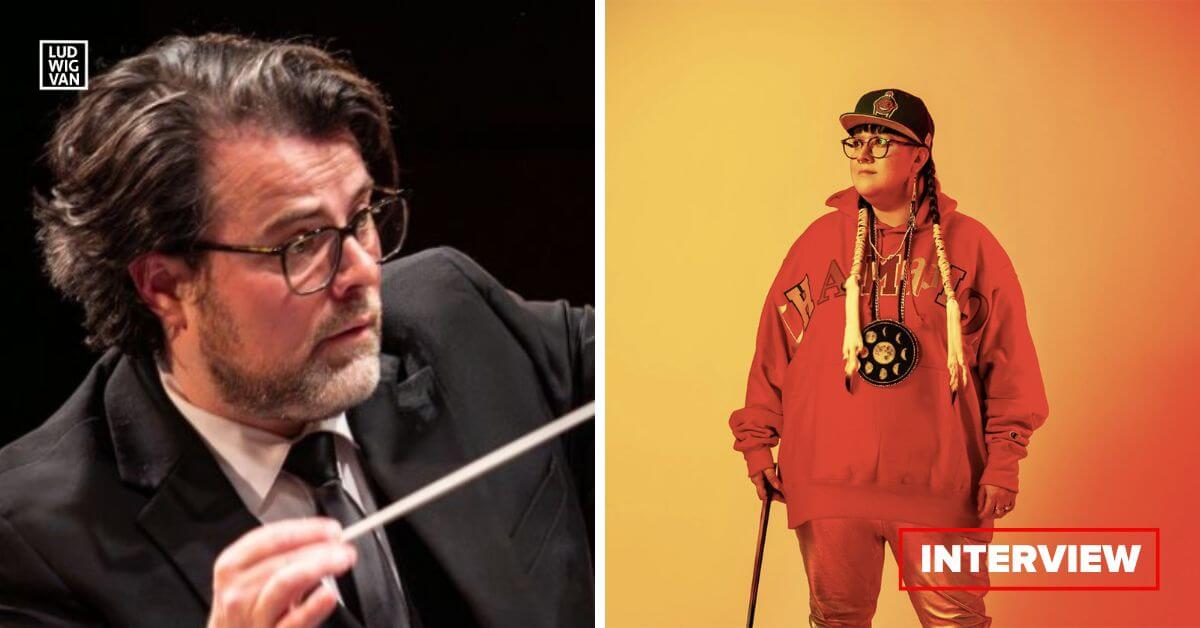
The Cathedral Bluffs Symphony Orchestra continues their 40th season with a concert titled Controlled Burn on November 15. The title comes from a work by two-spirit JUNO nominated Cree cellist Cris Derksen, in a program that incorporates music spanning two centuries.
The full program includes:
- Franz Schubert: Symphony in B minor, D.759 Unfinished
- Cris Derksen: Controlled Burn (2023)
- Germaine Tailleferre: Ouverture (1931)
- Stravinsky The Firebird: Suite (1919)
We spoke to CSBO Music Director Martin MacDonald and composer Cris Derksen about the upcoming concert.
Martin MacDonald: Repertoire
The program kicks off with Schubert’s so-called Unfinished Symphony, which doesn’t appear on many concert bills these days.
“I haven’t had that score in front of me for quite some time,” notes MacDonald. “It’s tricky to program because it’s not a complete work,” he continues. “It’s not in the sweet zone as far as length. A 25-minutes symphony is too long to be an overture, but too short to be a symphony.”
The answer to the challenge is to incorporate other pieces that fit around it.
“Firebird is the anchor piece,” he says. “Years and years ago, my teacher had programmed Schubert unfinished with Firebird. There’s something about the sound worlds that really clicked.”
The Firebird Suite, as he notes, is at a similar length at about 23 minutes.
“It’s one of those great programs where you get to perform more than overture — symphony,” Martin notes.
Schubert’s Symphony in B minor, the Unfinished, was begun in 1822, but the composer left it at only two movements. He completed several works after it during the six years before his death.
“It’s a haunting piece in many ways,” MacDonald says. “It’s so lyrical and it’s so beautiful. Every phrase is so note perfect. There really is no explanation for why he left it,” he adds.
There are many theories among scholars and historians as to why Schubert abandoned the symphony, but no definitive answers. “He just dropped it abruptly.” Those theories range from ill health to the fact that Schubert was unnerved by the idea of composing in the shadow of Beethoven. Both composers lived in Vienna at the time. History has been kinder to the music than the composer himself.
MacDonald likes the challenge it offers the orchestra.
“It gives us the opportunity to work on some really long lines, and build suspense.”
Martin notes the work’s almost cinematic quality. “There are some really powerful and really dramatic passages.”
The Tailleferre Ouverture is another work that doesn’t often see live performance.
Germaine Tailleferre composed her Overture in 1931, and it premiered in December of the following year. It was originally intended to be the first piece of a comic opera, but that project folded. She would later use it when she was commissioned by conductor Pierre Monteux to write a piece for the Christmas concert of the Paris Symphony in 1932. It’s a lively, rhythmic work that appealed to audiences from its debut.
“I didn’t know about this overture until several seasons ago,” MacDonald notes. He was guest conducting in Western Canada, and a programmer had combined with the Firebird Suite in one of the concerts.
“It’s this really sparkling gem of French repertoire,” he says. “She was the only female member of Les Six.” Les Six were a group of composers who lived and worked in Montparnasse, including Georges Auric (1899–1983), Louis Durey (1888–1979), Arthur Honegger (1892–1955), Darius Milhaud (1892–1974), and Francis Poulenc (1899–1963), along with Germaine Tailleferre.
Martin notes that Tailleferre was about a decade younger than Stravinsky, and looked up to the more famous composer.
“It’s really neat to tie these two together,” he says. “She has her own distinctive voice. It’s explosive, kind of like a Candide overture vibe — fast, cheerful exuberant,” he continues.
“We contrast that with the very dark opening of the Firebird Suite,” he says. “It’s a delight for us […] to introduce these works.”
The Firebird is a ballet and orchestra work that Stravinsky wrote for the 1910 season of the Ballets Russes. The composer would later create orchestral suites based on it.
“It’s one of the greatest finales in symphonic music,” he says. “There’s darkness, anger, [from] simplicity to life affirming — life changing.”
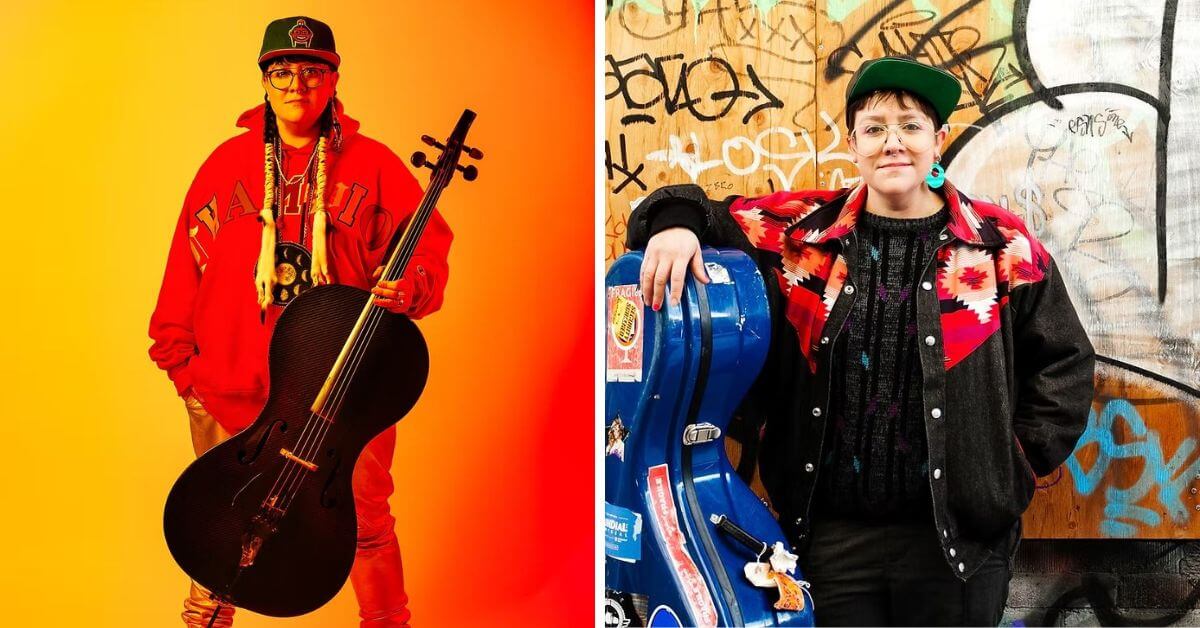
Cris Derksen & Controlled Burn
“In the classical music circles, I’ve been hearing so much about Cris Derksen and her music,” Martin says. “As soon as I heard this piece, I thought, wow, we have to find a way to do this. It’s just so innovative and different,” he adds.
Cris Derksen, originally from Treaty 8 territory in Northern Alberta, has carved out a unique musical career as both performer and composer. She is known for music that blends traditional classical as well as Indigenous elements, often using guitar effect pedals in her cello performance. She has performed with indie rock bands as well as orchestras, and artists like Tanya Tagaq.
Cris’ music has been commissioned by the Calgary Philharmonic Orchestra, the Toronto Symphony Orchestra, the Thunder Bay Symphony, and Orchestre Métropolitain under Yannick Nézet-Séguin, and in 2022, she composed for the Canadian Pavilion at the World Expo in Dubai. Her recorded music, including from her debut album The Cusp, is often licensed for film and TV.
“With Controlled Burn, I had heard so much about it,” MacDonald says. He calls it something that’s a concerto… but not a concerto, featuring a cellist who performs with looping pedals.
“The piece itself, it’s really well written, and it really effectively uses the orchestra.” He notes the use of a technique called col legno, where string players use the wood of the bow to create sound. In Controlled Burn, the cellos and basses use it alongside Derksen in performance.
“It creates this image of a roaring fire,” he says. “It creates a really thunderous effect,” he adds.
“I’m a cellist by training, and I love having a cello soloist in every season. It’s very accessible too. I think we’re very lucky as a community orchestra to collaborate with an artist like Cris.”
Cris Derksen: On Controlled Burn
Cris Derksen studied music at the University of British Columbia, earning a Bachelor’s in Cello Performance.
“When I was going to university, I knew that I had to be a good cellist to play my own music,” Derksen says. “I didn’t take composition at all. I didn’t want to get overly influenced.”
She began using loops and other electronic elements to make the music more accessible to people like her own family members.
“It was about making the cello relatable, and taking it out of the classical, high class [sphere],” she says. “That was the beginning of it. Now I’m back in the classical sphere daily,” she laughs.
For Controlled Burn, Derksen uses multiple effect pedals in performance.
“It’s pretty exciting and nerve wracking all at once,” Cris says. “The piece is still very classical.”
Controlled Burn
The title comes from a historical practice among Indigenous people.
“Controlled burns were things that happened pre-contact all over North America,” she explains. Indigenous people would hold a controlled burn over specific areas in the spring when the ground was wet. Excess debris would be cleared out of the area, leaving organic ashes that helped fertilize the land. It helped to prevent the kind of wildfires that have now tragically become common across Western and Central Canada.
“We used fire in so any ways,” she adds.
Derksen did some research on the subject with the help of Dr. Amy Cardinal Christianson, formerly a Research Scientist with the Canada Forest Srvice, and an Indigenous Fire Specialist in the National Fire Management Division of Parks Canada. Christianson is Métis, and like Derksen, grew up in Treaty 8 territory in northern Alberta.
From her, Derksen learned about other ways that First Nations people used fire, including using the smoke to cool down bodies of water in the summer to help flora and fauna flourish.
“It was always about sustainability,” she says.
When the European settlers arrived, they did not understand the renewing power of fire, and feared it. As Canada was created as a new nation, various pieces of legislation were installed to prevent controlled burns, such as the Bush Fire Act of 1874.
“They were afraid of fire,” Derksen says. “They thought it was about burning trees, and trees are money.”
Her piece Controlled Burn examines that issue from various angles.
“The piece is about that — who controls the burns? It’s also about loss — loss of our good relationship to fire,” she explains.
Other parts of the piece portray the traditional event as it was. “The other thing that really comes out in the piece — sonically — it was safe, a community event, kids there playing,” she says. “It was a safe and beautiful event. Now, when there’s fires, it’s a military event.”
Cris Derksen — Awasowin ᐊᐊᐧᓱᐃᐧᐣ — performs a different piece about fire, Warming by the Fire (2021) – Blueridge Chamber Music Festival:
The Music
“The piece has so many different moments. The piece starts with a spark,” Cris says.
That’s where the col legno technique comes into play.
“I start the piece with the spark of this fire, and have the low strings tapping on the strings,” she describes. From there, the snare drums take over in a kind of militaresque heroic mode. Along with the pedal effects used in the cello performance, it replicates the effects of the fire.
“You can feel the land in that moment,” she says. “I also added some water bombs in the piece.” That represents the notion of taming the fire.
She’d like audiences to think about the implications, given our current reality of summer wildfire season, particularly in Western Canada.
“I get a little flashlight on something that we should be looking at,” she says. Can we take measures that would minimize the fires that rage every year? “To be concerned about the fact that we have a fire season.”
The work was commissioned by Yannick Nezet-Sequin as music director of Montréal’s Orchestre Metropolitain, and is currently on a tour. She’s performed it with four different orchestras so far.
“We’ve performed it in the states in Philadelphia and also in Carnegie Hall,” she says. That happened in 2024, and there are more performances planned for 2026.
She acknowledges how lucky she is as a contemporary composer in this case. “A lot of new orchestral works don’t necessarily get [more than one performance],” she notes. Derksen also recently recorded the work in Montréal, a release that should be available within the next couple of months.
It’s quite a journey for an artist whose first idea was to take the music out of the hallowed concert hall.
“I never really thought that I would have a full symphonic recording.”
The Concert
“In this program we got four very different musical worlds,” MacDonald says. “This is probably the most ambitious program that we’ve done to date.”
You can take in Controlled Burn on Saturday, November 15 at 8 p.m. at the P.C. Ho Theatre, Chinese Cultural Centre of Greater Toronto.
- Find other details and tickets [HERE].
Are you looking to promote an event? Have a news tip? Need to know the best events happening this weekend? Send us a note.
#LUDWIGVAN
Get the daily arts news straight to your inbox.
Sign up for the Ludwig Van Toronto e-Blast! — local classical music and opera news straight to your inbox HERE.

- PREVIEW | Classical Guitarist Alexandra Whittingham Makes Toronto & Ontario Debuts - March 13, 2026
- PREVIEW | Soundstreams Presents Quatuor Bozzini: With Strings Attached - March 13, 2026
- INTERVIEW | Award-Winning Librettist & Against The Grain AD Royce Vavrek Talks About Canuck Cantatas - March 13, 2026