
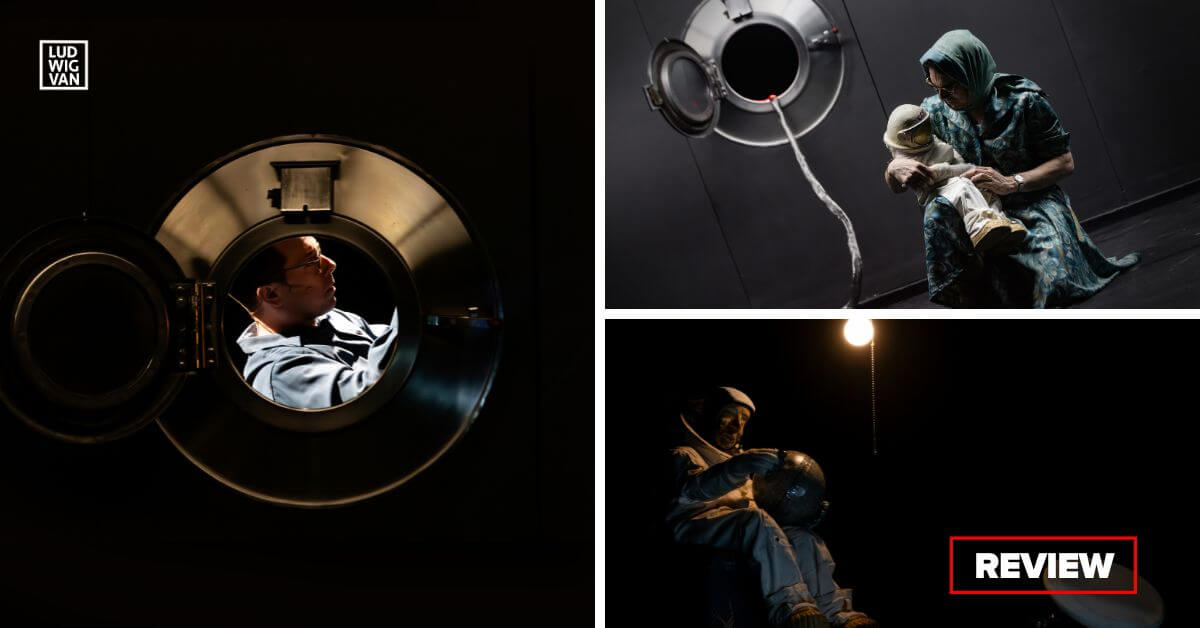
Canadian Stage: Far Side Of The Moon. Robert Lepage, writer & director, music composed & recorded by Laurie Anderson @2000 Difficult Music (BMI); Marie-Chantale Vaillancourt, costume singer, Pierre Robitaille & Sylvie Courbron, puppet designers, with Olivier Normand. Continues to November 16, 2025; tickets here.
A revival, even with its little alterations, does not necessarily entail a revitalization.
Such is the case with Canadian Stage’s The Far Side of the Moon, which, as the opening credits projected on the wall of a laundromat cinematically announces, is written, directed and designed by Robert Lepage, whose dazzling theatrical vision almost eclipses his play’s shortcomings.
Ushered in by Laurie Anderson’s score, which questionably utilizes the erhu — a Chinese instrument — to evoke a tone of reminiscence, and a 180 degree turn of a rotating light fixture centre stage that reveals a mirror on its other side, Philippe (Olivier Normand) addresses the audience in an astronaut’s blue jumpsuit (costume design by Marie-Chantale Vaillancourt).
In a moderately Québécois-tinged accent, he speaks of Galileo, of the Cold War, of the poetic meaning behind the title, before the set, with its many sliding doors, transforms into the aforementioned laundromat where he washes the clothes of his recently deceased mother.
Key to the staging is a circular pane of glass that represents the washing machine, but throughout the production, which runs at two hours without an intermission, will represent several entities — a fish bowl, a clock, an MRI scanner, a spaceship window. In a recent profile, Lepage explained that encountering a washing machine in an alley brought to mind Apollo 11, which, in turn, returned him to memories of his late mother, becoming what he calls a “sensible resource.”
A Sensible Resource
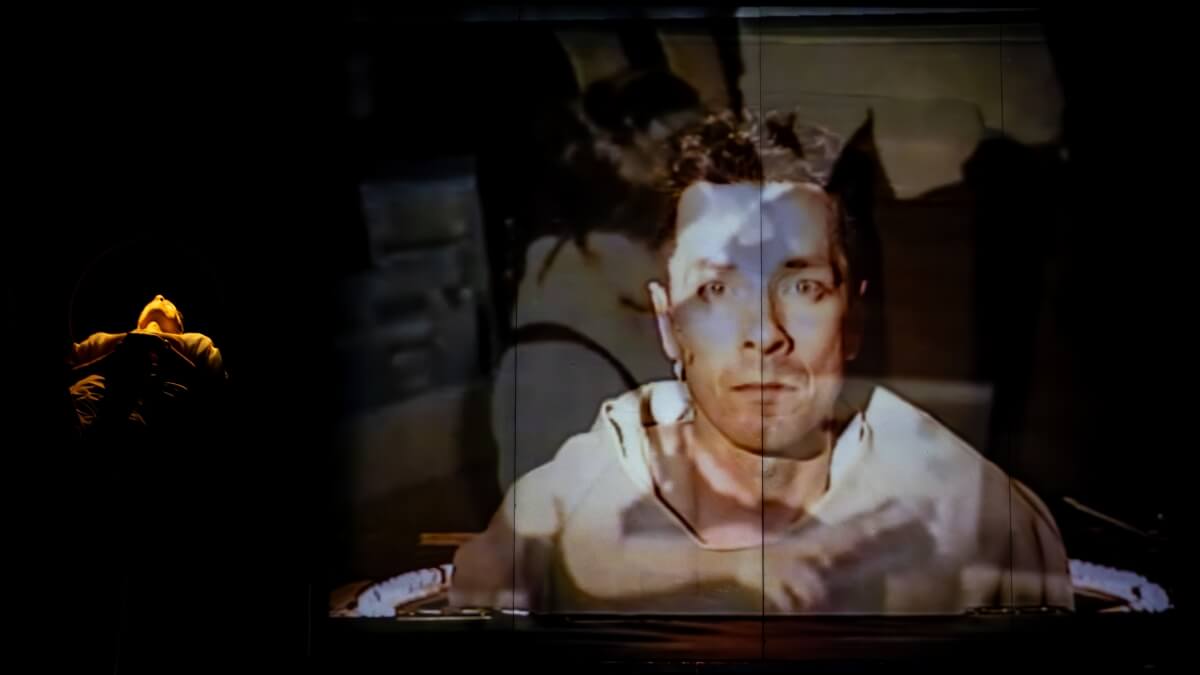
It is indeed sensible and riveting when Philippe first leaps into the washing machine and immediately finds himself floating in space, an effect which is assisted by live-feed cameras that provide an additional dimension into the viewing experience, an inside-look into the intricate machinery.
In addition, as transitions, since it is also in Lepage’s impulse to mix mediums, a sliding projector downstage presents archival footage ranging from 1957 — when the Soviet Union launched Sputnik — to 1969 — when Apollo 11 landed on the near side of the contentious moon.
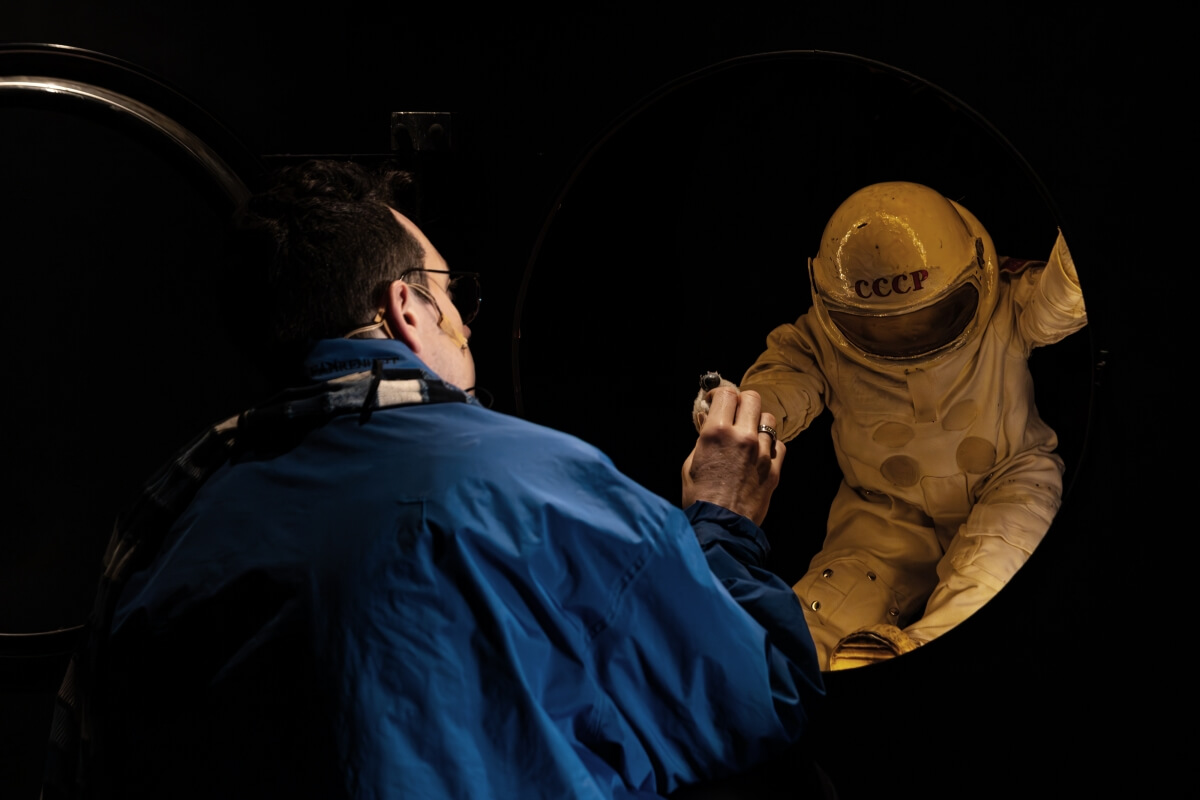
This historical event and the international divide that defined it is intended to be mirrored in Philippe’s relationship with his brother André (Normand), a gay weatherman with a distinguishing moustache who has no patience for his brother’s neurosis, and who appears on stage so infrequently that the drama, the stakes between them — whose possible reconciliation is supposedly a key narrative point in this autobiographical tapestry — are never convincingly realized.
The Production
The fault is inherent in the production itself. As a one-man show, there is never a time for both characters to be on stage at once, leaving Philippe scenes of having one-sided conversations on the phone, or for André to awkwardly be yelling at an empty chair. It’s a division we are meant to assume based on the thinness of facts, even though there are interpretations to be made.
For instance, it struck me that, as a weatherman, André looks down at the world from above to study it, but that as an aspiring cosmonaut, Philippe, as expressed in a moving speech set in Moscow, has taken it upon himself to decidedly look away from earth and into the void. But, these are resonances Lepage leaves the audience to piece together as he blinds us with strobing lights, Eric LeBlanc’s enchanting puppetry, and sweeping dance sequences to ease the longeur.
More estranging, and dragging, are sequences when Philippe works out using every possible positioning of an ironing board and cleaning up after in the locker room, a physical gag which leads nowhere in particular. Or André, having discovered the goldfish has died and is tasked with delivering bad news to him, rather than play it as tragically complex, opts for the comic route and earnestly offers his brother clichéd advice: “When life gives you lemons, you make lemonade.”
Towards the end of The Far Side of the Moon, as my patience waned waiting for a spaceship to zip across the stage on a string, I realized despite being about the Cold War and these two brothers grieving their mother, the play, without much narrative to grasp on, is, in reality, a vehicle for Lepage to exhibit his unparalleled technical genius, which does indeed expand your notion of what theatre — should you have the sensible resources and budget to achieve it — can be.
Unlike this past summer, at the Stratford Festival, where his inspired staging of Macbeth within the milieu of motorcycle gangs was well-suited to the adequate structure provided by Shakespeare to be buoyed by his wizardry, Lepage, in this play, has failed to develop the personal or the political strains beyond their superficial introductions to achieve the same epic feat.
Brilliant Staging/Ambiguous Text
His brilliant staging overcompensates for an ambiguous text — a contrail sputtering behind it.
Normand, who fumbled his lines in the bar scene on opening night, otherwise seemed at ease with the shape-shifting nature that the role — which was originated by Lepage and later played by Yves Jacques — demands of him, not emotionally, since dreary detachment is central here, but physically, working in total harmony with the production team to make the delicate choreography of it come to life (which, on opening night, still seemed to be smoothing itself out).
His prowess is most apparent in the play’s much talked about final scene, which is set at an airport. With his back on the ground, a mirror above his head, and Beethoven’s Moonlight Sonata playing, Philippe begins to crawl and, in the reflection, produces the effect of hovering in space.
It is an utterly captivating scene made up of such simple elements, which, in my reading of the scene, renders Philippe’s sense of weightlessness in an existence that, at every turn, fails to keep him down to this earth. His consciousness provides him this freedom to float out of his body in a public space, as he faces the future, finally unmoored. It’s a wish — a stunning spectacle.
But then it ends, the wonderment fades, and in its wake remains a line uttered by Philippe early on while defending his thesis. He argues it was not curiosity but narcissism that propelled humanity into outer space. Apparently it is what propels some into theatre as well.
By Nirris Nagendrarajah for Ludwig-Van
Are you looking to promote an event? Have a news tip? Need to know the best events happening this weekend? Send us a note.
#LUDWIGVAN
Get the daily arts news straight to your inbox.
Sign up for the Ludwig Van Toronto e-Blast! — local classical music and opera news straight to your inbox HERE.

- CLASSICAL CHARTZ | The Top Ten Classical Music Albums For The Week Of March 9 To 15 2026 - March 9, 2026
- SCRUTINY/INTERVIEW | The Leonkoro Quartet’s Premiere Performance Delights Music Toronto Audience - March 9, 2026
- INTERVIEW | Violinist— And Now Filmmaker — Lara St. John Talks About Dear Lara - March 2, 2026