
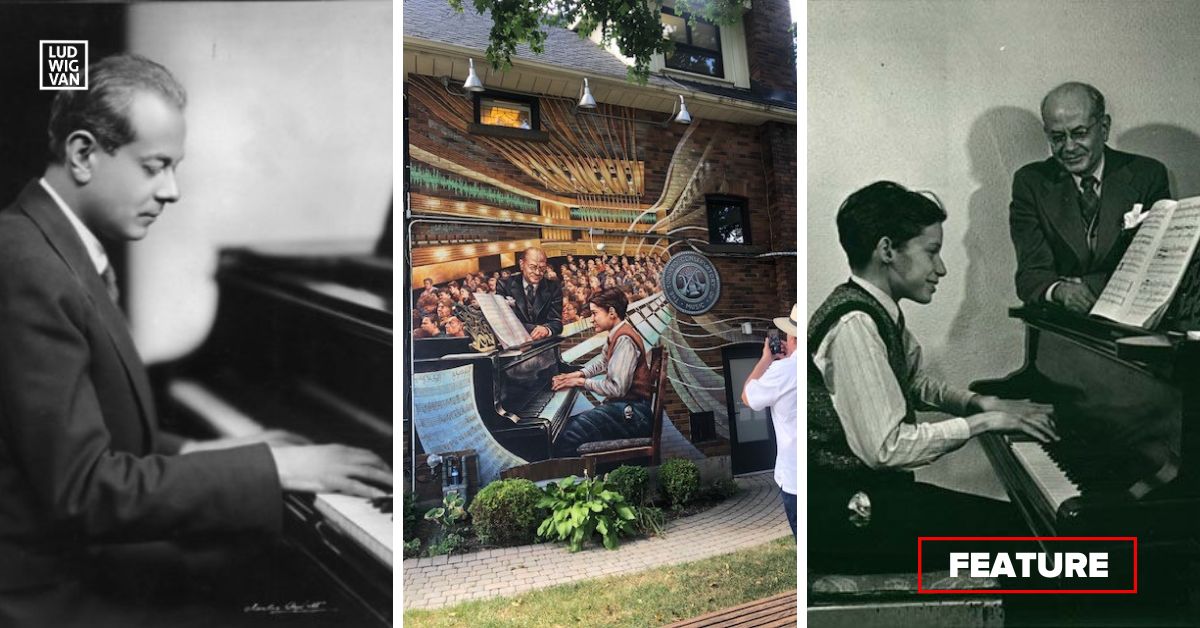
The right music teacher can make an enormous difference to student learning, and an extraordinary teacher can influence generations of musicians that come after them.
The life and legacy of Chilean-Canadian musician, and pedagogue Antonio Alberto García Guerrero is a vivid illustration of that fact. As a teacher at Toronto’s Royal Conservatory of Music, he influenced a long list of some of Canada’s most prominent and highly acclaimed composers and musicians.
His prominence in the musical world, however, isn’t matched by his resting place in the city’s St. James Cemetery, and that’s something his Canadian-based family and the Chilean-Canadian community are trying to change.
Antonio Alberto García Guerrero
Alberto Guerrero was born on February 6, 1886 in La Serena, Chile. He first studied piano with his mother and older brother Daniel, and then continued teaching himself. The family moved to Santiago in the 1890s, and there he would later become part of Los Diez, a group that included architects, writers, sculptors, musicians and painters. Los Diez would go on to become an influential group throughout Chile during the 20th century. Guerrero introduced Chilean society to the modern composers of the day, including Debussy, Ravel, and Scriabin, and he founded and conducted Santiago’s first symphonic orchestra.
Alberto arrived in Canada in 1918, and performed for a few years with the Hambourg Trio. He also performed radio recitals, an innovation when he began in the mid-1920s and continued through to the early 1950s. He presented a subscription series of solo recitals from 1932 to 1937.
Gradually, Alberto would shift his focus from performance to pedagogy, and in 1922, was offered a position to teach at Toronto’s Royal Conservatory of Music.
There, his students were made up of a group that would number among Canada’s preeminent musicians and composers.
He taught and mentored Glenn Gould for a decade (despite Gould’s later claims to be self-taught). For Gould, Guerrero developed a piano technique known as finger tapping.
He was inspired by a young boy performing an athletic dance at a Chinese circus. Guerrero was fascinated by his agility, and went backstage to learn more. The child’s trainer demonstrated how he moved the child’s arms and legs into position while the young boy was in a passive and relaxed state. The theory was that when the boy went to reproduce the movements later, his muscle memory included the relaxed feel.
Guerrero adapted the technique for piano playing by placing one hand on the keyboard with muscles relaxed from the shoulder downwards. Then the other hand taps the specific fingers down on the keyboard in the required sequence to perform a passage. Like the young acrobat, when the hand reproduces the movements, ideally it also reproduces the relaxed and effortless feel.
As a result, tension is minimized, and performance easier.
Other pupils included William Aide, John Beckwith, Helmut Blume, Gwendolyn Duchemin, Ray Dudley, Dorothy Sandler Glick, Stuart Hamilton, Paul Helmer, Horace Lapp, Edward Laufer, Gordana Lazarevich, Pierrette LePage, Edward Magee, Ursula Malkin, Bruce Mather, John McIntyre, Gordon McLean, Oskar Morawetz, Arthur Ozolins, George Ross, R. Murray Schafer, Oleg Telizyn, Malcolm Troup, Neil Van Allen, Ruth Watson Henderson, and others.
Along with teaching technique and performance, he was recognized as an intellectual, and for exploring connections with painting, poetry, and the work of philosophers such as Sartre.
“He was one of the few musicians from whom a student would get a vista of ideas beyond music,” wrote R. Murray Schafer.
In addition to his Canadian career, he retained ties to his homeland. Guerrero served as Honorary Consul of Chile in Toronto from 1921 to 1928 and also intermittently until the end of the 1930s.
Alberto Guerrero: Finding Family
LV spoke to Lillian Maldonado, a relative of Guerrero’s, and Luis Garcia, Chair Cultural Committee of the Casa Salvador Allende, Toronto about the initiative to create a memorial marker in St. James Cemetery.
While Guerrero may have been well known in the classical music community, he wasn’t as well known throughout Toronto’s Chilean community.
“Several people had heard a little about him,” as Luis Garcia explains it. “I heard about Alberto Guerrero years ago when I saw a documentary about Glenn Gould.”
On hearing the name, Garcia did a bit of research and discovered he was Chilean. He connected with a couple of researchers who were interested in the stories of Chilean immigrants.
“We found out he had relatives here in Toronto,” he says.
“They found out about me, and invited me to join the group,” adds Lillian.
Maldonado says that she didn’t hear much about him via her family, pointing out that he was already one generation removed from hers. When her family moved to Toronto in 1974, her father mentioned having relatives in the city, but not the context. When Alberto came to Canada, her father had not been born yet, and her grandmother, Alberto’s sister, died a year before Lillian was born.
“There wasn’t a great connection,” she says.
“One on my trips to Chile to visit the family, one of my sisters mentioned she had discovered this book,” she recalls. “She asked, do you know we have a famous uncle? We discovered that this was the uncle that my father was talking about.”
Naturally, when the group contacted her, she was eager to help.
“He had an extraordinary life and contribution to Canada,” Luis says. In fact, Guerrero is credited with teaching the techniques that Glenn Gould would apply to his seminal Goldberg Variations.
“That’s why it was so shocking for us to find the place where he is now,” he says. “We want to recognize that with a plaque.”
When they visited his resting place in St. James Cemetery, they found his ashes interred at an umarked grave in a small area that also held the remains of ten other families.
“They invited me to see just a piece of stone that doesn’t even have his name,” she says. “It shocked me.”
“In fairness, we have to say that his peers within the musical community have recognized him,” Garcia notes.
Former student R. Murray Schafer wrote his piece In Memoriam Alberto Guerrero in 1959 after Guerrero’s death. Guerrero’s story was also documented in the 2001 episode of White Pine Pictures’ A Scattering of Seeds series titled The Music Teacher, directed by Patricia Fogliato.
“However, he’s not that well known for our community as well,” he adds.
On November 9, the group will be launching an initiative to raise funds for a suitable memorial.
Pilgrimage Tribute for Alberto García Guerrero
The Alberto García Guerrero Project invites the community to a pilgrimage to the newly discovered site in the columbarium at St. James Cemetery, where the ashes of the distinguished Chilean-Canadian musician rest.
- Sunday, November 9, 11 a.m.
- St. James Cemetery (635 Parliament St, Meet at the main entrance)
Inquiries here.
Are you looking to promote an event? Have a news tip? Need to know the best events happening this weekend? Send us a note.
#LUDWIGVAN
Get the daily arts news straight to your inbox.
Sign up for the Ludwig Van Toronto e-Blast! — local classical music and opera news straight to your inbox HERE.

- PREVIEW | Classical Guitarist Alexandra Whittingham Makes Toronto & Ontario Debuts - March 13, 2026
- PREVIEW | Soundstreams Presents Quatuor Bozzini: With Strings Attached - March 13, 2026
- INTERVIEW | Award-Winning Librettist & Against The Grain AD Royce Vavrek Talks About Canuck Cantatas - March 13, 2026