
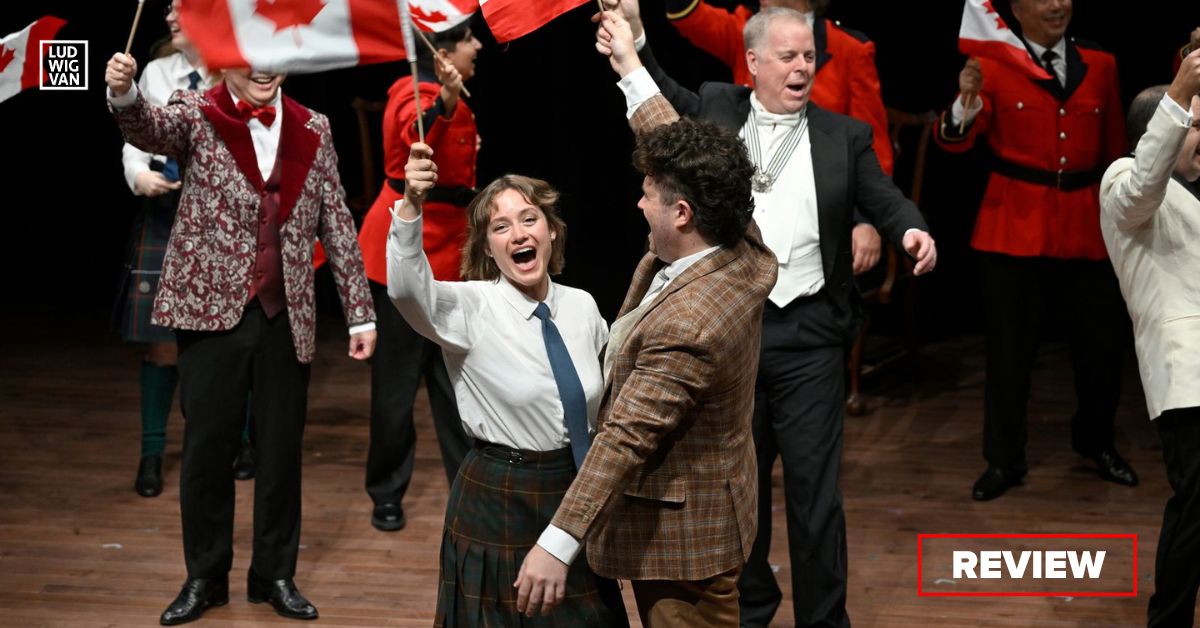
Toronto Operetta Theatre/The Mikado “Revisited”, composed by Arthur Sullivan, libretto by W. S. Gilbert, directed by Guillermo Silva-Marin, conducted by Narmina Afandiyeva, Jane Mallet Theatre, Oct. 24 to 26.
Sometimes you go to a production and you’re entertained. But sometimes you go to a production and it’s just plain fun.
That was The Mikado that Toronto Operetta Theatre mounted over the weekend at the Jane Mallet Theatre. I laughed and I laughed, and I owe it all to the artistic director of Toronto Operetta Theatre Guillermo Silva-Marin.
Silva-Marin and Comedy
Now, the organization is 40 years old, so he has had four decades to hone his craft. Silva-Marin understands shenanigans, hijinks, and slapstick comedy very well. It has become mother’s milk to him.
Thus, if something like The Mikado, farce, and Gilbert and Sullivan comes along, it’s like a red flag to the bull, and you know that you are in for a treat. Nothing is going to be left out and Silva-Marin is going to milk the production for every laugh he can get.
And that is precisely and exactly what happened.
Mikado “Revisited”
This Production of The Mikado is Revisited because, as Silva-Marin says in his program notes, Toronto Operetta Theatre hasn’t put on the operetta for 10 years, not since 2014, because in this era, you’ve got to be careful about cultural appropriation, along with diversity and equity, particularly because of the Japanese setting.
Thus, Silva-Marin reset the operetta in modern times in the neighbouring city of Burlington, which is just west of Toronto along the Golden Horseshoe.
Plot and Characters — The Men
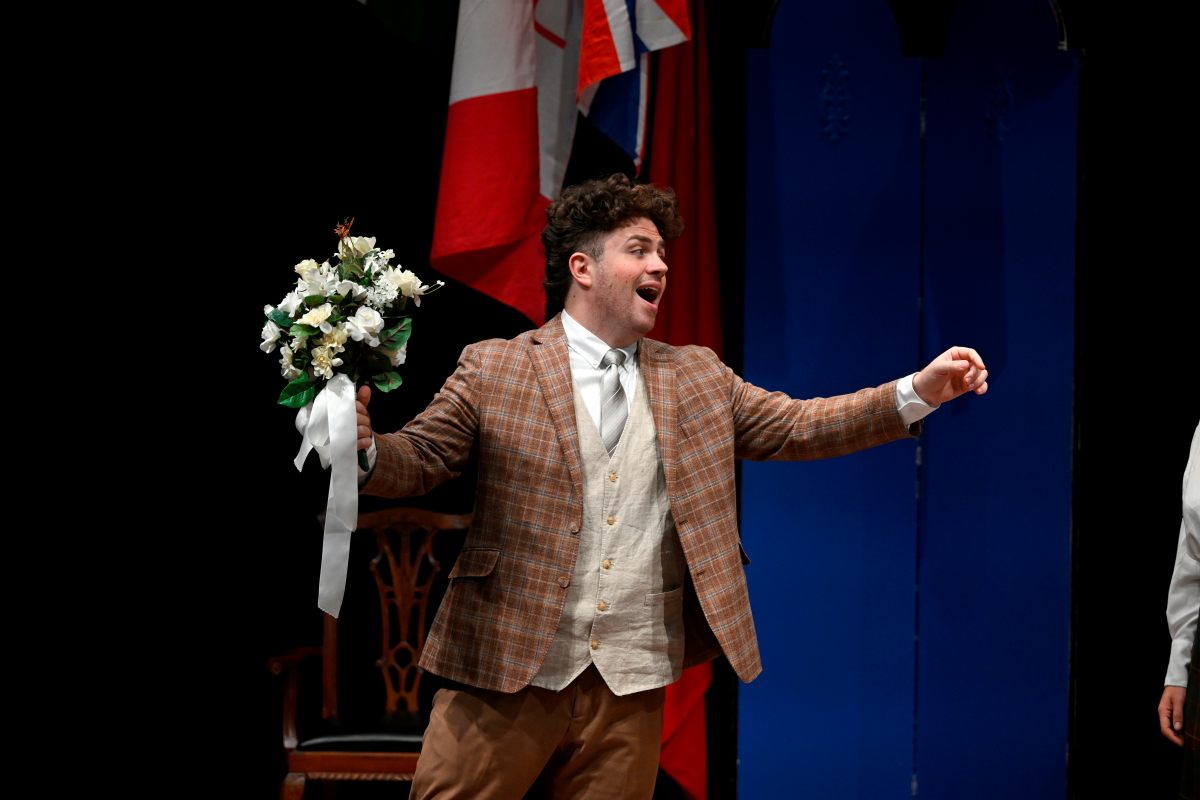
The six men of Canada, the male chorus, come out in red jackets, a reference to the Mounties, and they’re carrying clipboards. The Wandering Minstrel, now called Nanki Blue instead of Nanki-Poo (Marcus Tranquilli), wearing a suit and carrying a briefcase, sings about having met Yum-Yum somewhere out west and falling in love.
This version follows the plot as W.S. Gilbert set it out.
Unfortunately, Yum-Yum is engaged to her guardian, Sir Arthus Borborian, formerly Ko-Ko, who was going to be executed for flirting, but due to circumstances, was elevated to the position of the Lord High Executioner.
We also have Sir Arthur Dickey, formerly Pish-Tush, (Joseph Ernst), who explains how the Lord High Executioner became the Lord High Executioner, and we also have Lord Arthur Blimp, (Hendaya Rusli), who is the Lord High Everything Else, the former Pooh-Bah. He’s the Chief Chamberlain, the Lord High Justice, the Private Secretary — the running joke of all the ministerial positions.
Is Arthur the only name allowed in Burlington?
When the Lord High Executioner enters (Gregory Finney), it may have been the funniest moment of all the funny moments that happened in The Mikado.
Finney, who is one of the great clowns of all, comes in wearing a kilt, and the music isn’t meant for this, but it turned into a Hawaiian hula.
As he does his graceful hula movements, the six male chorus members and the former Pish-Tush and Pooh-Bah join in, all doing the gentle, graceful distinctive hand gestures and footwork of a hula as they sing Gilbert’s words. You cannot imagine how funny it was. The music and the words are the same; it’s just the movement that Silva-Marin added was belly laugh uproarious.
A quandary arises with a message from the Prime Minister, saying that there hasn’t been an execution in Burlington, Ontario, and there should be. What are they going to do? Since Nanki Blue is so upset that he can’t have Yum-Yum, he says, you can execute me. So that’s just wonderful — they now have a victim.
The Schoolgirls
Enter the young ladies.
There are five of them, three of whom have speaking parts. Yum-Yum (Madeline Cooper), Petit Pois (Mairi Demings), and Lucy Darling (Emma Puscalau).
These five wards of the Lord High Executioner are most likely attractive young women in real life, but to add to the humor and hijinks of the show, Silva-Marin has elected to have them as the scruffiest lot of schoolgirls you have ever seen.
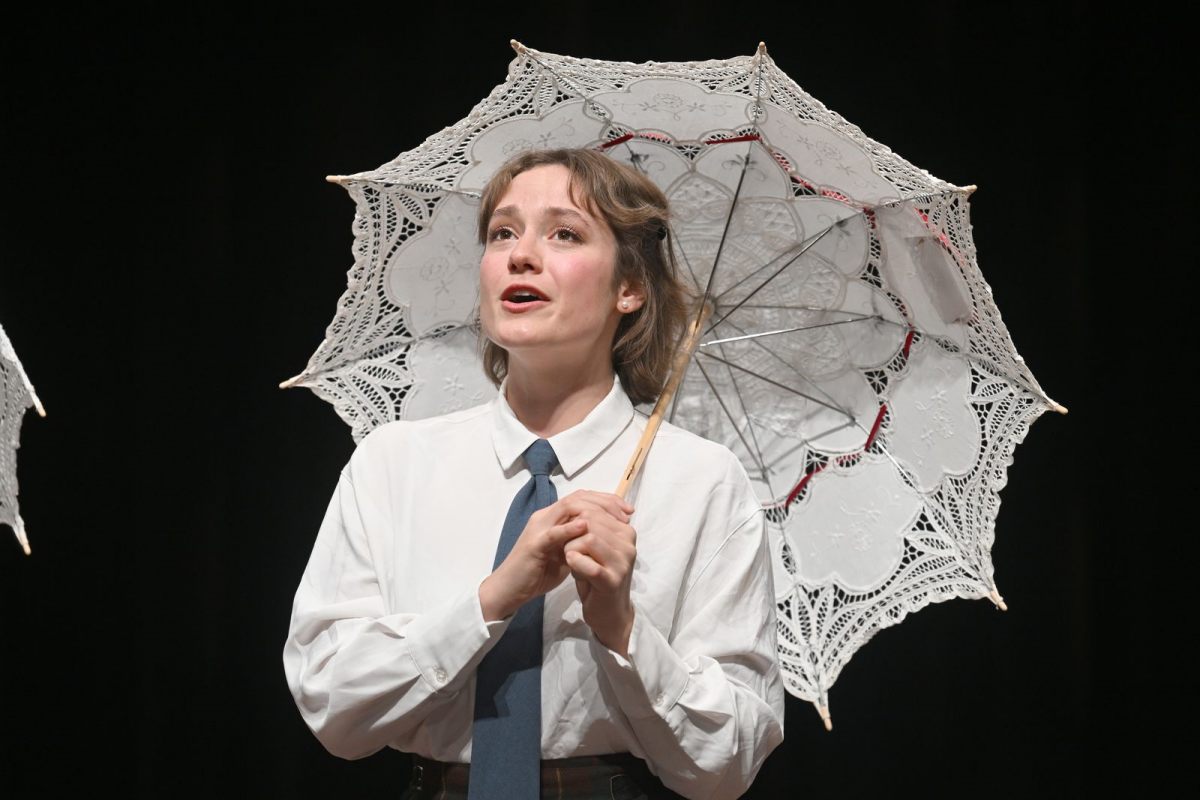
They’ve got their white shirts and their various ill-fitting tartan skirts to indicate school uniforms, but they are, without doubt, a scraggly lot. With their dishevelled appearance — each girl has made her hair appear singularly uncared for—they are truly the worst looking bunch of schoolgirls imaginable, which made their entrance hysterically funny, especially if you think back to the dainty, delicate Japanese girls of the original production.
They still do their umbrella routine, but their socks — some up, some down — add to their unkempt style. You would not like to meet this gang of girls in the schoolyard.
Enter the Contralto
Out of some kind of bizarre kindness, Nanki Blue and Yum-Yum are allowed to get married, and have one month together, at which point the Wandering Minstrel will be executed.
Just as they’re all rejoicing, enter Katty Kat, the former Katisha (Karen Bojti), the Dowager Duchess, who was betrothed to Nanki Blue, who we find is in disguise. He’s not a Wandering Minstrel — he is the son of the Prime Minister, and he fled Liverpool because he was engaged to this woman and didn’t want to marry her.
Katty Kat is wearing an outrageous outfit straight out of the Gilded Age: a sateen pantsuit with a velveteen sweeping cape and a squashed flat velvet hat, all in bronze, sepia tones. She tries to stop the merriment and is driven away by the chorus.
That ends Act One.
Just to add a note. One has to feel sorry for the contralto in every G&S operetta because she’s most likely always on the outside and probably unhappy.
The Shenanigans Continue
In Act Two, it is decided to fake the death warrant of Nanki Blue rather than have a real execution.
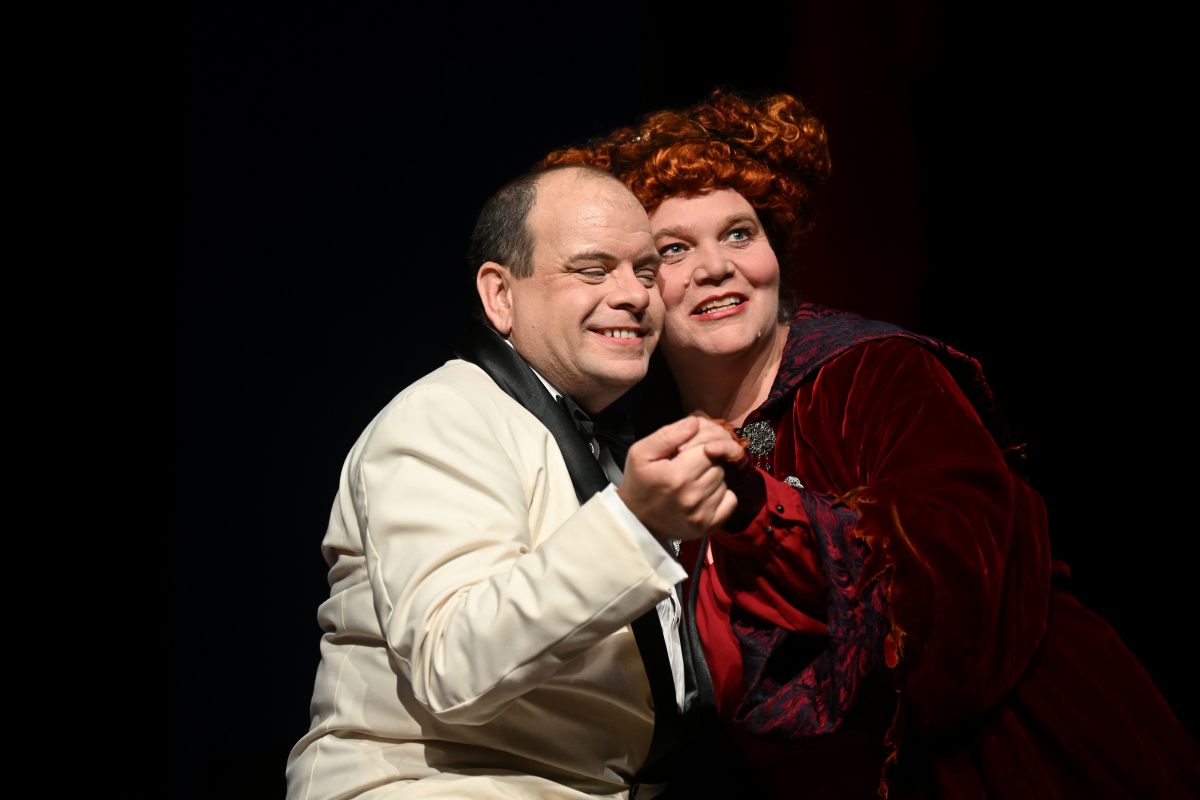
The Prime Minister (Stuart Graham), now called Sir Arthur Blarney (ha ha) instead of Mikado, arrives with Katty Kat to find out that an execution has taken place. When they read the death warrant, Katty Kat almost dies of hysteria because she realizes that it’s the Prime Minister’s son who’s been executed.
As the Prime Minister says in his song, the punishment fits the crime, and so he is going to execute the three people who came up with the idea to execute his son — the Lord High Executioner, Lord High Everything, and Petit Pois.
The only thing that’s going to save them is if the Lord High Executioner marries Katty Kat.
In the famous set piece, “Tit Willow”, he tells the story of a suicide and says he will kill himself as well if Katty Kat doesn’t marry him because he loves her. It’s a wonderful scene between Finney and Bojti, and Finney performs the iconic song with such pathos that Katty Kat just can’t resist. It’s a lovely, poignant moment in the operetta.
The Prime Minister can’t go through with the execution because the Duchess is married to the Lord High Executioner, et cetera, and all ends well with Nanki Blue and Yum-Yum’s return.
Messages and Themes
Gilbert’s farce of government inefficiency is intact — every decision has to go through a dozen officials, and nothing can get done. As well as Gilbert’s axe at government bureaucracy, the whole question of executions in general is raised.
In this revisiting of The Mikado, all the points that Gilbert was trying to make certainly get made.
We should also add the plight of women, which I think is strong here, because the suffragette movement was raging when this operetta was written (1885).
Yum-Yum is forced to marry her guardian, and she doesn’t have a choice in this. I think that’s important — that these wards were summarily placed with these guardians, and they had no voice or agency in the decision. Gilbert made that choice for Yum-Yum deliberately, at least I hope he did, and I hope that there’s a place about the rights of women in the libretto.
The Music
I knew we were in for a musical treat right from the moment the orchestra began the overture.
The conductor for this Mikado, Narmina Afandiyeva, led the orchestra with finesse and articulation.
Under her direction, the small ensemble of nine players beautifully and exquisitely rendered Sullivan’s marvellous score, with its shifts of softness and brightness, in perfect balance. Each song of The Mikado was given its own perfect expression. I was enchanted, literally enchanted, by the way the orchestra interpreted the Music
A note to Silva-Marin: please bring this lady back, because the music was wonderful. This nine-member ensemble sounded like a full orchestra, and I had as much delight listening to what was happening musically as watching what was happening on the stage.
The Singing and Diction
Note: One of my great problems with Toronto Operetta Theatre — and musical theatre generally in Toronto — is diction.
The Men
Happily, the Wandering Minstrel Nanki Blue (tenor Marcus Tranquilli) was word perfect, crystal clear. He’s also a talented actor. The problem is he has an unusual quaver in his tenor voice, which weakens the sound, alas.
Sir Arthur Dickey (baritone Joseph Ernst) came and went with his diction, but mostly came, thankfully. Lord High Everything (baritone Hendaya Rusli) has a heavy accent, but you could hear a fair bit of what he said.
The Lord High Executioner (baritone Gregory Finney), was perfect, crystal clear right through. Alas, the Prime Minister (baritone Stuart Graham), was muddy in his singing, much to my disappointment. He should have been better than that — and I missed a lot of what he said.
But overall, the men weren’t bad, and Gregory Finney and Marcus Tranquilli were word perfect.
As far as singing goes, the men had hearty voices and sang with gusto. There’s nothing like a group of mostly baritones to sing up a storm.
The Women
The young ladies in chorus alas, were terrible. You could not hear anything they were saying. In fairness, I should mention that when the men were singing together, you couldn’t hear a word either.
When Madeline Cooper (Yum-Yum) was singing her major aria, I heard “The sun and I”, and “The moon and I”, and that’s it. Mairi Demings (Petit Pois) was slightly better at 50%, but basically, the women’s diction was practically nil.
They did however have attractive voices, and the ensemble harmony was beautiful. The solo voices of the three women were quite lovely.
Madeline Cooper’s mezzo-soprano is light and lyrical. Demings’ mezzo is a little heavier but buoyant. Emma Puscalau lone soprano’s voice is feathery with colour.
Karen Bojti, the contralto, has a gorgeous, commanding, sound. She too came and went with her diction. Mercifully, I heard more of her words than not — about 60 or 70%. What a beautiful, strong contralto voice she has.
Overall, as far as voices went, if you pretended English was a foreign language, and you didn’t care about words, the singing from the women was quite lovely.
Diction Report Card
A final note on the diction side: I had two men with absolute clarity, two more with somewhat clarity, two choruses with no clarity, and women with barely any.
Pretty disappointing when you want to hear every clever word of Gilbert and Sullivan.
Final Thoughts
I had enormous fun.
Guillermo Silva-Marin is a past master at how to put comedy on the stage, and this Mikado may be the best effort he’s ever done in rendering humor. But they’ve got to work on diction.
So staging, singing, orchestra — pass with honours. Diction — fail.
Are you looking to promote an event? Have a news tip? Need to know the best events happening this weekend? Send us a note.
#LUDWIGVAN
Get the daily arts news straight to your inbox.
Sign up for the Ludwig Van Toronto e-Blast! — local classical music and opera news straight to your inbox HERE.


- SCRUTINY | Mirvish’s Shucked Is Loud, Brash & Unapologetically Corny - March 10, 2026
- SCRUTINY | The National Ballet of Canada Opens Winter Season with Classical Purity and Contemporary Power - March 2, 2026
- SCRUTINY | Mirvish’s Some Like It Hot Celebrates Broadway Glam Updated For 2026 - February 24, 2026