
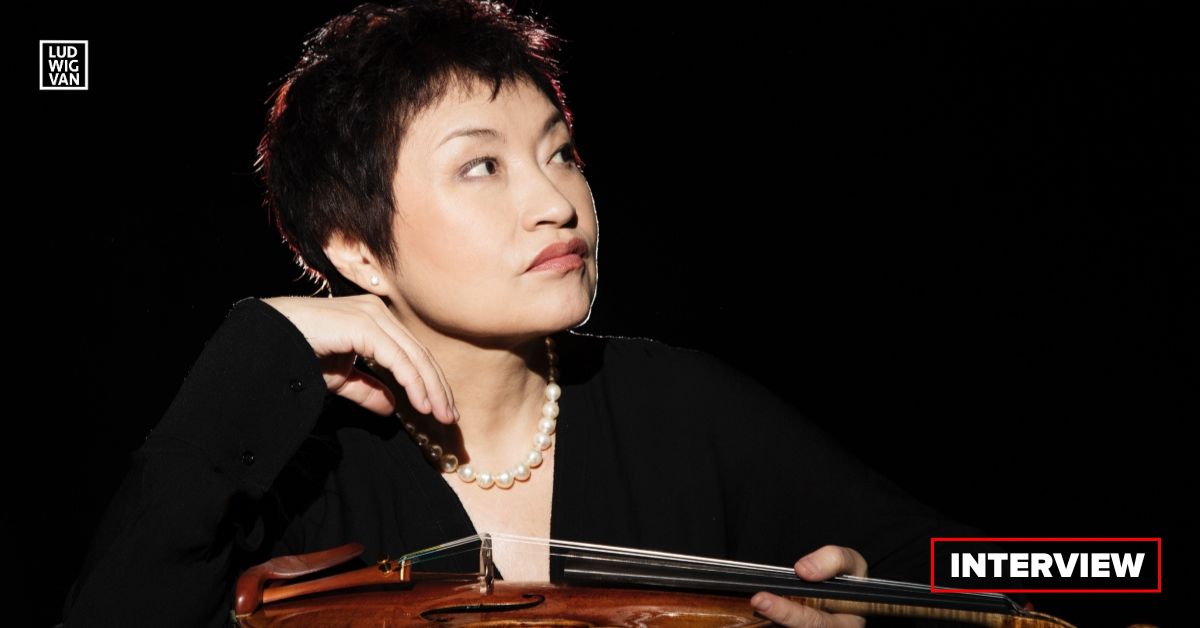
South Korean violinist Kyung Wha Chung has enjoyed a long career the world of Western classical music. She will be bringing a program of Schumann, Grieg, and Franck to Toronto’s Koerner Hall on November 9, accompanied by frequent collaborator, pianist Kevin Kenner.
Long recognized as one of the world’s leading violinists, her work has been highly acclaimed throughout her long career.
LV asked her a few questions about the program, and music.
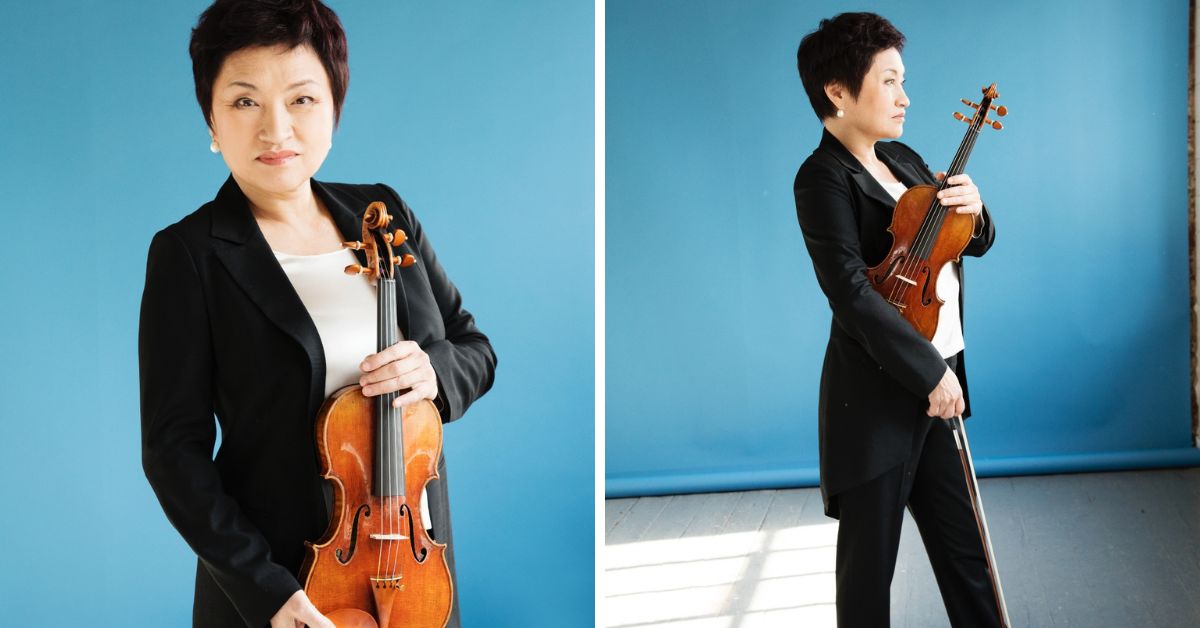
Kyung Wha Chung, violin
Born in Seoul, South Korea, Kyung Wha Chung arrived in the United States at the age of 13. She studied at The Juilliard School, joining her sister, flutist Myung-Soh Chung. It’s not the only one of her siblings to pursue a musical career. Younger brother Myung-whun Chung is both conductor and a pianist, and older sister, Myung-Wha Chung, a cellist, also teaches at the Korean National University of Arts in Seoul.
Just a few years later, in 1967, she shared top honours at the Edgar Leventritt Competition with Pinchas Zukerman, leading to several concerts in the US. Another big break would come in 1970, when she subbed in for Itzhak Perlman, with the London Symphony Orchestra. Her performance again led to more concerts in the UK. Her debut album of Tchaikovsky and Sibelius concerti with André Previn and London Symphony Orchestra solidified her reputation as a force to be reckoned with on the international stage.
She has gone on to create an enviable catalogue of recordings along with her live performances, only taking a break between 2005 and 2010 due to a hand injury. During that time, she served on the faculty at The Juilliard School.
Kyung-Wha Chung plays Tchaikovsky’s Violin Concerto in D major with RTÉ Orchestra (now National Orchestra) under the baton of Albert Rosen in Dublin’s St. Patrick’s College in 1972:
Kyung Wha Chung: Q&A
LV: For the Toronto concert, and the tour as a whole, you’ve chosen three works composed in the nineteenth century. What is it about the music of that era that continues to inspire you today? Is there a certain quality about it that you particularly enjoy?
KWC: I have always felt that the nineteenth century was the moment when the dialogue between violin and piano reached its most complete and eloquent form. The two instruments converse, challenge, and embrace each other — not simply as melody and accompaniment, but as two voices weaving a shared narrative. That sense of conversation, of music as a living exchange rather than a monologue, has always been deeply compelling to me.
What fascinates me about this repertoire is its richness of colour and the depth of emotion lying beneath every phrase. The layers of feeling are never thin; they shimmer and transform like light reflected endlessly upon water. I once likened it to Monet painting the same pond three thousand times — the texture of sound is never the same twice.
Through Schumann, Grieg, and Franck, I wanted to bring three distinct voices of the nineteenth century to life — each reflecting a different temperament, yet all united by their honesty. At the same time, these works continue to give me fresh inspiration, allowing me to rediscover something vital about myself each time I play them.
LV: Would you share a few thoughts about each of the three works — Schumann, Grieg, and Franck?
KWC:
- Robert Schumann – Violin Sonata No. 1 in A Minor, Op. 105
This sonata, written late in Schumann’s life, carries the weight of introspection. The violin and piano seem to speak privately to one another, as if transforming solitary thought into dialogue. What moves me is that precise moment — when inner reflection becomes shared emotion.
- Edvard Grieg – Violin Sonata No. 3 in C Minor, Op. 45
This work breathes the rhythm and colour of Norway’s spirit. There is both lyric tenderness and explosive vitality, especially between the second and third movements. To me, that contrast feels like the shifting of a landscape — sudden, luminous, and alive. I want the audience to sense that change of light as vividly as I do on stage.
- César Franck – Sonata for Violin and Piano in A Major
This sonata feels like a lifelong companion. I have often said, and still believe, that I will play it until the day I die. Its cyclical structure binds the work into one continuous breath, where violin and piano exist as equals. For me, it represents the purest form of musical conversation — two artists breathing as one. That is why I could never imagine this tour without it.
Kyung Wha Chung plays Mozart Sinfonia Concertante K.364 in 2013:
LV: You’ve called your pianist partner Kevin Kenner your “soulmate” in music. How did you meet, and how important is it to find someone like that to collaborate with?
KWC: Kevin and I have been performing together for more than a decade now. We began from very different temperaments — I am instinctive and spontaneous, while Kevin is calm and analytical. Yet it is precisely that difference that gives our partnership its life. There is a quiet electricity between us — a tension that keeps our dialogue vivid and unpredictable, never rehearsed, never safe.
To have a partner with whom an artist can be completely open, who can inspire and even surprise in performance, goes far beyond the notion of an accompanist. It is the meeting of two creative minds shaping a single moment together — a living, breathing instant that belongs to neither, but entirely to the music itself.
LV: You grew up in a deeply musical family and began studying at a very young age. Outside of music, is there anything that occupies your time — any interests or pastimes?
KWC: Beyond performance, teaching and mentoring young musicians have become deeply meaningful to me. During a period away from the stage, guiding others gave me a new way of listening — not with the ear of a performer, but with the patience of an observer. It has made me more honest with myself.
Away from music, I cherish silence. I spend time in my garden, reading or simply thinking. Those quiet hours restore balance; they remind me that music is born from stillness. When I return to the stage after such moments, the sound feels more human — less about brilliance, more about truth.
- Find tickets and details for the November 9 performance [HERE].
Are you looking to promote an event? Have a news tip? Need to know the best events happening this weekend? Send us a note.
#LUDWIGVAN
Get the daily arts news straight to your inbox.
Sign up for the Ludwig Van Toronto e-Blast! — local classical music and opera news straight to your inbox HERE.

- PREVIEW | Classical Guitarist Alexandra Whittingham Makes Toronto & Ontario Debuts - March 13, 2026
- PREVIEW | Soundstreams Presents Quatuor Bozzini: With Strings Attached - March 13, 2026
- INTERVIEW | Award-Winning Librettist & Against The Grain AD Royce Vavrek Talks About Canuck Cantatas - March 13, 2026