
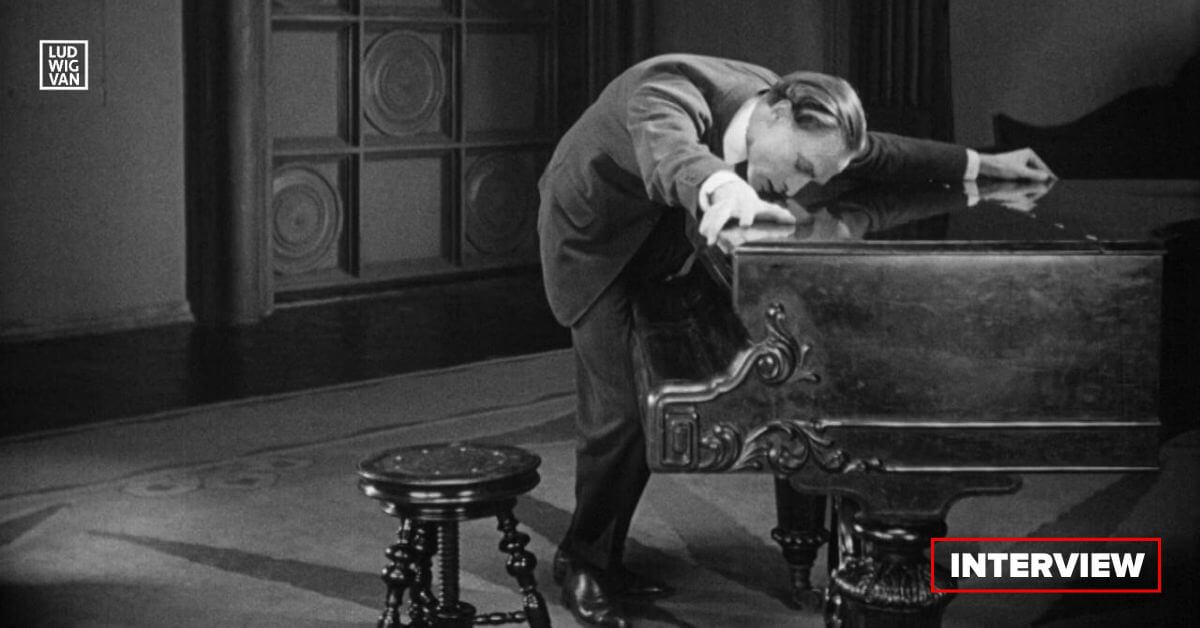
The Forest City Film Festival & Artsmote are presenting a special screening of the silent film era classic The Hands of Orlac. Directed by Austrian filmmaker Robert Wiene, the movie was released in 1924 in black & white, starring German/British actor Conrad Veidt, Russian actress Alexandra Sorina and Austrian film and stage veteran Fritz Kortner.
The event, The Hands of Orlac: A Gothic Film Concert Experience, adds live original music by London composer Scott Good, and takes place in the historic ambience of London’s Metropolitan United Church with lighting via dozens of jack o’lanterns.
The immersive cinema experience takes place on Halloween, October 31, 2025.
The Hands of Orlac (1924)
The Hands of Orlac is considered a masterpiece of early horror films, and expressionistic movies in general. It’s based on the novel Les Mains d’Orlac by Maurice Renard, published in serialized form in 1920.
The story of the century-old film is surprisingly modern. Orlac is a famous concert pianist. He loses his hands in a railway accident, and, his wife Yvonne, in desperation, agrees to a transplant.
The problem? They’ve given him the hands of an executed murderer.
Orlac finds out about the origins of his new body parts after the fact, and he’s horrified. He becomes obsessed, and feels drawn towards thoughts of violence.
Gradually, he spirals, convinced that his new hands are compelling him to kill.
The story underscores dramatic themes of identity and madness.
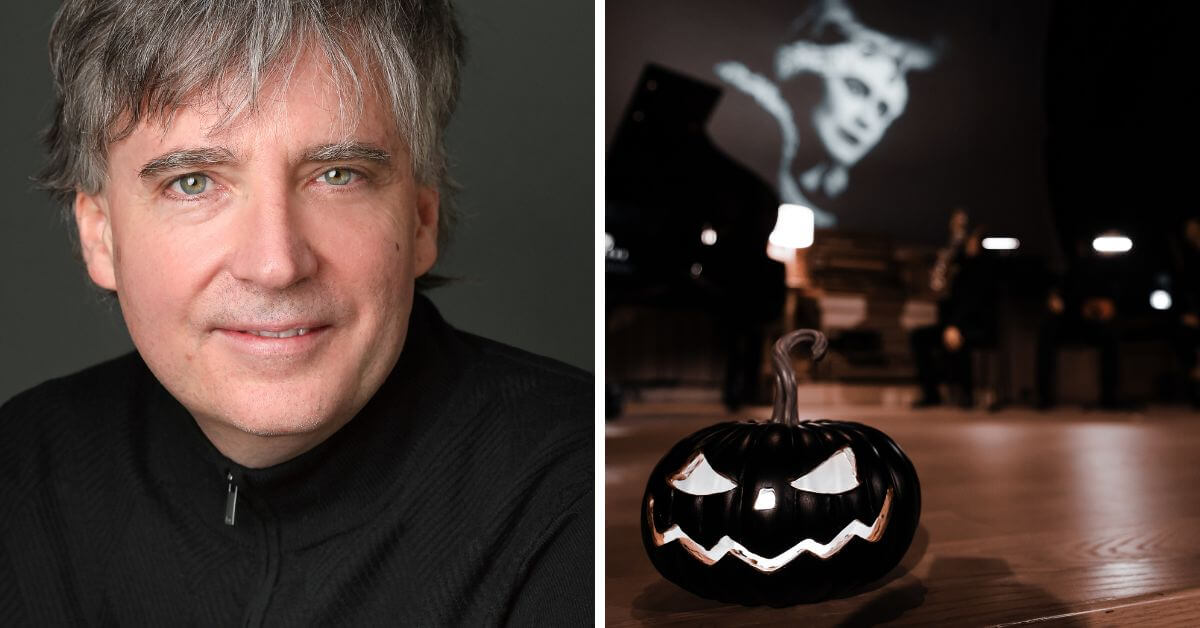
Scott Good: The Interview
Composer, conductor, and trombonist Scott Good has worked with a wide variety of artists and organizations, including orchestras, ensembles, choreographers, and others. He is Composer and Assistant Producer with London Symphonia, and previously served as Composer-in-Residence with the Vancouver Symphony from 2008 to 2011.
For a composer, working with silent films offers unique opportunities to create atmospheric music.
“I was working with the Vancouver Symphony in 2010,” Good recalls. “When I was out there, they performed Nosferatu with a full orchestra on Halloween night.
“Ever since that happened, I thought, I’ve got to write a score for a silent film.”
He took a while to research possibilities. “I thought a horror movie would be fun.” Scott’s concept was to use modern techniques and ideas in conjunction with a period film.
“I found this movie called The Hand of Orlac, and the protagonist is a pianist,” he says. “It had everything I wanted. It was relatively well known and highly regarded.”
He premiered his music for The Hands of Orlac with the Kitchener-Waterloo Symphony in 2015.
Silent Films vs Talkies
“There really is a difference between doing a silent film score and doing a talkie,” Good says.
For modern films with sound, the score has to work with other sounds. “Music comes in and out [and] there’s all kind of sound effects,” he explains.
“There’s none of that in those [silent] movies. You get to do the entire soundscape.”
It’s that aspect that had piqued his interest. The length of the movie was part of the challenge.
“It is two hours,” he says. “It’s a lot of music.” All of it is synced to the actions on screen. “It’s basically 27 scenes.”
Naturally, film incorporates several very dramatic scenes.
“It has a real stage quality to it,” Scott says. There’s even a train crash. “For its time, it was really quite extravagant.”
Composing The Score
Filmmaker Robert Wiene’s approach was part of the appeal. “He created a movie with a lot of spaciousness that invites music,” Good says.
Scott’s initial research had led him to consider other silent movies, including The Passion of Joan of Arc, but it was The Hands of Orlac that offered a greater emotional range.
“Because it’s a thriller, and it has horror elements, the relationship that Orlac and Yvonne have in the film is very poignant.” The score includes moments, and music, that highlight their romantic relationship as well as more dramatic scenes.
In the score, Good uses music in various ways. At times, it’s a modern treatment that intercuts with the action of the film. At other moments, the music adds atmosphere and emotional depth.
In order to be able to fully focus on the considerable task, Scott rented a cabin in the woods with no phone or internet access. “I make my scores on the computer,” he notes. “I spent 24/7 [just] writing and eating. A week’s worth could be done in two days there,” he adds.
“The score really kicked my butt. It was tough.”
Performers
For the live screening version that will take place in 2025, he’s reorchestrated the music for an orchestra of 17, a soprano (performed by Stacie Dunlop), together with a youth ensemble of 12 players from the Yapca School.
“I created youth parts for this score,” he explains. “They get their own special part in this piece. I’m getting them to play special effects with their instruments. It’ll be a lot of fun,” he adds.
“I like to give young people something really special when they come. There’s no traditional notation in their parts.” He explains they’ll be making sounds with their instruments in unusual ways. “And it sounds great. When you can get enough people together, you can create these textures.”
Toronto keyboardist extraordinaire Gregory Oh will be one of the performers.
“Greg is playing on two pianos,” Good explains. That includes a concert grand piano, and an upright, that will be prepared for what he calls, “a John Cage kind of piece”
“He’s going to be doing extended improvisation on it that will be amplified,” he adds, “it’s almost big, like Rachmaninoff romanticism in some parts.” It was written with Oh in mind. “It’s a real showpiece for him. I’ve worked really hard to write some virtuoso piano music for it.”
The prepared piano sounds will be “very alien” Good says, to mirror Orlac’s mental deterioration in the story.
“It’s a sonic mapping of Orlac’s deteriorating mental state,” he says.
The high drama and big emotions made for a satisfying set of challenges, no matter what it took. “I had a great time writing it.”
- The Hands of Orlac: A Gothic Film Concert Experience takes place October 31, 2025 at the Metropolitan United Church (lit by jack o’lanterns); performance details and tickets [HERE].
Are you looking to promote an event? Have a news tip? Need to know the best events happening this weekend? Send us a note.
#LUDWIGVAN
Get the daily arts news straight to your inbox.
Sign up for the Ludwig Van Toronto e-Blast! — local classical music and opera news straight to your inbox HERE.

- PREVIEW | Classical Guitarist Alexandra Whittingham Makes Toronto & Ontario Debuts - March 13, 2026
- PREVIEW | Soundstreams Presents Quatuor Bozzini: With Strings Attached - March 13, 2026
- INTERVIEW | Award-Winning Librettist & Against The Grain AD Royce Vavrek Talks About Canuck Cantatas - March 13, 2026