
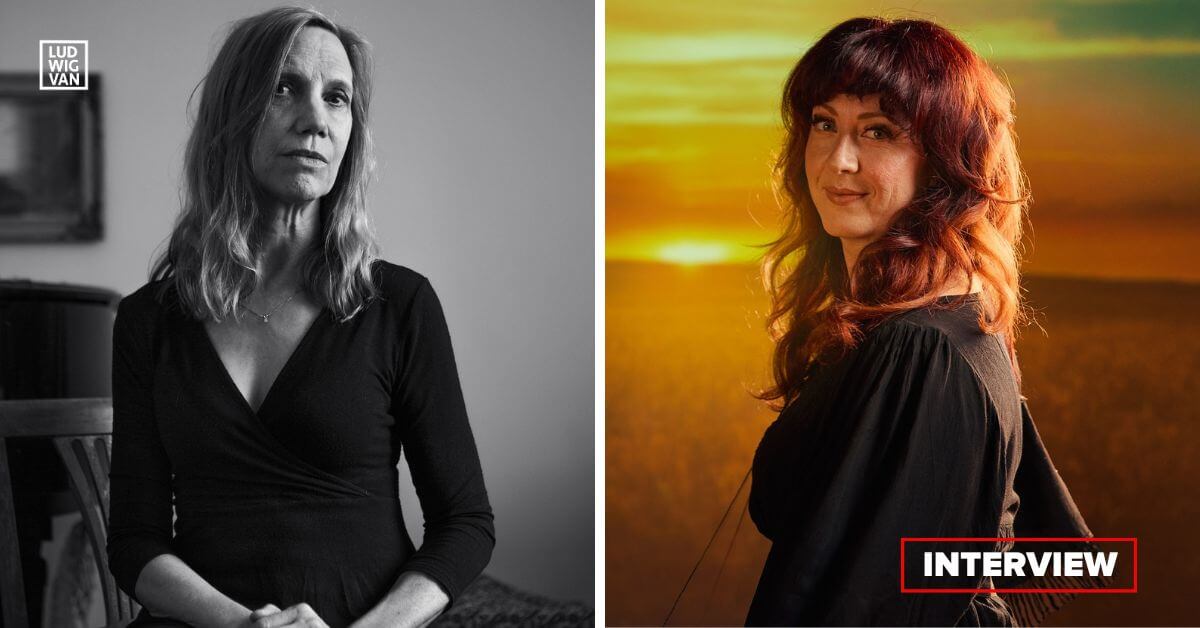
The Plains, a new album that releases today (October 3, 2025) on Redshift Records, is the result of a collaboration, and friendship, between pianist Cheryl Duvall and composer Linda Catlin Smith. It’s the first volume of a new set of recordings of Duvall playing Smith’s complete works for solo piano to date.
Smith’s music has been gaining accolades in recent years, including praise from international media like the Guardian, the BBC, the Wire, and Gramophone — along with a commission from the BBC Proms.
Unusually, The Plains consists of one, one-hour long work.
LV spoke to both artists about the project.
Composer Linda Catlin Smith
Linda Catlin Smith was born in New York City, where she first studied composition and theory with composer and pianist Allen Shawn. She went on to further studies in composition at the University of Victoria in British Columbia. Her studies in piano began at the State University of New York at Stony Brook, and continued privately in Victoria.
Smith made the move to Toronto in 1981, and became Artistic Director of Arraymusic from 1988 to 1993. She taught composition at Wilfrid Laurier University from 1999 to 2020.
Her compositions have been performed by a wide range of ensembles and artists in North America and internationally, including Goeyvaerts Trio, Psallentes, Tafelmusik, Victoria, Kitchener-Waterloo and Vancouver Symphony Orchestras, Continuum, Tapestry New Opera, Via Salzburg, Evergreen Club Gamelan, Exaudi, and the Penderecki and Bozzini string quartets, and soloists such as Eve Egoyan, Philip Thomas and Elinor Frey, among others.
Pianist Cheryl Duvall
Cheryl Duvall has developed a reputation as one of Canada’s premier interpreters of new music. With an Honours BMus and Diploma of Chamber Music from Wilfrid Laurier University, and a Master’s of Piano Performance and Pedagogy from University of Toronto, she began to focus on the music of living composers during her student days.
Cheryl co-founded Thin Edge New Music Collective in 2011 with violinist Ilana Waniuk, and since then, the ensemble has commissioned more than 70 new works from composers, have toured and held residencies internationally. Cheryl has also worked with choreographers, film composers, and others on unique projects.
Linda Catlin Smith & Cheryl Duvall: The Interview
Linda Catlin Smith and Cheryl Duvall met as teacher and student, respectively, at Wilfrid Laurier University
“Cheryl was performing student compositions as a concert series,” Smith recalls.
Duvall was taking a course in composition as part of the theory component in her degree. Smith helped out with student concerts at the time.
“I got to know her when she was a very interesting composer in the first year,” Smith says.
Their musical friendship continued, and a few years later, Duvall would form Thin Edge New Music Collective in 2011. Thin Edge’s inaugural concert included one of Smith’s pieces. In 2023, the ensemble commissioned and recorded Dark Flower from Smith, for which the composer netted a JUNO nomination. (Begin watching below at the 51 minute mark or so.)
The Plains will be the first volume of what will become a collection of Smith’s works for solo piano.
“The first volume is ready to come out on the third of October,” Cheryl says. The rest of Smith’s solo piano catalogue has already been recorded over a two-day studio session. “When we recorded The Plains in December, I recorded three other pieces that day as well,” she says. Other works have been collected over the years, including two that originally appeared on the Dark Flower album.
“She surprised me with this idea,” Smith says. Naturally, the recordings only include what she’s written so far. “There might be more in the future.”
“We’re calling it the complete works from 1989 to 2023,” Duvall adds.
“Hopefully I’ve figured out a few things in those years,” Smith laughs.
Smith’s reputation has been growing by leaps and bounds during that time period.
“It has for sure,” Smith says. “I think it started when Another Timbre started putting out CDs. That appealed to certain fans,” she says. “I don’t think he expected the kind of reaction. I think that was a turning point,” Smith adds. “Who knows how this works?”
Fame and popularity weren’t on her list. “It wasn’t my goal,” Linda says. “It’s not about how many people listen to it. It’s trying to be true as you can, and hoping that someone will like it.”
She adds that having musicians like Cheryl who want to interpret new music is essential.
Smith’s music is often called meditative or contemplative.
“There’s a lot of room for interpretation in my work,” Smith says. “There’s not a ton of information on the page. It’s not micro managed in terms of interpretation.”
Two pianists might play it quite differently, in other words.
“It’s more satisfying,” Smith says. “Just because I wrote it doesn’t mean I know everything about it,” she adds.
Her approach includes the performer as part of the process.
“That informs me,” Linda says. She says she learns something new with each interpretation of one of her works.
As she notes, many composers have a very specific vision about what they want to hear. “The performer has to rise to that technical feat,” Smith says. “That’s a very different kind of music.”
It’s also, as she points out, a relatively recent element in the realm of Western classical music.
“I think of myself more about earlier music, where there’s not so much on the page. It doesn’t have dynamics,” she says.
Cheryl Duvall plays Linda Catlin Smith’s The Surroundings (2014):
The Recording Studio
Duvall says that the series of albums will include surprises for Linda Catlin Smith fans.
“I think there’s quite a few of the works that have never been recorded,” Duvall says. That’s despite the fact that they have been performed in public. “I certainly felt like a lot of freedom with the unrecorded ones. It was so exciting to explore the colours, and the phrasing, and taking Linda’s musical instructions.”
Working directly with the composer is rewarding in many respects. The new album builds on their musical relationship, which includes recordings of Smith’s music made with Thin Edge.
“We would always consult with Linda about interpretation of the piece,” Duvall recalls. “I feel like there’s this history,” she adds. With Linda present in the studio, those consultations continued. “Inevitably, when we were in the recording studio, I was able to take those ideas, and also to be very present with the instrument.”
It creates a singular performance of Smith’s work.
“The interpretations are very special,” Duvall says. “They’re unique to that piano and that room.” The process was both reactive and collaborative.
“A lot of the takes we decided on were the first ones,” Cheryl notes.
Smith says the back and forth allowed for both perspectives. She could sit back and present a more objective viewpoint.
“I think Cheryl and I were quite on the same page about what a recording experience is.” It’s not about cutting and editing to a seamless polish. “It’s more of a lived experience.”
The Fazioli
The piano they used, a Fazioli, offered its own unique character for the project.
“The piano — that Fazioli is such an unusual beast,” Smith says. “Pianos are very interesting because each and every one has its own character,” she adds. “Luckily she’s played that piano a few times.”
“I think the first time, when we were doing the Dark Flower recording, it was the first time I played that instrument,” Duvall says. As she did, she realized it was the perfect piano for Smith’s music. Other pianos require a different approach.
“It takes a lot more work to make what I want to have happen,” Duvall says.
She notes that the piano she premiered The Plains on as a live performance was a different instrument. Her performance was a full six minutes shorter than the recorded version.
“It didn’t resonate the same way,” she says. The Fazioli makes the difference. “I didn’t have to go as fast to make the phrase alive. There’s a lot of more delicate and nuanced colours that you need, rather than a bombastic attack.”
The Fazioli offers a warmer and more intimate sound.
“It’s full — but it also has a gentleness that I feel is not always easy to get on every instrument.”
An Hour Long Piece
Smith says it took about a year, on and off, while working on other projects, to complete The Plains.
“This feels like this may be the hour long piece,” she remembers thinking. “It was just an idea that Cheryl put in my head.”
An hour long piece allows her to more fully explore her compositional ideas. “I decided to pursue that. When you know that you have an hour, what it does for me is it allows me to explore a bit more,” Smith explains. “I feel like I can wander in the material. What happens if I do this, and experiment? How long does it want to be?”
That line of thinking led to the title of the work.
“You might have a large field, but within that field, you might have flowers,” Linda says. The piece is large, but brims with small, telling details. “Titles are really late with me.”
Smith seems to have developed a taste for longer works. She says she’s currently writing another hour-long piece for the Thin Edge Collective.
“I’m back in the world of extended thinking,” Smith adds. “It’s nice to have just that whole experience I can shape from beginning to end, and to allow these longer thoughts.”
It comes in contrast to the zeitgeist, of course, which says that attention spans are getting shorter.
“I feel like I’m training myself to have these longer thoughts,” Smith says.
Cheryl’s interest in performing longer pieces goes back several years.
“I started a project for myself in 2019, where I did commission six hour long works,” Duvall says. The Plains was an offshoot of that initiative. Linda had come to a concert to hear the premiere of another piece, and Duvall put the idea to her.
“We talked,” Duvall recalls. “I had actually played Linda’s longer cello ballad with other pianists,” she adds.
“The experience I had of playing those pieces between 2014 and 2019 was what made me want to sink my teeth into these longer works,” Cheryl says. “My experience of playing never felt like an hour,” she remembers. “That so intrigued me that I wanted to dive deeper into it.”
Feedback from audiences told her that their own experience also had a timelessness quality.
“It was never, oh that felt so long,” she reports.
Learning it wasn’t much of a stretch. “The interpretation is kind of the same as learning a large sonata,” Duvall says. “Like a big Beethoven sonata — it’s long. You have to understand it as a macro, and see a map of it. But you also have to see the micro,” she explains.
“I approached it similarly to how I was trained to interpret working on my Masters,” she says. It’s about understanding the whole, but creating each moment as they come up.
“You’re in two places at once. You’re guiding the audience through the experience. You know the end, they don’t,” Cheryl adds. “I loved interpreting it. It was just a joy, and pushed me in amazing ways.”
It’s a different kind of experience than the kind of flashy technique that might be expected from a Chopin or Beethoven, or other work in the historical canon. Touch, balance, colour, phrasing, and connecting the phrases takes on a different quality.
“The kind of virtuosity that it takes to play nuanced, subtle and spacious music, still music (it’s hard to come up with the correct adjectives, to be honest) is its own unique challenge.”
“It’s not technically difficult,” Smith adds. “But, the technical difficulty is controlling the colour. It’s just massive concentration. I imagine it’s quite tiring in the end. It’s a bit more tightropey.”
“That’s what makes it rewarding,” says Cheryl. “And that’s what makes it feel like you’re sucked out of time.”
“Music changes time,” Smith notes. “I wanted to write music where you can hear everything.”
- Buy the digital album The Plains [HERE].
Are you looking to promote an event? Have a news tip? Need to know the best events happening this weekend? Send us a note.
#LUDWIGVAN
Get the daily arts news straight to your inbox.
Sign up for the Ludwig Van Toronto e-Blast! — local classical music and opera news straight to your inbox HERE.

- PREVIEW | Classical Guitarist Alexandra Whittingham Makes Toronto & Ontario Debuts - March 13, 2026
- PREVIEW | Soundstreams Presents Quatuor Bozzini: With Strings Attached - March 13, 2026
- INTERVIEW | Award-Winning Librettist & Against The Grain AD Royce Vavrek Talks About Canuck Cantatas - March 13, 2026