
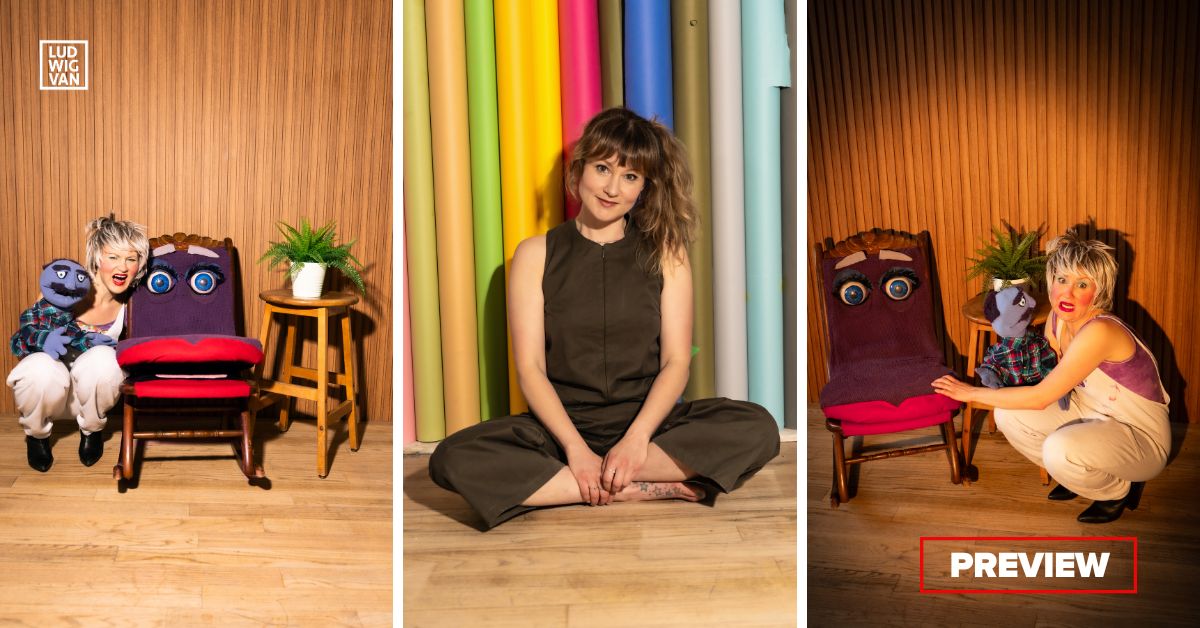
Toronto’s What The Festival is for the adventurous, for those looking for something a little out of the ordinary. Its focus is clown, puppetry, and drag, and it’s the second year for the eclectic performance series.
What The Festival takes place from September 25 to 27 at three venues in Youngplace, a cultural hub in the city’s west end.
Expect a series of over the top performances and characters, chock full of DIY stage magic and costumes.
We spoke to Morgan Joy, creator and performer in Peggy’s Place, an interactive show in the Festival.
Peggy’s Place
Peggy’s Place combines colourful puppets with music and clown in a format modelled after the classic after school specials of the late 20th century, with a live studio audience. After School Specials were directed at teens, and designed to examine difficult topics and socially relevant issues such as drug use.
In Peggy’s Place, the theme is friendship — but it’s a show designed for adults, led by a middle-aged clown (played by Morgan). Peggy, the clown, shares an apartment with puppet roommates Hobart and Lenor.
It’s unexpected, but entirely intended by Joy, who was co-creator of Sweet and Sultry Burlesque, which won Patrons’ Pick at the 2025 Toronto Fringe.
Along with clowns and puppets, the show will include musical accompaniment by Trevor Nelson.
Expect the unexpected: “In Peggy’s Place, you never know which set piece will come alive next in puppet form.”
Morgan Joy: The Interview
Morgan’s Peggy sings as part of the show. “I co-composed the theme song,” she says. She worked with singer-songwriter Dana Jean Phoenix, and collaborated closely on the music for the show. “I’m directing the mood of the show and how I want the music to go,” she explains.
Morgan’s also responsible for the set and costumes, and the puppets (the latter with support by Robert Webster).
“Everything I do is really, really collaborative, and I like to tap into the strengths of the people around me.”
Assembling the right team is key. That includes fellow performers Dani Zimmer and Bobby Knauff, musician Trevor Nelson, with Dramaturgy and Direction by Isaac Kessler.
“A lot of it is trust, and being clear with what I want.” When the group syncs, everything works. “That’s my joy. I try very hard to work in groups.”
As she points out, in clowning, a lot of shows are solo shows. It makes sense when you may be touring to Edinburgh for the Fringe or other festivals.
“But, that’s not my joy. I like to offer jobs, and find work for people.”
When it comes to creating the show, it’s also a group effort much of the time. “Okay, what jokes can we find together?” The successful results end up in the show.
Peggy’s Place
“For me, Peggy is my clown character who is my inner child. She’s like my Id. She’s not censored, she’s very loud. She’s very self oriented.”
Picking friendship — a concept you’d typically link to a kids’ show — was part of the plan.
“I think there’s something very funny that adults have to learn the same lessons that children learn.
— how to work with others, and work in a safe environment,” Joy says.
“I’ve got this character who’s doing what she needs to do. I kind of refer to her as a scavenger, she’s a raccoon of a woman.”
Friendship doesn’t come easily to her.
“She’s willing to love, but it takes her a little longer.”
The puppets become characters who embody some of the qualities of friends and family, and in particular women, who’ve influenced Joy throughout her life. Of course, being puppets, they have a quirky side.
“I’m really influenced by the anything goes reality of cartoons, and how you can bend the truth and play with it,” Morgan explains.
Like clowns, puppets can do or be anything at all.
“There’s no rules,” she points out.
DIY Ingenuity Meets Interactive
The show offers audience members a chance to join in the fun.
“The audience is on the journey with you,” she explains. “Using puppetry and using humour, people, their defences come down, and I think they see themselves in these situations.”
Exaggeration is the base for a lot of the humour. Peggy is very self-centred, and has a lot to learn about making friends.
The set itself is part of the humour.
“Everything I make is recycled mattresses and cardboard,” Joy says of her set pieces. “It’s all junk,” she laughs.
Some of that ends up in the show, including — without giving too much away — a “telefoam” that Peggy uses.
“In terms of the music, at one point I turn to the audience to get ideas on what words we should sing.” It’s part of their participation. “The audience is there for a reason.”
Without having a set format, Joy creates shows that she would want to see and experience herself.
“What do I want? What experience do I want, and how do build that world for my audience — with cardboard and duct tape?” she considers.
Final Thoughts
“One thing that’s kind of important to me about this show, is that for a long time I didn’t identify myself as a composer or a musician,” Morgan says. She studied music, but kept hitting a wall when it came to theory. “I gave up,” she adds. “But I was always making up songs in my head.”
It’s part of the spirit of the show.
“I think part of the reason that I’m doing this show […] is kind of a love letter to say, hey you can do this too. This can be accessible. You can bring to life this idea.” The audience can sing along with the show.
Clown performances have become more and more popular over the last decade or so.
“I really think that people are curious about boundary testing, because clown can sometimes feel a little […] unpredictable.” Clown performances can veer in any direction, and often highlight ugliness and imperfections.
“I think people are sick of the image of perfection,” she says. “Clown is the antithesis of perfection. I think people are drawn to [it].”
Peggy, as she points out, is a model of imperfection. And that’s perfect. “She is a 50+ woman who doesn’t care what people think of her.”
Joy has been playing and developing the character since she herself was in her 40s. She says that women in particular tend to love her.
Clown is always a safe place. “I don’t have to be beautiful,” Morgan says. “It’s fun.”
It’s the clown’s job to respond to the world we live in. The show isn’t overtly political, but does include some social commentary as par for the course.
“The music is a really important character,” she adds. “Maestro is a character in the show.”
It’s all about creating a kind of Looney Tunes reality. “Music is a huge part of that. It’s really important to the show.”
- You’ll find tickets and show details for the What The Festival [HERE].
- Find tickets and show details for Peggy’s Place [HERE].
Are you looking to promote an event? Have a news tip? Need to know the best events happening this weekend? Send us a note.
#LUDWIGVAN
Get the daily arts news straight to your inbox.
Sign up for the Ludwig Van Toronto e-Blast! — local classical music and opera news straight to your inbox HERE.

- PREVIEW | Classical Guitarist Alexandra Whittingham Makes Toronto & Ontario Debuts - March 13, 2026
- PREVIEW | Soundstreams Presents Quatuor Bozzini: With Strings Attached - March 13, 2026
- INTERVIEW | Award-Winning Librettist & Against The Grain AD Royce Vavrek Talks About Canuck Cantatas - March 13, 2026